

zubeida agha ahead of her times
Zubeida Agha, an abstractionist with a singular vision, stirred up a storm of controversy with her debut show in 1949. A significant departure from conventional art, her exhibition gave Pakistan her first whiff of modernism. Agha’s oeuvre in the subsequent years added momentum to the modernist initiative and paved the way for others. Working within a deliberate intellectual and emotional discipline, Agha explored the science of the mind. The metaphysical and the philosophical found expression in her art through a symbolic vocabulary and brilliant use of colour. Indeed she is remembered as an emphatic colourist whose enigmatic art is as intriguing today as it was then
Zubeida Agha, premier avant garde artist of Pakistan, earned her iconic status entirely on her own terms. An island unto herself, she pioneered modernism in a state grappling with post-colonial confusion.
The euphoria of freedom and the trauma of Partition marked post-independence sentiments in Pakistan, a fledgling state coming to grips with the magnitude of nation- building and everywhere there was a keen urgency to define one’s identity. Having severed ties with the Raj, Pakistanis were now free to forge new links. New thoughts, ideas, opportunities and enthusiasm were beckoning the young and the upcoming. The Karachi Fine Arts Society, which sprouted in the newly born federal capital, was perhaps the sole torchbearer of artistic activity in the city. The society organized, albeit sporadically, group and solo exhibitions of painters. From a somewhat staid beginning KFAS suddenly shot into prominence when it exhibited the work of a young female artist called Zubeida Agha. Her first solo in 1949 at the Karachi YMCA was also the first display of abstract art in the country and it made art history. For audiences familiar with traditional stylization by the likes of A R Chughtai and Allah Baksh, the shock of the new was stunning, to say the least. Here was a bold young artist spirited enough to break the rules and come up with an individual idiom. Attiya Begum, wife of the senior artist Fayzee Rahamin, vehemently denounced this show in the press as ‘art of the addled type,’ and fit only for mental asylums. Miss Agha’s defenders duly countered this and similar accusations, and the resultant debate, recorded in the Civil and Military Gazette, became the talk of the town. Attiya Begum’s scandalous uproar and denunciation of the show had launched modern art in Pakistan. The controversy raged in the press for weeks but Agha, unfazed by the upheaval, continued with her quest for the new.
Born in 1922 in Lahore into an enlightened family of bureaucrats and professionals, Agha received a sound education and graduated in political science and philosophy from Kinnaird, the city’s foremost college for women. In the culturally conservative society of the 1940s where women were largely confined to the home, this was a privilege and an achievement. Restless and introspective by nature, Agha then had just a passing interest in fine arts; it was the study of philosophy that really intrigued her. Serious interest in art was kindled by a strange epiphany. A recurring dream about colours that stayed with her even during her waking hours compelled her to explore the world of form and colour. Her brother Agha Hameed, who had friends among the fraternity of artists and writers, was instrumental in arranging for Agha’s art lessons at B C Sanyal’s studio, situated above Regal Cinema on the Mall in Lahore. A popular rendezvous of art enthusiasts and literary personalities, the studio was Agha’s first formal encounter with the fine arts. She was introduced to the technique of the old masters whose work she learnt to copy. She began to draw rigorously from plaster casts and was initiated into watercolours and oils. She worked with Sanyal for almost a year but she could not find genuine satisfaction in conventional artistic forms. Thirst for the new prompted her to look beyond.
In 1946, once again through her brother Agha Hameed, she had the good fortune to meet Mario Perlingieri, an Italian prisoner of war based in Walton, a suburb in Lahore. A one-time disciple of Picasso, Perlingieri discussed modern art, music and philosophy with his pupil, encouraging her to analyze abstract thought. Under his guidance, Agha began to understand the nature of interpretative art and learned to capture the essence of things rather than the reproduction of their apparent form. Her art absorbed the impact of mysticism, Greek philosophy and Western classical music. When she produced ‘idea’ paintings like Wind, Wisdom, Creation, Youth and Future, one could tell that she had begun to dispense with the literal in order to grasp the intangible. Initially her forms were stylized and concentrated on establishing movement and rhythm. Her colour palette at this moment tended to be murky.
Zubeida Agha’s first solo in Karachi created a sensation. It heralded the emergence of a new language, quite unlike anything existing in Pakistan till then but very much in keeping with trends in the West. While absorbing varied influences of the Cubists, Expressionists, Fauves and Surrealists, Agha exhibited a pronounced bent for the metaphysical and surreal. It seemed only natural that she would eventually proceed westwards to gain firsthand insight into the mechanics of modern art.
A scholarship took her to the UK. After spending six months at St. Martin’s School of Art in London she had a solo at the Trafford Gallery. Another solo followed at the Gallery Henri-Tronche in Paris. Thereafter she transferred to the Ecole des the Beaux Arts and studied there under professor Narbonne for the next three years. Her intellectual bent of mind, extensive education and confidence in herself put her work on a firm footing.
By the time Zubeida Agha returned to Pakistan in 1953, the shock element of modern art had diminished and the genre had become more acceptable. Shakir Ali had already introduced Cubism to artists in Lahore. Modernism had taken root and Agha, fresh from her encounters with the then current European ‘isms’, was now on fertile grounds.
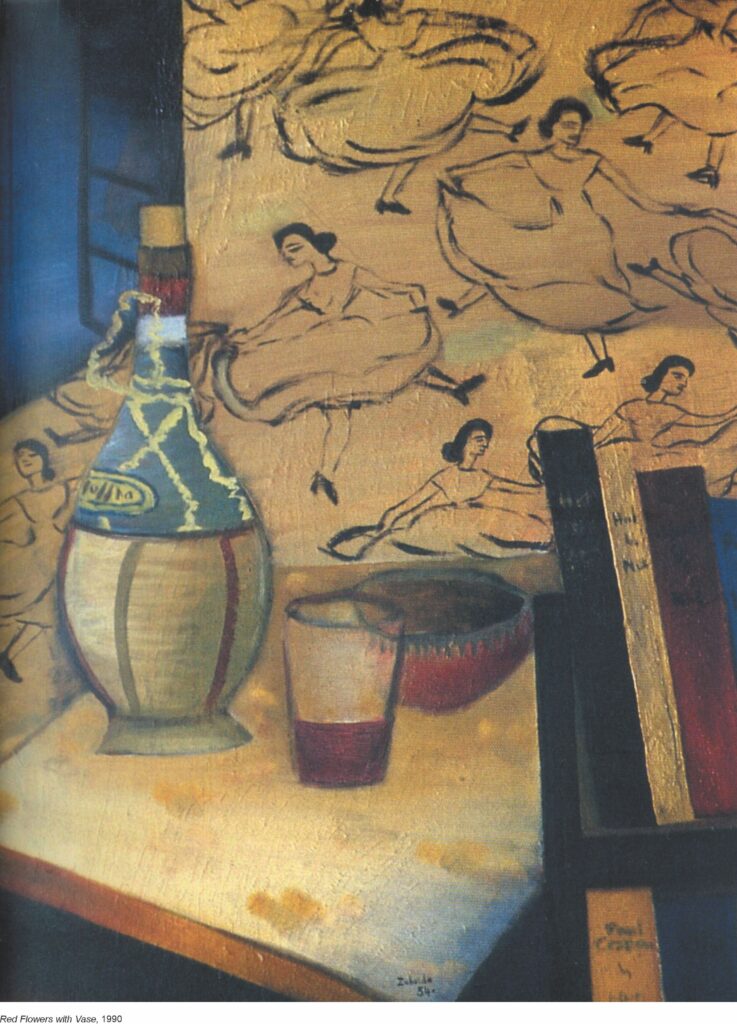
She lived in Karachi for a while and put on two solo exhibitions. In 1954 she painted the well known ‘Clifton Lights’ and ‘Still Life with Dancing Girls.’ From that moment onwards till 1960, she went through a productive phase moving through various styles. Worked in flat tonalities, her ‘Flowers’, ‘Autumn 1’, and ‘Karachi by Night’, carried a cubist inspired mindset whereas ‘Still Life with Horse Cart’ was eerily surreal and ‘Girl with a Book’, ‘Two Women’, and ‘In the Forest’ decidedly figurative. At this stage Agha was expanding her expressive range. Her geometric and organic vocabulary grew with time but the figure soon disappeared from her oeuvre altogether. She delved deeper into self-exploration, and sought to portray her ideas through line and colour and not through faces, figures, land or seascapes. This was a philosophic rather than a poetic or emotive approach to art and the paintings were often strongly linear, overly structured and somewhat frigid.
The sixties preoccupied Agha on another front also. Her second major contribution to the art infrastructure of Pakistan was the role she played in making the Gallery of Contemporary Art in Rawalpindi fully functional in the otherwise aesthetically bleak and barren environment of the city. The late Ali Imam, Pakistan’s grand old man of the arts, who frequented the gallery on his visits to Islamabad claimed that the institution was a salutary effort for it promoted art and artists at a time when there was no art venue in the city.
The gallery held numerous successful exhibitions, hosted lectures on art, organized film shows and seminars. Agha worked frugally and conscientiously on a low government budget and is known to have extended generous personal support, morally and otherwise, to struggling artists.
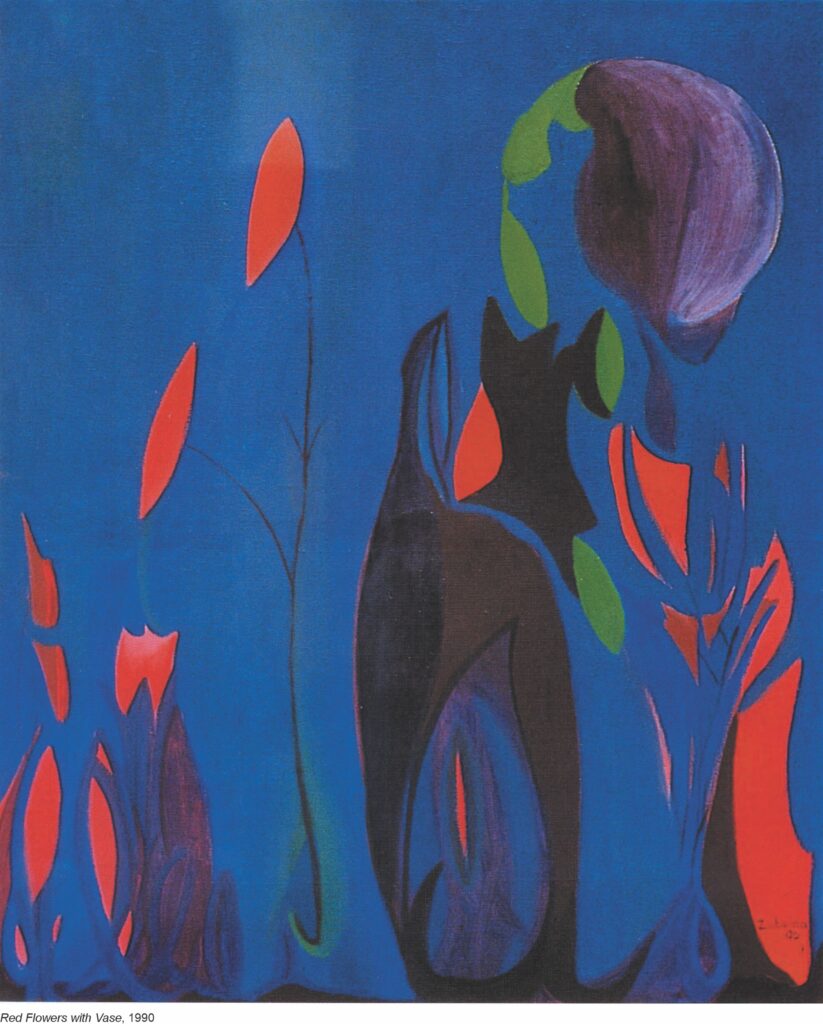
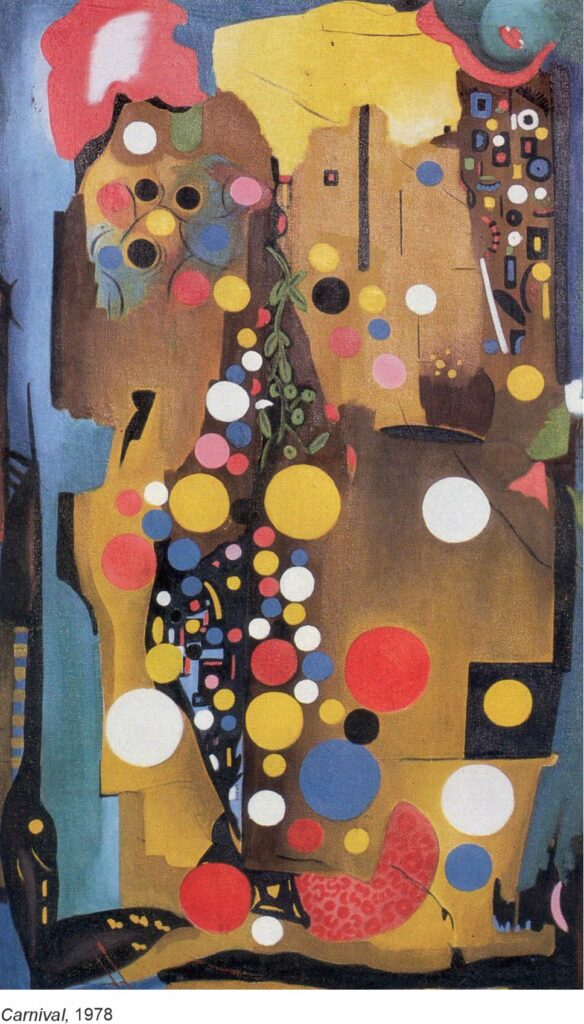
The geometric severity of her cityscapes relaxed and softened as she moved into the realm of colour. Her art attained greater vibrancy as she began to wield colour to the pulse of her inner rhythms. Gone were the sombre hues of her previous work; now she began to exploit the intensity of the pigment. The strong effect of illusion in ‘Red Poppies in the Storm’ which she painted in 1970 heralded her new approach and articulated her singular fascination for blue. Regarding this work she is known to have said, ‘All physical dimensions melt here into the mysterious blue signifying time and space’. The ‘Carnival (Balloons)’ painted in 1978 has a clown in it. Though he is hidden from our eyes, we can feel his presence in the effervescent effect of polka dots, patchwork pieces, leaves and tendrils. It is a fine synthesis of free spirited masquerading, festivity and gaiety in an abstract rendering. However, her colour play was not a wild expressionist frenzy, but a deeper, more contained exultation, as if she had identified or resolved a conflict, issue or idea.
Painting for Agha was always a responsible act, a very deliberate intellectual and emotional discipline. Discussing her oeuvre she remarked, ‘People think I am crazy to want to paint ideas, which is much more difficult than wanting to paint something from life. Indeed it is very difficult to create something from your mind.’ Shedding further light on her creative process she disclosed, ‘Someone said that I must enjoy my work. On the contrary I am in agony when I paint. It is a total mental experience for me.’ An ardent fan of classical music, she composed paintings to the strains of symphonies. While painting her famous ‘Beethoven’s Fifth Symphony’, Agha had to work over innumerable preliminary sketches and had to play the record four times a day for two months in order to achieve this highly imaginative representation. The humorous side to this is that she wanted to paint the Ninth Symphony but was unable to procure a record and settled for the Fifth.
From a pleasant, self-assured young lady in the forties, Agha matured into a thoughtful, rather reserved, older person. Once her gallery days were over she moved away from mainstream art, becoming somewhat reclusive. Commenting on her personality, Ali Imam once remarked, ‘Even though she valued her privacy and was fond of solitude, on my visits to Islamabad I found her a friendly and kind person, one who wanted company and initiated intellectual dialogue.’ Agha’s life remained wedded to art. Unmarried and free from the responsibilities of nurturing a family she gave her undivided attention to art.
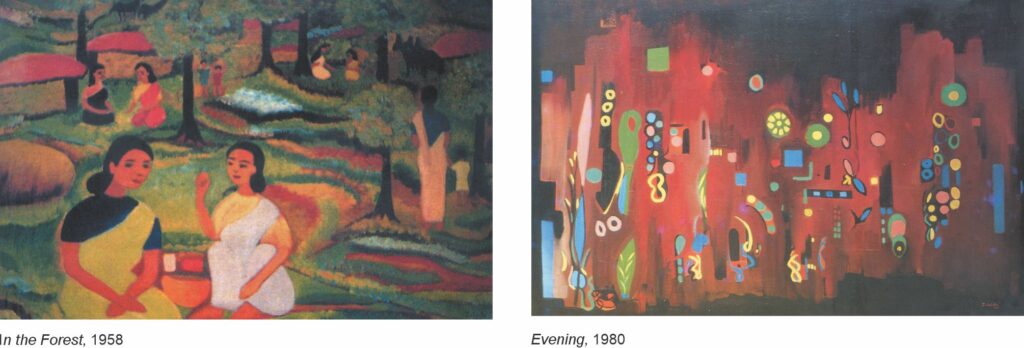
If colour was her forte, no less important and exciting was the new alphabet she was inventing to accompany it. Squiggles, dots, bubbles, flecks, leafy tendrils, floral bursts, calligraphic meanderings, geometric spikes, and a host of quirky vegetal growths on her canvas may remind one of Kadinsky, Miro, Leger, Marc and Chirico but the synthesis was entirely her own. Frolicsome exuberance, scintillating sparkle, spartan classicism and chaste stoicism were just some of the attitudes she was able to conjure with her visual language. Unlike the artists who are geared to market demands and heavily indebted to promotion and publicity, Agha remained free from external pressures. Hers was an inner evolution. According to her ‘The creative act is not only an emotional activity. It is only when the emotion is seized by the intellect that the painting starts taking an artistic shape’.
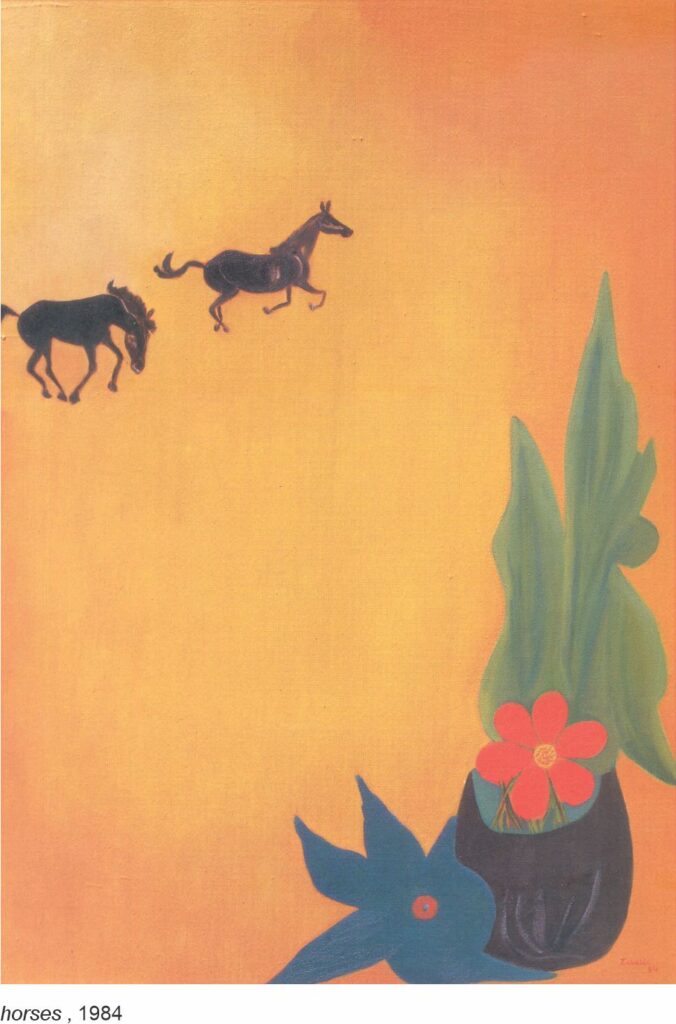
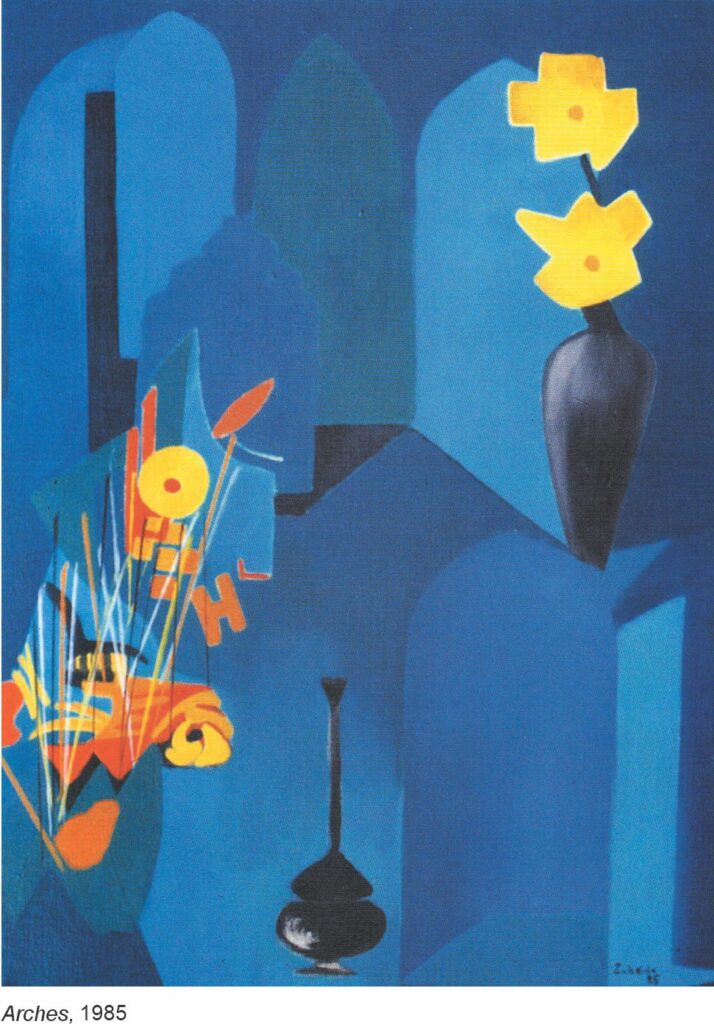
Her paintings of the eighties like ‘Arches’, ‘The Deep Blue Sea’ ‘Fallen Tree and Vase’, show that she continued to play with the structural and the organic but entirely guided by her own sensibility. The windswept ‘Autumn 2’ was a delightful evocation of the season in Islamabad and the baby yellow ‘Three Flowers on a Deep Blue Ground’ reach out to the viewer in all their innocence. Similarly her horses galloping in the distance enjoy a surreal life. Right from the beginning there had always been a mystical core in her thinking and if it was technique and substance that defined her earlier works, the later ones were purely products of the spirit.
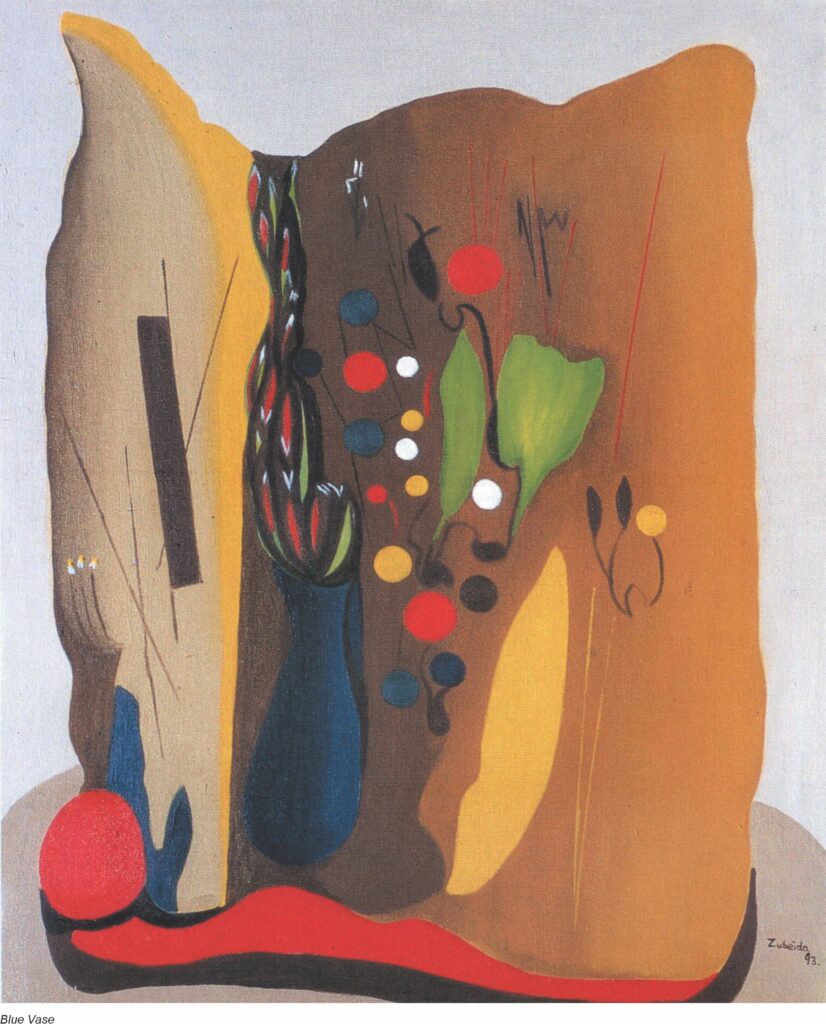
A number of Agha’s paintings in the 90’s represent communion with nature. Quite a few are centered on red flowers, trees, rocks and clouds. However, it was in the ‘Blue Vase’ painted in 1993 that she was at her dynamic best. This work carried a smattering of all her alphabets and expressive forms like her design language of leafy shoots, dots, discs, bars and lines, pliant supple doughy forms, and luscious colour. And it maintained a structural harmony in spite of being incomprehensible. The colour balance was exemplary and the entire piece was executed with confidence and maturity. The technical strength of its abstract format was a direct reflection of a deeply felt intellectual idea or a properly crystallized emotional experience. The work may defy conventional categorization but it sits easy on the eyes because it carries a strange optical balance.
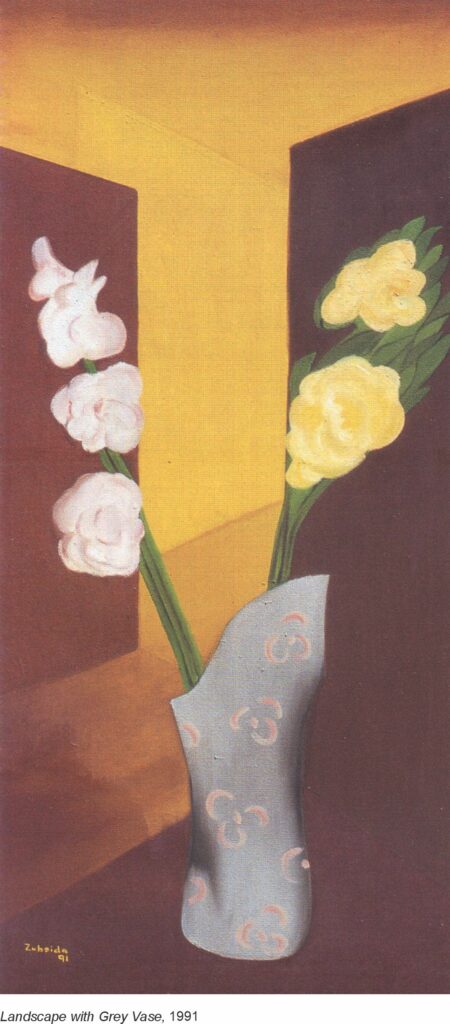
Zubeida Agha always looked at art through the prism of life. Her quest for understanding the nature of reality and the problems of life that began in 1944, gradually and imperceptibly changed over the years into a joyful acceptance of life itself in its infinite variety and beauty. Hers was an art for life’s sake. She is known to have said, ‘An artist has to be a human being of great awareness and sympathy, and a responsible member of society.’ From the outset, she had realized the primacy of arts’ capacity for moral communication. Her inscapes are blissfully free of the grotesque and the bizarre and are not racked by the turmoil or aggression so often found in contemporary art. Even the naïve primitivism that surfaces in her works is handled with a delicate sensitivity and often displays a childlike innocence. For instance in ‘Landscape with Grey Vase’, executed in 1991, two stalks of flowers sticking out of a grey vase, two panels of solid brown on each side and a glowing, golden zone in the centre form the text of a mysteriously ethereal painting. The luminous glow evokes a strange spiritual calm. It is a beautiful revelation of Agha’s introspective depths. Her canvases reveal the real Agha to us, elusive and enigmatic but very disciplined and wholly capable of charting her own mystical wavelength. Indeed, her oeuvre remains unmatched in content and form in Pakistan.
Salwat Ali is a practicing artist with an interest in the history and culture of Pakistan. She writes regularly on art in the country’s leading English-language newspapers and periodicals
Zubeida Agha, an abstractionist with a singular vision, stirred up a storm of controversy with her debut show in 1949. A significant departure from conventional art, her exhibition gave Pakistan her first whiff of modernism. Agha’s oeuvre in the subsequent years added momentum to the modernist initiative and paved the way for others. Working within…