
the art of shaun kirby playful magic, dark purpose
Shaun Kirby is one of the dark stars of the South Australian art scene. He has been absent from the capital, Adelaide, for over a decade now, but shows at regular though too-long intervals. His exhibitions are eagerly awaited and relied upon to offer enormous surprise. Because he has been influential locally, and is in some ways a distillation and the best exemplar of his era’s directions his work is looked at with envy and interest by younger artists who have emerged after his Adelaide period
Shaun Kirby began exhibiting in the mid to late 1980s, in Adelaide–paintings full of a presentiment that had to do with narrative knowingness, a deliberate non-disclosure and an address that seemed as if made to some non-logical part of our being, an address that slipped under our guard. These culminated in work he showed in a group exhibition with four other artists, at the Adelaide Arts Festival in 1988, The Image in Question.
As with the earlier work the paint was handled in an impersonal style drawing on old media (popular prints, woodblocks, with their conventionally styled cross-hatching and modelling) and on imagery that derived mostly from the medieval and early modern periods or the age of Victorian industrialism. The paint was flatly applied, the style of the visualisation was that of pedagogic illustration; the imagery itself was mysterious, in some cases violent or threatening. The presentation or marshalling of the imagery could be described as, variously, theatrical or evidentiary. His two paintings in the Image in Question were very large shaped, differently canvases, one a triptych, the other more or less cruciform.
The better known of these paintings had an mage of a ‘bucket of blood’ flanked symmetrically on either side by identical containers covered in cloth. The colours were flatly applied and unmodulated and heightened colour: crimson blood against deep grey bucket all on a blue ground; the material-covered objects were a warm biscuity colour. It was dramatic though one didn’t know what it meant.
Works from the show by Kirby and another artist, Bronwyn Platten, were immediately chosen to be exhibited in Sydney’s State Art Gallery, and the AGNSW’s then annual showcase of ‘new national talent’, Perspecta for the following year. But Kirby turned his back on painting. He had come from a sculptural and conceptualist background and felt freer working within it, despite painting’s far greater commercial viability. This is partly an Adelaide inflection: the more cerebral, conceptual and inventive stimulus, whatever medium the students in question were majoring in at South Australia’s main art school, was traceable to the sculpture department which favoured a kind of associative, anti-rational/anti-rationalist art of assemblage and installation. It might also reflect the lack of a strong commercial gallery scene in the city–and hence less of a real temptation to aim for cash reward. It manifests, too, as a high-minded rejection of art’s serving a decorative, luxury function.
A funny thing had happened to ‘the New’ as it existed in Adelaide. A few years before it had centred around power and gender issues. This mutated to an interest in ‘the image’, in foregrounding styles (or rhetorics) of presentation, and in genre associations and degrees and kinds of (inherent) narrativity. Epistemes were revealed, or were seen to clash, prevail or become ‘problematic’. Kirby was part of an art that is cerebral but poetic, not particularly interested in being rational or discursive but made by rational minds interested in the fascination of the irrational and in its claims to ‘sense’. Kirby’s first solo show after The Image in Question (shown at the Experimental Art Foundation) was Cultic Gloss (at the Contemporary Art Centre of South Australia) in 1992. It was a very good show. Kirby’s exhibition had to meet very high expectations. And I think it did meet them and raised the bar even further, though at the time, I am now embarrassed to say, I was critical of aspects of the show, not ready to follow where Kirby’s work led and disappointed at the move from painting (or from the kind of paintings Kirby had done, if not Painting per se). As well, in the mixed medium of sculpture and installation, Kirby’s tone was much more evidently and deliberately varied, ranging from the (seemingly) solemn to the rather cynically cryptic, mordant, bitter and jokey—as if Beckett were blended with Joseph Beuys. I liked the show–but I had reservations that seem to me now meaningless, or to speak of my being affronted by an intelligence much more mobile than my own. I remember every bit of the exhibition well and all its pieces seem to be benchmarks against which I now often judge work by others, forgetting my initial hostility and puzzlement.
Kirby’s work at this stage might be described as having a Minimalist-purist sensibility showing a conceptualist bias in an impure mode or field: assemblage. That is, literal(ist) dumb matter, sometimes with an almost art povera emphasis on materiality, and yet with a tendency to think allegorically. Allegory, of course, is seen as typically ‘impure’ and postmodern. Purism—as distinct from purist taste—is typically modernist. (‘Taste’ itself being here nor there.)
The work dealt with a content that is driven by metaphor, irony, by allegory even (as that term is employed in the visual arts). It consisted of logical quasi-linguistic propositions and had the look of syllogistic equations, formulations, or ‘arrangements’ of objects and images. As in the past these included Joycean/Beckettian humour and concerns: i.e., richly verbal and blackly reductivist—yet, whether negatively or positively, humanist. Not American-style Greenbergian formalism but attitudes and reference points that mark a continuity between continental modernism and particularly continental post-modernism. Beuys was the obvious reference to make, to mark out something of the territory within which I think Kirby then worked. Later work suggested for a time Richter and Polke.
Meaning’s mechanisms here were theatrical, yet visual presence on occasion won out. Like a stylish round-head, Design sometimes closed Theatre out. A quality of inarticulateness and understatement has been a feature Kirby favoured from this point on, partly through humour—a deliberately stumble-bum inadequacy of expression or a muffled, pregnant-with-meaning quality have given some works a sort of centripetal heaviness or weight and managed to suggest the vague, inchoate and incommensurable, the mysterious, ambiguous and equivocal. Work that is exactly and precisely vague.
Though it was sculpture, half the pieces were two dimensional rather than free-standing. They hung on the wall like pictures (one was a photo and many contained photographic images on or against a ground that was always rectangular and sometimes framed). So, much was rather unsculptural—that is, not to do with mass, volume, physicality or the manner of its making. Nor was it especially inviting of inspection from any but preferred points of view: typically they stood backed against a wall or into a corner, only one was free-standing. They were image-arrangements, slightly pictorial, somewhat like poetic equations: this placed beside that produces puzzle, enigma or a nagging sense of pun.
Generally the work in Cultic Gloss was hermetic and obscure: an unerring formalism applied to themes that were stoically and bleakly humanist. It was possible then to see Kirby as a strangely unengaged, nihilistic or pessimistic modernist. The observations were ‘mordant’ but the works hardly chuckled or cared much. One untitled piece consisted of an exquisitely mounted photo (moodily dark and partial) of what could be made out to be the top of a skull seated on an ancient book. The skull lid had suture marks (that enable it to be identified as such) and the book had visually rhyming—i.e., similar looking—holes in it, as if the pages were being eaten up or were rotting. Life, culture, learning—all rotting and mortal? Was this an insight or an attitude?
‘Cathedral’ consisted of a creamy white cone standing on one end of a low, narrow, metre long, black velvet box. It was visually pretty sharp and reminded me of Rauschenberg’s ‘Empire’ and also, less explicably, of Venice and witches, and the Commedia dell’ Arte figures—maybe via Tiepolo drawings and Goya prints. Plus the Ku Klux Klan. But the title said it all. The cone stood for that—the white pinnacle of aspirations and twisted dreams and religious ideas—built on the nothingness, possibly, of the funereal black box. (All those artisans, generations of them: the cream cone was of thin, soft, organic latex. Ah, humanity! I doubt the work makes these meanings available exactly. Perhaps they’re not meanings so much as sources of the work’s formal and associative coherence, and of its power to absorb readings and responses.)
Kirby was one of a number of artists of his generation who constituted an unprecedented wave of talent in Adelaide at the end of the 1980s and early 1990s. Kirby’s work, though, was of especial interest to all his peers and has remained so. A sure sign that he was one for critics and a larger public to watch. He took part in a number of group shows and showed solo again some time later (1995) at the small Sym Choon Gallery—Old Dust and Medical Gas.
By now the constants in Kirby’s work looked to be a strong material presence that seemed to hide, almost as a secret sorrow, its causes or meanings. In this it mimicked psychological baffles, blocks, neuroses and screen memories—a protective or obscuring metonymical grab at what is not quite the point but which stands in some approximation to it and is less painful to behold. (He-went-that-a-way.) The works manifest a poverty of appearance that is rather classic and austere yet could seem a transposed rebus punningly derived from tantalisingly unguessable verbal formulae. Here, while the detail might resist the interpretation it invited, still, the work cut recognisable intellectual or symbolic silhouettes: the Freudian, the Oedipal, time and memory.
One piece brought the viewer back to instances of intensely lived but lost childhood: it raised a strip of chequered linoleum kitchen flooring and the sort of dragster-styled car a boy might spend hours with in solitary playing and noise-making fantasy—brought right to our eye-level, its tiny front wheels in the air, rear wheels spinning, a ridiculously ghoulish figure (bug-eyed, tongue drooling) at the wheel. There were old photos of extraordinary melancholy effect. A figure suggested by riding coat and long boots etc, riding crop placed beside clear plastic sheeting on which were printed jumping rails. It seemed to insist (from the past) that we jump, yet it was upended, as though it had itself failed its own test. ‘Headless’, the figure and scene suggested a reversal of parental authority and impregnability. Another piece was rather hilarious. A small child’s cotton or terry-towelling jump-suit, pink, hangs from a projecting beam in the stairwell between the gallery’s levels.. The shadow it cast on the wall resembled a gallows image. On the back of the little suit, in white copperplate lettering was embroidered
I’m not a charlatan
He’s a charlatan
He hates me.
It is an emblem of tiny rage and frustration—of the powerless son? of artist towards critic? There was more of course. Where earlier shows might have had standing behind them Joyce and Beckett this body of work had perhaps Trevor Winkfield and Raymond Roussel. Individual titles were supplied (‘The Horse Father (Ten Hands High)’, ‘German Tailor’s Scissors’, ‘Elapsed Time’, ‘The Kundmangasse House’) but they weren’t assigned to specific pieces–attribution was left to the viewer. The following acrostic poem was my catalogue essay for the Old Gas show at its first showing outside Adelaide. It gives some idea of the fun the work generated for viewers.
Shaun Kirby, Deep Farceur
Since the mid-eighties Shaun Kirby’s work has changed a lot—though it coheres mightily and its coherence
Has much the ‘appearance’ of a densely fortress-like structure,
A castellated, buttressed siege building, a forest of tall and closely packed firs, or the ‘castle’ perhaps of a Coney Island.
Unlike much difficult art—though exactly like much of the best— Neither fun nor profundity is absent from Kirby’s pieces. Some are funny ‘even’—sure—some are affectingly tragic or stare at tragedy as if ‘with’ us. (Insisting, ‘Look!’) The
Key to Kirby’s works—and this is not a key so much as a formulation of mine that expresses only the kind of my bafflement before them—
Is that they have the feel of screen memories about to be cracked (a sudden insight, we feel, will explain them to us) or at least see them
Revealed as such. ‘Screen memory’ is a Freudian term for a recurrent memory the subconscious throws up, to hide, substitute or go decoy for memories that must not reach consciousness.
Because, Kirby’s rebus-like pieces (sometimes bristling with clues, in a seemingly text-like charade—or at other times un-
Yieldingly minimal—opaque, confrontingly dead-pan, denying yet grinningly confident of our return)
Describe or emulate the morphology of thought and understanding: its fumbling, convulsive manner, at one moment stymied at the next naming an
Equation that had not been apparent or that loomed like an accident about to happen, an uncle one shouldn’t mention yet who
Even as we lowered our eyes cleared his throat—and then ‘It’s Uncle
Pete!’ A gasp from the conscious mind when we wake up but here, asleep, Pete seems completely, now, one of the family.
Firmly Pete nods and tells the story that it is as if he has been telling, and re-telling, for ages: he is in a carriage, the scenery rocketing comfortably by, jawing to a stranger when the stranger’s eyes light up at something innocuous Pete has said, with ‘a wild surmise’. This is clearly a ‘literary’ phrase and events seem to pause–the wide eyes of the auditor looking on—while Pete considers it–only to be woken by the conductor pulling at his sleeve: wild mice, sir the porter is telling him, have been swarming across the tracks so that the train has slowed and will be arriving late.
At once the screen memory, the image of Pete’s sister, our Aunty Esther, saying ‘Perestroika’, or discussing the Petrov scandal, or something similar (which
Reliably ended the dream at all times before—our dream, not Pete’s), presses its
Cheek against the window of our train of thought, head turned from us who are the assembled clues who long had gathered to break this case—
Esther, we thought, was one of us. But she had held steadily to the key. Bereft of it she stares
Unhelpfully at the landscape that rushes by in the dark outside. How can art be like this?
R—the letter that begins this line, unhelpfully—like Esther—is no help. Merely interrupts. How can art be like this, in the gallery’s bright light? That is its talent—in the master’s hands. Kirby’s work from this point on has seemed less Viennese or Freudian. It remains psychologically suggestive and interested in ‘psychology’ but seems less weighted towards the period flavour of mittel europa. Kirby’s method has become also much less design-related and more forthrightly punkish or, simply, direct and, often, grungey, less elegant. The work seems more genuinely meant, too, where Cultic Gloss, say, might have seemed to be fencing with not very dangerous or potent targets.
International Headache Congress was another tour de force (shown at the Experimental Art Foundation in 1996). A vast number of black biros bearing the show’s title on their sides in gold copperplate were stuck, porcupine-fashion, into a saw horse. At the end of the gallery an enormous cloud of cotton material was held in place by a very crudely built scaffolding of wooden pieces one only saw when one walked behind—to find a deliberately desperate-looking gesture, an allusion to shoddy artifice. The material had a design printed on it that suggested ‘underpants’. The effect (grandeur and inanity, and futility) was to produce sniggers. An antiseptic and unsexy penis-shaped object elsewhere was cushioned on a weird pillow of industrial foam. Almost no one could explain the installation satisfactorily, but it was a knockout: almost thrillingly absurd.
The Gasfitter—also at the Experimental Art Foundation—followed. More than other of Kirby’s exhibitions this seemed to be a single, staged event, a unity—not an exhibition of separate, if cohering, pieces. And the gallery space seemed a little emptier than is usual with Kirby’s work. Other shows of his have contained less, physically, but Gasfitter, more or less a single gesture, or gestalt, designed to fill the gallery, didn’t quite manage to do so.
The Gasfitter introduced the viewer to a curving structure of industrial, translucent plastic and lightweight lumber. It had the character of a building site, the same purposiveness. This structure differed as a simulation (or stage set) might differ from the real thing: this was clean, lacked scars and abrasions.
The installation led one to a number of photos at certain junctures. These showed shadowy scenes of the interiors of abandoned buildings: the first of an alleyway between factory or warehouse buildings with rubbish strewn about, windows boarded up—suggesting decay, but also the pause before repair or final demolition—a holding state pending a move either way. A good site for a mugging. The next picture, which on entry one saw on the right, showed a factory table, again abandoned, with the stains of chemicals, fire, rust—a look as of heavy industrial spills and temperatures. It was characteristically Kirby in looking mysterious, threatening, moody—and also in amusedly and openly appropriating a look that said Heavy, High-European, Meaningful—the fat and iron and rust that says Beuys, Kiefer.
One followed the curve of the wood and plastic and was funnelled into the larger gallery space—to confront a vast, angular and stylized wrought-iron spider in the far gallery corner.
What the exhibition seemed to do was offer the funky, the real, the textured (rough, greasy, dark, dank, corroded)—always through photographic illusion. It married this to an in-situ simulation that was by contrast deliberately sterile, denuded of the marks and signs of authenticity, literalness and immediacy. The building site construction was of clean, distinctly un-distressed plastic and light wooden beams. One’s progress into the gallery (echoing the alleyway in the first photo—a right hand turn into a cul-de-sac) was clear sailing: a relatively few visual elements leading to a rather antiseptic joke spider. The spider had some real presence—for a moment or two—that translated fairly permanently to jokey deflation.
It was an intellectually interesting tack: the anaesthetic withholding of the gritty and mysterious real posited and the confining of ‘reality effects’ to the fictive, illusionistic space of the photographic images. A kind of mildly sadistic toying with expectations that the show set up: material presence becoming a kind of absence. A conceptual reversal, but not so interesting as an art experience.
Study in the Netherlands followed in the late 1990s. Subsequently, and for some time, Kirby worked for a company bringing art-trained thinker-makers to problems of design and installation for the commercial world: designing shop, gallery and display fittings and arrangements and supervising their building. It paid Kirby’s bills but took him away from art-practice a little. He returned to it more fully after a few years out of the art scene, with the exhibition Human Weeds (at CACSA) in 2004.
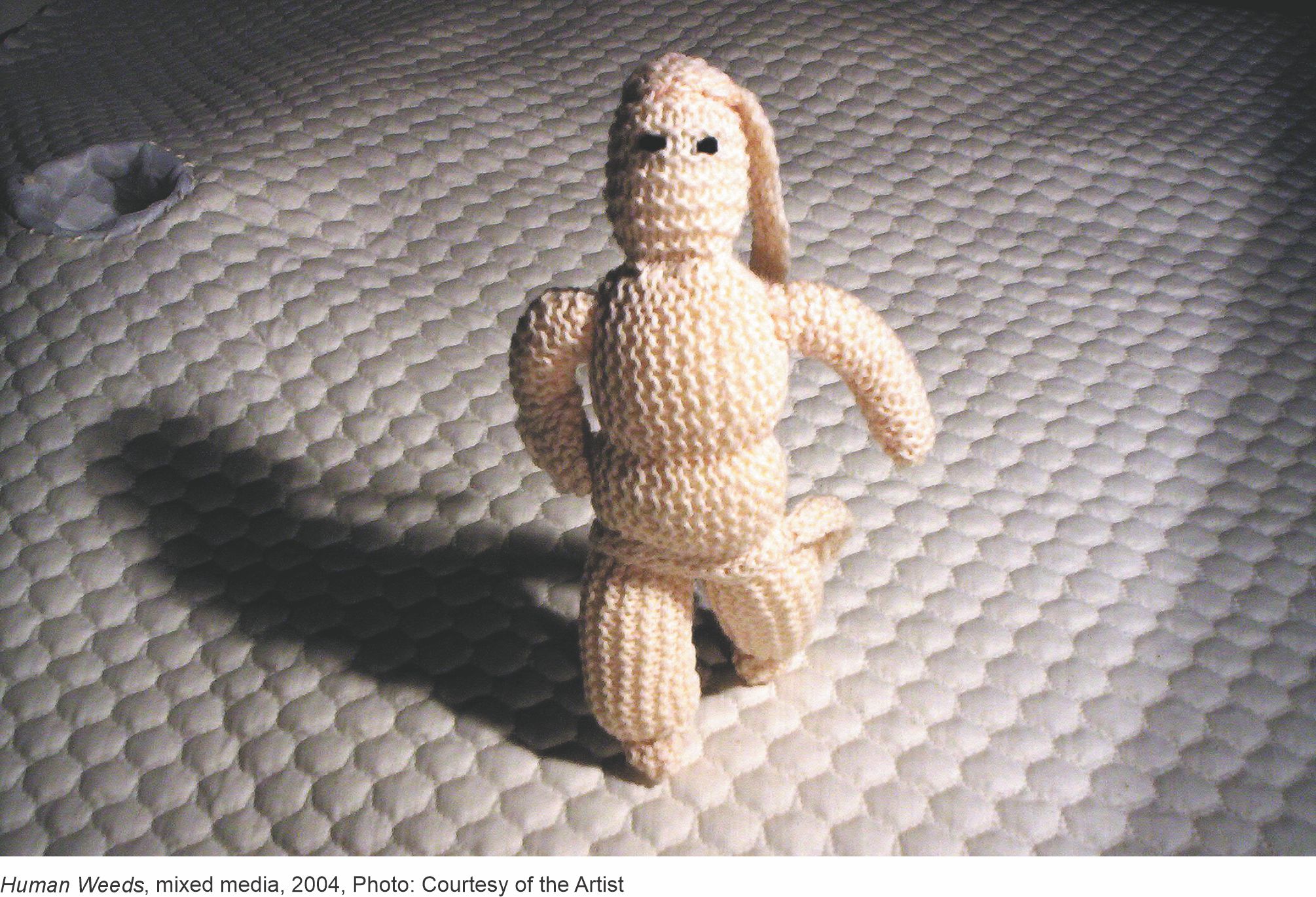
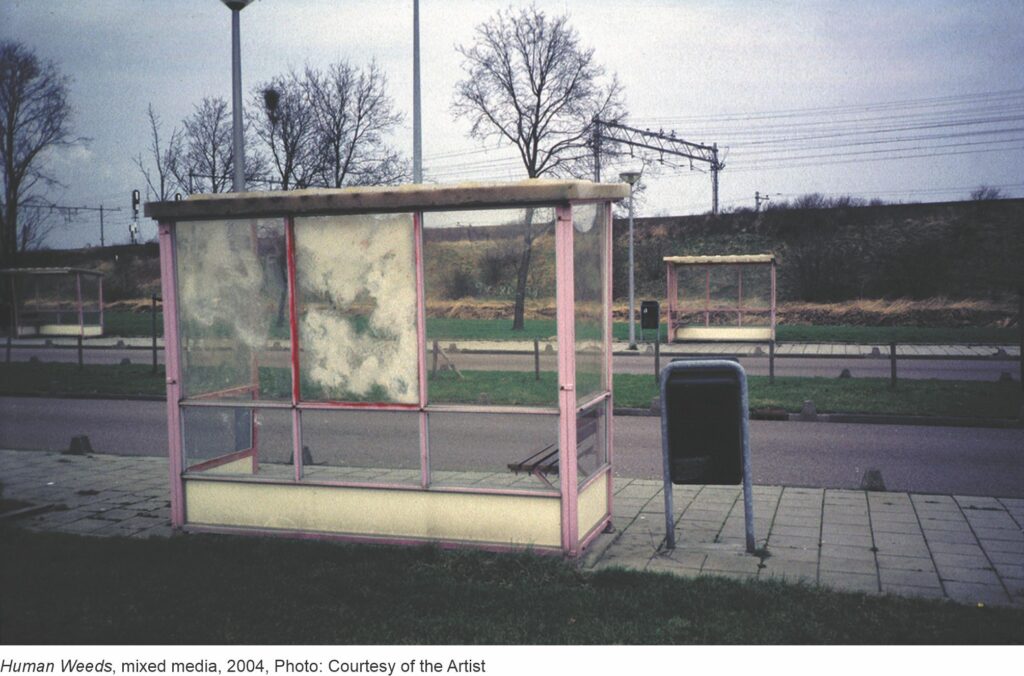
Again this was installation—and the themes seemed to be those of confrontations with ‘otherness’, (and) with inchoate but powerful drives and repressions. There were photographic images of sterile building interiors that suggested old mad-houses, hospitals and extermination camps, a grim and utilitarian industrialised cruelty. A large table of waffle-surfaced foam featured a small figure bowling confidently along towards one: a comically confident little tyro, but also a (comically) threatening outsider-figure, slightly piratical. Most powerful were large colour photographs of what looked like empty glass bus shelters in uninteresting, empty outer-suburban country. Attaching to each of these photos were ochre, clay-coloured umbilical cords–galvanizing arcs that jumped between the photo and the gallery floor. Energy seemed to run between them. They were unpleasantly organic and obscene against the antiseptic images and between the clean surfaces of photo and floor.
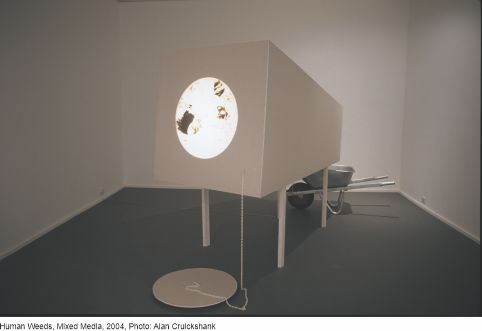
Another piece was a large funnel shape on four metal legs in the corner of the gallery. It might have been for directing grain from one container to another. The large end was filled, not open, and attached to it was a strange old photo. It showed a kind of Enid Blyton ‘Noddy’ doll as a policeman, like an English bobby, maybe ten inches high, standing in Australian bush grass beside a rabbit burrow. He was staring testily at a rabbit’s head, which, from its hole three inches away, looked back at the wooden figure. It seemed an amusing confrontation between instinctual life (it was a real rabbit) and the repressive arm of the Law. The other, narrowed end of this metal funnel was a kind of vagina or anus. It was low down and one either walked away or, if you didn’t take your dignity too seriously, bent down to look—which felt very odd. A kind of pump hung from it. It could suggest some horrible treatment to be administered to a farm animal, or that you were looking up its bum, or looking up the rabbit’s burrow—at its bum. You were surely in trouble with the policeman, at any rate. And the work is a joke and a serious proposition at the same time. At one end of the object you are a spectator looking at an exchange of glances. At the other you are a spectacle yourself as you look… well, wherever it is you are looking.
There were other aspects to the exhibition. Typically, the large photographic images—though nothing in the show supplies this ‘meaning’, which is unavailable and is not therefore the meaning, but is arguably the source of these images’ power—show zones outside Amsterdam where drive-by prostitution is tolerated. They are called ‘comfort zones’. Kirby was (no doubt) attracted to the images as revealing liberal attitudes, a sanitary tolerance, and at the same time a puritanism protected by this device, a denial of the human, etcetera. (The women are most often immigrant women, Albanian, North African, not Dutch.) I give this privileged information as an example of Shaun Kirby’s quite private working methods. He relies on his own relation to chosen imagery to suggest and license what he then does with it. He does not intend that it must disclose the significance which it has for him: he trusts it, though, to maintain the power he sees in it or invests in it. This is the most important continuity running through all Kirby’s work so far. And it means that cumulatively his exhibitions, his oeuvre, has gained in resonance from one show to the next: his most loyal audience often know what he means but don’t know why they know.
Ken Bolton is a poet and art critic. He works at the Experimental Art Foundation in Adelaide, Australia
Shaun Kirby is one of the dark stars of the South Australian art scene. He has been absent from the capital, Adelaide, for over a decade now, but shows at regular though too-long intervals. His exhibitions are eagerly awaited and relied upon to offer enormous surprise. Because he has been influential locally, and is in…