

trinidad's trinity carnival, calypso and steel band
Like many of the world’s great carnivals, the Trinidadian Carnival has origins in Catholicism’s traditional licensing of a period of sensual indulgence, prior to the abstinence of Lent

In a frequently quoted comment in his 1962 travel book The Middle Passage, V.S. Naipaul wrote of the Caribbean: ‘The history of the islands can never be satisfactorily told. … History is built around achievement and creation; and nothing was created in the West Indies’. It is the kind of negative polemical remark for which Naipaul has become notorious and in this case the comment also appears to be disingenuous, since the Trinidadian-born Naipaul had himself, from his boyhood, been an enthusiast of one of what his late brother Shiva referred to as Trinidad’s ‘two indisputably original creations’, calypso. Calypso is an integral component of both the social milieu and the narrative mode of his linked short-story sequence Miguel Street (1959); and in the Trinidad chapter of The Middle Passage, Naipaul had stressed the genre’s hold on the Trinidadian imagination and its uniqueness as a Trinidadian cultural form:
It is only in the calypso that the Trinidadian touches reality. The calypso is a purely local form. No song composed outside Trinidad is a calypso. The calypso deals with local incidents, local attitudes, and it does so in a local language. The pure calypso, the best calypso, is incomprehensible to the outsider.
Such notions of cultural ‘purity’ have, of course, become increasingly suspect at the beginning of the twenty-first century, and they seem particularly inapposite when applied to as complex a creolized society as Trinidad. By the time Naipaul was writing The Middle Passage, calypso was very clearly a cross-pollinated form (in fact it had been so from its nineteenth-century beginnings) and one of its defining characteristics has been its capacity to import ‘foreign’ strands into its chameleon-like make-up. More recently, its derivative soca introduced American soul music into its repertory, while David Rudder, Calypso Monarch in 1986, generated controversy by incorporating samba elements into his composition ‘Bahia Girl’. And the fact that the most famous calypsonian of the post-war years, The Mighty Sparrow (Slinger Francisco), whom Naipaul quotes in the Trinidad chapter of The Middle Passage, was born in Grenada, also serves as a salutary reminder of the dangers of the kind of exclusive commentary that Naipaul indulges in in the above passage. Today calypso’s popularity has spread throughout the Eastern Caribbean and what the sociologist Paul Gilroy calls the Black Atlantic region (the area on both sides of the Atlantic, in which Africans and members of the African diaspora live), particularly as a consequence of Caribbean migration.

Nevertheless, hybrid though it may be, calypso is, in Shiva Naipaul’s words, along with his other such form, steel band, an ‘indisputably original’ Trinidadian creation. Both are offshoots of the central event in Trinidad’s cultural calendar, its annual Carnival, a festival which lasts for just forty-eight hours, but which has a year-round importance in the island’s social life, both in relation to the lavish preparations that go into its making and its perceived role as a central expression of the Trinidadian psyche. Contemporary Carnival provides a livelihood for a significant segment of the island’s inhabitants and a wellspring of possibilities for artistic creativity to the population at large, whether as performers, participants or simply onlookers. Along with calypso and the steel band, it comprises the trinity that lies at the heart of Trinidad’s popular culture.
Carnival
Like many of the world’s other great carnivals, the Trinidadian Carnival has its origins in Catholicism’s traditional licensing of a period of sensual indulgence, prior to the abstinence of Lent. As in the carnivals of Southern Europe, Rio and New Orleans, Carnival (from the Latin ‘carne vale’) is the farewell to the flesh that begins on the Monday of Holy Week, at ‘J’Ouvey’ (a contraction of ‘Jour Ouvert’, or ‘break of day’) in Trinidad and ends at midnight on Tuesday, when ‘playing mas’ ceases and Ash Wednesday begins. Yet, despite similarities with several of the world’s other great carnivals, the Trinidad Carnival has a highly individual character. This has developed from two distinct genealogies that came together in the late nineteenth century to shape forms from which contemporary Carnival has developed.
As Errol Hill has pointed out in his definitive study, The Trinidad Carnival: Mandate for a National Theatre (1972), the earliest form of Trinidad Carnival developed from the pre-Lenten masquerades and festivals of the French plantocracy who became a significant component of Trinidad’s population when they settled on the island after the Haitian Revolution. At the same time modern-day Carnival has origins in forms that evolved from the folk culture of the Afro-Caribbean majority population, which rapidly took shape after the abolition of slavery in 1838.
Particularly prominent among these forms was ‘canboulay’, a ritual that developed from the practice of slaves’ extinguishing plantation fires and which after Emancipation became associated with the changed condition of the ex-slaves. Significantly, this ritual was not held in the pre-Lenten period but on August 1st. Emancipation Day. This points to another provenance for Carnival and, in Errol Hill’s words, it is clear that by the end of the nineteenth century, it ‘had become a symbol of freedom for the broad mass of the population and not simply a season for frivolous enjoyment’.
Today Carnival is held in the pre-Lenten period and is widely seen as having been co-opted by commercial forces, but as novels such as Earl Lovelace’s The Dragon Can’t Dance (1979) and plays such as Derek Walcott’s The Last Carnival (1982) suggest, it remains an ambivalent site, meaning very different things to different people. Its multiple aspects include: a capacity to express political resistance to the status quo, which can be traced back to the ex-slaves’ processions of the nineteenth century; the provision of yet another venue for global (particularly North American) tourism; and most simply, an occasion that sanctions licensed escapism, an amoral ‘bacchanal’ in local parlance. In this last avatar it looks back to and renews the traditions of the festival’s early Catholic forms, even if the shadow of the austerity of Lent has lost the potency attached to it in earlier centuries.
As the Russian formalist critic, Mikhail Bakhtin, has put it in his book, Rabelais and His World:
[C]arnival celebrated liberation from the prevailing truth and from the established order; it marked the suspension of all hierarchical rank, privileges, norms and prohibitions. Carnival was the true feast of time, the feast of becoming, change and renewal. It was hostile to all that was immortalized and completed.
And in Bakhtin’s reading, in addition to this temporary suspension or inversion of ‘established order’ and its emphasis on process rather than completion (on ‘change and renewal’), Carnival is also a system of discourse, in which oral and folk cultures invade the domain of the scribal (or ‘literary’), usually in comic or parodic forms, as in role-playing which mimics and mocks aspects of the status quo.
Perhaps unexpectedly, given that Bakhtin is referring to medieval and later Christian carnivals, Trinidad Carnival has served very similar functions, albeit in a completely different geopolitical context and in a particularly creolized form; and his comments on Carnival as a system of discourse also have a striking resonance, when one looks at the way in which novels such as Lovelace’s The Dragon Can’t Dance and Salt (1996) and Sam Selvon’s The Lonely Londoners (1956) challenge European-derived fictional habits. Even Naipaul’s use of calypso in the ostensibly more conventional form of Miguel Street demonstrates the presence of competing narrative traditions within Trinidad and what Bakhtin refers to as ‘polyphony’ (multi-voicedness) permeates the daily speech of the island’s population as well as the complex, constantly transforming art forms that make up Carnival.
Today, however, since Carnival has become a commercial event run by the middle classes, the extent to which it retains its former power to express social protest or even to offer temporary release from everyday social realities is increasingly questioned. At its best, though, it remains an egalitarian occasion of the kind that Bakhtin describes, a time during which the divisions created by ‘hierarchical rank, privileges, norms and prohibitions’ are suspended, a space that expresses Trinidad’s creolized heritage and which articulates commonalities that span class, race and gender difference.
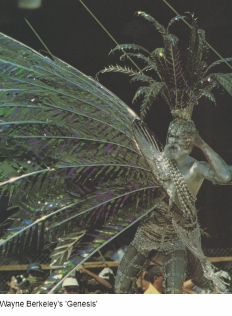
Carnival is quintessential street theatre and as it evolved in the early twentieth century, it gave rise to numerous stylized masquerade figures, including the Midnight Robber, the diablesse, the Pierrot Grenade, the dragon and various other kinds of devils. As the years have gone by, the costumes have become more and more extravagant and artists and designers such as Peter Minshall have recreated traditional figures in new incarnations, as for example in Minshall’s reworking of the traditional devil band in the shape of Red Devil fish. Similarly, designer Chris Santos’s ‘Creature from the Black Lagoon’, which won John Balkaransingh the title of Individual of the Year in 1979, transformed the customary devil mythology of Carnival into a monster from a Hollywood film that had already been used for comic purposes in calypso.
From comparatively simple mimicry of colonial figures, to be seen in costumes and dances that subversively imitated the Establishment, Carnival has moved to ever-more ornate renditions of mythical subjects, as can be seen in Wayne Berkeley’s ‘Genesis’ costumes, which go back to the beginnings of Christianity, reinventing Eden in astonishing new ways that resist location in any particular cultural context—except the licensed extravagance of Carnival. Calypso
Calypso is umbilically linked to Carnival. Its season takes place in the two months leading up to the annual Lenten festival and calypso awards in various categories, most notably those for the year’s Calypso Monarch and the Road March (the people’s choice of their favourite composition), are tied to Carnival. The etymology of the word ‘calypso’ is uncertain, but it is widely believed to derive from the Hausa ‘kaito’, a term used to convey praise or approbation, and today the music is often referred to in Trinidad as ‘kaiso’. However, a different school of thought claims that ‘calypso’ derives from the Spanish ‘cariso’. This suggests the influence of another aspect of the colonial history of Trinidad, again one which continued to be influential at the time when the music was emerging in the late nineteenth century, along with the more general influence of Hispanic culture from the South American mainland arising from the island’s proximity to Venezuela. In short, the origins of calypso are as mixed as those of Carnival and the debate on the origins of its name again points to the extent to which it is a popular art form that fashions something new from materials of mixed provenance.

Traditionally, calypsoes were improvised, humorous compositions, in which the calypsonian (originally the ‘chantuelle’ or ‘shantwell’, i.e. the male singer/composer) attempted to demonstrate his virtuosity against rivals, often by employing long words in a spirit of oratorical warfare. More eclectic in orientation than reggae, calypso covers a wide range of topics, including social and political themes, the man-woman relationship and the state of the music itself. Its origins date from the nineteenth century, when one particular form of the music, the ‘kalinda’, evolved from the chants of stickfighters, whose martial endeavours were accompanied by combative rhetorical ‘speechification’. As the years went by, verbal warfare more or less completely superseded actual combat, but calypso remained dominated by macho attitudes and these can be seen at their most extreme in some of The Mighty Sparrow’s most famous calypsoes, including ‘The Village Ram’, ‘Congo Man’ and his latter-day ‘kalinda’, ‘Ten to One is Murder’. By and large, though, the martial dimension of calypso has been replaced by more playful treatments of male identity and the man-woman relationship. Meanwhile, the emergence of steelbands (see below) came about through forms of male bonding in the poorer parts of Trinidad’s capital, Port of Spain, which produced closed groups that have been likened to street gangs.
As calypso developed in the first half of the twentieth century, it increasingly became a vehicle for conveying any and every kind of commentary on both local and international affairs. In an age before today’s mass media became the main means of disseminating information, calypso was, quite simply, the people’s newspaper; and the calypsonian has been seen as a descendant of the West African griot, who served as the oral repository of his tribe’s history. Famous calypsoes of this period include compositions on the abdication of Edward VIII from the throne of England, the burning of the treasury in Port of Spain and the Joe Louis-Max Schmeling fight. After World War II, calypso became particularly associated with the nationalist struggle of the PNM (People’s National Movement), the party that dominated the island’s politics in the period after independence in 1962. Later calypsoes have continued to deal with virtually every aspect of the island’s social life—from food prices to Black Power—while also continuing to comment on international affairs and the state of the music itself.
In 1939, the first Calypso King, a title that would become a standard annual award, was proclaimed during the festivities of Carnival and this was followed in 1945 by the first people’s choice of Road March. Until the 1970s calypso remained an almost exclusively male preserve and the gender ethic implicit and often very explicit in most compositions was distinctly chauvinist. However, during that decade the emergence of female calypsonians such as Calypso Rose (Rose McCartha Sandy-Lewis), who won the calypso crown in 1977 and 1978, challenged the male monopoly of the genre and the title of King was subsequently changed to that of Monarch. Calypso continues to flourish, constantly metamorphosing itself to incorporate new modes and reflecting the condition of Trinidad as it exists in a particular moment of time. Musically there have been changes, reflecting the use of electronic and more recently digital technology. Thematically, the range of subjects, while constantly being updated, is as eclectic as ever. The most significant shift has been occasioned by the ready availability of news in other media and hence less need to provide information. It has led to an increased engagement with editorial commentary, though from its earliest days the people’s newspaper never shied away from controversy.
Steel Band
As in West Africa, the drum was central to both the secular and spiritual traditions of the Afro-Caribbean community of Trinidad and percussion forms from other cultures (Indian and European) also influenced the development of nineteenth-century Trinidadian music. After Emancipation, the skin drum and shack shack (a rattle of West African origin) became a staple part of the street masquerades from which the Afro-Caribbean aspects of Carnival were to develop; and the French plantocracy were not immune to the drum’s attractions. In a reversal of the notion that Carnival is based on the populace’s mimicry of elite society, Trinidad’s privileged Creole classes imitated the rhythms and cadences of ‘native songs’. Then, in the late nineteenth century, colonial officialdom took the view that the drum was a rallying point for subversion and banned the playing of skin drums in street processions, so that the shack shack remained the sole percussion instrument accompanying masquerade performances.
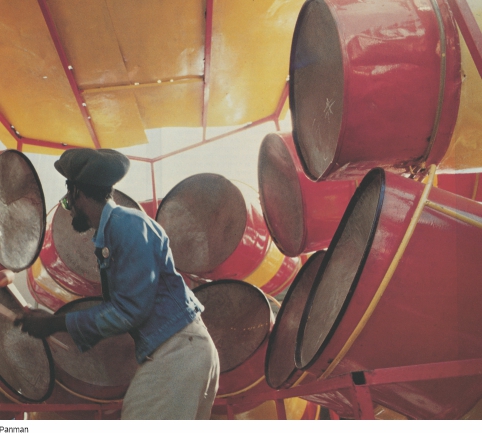
According to one version of its supposed origins, the third component of Trinidad’s trinity of popular cultural forms has a much shorter history. The Steel Band’s origins have been traced to the moment shortly after World War II, when Trinidadian musicians realized the potential of discarded oil drums. Trinidad’s oil reserves and refineries had made it the anglophone Caribbean’s leading oil producer and refiner and the discovery that used oil drums could be turned into extraordinarily versatile musical instruments certainly marked a turning-point in the development of Trinidadian percussion. It would be attractive to believe that at this moment in the late colonial period, local artists were able to fashion a completely new form from the bricolage of one of the central components of global capitalism and to some extent this is what happened. But nothing emerges from a vacuum and the musicians who ‘discovered’ the gasoline oil drum belong to a long line of creative artists, whose genealogy can ultimately be traced back to the earliest African arrivants in the New World.
Ever given to improvisation, the poorer sections of the community sought an alternative means to create percussion and found it in the bamboo stem. The early years of the twentieth century saw the emer gence of the tambour-bamboo band and this became the standard music of Carnival in the second decade of the twentieth century. It survived as such in the face of the colonial authorities’ opposition to percussion, while being subject to refinements that made it an increasingly sophisticated medium until it was replaced by the ‘pan’ in the 1930s. This movement from wood to not-so-heavy metal represents another watershed moment in the evolution of Trinidadian popular culture. Debates have raged about who deserves the credit for introducing this development into Trinidadian percussion, but what seems clear is that the movement to metal occurred in 1937 and the main metal concerned was the dustbin. So once again, the music affords a remarkable instance of cultural bricolage, of a dispossessed people creating art from respectable society’s rejected materials.
The post-war introduction of the oil drum was, then, little more than a logical extension of a long established tradition of making art from nothing. Naipaul’s remark that ‘nothing was created in the West Indies’ demonstrates a curious blindness to the evidence of what was happening around him during his teenage years at school in Port of Spain (in the late 1940s). It comes close to an inversion of the reality that something was created out of what respectable society regarded as ‘nothing’: the waste materials of consumer and capitalist society, the dustbin and the discarded oil drum.
Bands competed with one another in warrior-like competition and boasted names such as Renegades and Desperadoes. Their members traditionally rehearsed in yards, forming closed gang-like communities, an aspect of Trinidad urban culture vividly portrayed in Lovelace’s The Dragon Can’t Dance, which celebrates the African-derived warriorhood aspects of the music, while lamenting its commercialization and the middle-class appropriation that betrays its original driving force.
The history of steel bands in the last half century is a story of extraordinary achievement. Panmen refined their instruments to sound a range of pitches that covered full chromatic octaves and the music became a central part of Carnival celebrations. The bands developed repertories that extend from the latest catchy calypso to full European symphonies, while pan design and tuning became art forms in their own right. The music spread through the Caribbean and became popular in North America and Europe, though Trinidadians still tend to look down on what they see as the vain efforts of bands from elsewhere to emulate their prowess!
Such success has inevitably brought detractors. As with Carnival, the popularity of the steel band has led to questions concerning whether it remains a genuine expression of the people’s culture or whether this has been sacrificed to commercial considerations. Again, there can be no single, clear-cut answer to such questions. Like all popular cultural forms, the steel band was, and is, vulnerable to commercial exploitation, particularly by those in search of the tourist dollar. At the same time, and the history of percussion in Trinidad demonstrates this again and again, it contains a potential for regeneration and self-reinvention in new shapes that temporarily at least resist any such appropriation. Like the two other components of Trinidad’s trinity, the steel band remains central to the articulation of the nation’s most strongly felt cultural concerns.
John Thieme is editor of the Journal of Commonwealth Literature
Like many of the world’s great carnivals, the Trinidadian Carnival has origins in Catholicism’s traditional licensing of a period of sensual indulgence, prior to the abstinence of Lent In a frequently quoted comment in his 1962 travel book The Middle Passage, V.S. Naipaul wrote of the Caribbean: ‘The history of the islands can never be…