

the tablaist
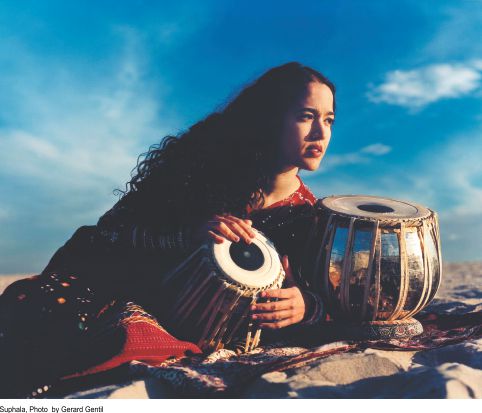
Suphala is a slight woman, almost elfin, who is transformed when she gets behind a pair of the skin-covered hand drums, one a little larger than the other, that make up a tabla player’s precision instrument.
North Indian classical music, though rooted in tradition, has always been open to the world. It evolved its signature gharanas, or schools, from elements of Arabic, Iranian and Sufi music, mixed with ancient Hindu tradition. Some say the word ‘tabla’ is most likely derived from the Arab word for ‘drum,’ which is ‘tabl.’ Distinct from the more devotional music of the south, north Indian music, also called Hindustani music, has changed enormously in recent decades. The social upheavals of the sixties, originating in the West, travelled in a straight line to the countries of the East. There may have been a time lag of some years but the protest and experimentation that defined the decade eventually became something of a global phenomenon. In India, the new inclusiveness produced some unexpected results. The sitar, considered one of the premier instruments of north Indian music, would find itself sharing the spotlight with other instruments, especially in the newly invented world of fusion. Ravi Shankar, the instrument’s leading exponent in the sixties and seventies, performed with tabla accompaniment provided by musicians such as the late Ustad Alla Rakha, but Alla Rakha was invariably the sideman and Shankar the undisputed star. In time, this equation too would change. Alla Rakha’s son Zakir Hussain would make the tabla a lead instrument, and on his own CDs the sitar, the guitar, and other instruments would share equal, or lesser, billing.
If Ravi Shankar popularized the sitar beyond Indian classical music, Hussain did the same for the tabla, taking it into realms it had never before entered. Today it is not unusual to hear the instrument in a television commercial for a luxury car, or in the theme music for a CNN special. It is an oddly recognizable, if still unusual, sound, and as such it has become a part of the world’s musical vocabulary. As the instrument moved front and center so too did the instrumentalist. In Hussain’s seminal eighties ensemble Shakti, he shared the frontline with the British jazz guitarist John McLaughlin; they were accompanied by two south Indian musicians, Vikku Vinayakam on ghatam (a large pot used as a percussion instrument) and L. Shankar on a custom-made double-necked electric violin. Shakti set the standard for a certain kind of East-West ensemble, and achieved tremendous acclaim before disbanding. In the process, Hussain became an ambassador to the West, playing with a wide and eclectic range of musicians. His students and imitators are many, and their own work continues to popularise and adapt the instrument to new settings.
I met one such student, Suphala Patankar, in New York City where she is based. She is a tabla player and producer, and a composer who uses the sound of Indian percussion in the idiom of contemporary western music. She goes by one name, Suphala, and has recently signed with the record label Rasamusic, which is backed by Tom Silverman of Tommy Boy Records. She said she was ten years old when she first heard Zakir Hussain.
‘I was blown away even then,’ she told me on a warm spring day in a coffee shop in midtown Manhattan. Hussain told her to study with his father Alla Rakha at the institute he then ran in Mumbai, India. She did so, travelling to India once a year to study with Alla Rakha, and later with other teachers. It was the traditional guru-shishya system of instruction with its attendant disciplinary method and long apprenticeship period. It helped to be able to live in close proximity to her teachers. ‘There’s nothing like being able to see the masters play up close, and you can do that many times a season in India.’
She said: ‘My gurus, Ustad Alla Rakha and Ustad Zakir Hussain, introduced the instrument to the world. They blew people away with how beautiful the tabla can sound. Zakirji’s brilliant hands and adaptability has allowed a whole new world to open up in terms of hearing the tabla outside of India and in a non-Indian context. You can hear the tabla in so many kinds of music these days. It may be true that everything Indian is hot right now, but as far as the tabla and Indian music is concerned, we are here to stay.’
Born in Canada, and raised in Minneapolis and San Francisco, Suphala is the only musician in her immediate family. Her father is a professor of mechanical engineering; her mother volunteers in a cancer hospital; her sister is a doctor. She arrived in New York five years ago, because, she said, ‘there was something going on here.’ Since then, she has collaborated or performed with Perry Farrell, the lead singer and songwriter of the retro-rock outfit Jane’s Addiction, with Vernon Reid of Living Colour, and with a pre-stardom Norah Jones.
She is a slight woman, almost elfin, who is transformed when she gets behind a pair of the skin-covered hand drums, one a little larger than the other, that make up a tabla player’s precision instrument. She becomes a bandleader and performer. At a small club in Brooklyn, New York, she commandeered the stage, inhabiting it with a power and fluency that was exhilarating to watch. The beat was volatile, endlessly mutating, infectious. Very soon the crowd at the club—a group of musicians, industry types and Brooklyn hipsters—were moving to the beat, adding their own buzz to the mix.
Suphala has two CDs to her credit. The first, InstruMental, appeared in 2000, and, for me, it served as a quick introduction to her work; it is dedicated to Alla Rakha, and makes interesting use of space age electronica, experimental jazz, hip-hop and western classical. Throughout the album’s eight tracks the tabla is the lead instrument: “I wanted the tabla to be the main voice on every track, kind of replacing what a vocalist might do. I wanted it to be rhythm- and percussion-oriented, with time cycles, mutating beats, and electronic and acoustic percussion.”
Her second CD Suphala (2003) showcases her songwriting and producing skills. The music is no longer tabla-centric; it incorporates melody and harmony. ‘I approached it more like a producer than a tabla player. It is like soundtrack music, more melodic, not merely an exploration of rhythm. There are actual songs with string parts and vocals,’ she said. ‘I wanted to show what I could do as a producer and composer.’
Taken together, the two CDs have a beguiling, encompassing appeal. More than East and West, the music combines genres—classical and modern, trance and electronica, sci-fi and lo-fi—there is as much western classical as Indian classical, with strings as prevalent as, say, bamboo flute. The five-minute ‘Elephant Monster,’ from InstruMental, has a talking bass line with squeals and shrieks and the sound of children laughing, and temple bells that peal in the near distance.
The main point about the two CDs is that they are self-released. You can buy them at Suphala.com or at Tabla.com or at a performance, but they are not available at a record store. This is because the CDs were not commercially released. Working with a laptop and studio programs such as Pro Tools, she did pretty much everything herself, from production to design, and in the process was able to bypass the music industry’s ruthless money-oriented system. But her next album will be commercially released; she is now a part of the very music machine she once took pride in circumventing, and she seems to be enjoying her new visibility. Recently she collaborated with the hip-hop producer Timbaland, and flew to Miami to put tabla on several tracks for his new record.
I spoke to some noted American musicians and asked them what they thought of Suphala’s music. ‘She is a wonderful composer, musician and modern woman,’ said Living Color founder and downtown luminary Vernon Reid. ‘She is funky fresh, a psychedelic tabla mama.’
Bill Laswell, the producer and musician who has been involved with Indian electronica through its various recent permutations—from fusion to Asian Underground to Bhangra and Asian Massive—told me the new Indian music was still evolving. ‘It is vital and popular and people love to hear and share it,’ he said. ‘It will continue to grow. Indian culture has so much to offer. It can apply to a number of genres. The sound is not foreign to people who listen to beat-oriented music.’
It reminded me of something Suphala had said, that the nature of tabla was such that it lent itself to different types of music and different environments, that people could pick up on it even if they had never heard it before.
‘The tabla has a vast rhythmic and tonal range as well as a totally sublime sound,’ she said. ‘In this way, the instrument is universal and adapts to almost any form of music. When people hear it played well, they instantly fall in love with it. So it is no surprise that artists in mainstream American music are drawn to it.’
When I asked Laswell to comment specifically about Suphala’s music he said her style was unique, a combination of classical and devotional elements. ‘I recognize her dedication to the culture of tabla,’ he said. ‘She looks at the music in a serious way, but adds fun and looseness, which gives it a nice balance: classical and electronic, devotional and experimental.’
Jeet Thayil’s most recent book of poems is English (Penguin/ Rattapallax 2004). He lives in New York City where he works as an editor and writer.
Suphala is a slight woman, almost elfin, who is transformed when she gets behind a pair of the skin-covered hand drums, one a little larger than the other, that make up a tabla player’s precision instrument. North Indian classical music, though rooted in tradition, has always been open to the world. It evolved its signature…