
shakir ali passion for the sublime
Writing about Shakir Ali is difficult. In the absence of indigenous tools of art criticism a third world artist is often addressed in ‘borrowed robes’. It is imperative for a critic to devise a narrative that is not designed to compare appearances or draw analogies with Western artists but locate and define the artist’s own intentions
English is a convenient tool but as a language for art criticism it has evolved describing the concerns of Western art. For instance, it attributes specific epitaphs to schools and styles of Western Art. Terms and phrases like Op, Pop, Modernism or Postmodernism, so pertinent in the European context, can be misleading if transported to describe the meaning, content and intention of artists working in our parts of the world. Our artists must be judged for themselves and not compared to their contemporaries in the West, whose concerns have been and are somewhat different. The present practice of drawing analogies and identifying Western influences leads to false conclusions and amount to denigrating the practice and achievements of our artists.
Many pages have been written about Shakir Ali’s work. But most writers gilding his creative attributes, present him in ‘borrowed robes’. In spite of his unusual skills for drawing, aesthetic refinement, and ability to create bold images and symbols Shakir Ali has been portrayed only as a regional artist. He may have pioneered the modern art movement in Pakistan but he has been placed on the outer fringes of the international art centres. Shakir Ali was born in 1916 at Rampur in India but settled in Pakistan. Zainul Abedin and Shakir Ali were close friends. Murtaja Baseer came to know him quite intimately when he stopped at Lahore on his way from Paris to Dhaka in the early sixties. Most painters of the time from Dhaka and Chittagong knew Shakir well. I wonder if the new generation of painters in Bangladesh, with their ears tuned to record the faintest tremor in the European art world, know of Shakir Ali–and for that matter, if the young generation of painters in Pakistan of Zainul Abedin? It is amazing how quickly the memory of the achievements of third world artists is lost and buried.
And yet there must be few painters who have been exposed to such diversity of cultural experience as Shakir Ali. He began his art career in 1937 at a private studio in Delhi that imparted training in the techniques and methods of the New Bengal School that had set off the revivalist trend by pandering to traditional schools of painting. An artist of Shakir Ali’s temperament could not have stayed there longer than he did but during his brief apprenticeship he must have relished outlining figures with a fine brush.
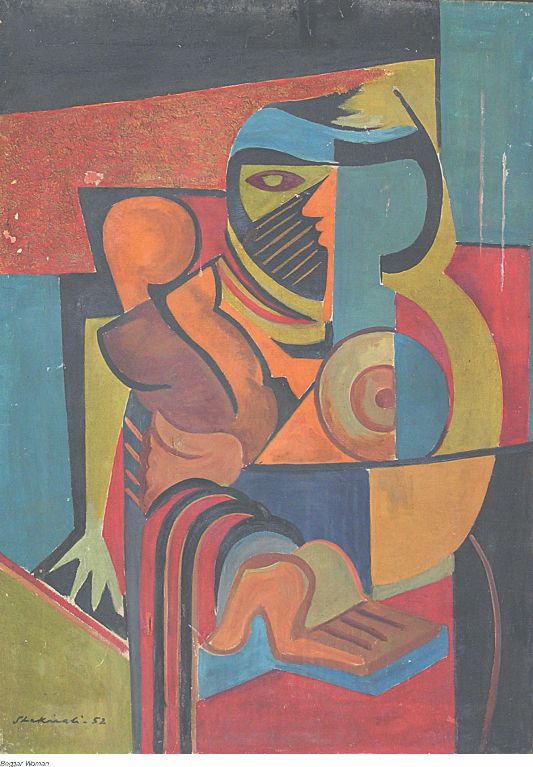
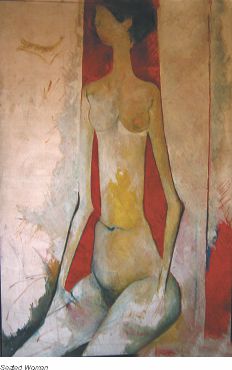
Shakir’s natural inclination to delineate human forms intensified when he joined the JJ School of Art in 1938. At this Bombay School he had the opportunity to study Ajanta, Kangra, Rajput and Jain art. He specialised there in mural painting. Later he toured South India, visiting temples and archaeological sites and nurturing his appetite for frescoes and sculpture, particularly south Indian bronzes. I recall a Nataraj and a statue of a tall elegant deity, with buxom breasts, a narrow waist, striking a pose on her slim long legs, residing on one of his bedroom tables all his life. He was also enamoured of objects of folk art, especially brightly coloured Gujarati wooden dolls with highly stylised features. There were also in his possession pieces of pottery from Halla in Sindh and woodcarvings from Swat. Gandhara sculpture that could be easily acquired in those days was conspicuous by its absence. The exotic forms of south Indian bronzes seduced his imagination and subtly guided his brush when he delineated the female figure – large rounded breasts, narrow waist, legs with lithe thighs and thin calves. It is also noteworthy that most of Shakir’s canvases of the early fifties are executed in red, black and yellow, the basic colours of Rajput and Jain art.
Shakir Ali proceeded from the JJ School of Arts to London’s Slade School in 1946. While in London he enlisted himself as a member of an international brigade that proceeded to Lidice the beautiful civilian city wilfully destroyed by the Nazis during the Second War, to clear the rubble so that a new city could be built on its foundations. Later in1944 he travelled to France where he painted with Andre L’hote who was then regarded an avant-garde cubist painter. Still later, he spent two years in the school of Industrial Design at Prague (1949-1951) engaged in textile designing. While he was there, he designed textiles based on Jain motifs and images.
During his stay in Czechoslovakia Shakir Ali was greatly inspired by Julius Fuchik’s ‘Notes from the Gallows’ written at a Gestapo prison where he was incarcerated for several seasons. Shakir was deeply moved by the way Fuchik had led the resistance against Hitler’s invading army, and the courage with which he bore brutal torture after his arrest, and his subsequent execution.
Shakir was inspired to write, ‘Even in his most difficult moments –when threatened with the sentence of death–(Fuchik) was able to write about the sun, flowers and birds.’ These are the images that pervade most of Shakir’s canvases.
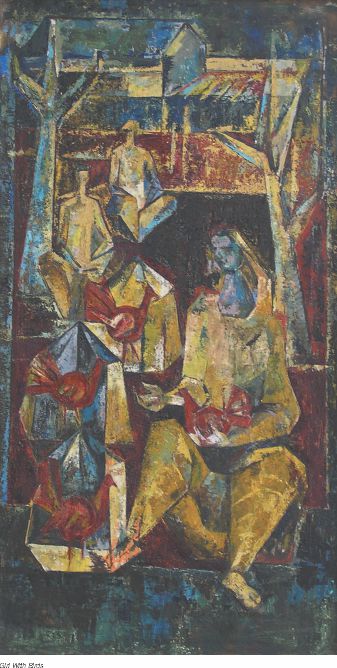
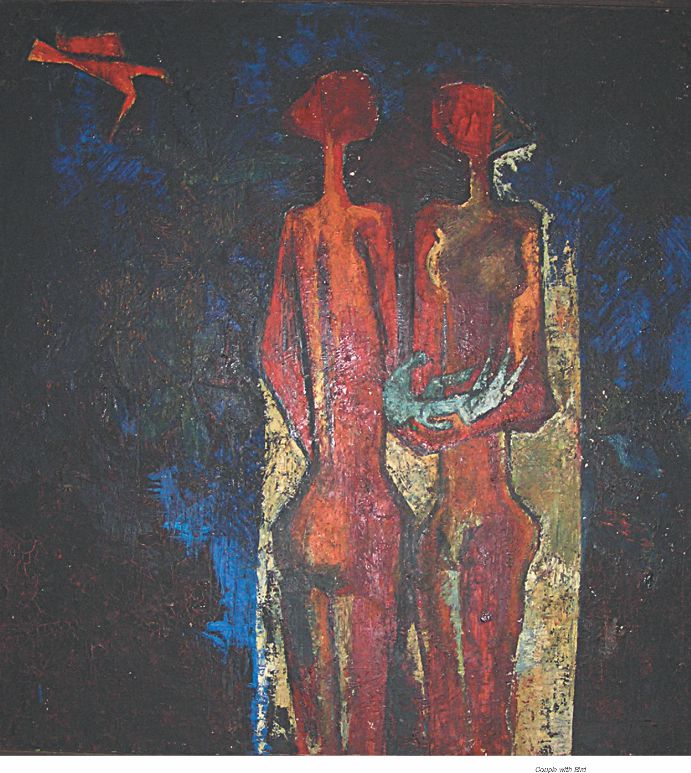
Shakir Ali recurrently includes the sun, the moon and flowers in his works to express his feelings and articulate his thoughts. He also depicts birds incessantly–a bird in a cage or birds in flight; birds in captivity and birds that are free, thereby expressing the artist’s own loneliness, concern at captivity and the irresistible human urge to be free from all kinds of bondage. He observes, ‘Each one of us is born with a bird, free unfettered reaching out for the infinite, but owing to the prejudice of our civilisation, the restrictions of our families and the superimposition of convention, that bird is caged and loses its notes of freedom.’ Shakir hoped to find that bird in him. ‘And if I do,’ he promised, ‘I will pass it on. The bird will go right from me to you.’ The act of painting for Shakir was not art, an act of self-expression but also a means of asserting and finding his own freedom. It is as if he believed that you cannot be more than what you are, and what you are is determined by how you act.
When he joined the Mayo School of Arts and Crafts (now National College of Arts) at Lahore in 1952 Ali’s paintings were simple in style. The forms are vividly presented in flat colours and heavily outlined. This was a brief phase quickly followed by a more relaxed artistic ambience. The static attitudes are put at ease. The colours are also bleached in preference for a creamier orchestration, enlivened by texture and tactile stresses of the line. The line that advanced, stressing essential attributes of human anatomy, races along without long halts on its course. It is true that the figures are still in somewhat striking attitudes but the contours have become friskier in character and sit or stand more comfortably. A figure gently petting a bird, modelling an urn or playing a musical tune are unfettered by the established mannerism held in esteem at London or Paris. Among other things Shakir’s human figures squat comfortably on a dusty floor while the European models have to be reclined or seated in a chair because they cannot squat.
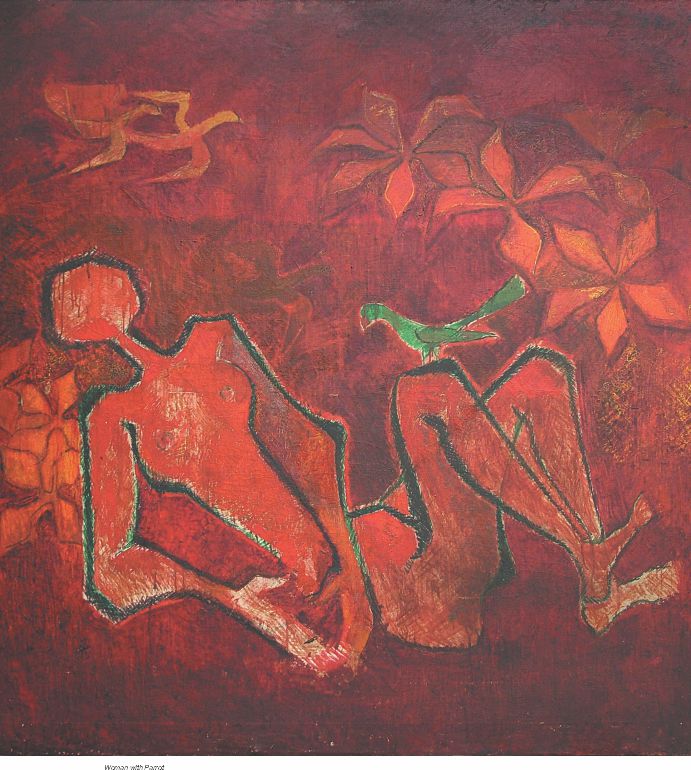
Ali’s paintings of the period promise much more to come. The artist stood as it were on a promontory from where he could peer deeper into himself or look across at the enigmas of life. Shakir resolved to do both, delve deep to fathom his emotions and feelings, and also address larger human concerns. At the same time Shakir Ali felt the need to take on something that most painters were avoiding. The highbrow tenets of Modernism had spurned the human figure. It was not considered right for a legitimate modern painter to allow the human image to defile the purity of the canvas surface. Shakir Ali however, made it into one of his central preoccupations. We find him using the human form to express multiple shades of feelings and ideas. It is amazing to see how casually he could delineate the human form.
According to Safdar Mir, the only passion Shakir expressed was the passion for the sublime. Much of his earlier work is dull and heavy in feeling, and reflective of the introspections of a lonely person. After briefly finding happiness with a fair woman in the mid- sixties the bird in his heart suddenly began to sing again. He produced innumerable canvases full of poetic exuberance.
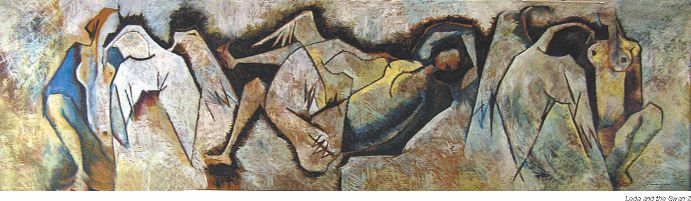
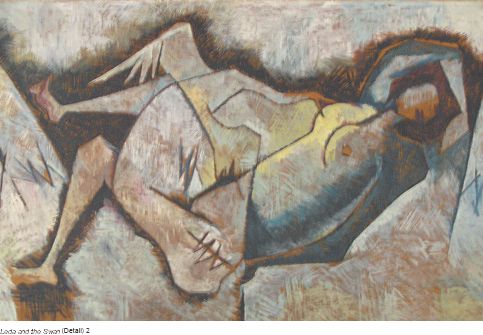
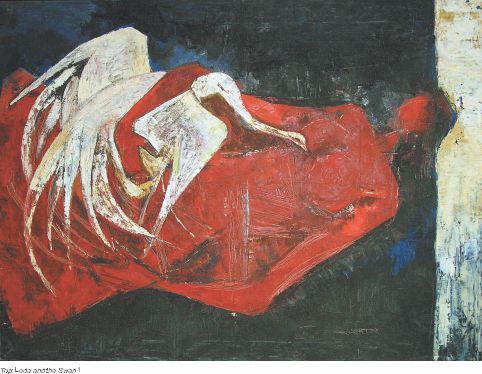
During the last decade of his life the scale of his work, and his feelings and concerns, changed from canvas to canvas. During the period he produced some superb murals. The ‘Pastoral’ brings together all the symbols that were meaningful for him in expressing his longing to be free and his dream for a pastoral paradise on earth that had been forever lost by humans. ‘ Leda and the Swan’ depicts another aspect of the human predicament namely conflict and denial. ‘The Flight’, symbolising freedom, shows a flock of birds, with their wings traced with lemon flying from darkness towards light, from servitude and ignorance towards freedom and enlightenment. This large canvas was gifted to the Lidice Museum built to honour the memory of those who had died during the German bombing of the city.
Shakir also produced three splendid murals that are based on calligraphy. These undertakings go beyond the precincts of tradition. Shakir evolves through conventional calligraphy abstract forms that are congruent with his basic imagery as a painter. The Arabic letters and words seem to acquire forms and shapes familiar to figures and objects in his paintings. The Bait ul Koran mural at Lahore, the Ayat ul Kursi (a triptych) at Islamabad and a third one commissioned by an insurance company, express different moods and aesthetic intentions. The Bait ul Koran mural’s freely rendered calligraphic arabesque is sparingly embellished with elements from nature and enriched with subtle textures and golden hues to achieve a sumptuous effect. The Ayat ul Kursi is conceived on a heroic scale and is awe inspiring. The third mural attempts to capture the effect of a stained glass window. It is the earliest of the three and eschews delicate surface processes to insist on establishing the vivid impact of colour and shape.
Shakir has scrawled on the edge of a canvas a passage from Rilke that begins with these two lines, ‘Always at the commencement of the work/ the first innocence must be achieved.’ That is why perhaps we find Shakir Ali never repeating himself. Each of his paintings is unique because each commenced from a new beginning.
Shakir Ali died in February, 1975. His great peer A R Chughtai had died some months earlier. A poet referring to the battle between Chughtai, who represented tradition, and Shakir, who stood for modernity, quipped that.
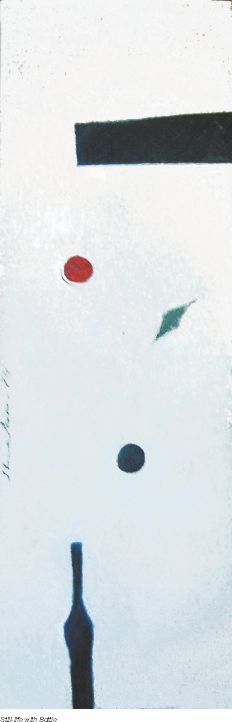
Chughtai would say ‘Sala! He has followed me even here.’ But trust him to have anticipated his death by painting a series of slim vertical canvases, sombre as a church steeple on a cold wintry day, completely devoid of mirth and the poetic spirit that had imbued his preceding works. The surface textures, vibrant with poinsettia flowers, animated with flitting birds and sensuous hues are no more in evidence. Stern bottles and spheres replace the lively forms. Feelings are no longer expressed through breathing images but frozen in shapes. Are they paintings or tombstones? Perhaps both.
Mian Ijaz ul Hassan is a writer, painter and political activist. He is author of Painting in Pakistan and is a weekly contributor to the Daily Times
Writing about Shakir Ali is difficult. In the absence of indigenous tools of art criticism a third world artist is often addressed in ‘borrowed robes’. It is imperative for a critic to devise a narrative that is not designed to compare appearances or draw analogies with Western artists but locate and define the artist’s own…