
creative intimacy
When both husband and wife are artists, competition may be a stimulus to creation. A personal account of the contemporary Indian painters Manu and Madhavi Parekh by Shakti Bhatt
‘Artist couples always fear competition and comparison’
Madhavi Parekh
‘The idea of competition between an artist couple is bullshit, nonsense, and clichéd.’
Manu Parekh
I was 13 when I first met Manu and Madhavi Parekh, and I made nothing of the fact that they were both painters. They were friends of my mother’s and shared with her a common Gujarati heritage, mostly, a passion for food and talk. From what I remember of the way they looked then and now, more than a decade later, they haven’t changed much. Madhavi usually wore dark colours, cotton salwar-kameez or saris with her hair oiled and tightly combed into a bun with a large, round, bright red or black bindi on her forehead. Manu would be in a similar cotton fabric but his clothes would usually be in lighter, earthier, colours. He wore leather sandals and carried a trimmed beard that has become lighter over the years. He had thick hair parted on one side and round glasses, which only partly obscured the seemingly permanent dark shadows under his eyes.
By that time, both were internationally known artists and had won many honours; most critics in India had reviewed them; their work was a part of almost every exhibition of contemporary Indian art, and they had long been full-time painters. At 15, when my mother was away, I lived with them for two weeks in their house in south Delhi. They appeared to be a typical couple: Madhavi, with a disdain for domestic help, managed the kitchen on her own and Manu was the acknowledged bread-earner who disappeared for hours into his studio, reappearing only for nourishment. In the company of friends, they would make funny jibes at each other, and in doing so externalize their squabbles. On the whole, they appeared to be connected by a strong bond. Their habit, for instance, of touching each other’s hands or shoulders after even a minor altercation, belied their intensely creative natures and different temperaments.
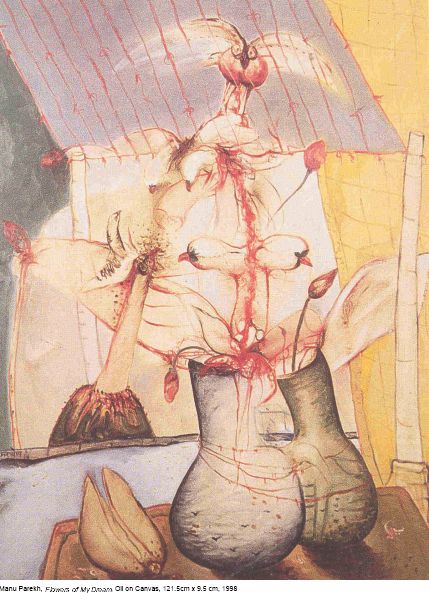
From those years, Madhavi’s child-like drawings and Manu’s forceful dark strokes left a memorable impression on me. But as I look at their work and their relationship with different eyes, it seems that the overt tumult that is conspicuously absent from their marriage of more than 45 years is evident in their work and in the significant differences in their styles, subjects, and attitudes.
*
‘I had to walk more than one kilometre to go to school. On the way, there were trees, birds, animals, and fields. I saw the colours and forms change with each season. I built my own inner world with these things’,
Madhavi Parekh
*
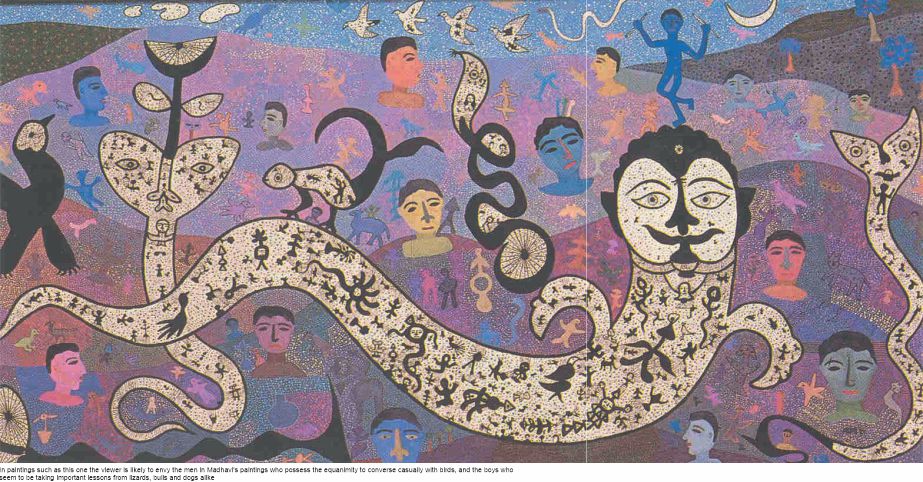
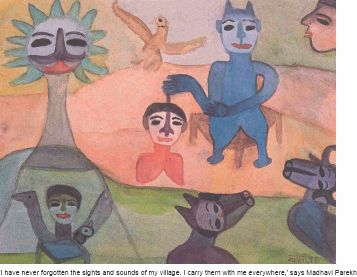
Madhavi’s works originate from her experiences in Sanjay, the village in Gujarat where she was born. She draws shapes within shapes, forms within forms. If the colors and figures in her paintings seem familiar there is also something mysterious about them. ‘Art gives us wings and carries us far, far away’, says a Chekhov character, and when I think of that I think of the world Madhavi Parekh creates. Her paintings pull us back into a time when we conceived the world in terms of innocence and happiness; when the sight of animals or trees could rouse us to wonder. Madhavi draws animals with human heads and humans with animal heads. Inside these indeterminate beings there are all kinds of other lives—birds, reptiles, children. Her representations are simple to an extreme; it is as if a lot of effort has been exerted to avoid complexity. In an age of loaded, often overloaded, metaphors, it is something of a mental relief.
*
‘Painting is like cooking. The colors are the masalas. Whether you crush them yourself or get them readymade, whether the heat is low or high, whether you cover the vessel or not, whether you are in a hurry or not, these things make a difference. And how it looks is one of the most important things’,
Madhavi Parekh
*
When I spoke to Madhavi recently, she insisted on talking in Gujarati. When I asked her if I could frame the questions in English, she asked me to use simple words. She talked rapidly and in short sentences. Madhavi married Manu in 1958 when she was 16 and he a year older. She started painting when Manu asked her to draw, for an entire day, geometric figures, triangles, circles and squares. Tired of doing the same thing over and over again, she began to make heads out of the circles and bodies out of the triangles. At the time Manu was working as an Art Designer with the Weavers Service Centre and as a result was used to teaching painting in simple terms using the pedagogical exercises of Paul Klee. Klee’s idea, to ‘take a line for a walk’, is evident in Madhavi’s work. Sizes in Madhavi’s paintings are almost always disproportionate; shapes, too, are knowingly altered. The result is not distortion but revelation. There are various movements, physical and philosophical, that occur in the large topographies that her paintings cover. When animals assume human shape and humans animal ones, the transformation is not always complete. They do not become unrecognisable but achieve a kind of organic sameness.
*
‘When I was 10 or 12, my teacher would ask me to draw on the blackboard and tell the rest of the class to copy it. I realized if I could do this for a living, life would be much more interesting’,
Manu Parekh
*
Manu speaks in fluent English and unlike his wife, takes time to choose his words. After their marriage he went on to study at the JJ School of Art in what was then Bombay. Under the influence of his teacher, painter S. B. Palsikar—whose protégés include M.F. Husain, Tyeb Mehta and Akbar Padamsee—he took to Western abstractionism on the one hand and Indian miniature art on the other. When he graduated in 1962, they got an apartment which was less than 200 square feet, where Manu painted and Madhavi cooked. His next job took the couple to Calcutta where they spent almost a decade. In the ‘city of joy’, Manu was part of a dynamic, coming-of-age group of painters – Ganesh Pyne, Shyamal Dutta Ray, and Bikash Bhattacharjee — during the same time when legendary American Beat poet Ginsberg and his partner Orlovsky visited the place. Calcutta’s ‘decay, darkness, and broken walls,’ (Manu’s words provided) him with a ready supply of artistic stimuli.
The first two or so decades for the artists during the days when art was least of a moneymaking enterprise was a struggle. Manu worked at a daily job for more than 26 years to support his family. Madhavi remembers a time when she stitched clothes for their two daughters; giving them a treat then meant budgeting 2 rupees to eat at the school canteen. Right from the beginning, Manu and Madhavi had an implicit rule, a tacit understanding to paint every day. Madhavi started painting around 2 p.m. after her daughters got home from school. She would give them lunch and paint while they napped. Manu worked after he got home at around 7 p.m.
*
‘I am mainly interested in contrasts and contradictions. Colours can convey these two things very well. Some people say my work is too crowded. Yes, it is crowded and full of human activity, because the life around me is like that. India is like that’,
Manu Parekh
*
Though both artists have always exhibited fairly frequently, solo and in groups, the real break came in 1989 when their paintings began to fetch the kind of money that would allow them to pursue their vocation fulltime. At this point, Manu was appointed design consultant for the Handicraft and Handloom Export Corporation of India in Delhi. But he found Delhi an ‘uninspiring’ place. It was during this time that he discovered the pilgrimage city of Benares, which had been the subject of work by Rabindranath Tagore, an acknowledged influence, and by FN Souza, a contemporary and friend. Benares replaced Calcutta as his muse and it has been a focus of his attention for over a decade. Manu visits it several times a year and has continued to rediscover and reinterpret it in his works. His recent paintings of Benares exploit the power of impression and suggestion; there is an inescapable vigour, a distinctly masculine quality, reflected in them. He says he ‘freaks out on the canvas’ and this shows. We are certainly taken aback, if not awed, at the uninhibited display of power.
*
‘Madhavi doesn’t question. She narrates straightforwardly what she sees and what she believes. Her paintings have a slow and lazy atmosphere, which is organic and natural’,
Manu Parekh
*
As Manu likes to remind his friends, Madhavi received the National Award from India’s art academy before her husband. By the early 1990s, both had won numerous awards and were selling well enough to afford a comfortable lifestyle. But the couple had a Gandhian work ethic, and complacency was not a choice. This belief in constant work permitted them a fresh, experiment-friendly body of styles and methods. Both told me that confidence deprives the painter of insecurity, a necessary condition when faced with a blank canvas; each, in separate conversations, also spoke in favor of self-doubt and warned of techniques that become too polished.
Madhavi’s paintings have roots in the rustic traditions of Madhubani and Worli where, with a thin stick of wood dipped in red mud, the artist creates, or more accurately invents, myriad forms. These drawings occupy numerous worlds inside and outside the house. Most of the motifs, like the mud—or cowdung—caked walls, the candle stands, the clay water jar, the four-legged wooden stands, reflect a longing for the simplicity and natural beauty of Indian rural life.
Madhavi’s paintings may seem romantic, sentimental, and unrealistic, but these judgments do not necessarily qualify as criticisms. Her worldview, her playfulness, her spirituality is reassuring. The viewer is likely to envy the men in her paintings who possess the equanimity to converse casually with birds, and the boys who seem to be taking important lessons from lizards, bulls and dogs.
*
‘I like the force and the power in [Manu’s] paintings. It’s like action painting. I like his colour scheme. I think he does sky and water very well’,
Madhavi Parekh
*
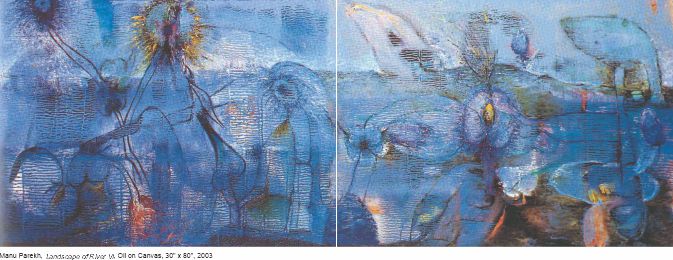
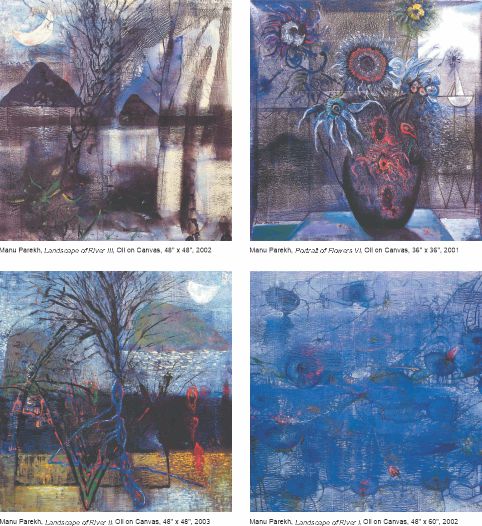
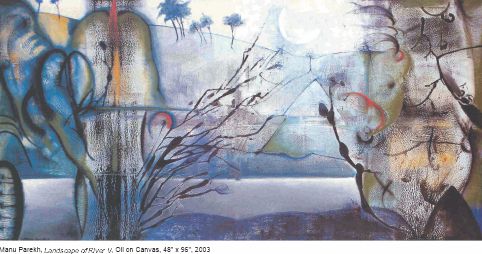
In Manu’s work, colour assumes tremendous importance as the form is often abstract; it has a disconcerting pull and the viewer feels overwhelmed by its immediacy. Sometimes he uses water to distort or to depict distortion; it becomes an element that alters reality and in the process, illuminates. At other times, as in ‘Landscape of River II’, it he uses water to suggest light, reflecting the life on the banks. These river pictures are as crowded as the landscapes. In ‘Landscape of River V’, each branch and leaf of a submerged tree is filled with life. The crescent moon, ever-present, bathes the canvas in silver light. The images in these landscapes often overlap and interact with each other, if only through their proximity, and they struggle for a space of their own, which they are ultimately unable to find.
‘Landscape of River I’ is an interesting example of how the painter uses artistic influence. On a visit to the Museum of Modern Art in New York several years ago, Manu noticed that a Pollock had been placed next to Monet’s ‘Water Lilies’. Manu’s version is a tribute to both painters for in it he combines Pollock’s violent drips and slashes with the shimmering colors and reflections of Monet.
*
‘Art has to be beautiful. It has to make you happy. It should calm you when you are angry and quieten you when you are restless’,
Madhavi Parekh
*
In one of Madhavi’s paintings, tens of human figures carry spears, 3-pronged trishuls, and swords; there are severed heads spurting blood; there is a mustached sun, an 8-armed Kali riding a red-headed bull, and another 8-armed woman who floats horizontally in the middle of the canvas, resembling a Gujarati housewife rather than a fearsome deity. Despite the figures of death and destruction, the atmosphere is, mystifyingly, jovial. There is an unmistakable air of friskiness; you delight in it in the way one does when watching cartoon violence.
Everywhere Madhavi travels, in India and abroad, she takes up elements that belong to those places and makes them her own. She said she picked a greenish blue hue from a trip to Mauritius; from Bhutan’s temples she got the idea of using hundreds of lamps to light a small area, and she singled out the coffee tree from the south Indian city of Chikmaglur. She absorbs, blends and appropriates these elements with the manner of representation that she has become a master of: simple, joyous, and morally educational. Intellectualization is practically absent from her work.
*
‘How can art be beautiful? Life isn’t. But if you express something powerfully enough, it becomes beautiful. More than beauty, art should be magical. There should be some fantastical element. If it happens, it happens; a painter cannot cultivate it’,
Manu Parekh
*
The primary colours with which Manu portrays Benares gives it virility and life that is impossible to ignore. Sometimes, with just one colour and its immediate cousins, he produces a whole vista. In ‘Benares Landscape II’, he has captured with blue the carnal nightlife of the city. Naked breasts and long, flowing skirts are seen in various windows of houses or on the doors of temples. In these landscapes, human figures are almost absent except by suggestion. The depiction of contradictions, one of the primary concerns of the painter, is done not figuratively so much as through the sharp, edgy use of contrasting colours.
*
‘Excellence in a woman is exciting to me. With Madhavi, I knew that if I didn’t give her enough freedom, it would cost me dearly’,
Manu Parekh
*
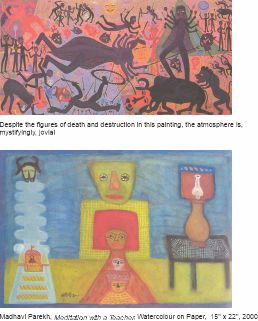
In her paintings, Madhavi often lets her imagination run riot but she rarely forgoes her vision and her commitment to her style. In one of them there is an idol, painted as a human bust, inside a small temple over which a large apparition headed by a bull’s face stares at us. Various conclusions, if one desires them, can be made of this work: that the god-figure is no different from the human, that the animal world is more pervasive than the spiritual one.
Madhavi is probably the least feminist of painters. Most of her subjects are male; her paintings present man and his response to the world around him. The difference between men and animals is minimized; there is nothing to tell them apart: we get to see the morphing of one into another. The animals are friendly and not terrifying. They are interested in engagement, in education through play. In one picture, a man is shown prostrating himself before a buffalo. Each painting tells us a story. What we hear, though, is not Madhavi’s narrative but our own.
*
‘The erotic element in my paintings is not figurative. It is abstract in spirit. I don’t believe in the Western terms of eroticism where there is one man and one woman’,
Manu Parekh
*
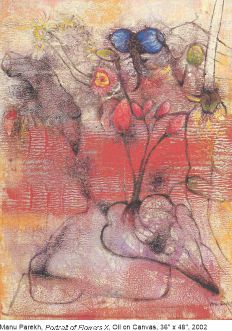
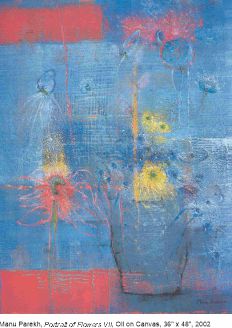
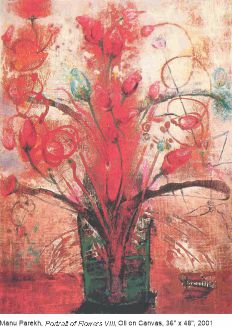
In his Portrait of Flowers series, a recent collection, the flowers are not only the principal subject, the foreground, but the background as well. They emanate power and emotion, and as if to demonstrate this literally, Manu fills the canvas with their presence. The frame locks them in place, as if they are dependent on nothing, as if they are to be studied in exclusion of everything else. The seductive curves and the fearless strokes give the flowers a pulpy, fleshy, ‘realer-than-real’ feel. In some cases, the flowers are withered and represent the ephemeral nature of beauty. When other elements — water, sky, ship, walls – are added to the canvas, they assume the colours and shape of the flowers.
*
‘I believe in work very strongly. Your work, where you spend your creative energy, will never let you down. Friends and relations may’,
Manu Parekh
‘I am moody but he is moodier. Painting is a peaceful and solitary activity. Marriage is the opposite’,
Madhavi Parekh
*
Madhavi and Manu have different temperaments; he likes to talk, she is reticent. When she comes out of her studio she rarely talks to him of what she has done. Manu, on the other hand, discusses his ongoing work at length. He likes her to visit his studio, which is a one-bedroom apartment separate from their single-unit house, and to give him feedback. He finishes a painting of the same size relatively faster than her; she is more patient than him, one of the reasons why she has adopted watercolors as one of her main mediums. Now in their late sixties, the painters are more prolific than ever. Their work hours are as strict as before. In the last decade, once free of direct parental responsibilities, the couple began to travel. Manu does not like to visit museums without Madhavi and says she is the best companion for such a visit. She did not take him very seriously when I told her about it.
He says there is no question of competition between them. She says artists compete. Their relationship may lack the fierce turbulence of Pollock and Krasner or Riviera and Kahlo but they do disagree, about this and other things, and in the process of disagreement and resolution they redefine their ideas and reinvent their work. Theirs is perhaps the ideal creative partnership.
Shakti Bhatt is a writer and filmmaker. She divides her time between New York and Bangalore
When both husband and wife are artists, competition may be a stimulus to creation. A personal account of the contemporary Indian painters Manu and Madhavi Parekh by Shakti Bhatt ‘Artist couples always fear competition and comparison’ Madhavi Parekh ‘The idea of competition between an artist couple is bullshit, nonsense, and clichéd.’ …