

panorama of dhaka in 1840
In 1840 an unknown artist painted an exquisite series of watercolours depicting the riverfront view of Dhaka. The series shows a row of elegant houses and palatial mansions in the colonial style, belonging to wealthy merchants, indigo planters, zamindars (native and foreign) and British officials of the East India Company. Historical landmarks of medieval and later periods, e.g. fort, mausoleum, tomb, shrine, temple, church, are also faithfully documented. So are court buildings and governmental and commercial offices of the period.
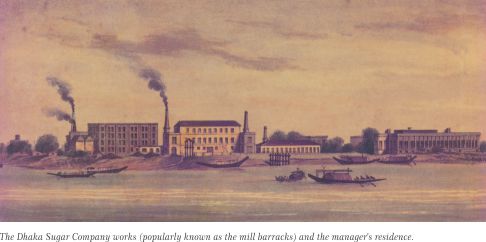
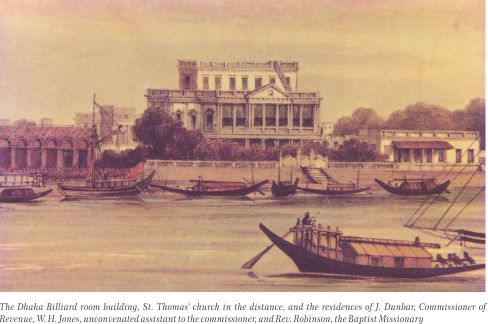
It is surprising that although the book, Panorama of Dacca, was published in mid-19th century London, the artist remains anonymous despite the fact that by that time it had become common practice to identify artists and writers on the title page. It is a mystery that merits inquiry.
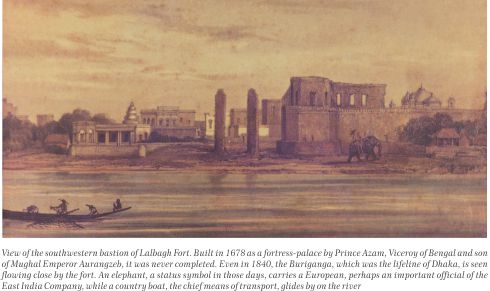
These quaint watercolours, which can be sequentially arranged in the form of a scroll, could be by an artist, whether amateur or professional, who was perhaps a European or East India Company official. But the possibility that the artist may have been a local person cannot be completely ruled out. The series is done in a style reminiscent of the Company School. In particular, the drawings reveal a penchant for realism, graphic detail, and an accurate sense of perspective, which are distinct marks of the European artistic tradition.
However, apart from the drawings of buildings, which bear testimony to the kind of skilled draughtsmanship that was another prominent feature of the Company School, the river scenes of boats and peopled evince a more vernacular style. It is on record that the Company School produced quite a few excellent native artists who were trained by European tutors and worked for European patrons.
The picturesque riverfront gave a rather deceptive introduction to Dhaka to first-time visitors, who as they approached the landing ghats on the river Buriganga by ship were often amazed by what they saw; this gave currency to the city’s erroneous sobriquet of ‘Venice of the East’. In fact, just beyond these rows of imposing buildings were hovels, bustees and bazaars of indescribable filth and squalor. Dhaka, then, was a city in decline, with a dwindling population and its Mughal structures in ruins, overgrown with jungles and interspersed with fetid malarial swamps, its once famous traditional arts, artisans and commerce yet to recover from past political upheavals.
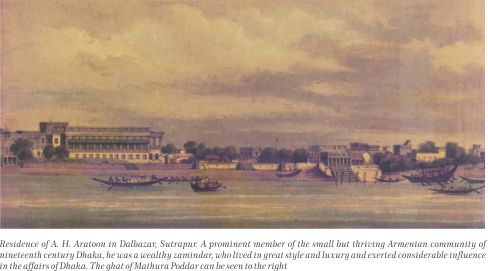
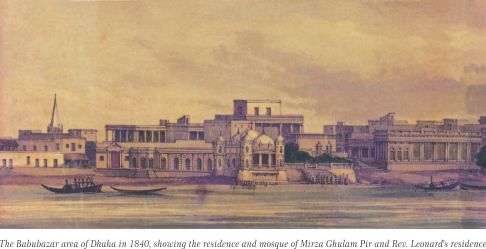
Whoever the unknown artist was, he did an exemplary service to posterity, by painstakingly documenting a few miles of the riverfront of Dhaka, including the Buckland Bund, as it looked in 1840. It appears that the artist may have worked out of a boat moored in midstream.
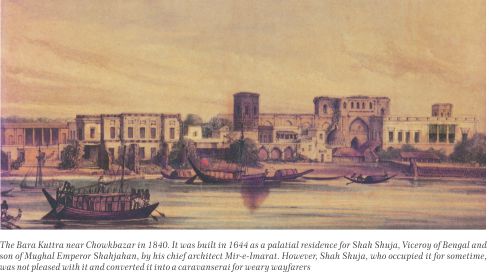
Regrettably, these prints are the only realistic images of the once posh, urban and residential part of the city in that age. It is indeed a rare contribution to the visual history of Dhaka.
And we are certainly the richer for it.
Waqar A. Khan is a writer and researcher. He has recently published Rare Photographs of Eastern Bengal (1880-1940)
In 1840 an unknown artist painted an exquisite series of watercolours depicting the riverfront view of Dhaka. The series shows a row of elegant houses and palatial mansions in the colonial style, belonging to wealthy merchants, indigo planters, zamindars (native and foreign) and British officials of the East India Company. Historical landmarks of medieval and…