
images of dhaka’s past
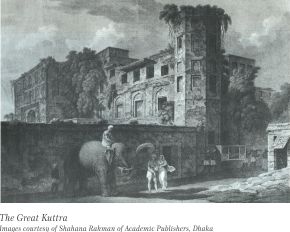
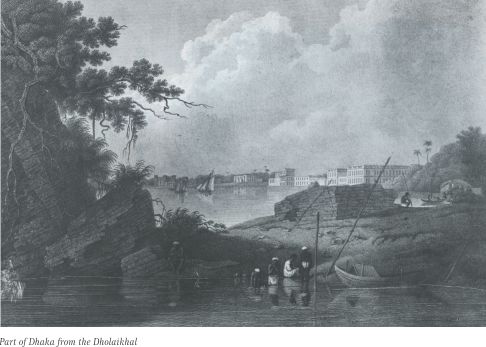
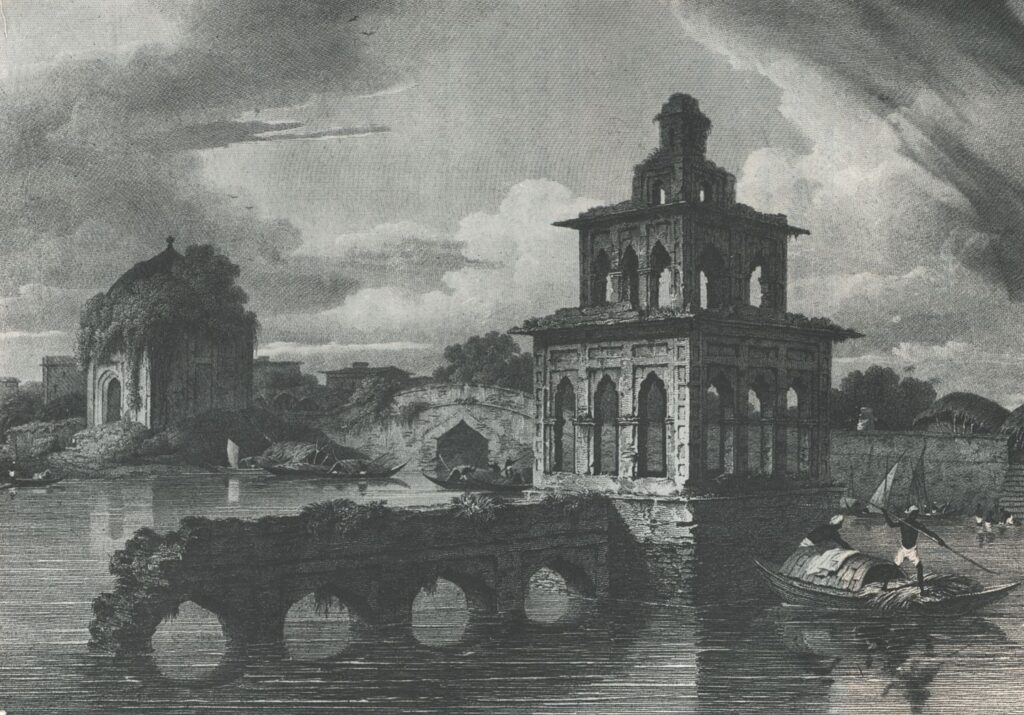
To anyone interested in images of Dhaka’s past, Charles D’ Oyly’s Antiquities of Dhaka is a work worth examining. It consists of folio volumes of illustrations accompanied by a brief account of the city and ‘vignettes’ based on George Chinnery’s sketches of the city. I first came across copies of this rare book in the libraries of the University of Dhaka and Jagannath University College. But when I saw the same work in the East India Company collections at the British Library, I realized that the copies I had seen in Dhaka had been tampered with somewhat, since the London folios had wider margins. In London, I also came to know that the text on Dhaka accompanying the folio photographs was not by D’ Oyly but by someone called James Atkinson. Intrigued by the possibility that our knowledge of the book was far from complete, and that aspects of it were still hidden from us, I decided to spend a few days in the British Library tracking down all the information I could gather on the book, the artists, and the writer of the text.
D’Oyly was born in India on 17 November, 1781, the son of Sir John D’ Oyly, the Company’s Resident in the court of Nawab Babar Ali of Mushidabad and a friend of Warren Hasting’s. D’Oyly joined the East India Company in 1798 and became Collector of Dhaka in 1808. He served the Company till 1834, when he retired as a senior member of the Board of Customs, Salt, and the Opium Board. Wherever he was posted in India, he drew pictures of its people and places. In A Narrative of a Journey Through the Upper Provinces of India (1828), Reginald Heber describes him and his passion for art thus: ‘He is the best gentleman artist I ever met with. He says India is full of beautiful and picturesque country if people would stir but a little away from the banks of the Ganges, and his own drawings and paintings make good his assertion.’
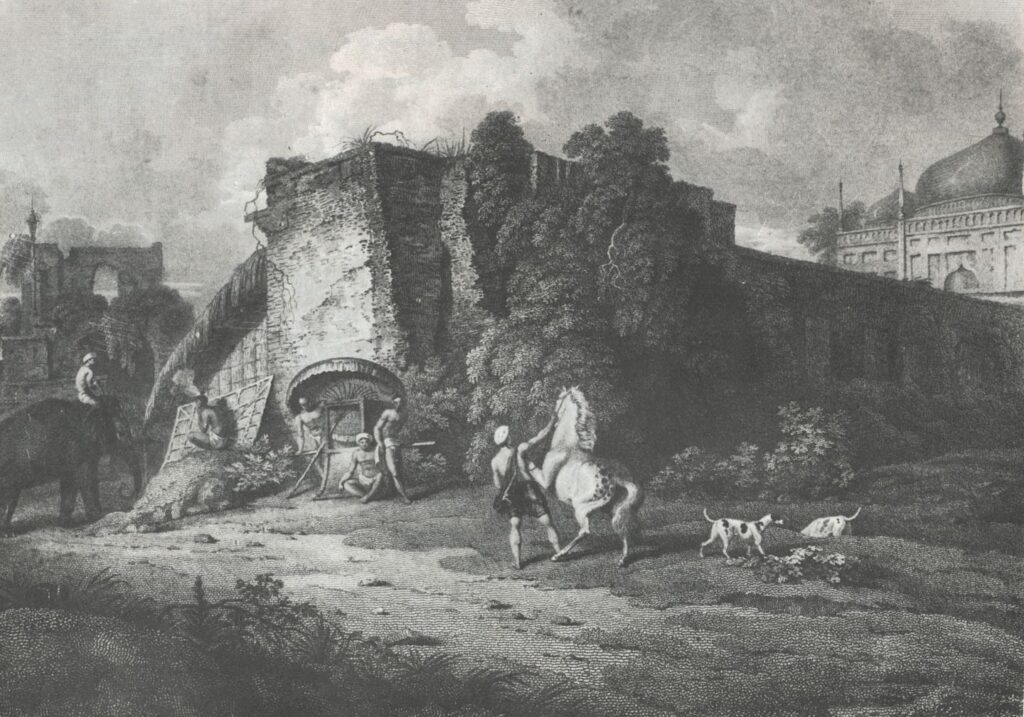
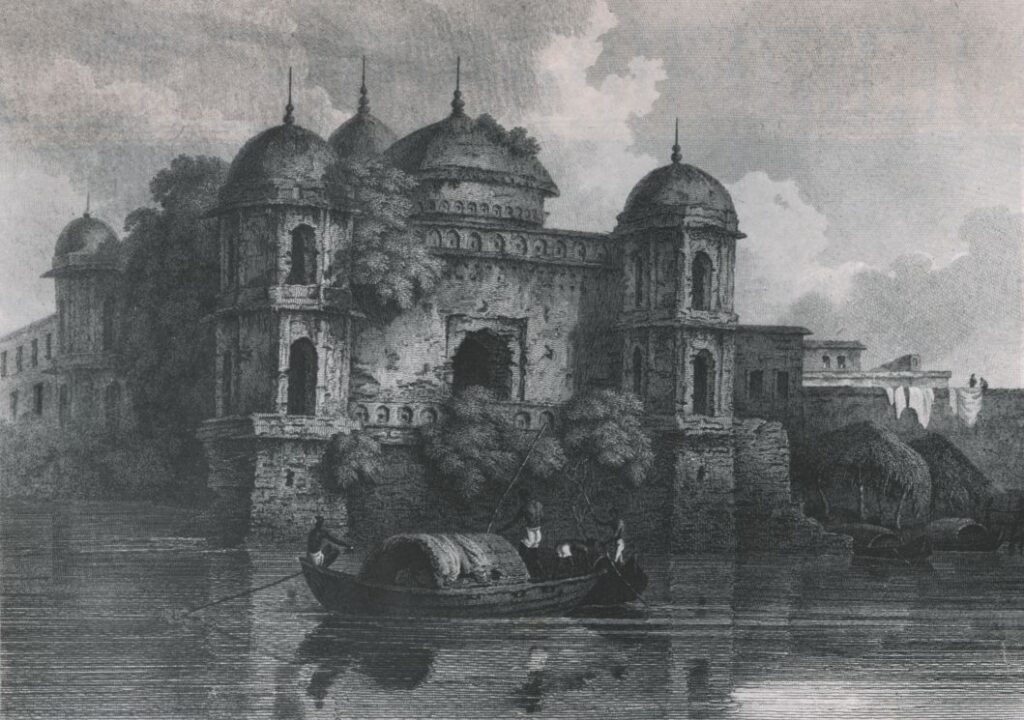
To the historian of Dhaka, the value of D’ Oyly’s book is immense. It gives us views of Dhaka during the period of its decline after the collapse of the Mughals. All company officials were taught drawing in Haileybury College since visuals were useful in colonial administration, but D’Oyly was much better at it than the average Company official. The Mughal ruins he saw in and around Dhaka fascinated him. Perhaps the ‘picturesque’ movement in the aesthetics of the period had encouraged him to treat Dhaka’s scenes artistically. No doubt drawings provided relief from the boredom and loneliness of his life in Dhaka. In any case, D’Oyly not only began drawing sketches of the city himself but also invited the professional artist George Chinnery to join him in depicting the city. Chinnery was an Irishman who had travelled to India after failing to do well in London–like so many of his contemporaries. Chinnery came to Dhaka from Calcutta in 1808, either because he wasn’t doing well in Calcutta or because Dhaka’s weather was more to his liking. He stayed in Dhaka for three years and drew many pictures of the city. Three of these are reprinted in Antiquities. One of them presents an ancient mosque next to some modern habitations. According to the text of Antiquities, the intention seems to be to contrast the city’s ‘present poverty with Mohammedan importance and rusticity with architectural elegance.’ The second one depicts a poor Muslim weaver, showing his hut ‘made of bamboo, mud and matting, thatched with straw: his umbrella and a few of his domestic culinary utensils… lying about..( and) part of an old loom.’ The third one shows the road to Tongi. Bishop Heber mentions other Chinnery works on Dhaka in his book on India as does Patrick Conner in his 1993 work on the artist, George Chinnery, Artist of India and the China Coast.
Chinnery appeared to have guided D’Oyly in the use of light and shade and colour in his paintings. This is revealed in a letter D’Oyly wrote to Hastings where he also mentions that Chinnery had painted over fifty pictures of Dhaka’s ruins all of which he found so ‘beautiful’ that he ‘knew not to which the preference ought to be shown.’ In another letter to Hastings he reveals that he himself had been drawing some pictures of Mughal ruins of Dhaka whose ‘picturesque beauties’ he found ‘unrivalled.’ He also expressed his intention to publish some of his drawings as lithographs that he intended to have engraved soon by the most skillful engraver he could find. This, perhaps, was how the idea of publishing Antiquities of Dhaka occurred to him.
D’Oyly eventually decided to bring out a folio volume based on his Dhaka work through money raised by subscription. To do so, he corresponded with John Landseer, a famous engraver in London. D’Oyly tried to get Lord Minto, the Governor General of India, as his chief patron, hoping that his family connections would help him in this scheme. He also counted on attracting enough subscribers by keeping rates moderate. The proposal for his scheme is contained in a letter he wrote to his friend Edward Stratchey in 1811:
Graphic illustrations of the Antiquities of the City of Dhaka proposals for publishing by subscription inscribed with permission to the right Honorable Lord Minto &c. An historical description of the ruins of Dhaka, with biographical anecdotes of the founders of those public edifices and some account of the founders of those public edifices and some account of the ancient splendor of that celebrated city by James Anderson Esq.

Illustrated and embellished with twenty-four views from drawings, taken on the spot by C. Doyly Esq.
Price to subscribers Ca Rs 100
Non-Subscribers¾125
To give value beauty and interest to the work the plates will be executed in a superior style of excellence by the most eminent engravers of the present day. And when the number of subscriptions amount to a sum sufficient to defray the expenses of publication the work will be immediately put to press.
James Atkinson who wrote the text of Antiquities of Dhaka was originally a surgeon but was so proficient in Persian that Lord Minto gave him administrative responsibility. He had received an award for one of his translations of Persian poetry and had published a book on Afghanistan as well as a folio volume of sketches of the country. He was, therefore, a good choice.
However, D’Oyly had to scale down his ambition of publishing an expensive volume since Lord Minto apparently declined to be the patron. A revised prospectus was issued, but Atkinson’s name no longer figures in it. Nor is Chinnery mentioned, but perhaps this was because of a printing error, since D’Oyly’s correspondence of the time continues to mention the professional artist’s work as accompanying his engraved views.
In the end Antiquities of Dhaka was published in four folio volumes in 1814. I list them below as I found them both in Dhaka and the India Office libraries:
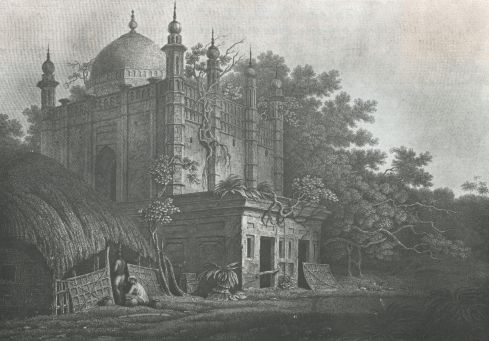
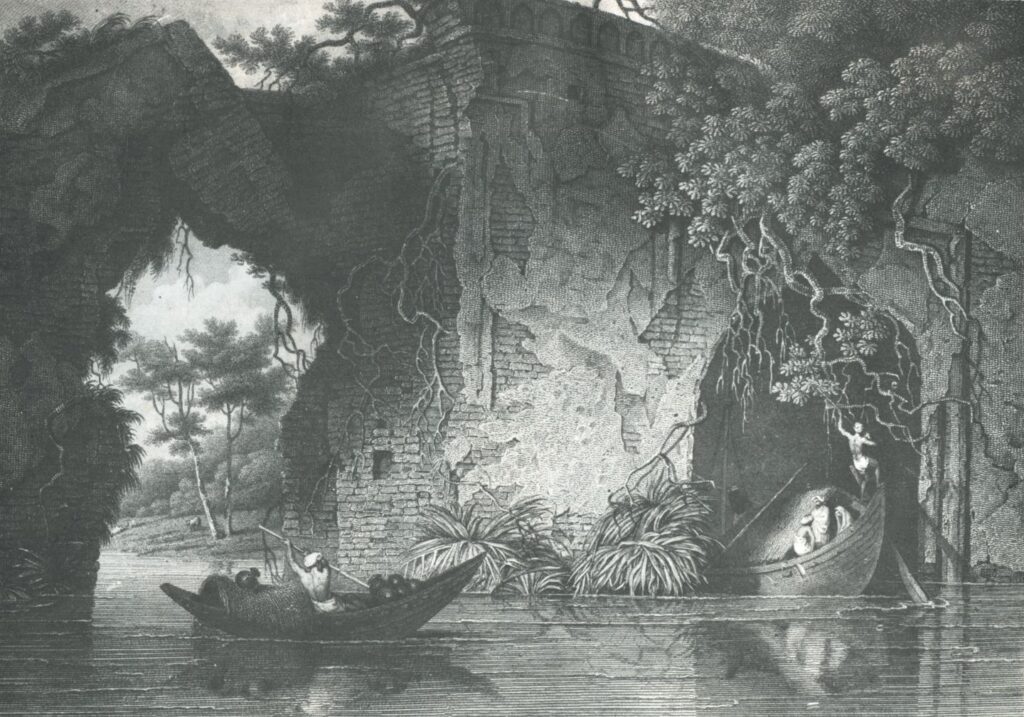
First Folio
Mosque on the Booragunga Branch of the Ganges
Part of the city of Dhaka
The mosque of Syuff Khan
Remains of a bridge near the Tantee Bazar
Second Folio
(This begins with ‘Some Account of the City of Dhaka’)
Small Kutra
Pugla Pool
The Fort and the North Gateway
Bastion of the Lalbagh
Third Folio
(The narration starts from p.7)
Paugla Pool, from the river
Modern Habitations (by Chinnery)
Ruins of Tungy Bridge
Facsimile of an Inscription in the great Kuttra
Mosque in the suburbs of Dhaka
Fourth Folio
The great Kuttra, (narrative is from p.15 to p.20)
Part of Dacca from the Doullay Nulla
Mosque on the Mug-Bazar
The Chouk
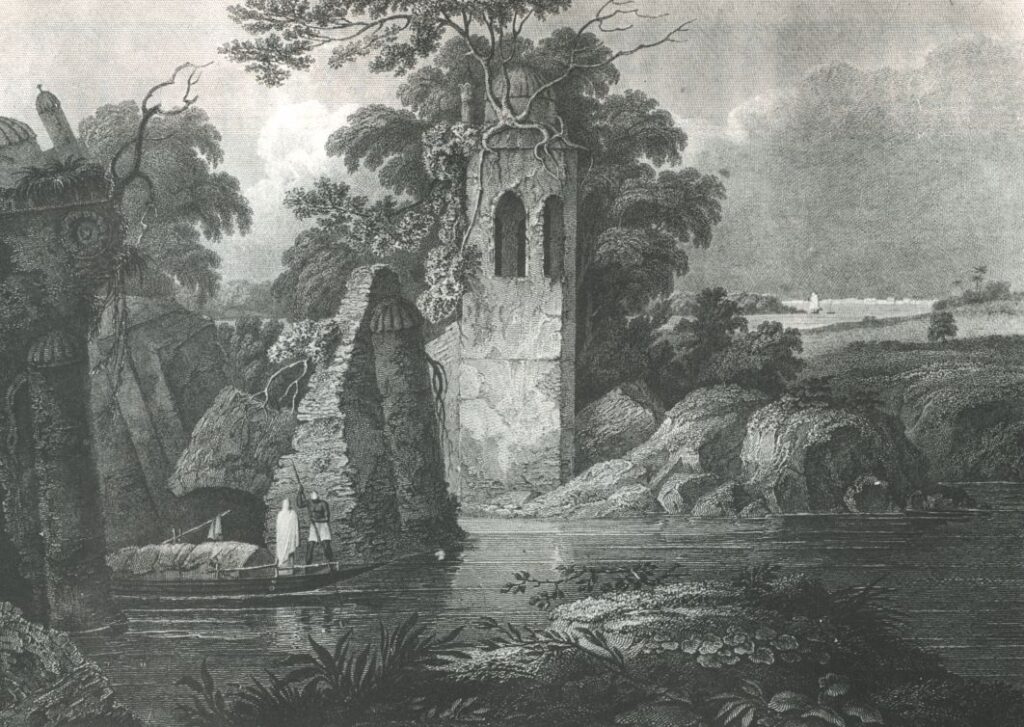
My examination of these volumes and the information I collected on Antiquities of Dhaka suggest the following conclusions: a) The book was probably published in four and not six folios, that is to say, not as D’Oyly had originally planned, since I have not been able to locate more than this number; b) however, we cannot rule out the possibility of the existence of the other two volumes, since Sir Jadunath Sarker, the eminent historian of Bengal, has mentioned the book and since a reproduction of another of D’Oyly’s sketches of Dhaka has been reprinted in George Azimusshine’s book on the city and has been identified in it as an extract from Antiquities; c) except for the third folio, there are four pictures in each folio; d) the work is mainly D’Oyly’s, although the narration is by Atkinson, while Chinnery has contributed a few ‘vignettes’ to it and Landseer has done its engravings. Above all, one can confidently affirm that the book has some remarkable pictures of Dhaka and can easily claim to be among the earliest and best attempts to capture the city through artistic eyes.
Translated from the original Bangali by Fakrul Alam
Muntasir Mamun is Professor of History at the University of Dhaka
To anyone interested in images of Dhaka’s past, Charles D’ Oyly’s Antiquities of Dhaka is a work worth examining. It consists of folio volumes of illustrations accompanied by a brief account of the city and ‘vignettes’ based on George Chinnery’s sketches of the city. I first came across copies of this rare book in the…