
company drawings bengal chapter
In the last decade of the 18th Century, the cultural interaction between local artists and their British and European patrons transformed indigenous Indian painting and led to a unique style that came to be known as the Company School
This genre of art surfaced in a number of regions in India and Bengal was one of its important production centres. Company Art of Bengal, like that of other regions, was characterized by its own distinct flavor that evolved out of its older local traditions. Shaykh Zyan–al–Din and Shaykh Muhammad Amir of Bengal were among its most outstanding painters. Their works, according to some critics, compare favorably with European work of the period. Other critics, however, find Company painting realistic, but essentially static. A renewed interest in the Company School has ensued in recent decades following a chance discovery in the 1970s of 230 hitherto unseen large watercolours of an obscure painter named Sita Ram of Bengal. This discovery inevitably questions notions about the Company School being static and decadent.
After the disintegrations of the Mughal atelier and the decline of Dhaka and Murshidabad, artists and the descendants of the court painters of north India flocked to other regions in search of patrons. Those who came to Calcutta found some elite patrons in civil servants and members of the Judiciary. This led to a transformed cultural milieu in Bengal. This new class of British Company servants came out energetically in support of European and Indian artists.

The perceived lack of western ideals of art in traditional Indian painting, such as realism, western style perspective, sense of proportion and the use of light and shade, had led East India Company officials to ‘improve’ the skills of the local artists when teaching them what they called scientific drawing. Earlier, the Company had employed English and European artists to good effect. Local artists had been trained to make the architectural, botanical and zoological drawings necessary for the Company’s administrative needs. Some of the native artists of Bengal had already been exposed to European art techniques through painters like Solvyns, T. Daniell, Charles D’Oyly and Emily Eden who had employed them either as assistants or copyists. Some were able to study the western prints available and some even received direct instruction from their patrons. They successfully assimilated European techniques and style with their own tradition and skills to meet the demands of the white Nabobs of Bengal. Watercolour replaced gauche, European made paper began to be used, while light and shade was introduced with soft washes of color. These developments resulted in visual records of Indian life rendered by Indian painters through European techniques commonly known as Kompany Kalam or Company paintings. The style gradually was on view in all the main cities of Bengal where sizable British and European communities existed.

One of the most important and successful Company School series of natural history studies was made for the Chief Justice of Bengal, Sir Elijah Impey (1777 to 1783) and Lady Impey. In 1777, Lady Impey commissioned Shaykh Zyan-al-Din, Bhabani Das and Ram Das to paint the birds, animals and plants of her garden. Of the three artists, Zyan-al-Din alone produced more than three-quarters of the paintings commissioned for Lady Impey. Zyan-al-Din flourished during 1770-1790; he was initially trained in the Murshidabad style of miniature painting but probably had very little exposure to European watercolour techniques. He had perhaps received a modicum of instruction and guidance on the type of drawings the Impeys expected from him. One wonders how he was instructed and what models were put before him by his patrons.

Zyan-al-Din’s life-like rendition of birds constitute the earliest dated natural history drawings painted for the British in India. The eminent art historian Toby Falk notes that contemporary illustrations in books of birds published in Europe were less florid and exotic than Zyan-al-Din’s drawings on the subject. Most of his drawings show animals in actual size, and details are recorded with great precision. The colours are rendered in different layers to produce an intense effect. ‘Of these, almost every watercolour is a masterpiece’ writes Toby Falk. His white-headed Ibis reminds us of the work of the famous court painter Mansur of Emperor Jahangir. It may be noted in passing that the work of the greatest of American bird painters J.J.Fougue Audoubun appeared nearly a hundred years after Zyan-al-Din had painted his birds for the Impeys.
The influence of European art is clearly evident in the works of the celebrated Bengal Company painter, Shaykh Muhammad Amir of Karaya, Calcutta who was active around 1840-58. His watercolours remind the viewers of the aquatints of Thomas and William Daniell. He specialized in depicting the houses and staff of British residents in the European style. We also know the name and identity of the patrons for whom he painted his dogs, horses, carriages and syces. His vigorous rendition of animals brought him favorable comparison with the British painter George Stubbs.

However, it was in Sita Ram’s topographical landscape done in the western technique of watercolour that the Bengal Company School reached a distinctive phase. In 1970 an album of his watercolours depicting fruits and plants ‘By Seeturam’ appeared at a London auction. Four years later, two albums were put up for sale in London. J.P Losty of the British Library, London, acquired the remaining eight albums known as Hastings’ Album for the British Library in 1995. It was due to Losty that we finally came to discover Sita Ram and found out about his patrons.
Sita Ram is referred to as ‘Bengal draught man’ in the journal of his employer, Lord Hastings, the Governor General of Bengal from 1813-1823. It was Hastings and his wife who recognized the talent of their Bengal draught man. They offered him ample opportunities to blossom into one of the most versatile artists of his time. He produced for his patrons a large collection of charming landscape drawings of historical monuments , mosques, temples, rivers , historical ruins, village scenes etc of not only Bengal but of different regions of North India while accompanying the Hastings’ on tour from Bengal and Haryanya. In January 1817, when Hastings visited Gaur and Pandua and in 1820-21 when he undertook another trip through Upper Bengal, Sita Ram accompanied him It was possibly during the latter trip that Sita Ram drew his watercolour the Firuz Shah Minar at Gaur which is reproduced in this article. (J.P.Losty)

Nevertheless, very little information is available about the life and background of Sita Ram. All we know is that he was at the peak of his career during 1810 to 1822. It is possible that he was familiar with the works of Hodges, the Daniells, and Chinnery. Initially trained in Mursidabad Kalam, he successfully utilized his extraordinary draughtman’s skill to produce realistic effects. The shadows in the foreground and the atmospheric cloud in his watercolour are proof of his ability to blend western landscape techniques with local artistic traditions.
Unlike the Impeys, the album drawn by Sita Ram for the Hastings’ was done purely for his personal reasons; these were intended to complement Hastings’ gifts to his children. Hastings’ patronage led to further enrichment of the Bengal Company School. The trips undertaken by Hastings and his artist widened Sita Ram’s views, freeing him from the limited geographic confines of Bengal and exposing him to new scenes, characters, and the Mughal art traditions of Northern India. Due to political reasons, Hastings himself avoided visiting Delhi, but he sent his wife and Sita Ram to the city to observe and record the historic sites there. This opportunity must have enabled Sita Ram to interact with some of the local artists of Delhi and scrutinize their works.

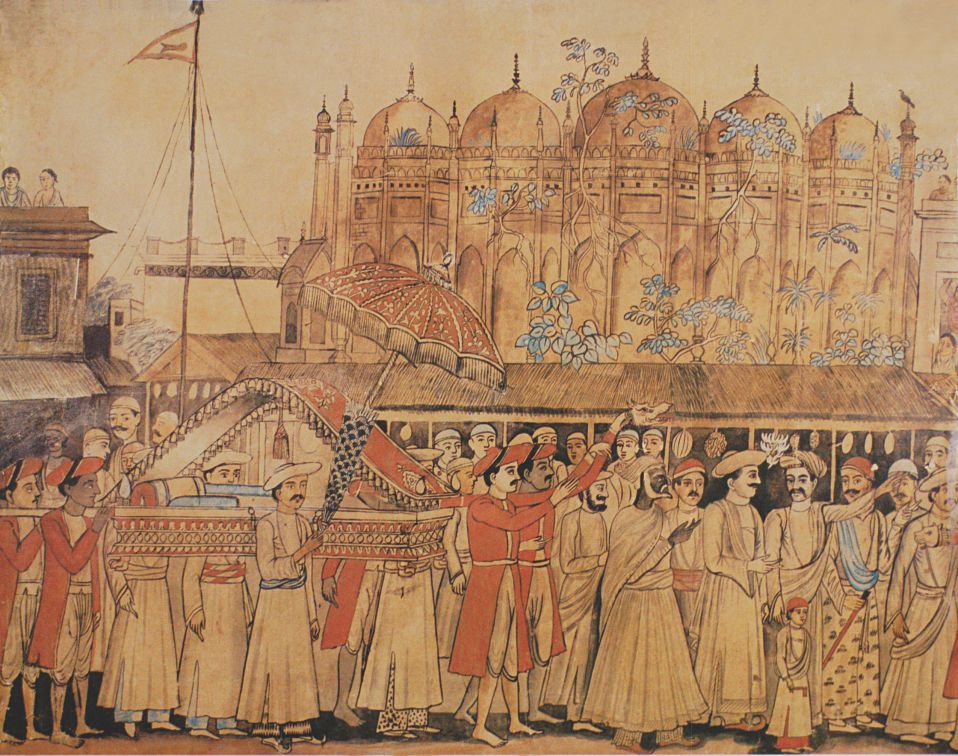
Did Company painting develop in 18th century Dhaka? Banglapedia (published by Asiatic Society 2003) believes that some of the works of Company art might have reached Dhaka in the late eighteenth century. Banglapedia bases its conclusion on the series of 39 watercolors depicting life and society in nineteenth century Dhaka, currently available in the National Museum of Bangladesh, Dhaka. However, it notes that one cannot be sure about this point because of the lack of other evidence to support this claim. Professor Dr. Enamul Huq, on the other hand, states that ‘these paintings representing an assimilation of the Mughal and European styles maybe classified as the Company School yet different’. The series drawn in Dhaka around 1820 by local painters such as Alam Musawwar vividly depict ceremonial Eid and Muharram processions, different sections of people, their costumes, landmarks and buildings in such a realistic manner that the paintings even include beggars, dogs, and snake charmers on the streets of Dhaka. Alam Musawwar seemed to be a descendant of the Murshidabad guild of the provincial Mughal School. The series is of considerable historical and documentary value for a study of the social life of Dhaka in the nineteenth century.
Company painting did not have time to develop as J.P.Losty declares and become a genuine nineteenth-century pan-Indian art .It survived the introduction of photography in India in the early 1840s and lingered on despite the demise of the East India Company. But following the tumult of 1857, British patronage declined significantly as English priorities shifted elsewhere. In Calcutta a visible change took place in the taste of the elites in favour of large portraits favoured for decorating their palatial buildings. As the sources of patronage started drying up, the Company school decayed and moved toward a slow inevitable death.
Mahboob Alam is a former ambassador of Bangladesh
In the last decade of the 18th Century, the cultural interaction between local artists and their British and European patrons transformed indigenous Indian painting and led to a unique style that came to be known as the Company School This genre of art surfaced in a number of regions in India and Bengal was one…