

arab women artists
A survey of eight Arab women artists, whose concerns, media and techniques, viewpoints, varied experiences, and observations are representative of the current beliefs existent amongst female artists of the contemporary Arab art scene
To say that women artists are different from men artists opens up a polemic that arguably can never be resolved. For isn’t good art genderless and/or sexless? Isn’t good art all about the art work itself, the end product, regardless of who made it, whether it be woman or man? Isn’t gender a ‘social construct’ and therefore irrelevant, or of secondary importance if at all to the content, which comes before everything else?
Critical theory interrogates gender thoroughly. Gender, we are urged, in addition to being a ‘social construct’, is in fact, a free floating ‘dichotomous construct’ that is constantly delineated by ideological definitions on the role of identity, the role of the body, and the role of sexuality in society. In other words, to be gendered a ‘man’ or a ‘woman’ is an idea above all else. We are—man or woman—exactly the same. But the reality is that we hardly live in an ideal world. True gender democracy is an ongoing pursuit in the truest sense of the word everywhere in the world. The fact is that being a woman in today’s world is hard. This results in significant differences between how women artists perceive the world and how men artists do so because the latter’s struggles and concerns stem from altogether different roots.
Art, in all its depictions and projections, we are told, is a celebration of life; of its richness, of its complexity and difficulty, and the relentless efforts of human beings regardless of sex in trying to fathom the truth of it. Like other women artists from South Asia and from the rest of the world, the work of Arab women artists is an affirmation of that richness too. In this essay, I look at the work of eight different Arab women artists, whose concerns, medium of expression, and techniques, viewpoints, varied experiences, and observations possibly portray the current persuasions amongst female artists of the Arab World.
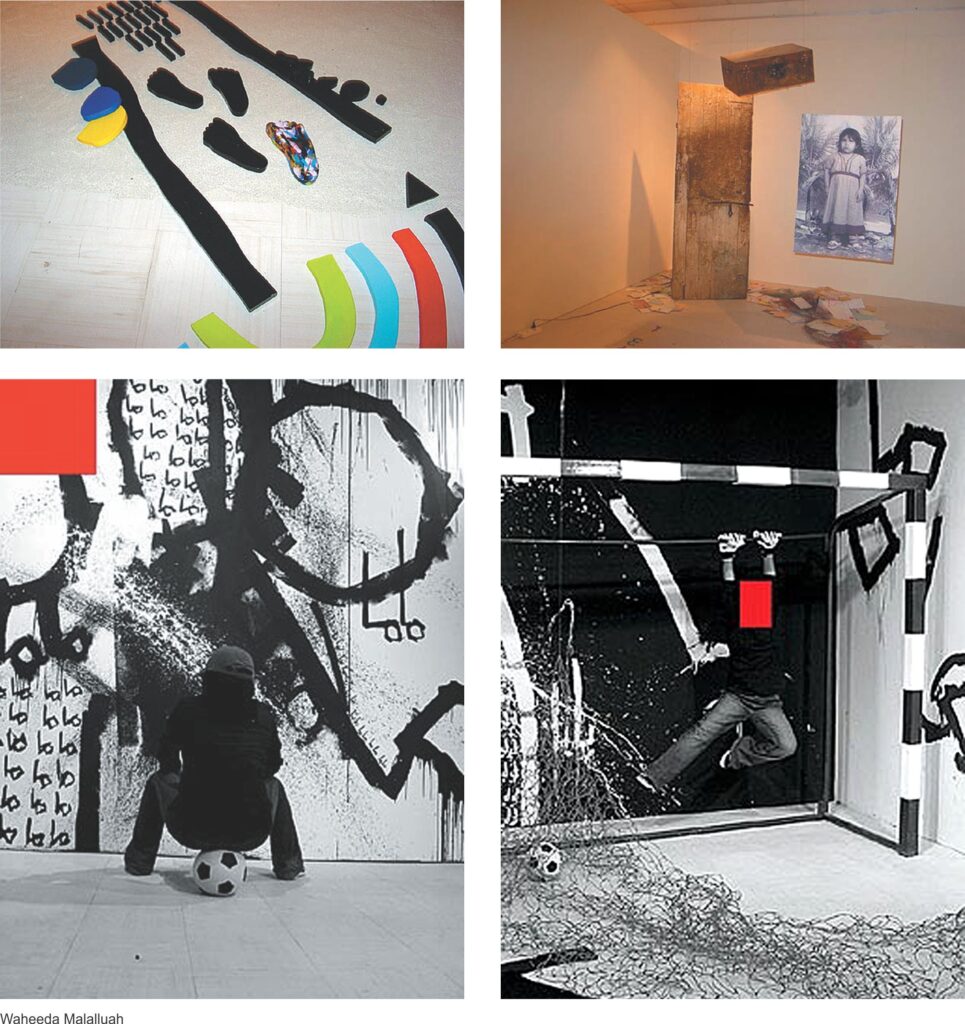
In her most recent work Bahraini artist Waheeda Malalluah deals extensively with the issue of gender. In 2003, at the premises of The Bahrain Contemporary Art Society, she collaborated with a group of men and women artists on an ‘installation’ exhibition. The show was titled More of Darkness… More of Light. To followers of her work, Waheeda’s shift from issues of memory, longing, and childhood, to gender was a surprise. She devoted her space in the exhibition to an actual, but scaled down, football pitch. Her attention—and ours as viewers—was focused especially on the goal keeper’s side. A life-size photograph board of Waheeda in goal keeper’s gear, stood centre stage. White gowns (thoubs), the traditional garb of Gulf men, were suspended all around, possibly denoting cheering fans, and a black gown denoting a woman was put on the floor by her feet. The football net was in red. The goal keeper’s—Waheeda’s—hands, though in action, were empty; the ball had actually hit home. She titled it–confusingly–Stopped Ball?.
In speaking about it, the artist clearly demonstrates that issues of memory, longing, and childhood have never left her really, and even in her most flagrantly socio-political statements, the problem of gender has always existed in her memory. Waheeda reminisces ‘When I did I Can’t Sleep in 2002, [it was all about] my dream, [I was asking my] father, why can’t I find you beside me? …Where are you?’ Waheeda continues, ‘I am looking for a challenge!’. She then describes her installation I Can’t Sleep, ‘[I put] an old door, hanging, father has passed away, and I left letters I had kept from 1995-2002 from all over the world thrown on the floor, [I put parts] of a game, wooden pieces strewn on the floor. [I put] a large childhood photograph of myself looking sullen and sad—father has passed away, and [I made] a voice recording of my intense feelings.’
‘Then in 2003 I did Stopped Ball?’ Waheeda tells me the actual names of ten men, and the name of one woman; was she herself the single female player? She’s in a team of one woman and ten men. Waheeda explains, ‘[There are] three sides [in Stopped Ball?]. One is black, with the word ‘father’ written in white. The other is white, with the word ‘mother’ written in black…The ball is on the floor, the net is red…white gowns for the boys up in the air, they are the number ‘ten’, a black gown thrown on the ground is number ‘one’, and there is a poster image of myself defending the goal corner.’
Though outwardly I Can’t Sleep and Stopped Ball? are clearly different installations done at different times, for different venues, they both retain a strong sense of longing for a position denied, of the kind only a woman can experience. They denote the intimacy of a relationship with a father, who perhaps would’ve had such a relationship with his offspring if she were a son and not a daughter. They gesture at the desire to play and join in a team just like the rest of the boys (and later on the men) who were given the bountiful freedom of childhood denied to girls once they reached a certain age.

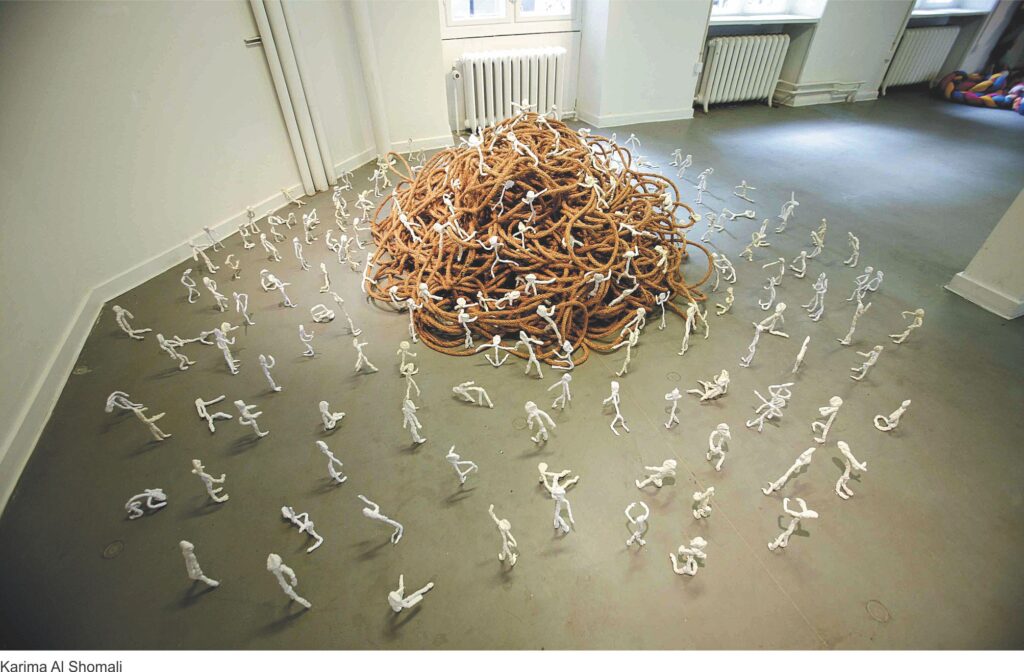
In a recent interview the artist Karima Al Shomali of United Arab Emirates acknowledges, ‘most of my work is about [the condition of being] human in general, away from certain environments or societies. It’s about the universal human being, with all his/her conditions and circumstances that constitute my art project as a whole. In most of my work I monitor this human being and the kind of life it leads, and how it’s affected by life’s happenings and changes.’
In a commissioned art project done by Karima for The Fine Arts Academy of Denmark, she decided to make a work on the Burqa which is the facial veil that many, especially older Emirate women, still wear. The artist reveals through her own research that in the history of the region the first time the burqa surfaced in the Gulf was in Saudi Arabia in 1840. She explains that it was perhaps a product of fashion or intended to hide the face of its wearer; however, over time the burqa took on the significance it has today. The artist understands it as signifying ‘a mask’ amongst other things. She continues, ‘I became interested in investigating what is parallel to the burqa in other cultures, and to search for the signifiers and symbolisms of such parallels. I learned that in Africa and even in Europe [masks prevailed at one time]. There are many kinds of burqa, each signifies a level of society, and a certain geographical area.’ In her installation Karima made large transparent plastic tubes filled with coloured paper, each tube a different colour; she then cut the spheres of large burqas and inserted them. As viewers we see large columns of colour headed by ghost-like burqas.
Arab art critic Talal Moualla devotes an essay to the issue of the burqa in Karima’s work, As he describe it, ‘[Women] used to put it on in the form of a mask’. He then describes it various parts, including ‘Alsief [literally means ‘the sword’]: a piece of wood that divides the veil into two parts whose job [sic] is to uplift the veil on the face’. And ‘Al Shabak: [literally means the net or snare]: that piece which links the veil to the head of the woman, consisting of red, or silver, or gold-colored cotton threads.
Burqas have inspired legions of poets and a love tradition that focuses on the ‘eye’ of the woman as metaphor for her whole being. Moualla says, ‘The absent or removed face is an indicator of an absent body…The veil, therefore, is a visual text making the career of the silent face; a detailed text of blackness or darkness extending over an endless area of whiteness or life.’
Egyptian artist Huda Latif studied at McGill University in Montreal, Canada, where she received her Ph.D. in Islamic culture and history in 1983. She has taught at the American University in Cairo and is currently an Associate Professor. A self-taught artist, Lutfi has been painting since 1992.

For a 2003 solo exhibition at The Townhouse Gallery, Cairo, titled Found in Cairo, Huda went on a quest in Cairo’s street markets for materials that best manifested her ideas and concerns. She explains, ‘Because of my training as a cultural historian, I became familiar with the culture of Sufism in Cairo. Every night in Cairo you may find members of different Sufi orders doing their respective dhikr [recitation of God’s names and virtues, a form of prayer and chanting]’. The largest installation Huda did for Found in Cairo was titled Remembrance. It was composed of ‘around 120 shoe moulds’. Huda explains, ‘The question that kept coming to mind as I was choosing my objects is how is it possible for me to visually convey an intangible state of being, of silence or meditation, the moving away from noise and forms to quietness. Well, the object that I found most appropriate for this was the wooden shoe mould, which I found in large numbers in a downtown shoe factory. These were cleaned, scraped and painted in silver, and on each of them I inscribed in endless repetition the old Sufi adage ‘I am the companion of the one who remembers me.’ Assembled en masse, these meditative moulds seem like a praying carpet, and with dimmed lighting, the whole space conveyed a feeling of quietness.’
The artist arranged the shoe moulds in rows opposite a mirror to magnify their numbers, and had light diffused in a halo-like circle on these ‘absent’ visible/invisible people. The installation induces a feeling of extreme stillness; shoes that are here but not here, people that are here but not here, chanting that is heard but not heard. It’s as if the room is filled with ghosts. This state of extreme stillness is like the end…of life.
Huda comments, ‘You know the biblical/Qur’anic story, when God asked Moses to take off his shoes when he entered the sacred valley. Well, this was the idea; you enter a space where you take off your shoes (metaphor for worries and attachment to the material world). The idea is that you cannot enter such a space in a true sense unless the mind is quiet. For many people this feels like death… . Those who wish to go into a meditative mood cannot do so unless they take off their shoes’.
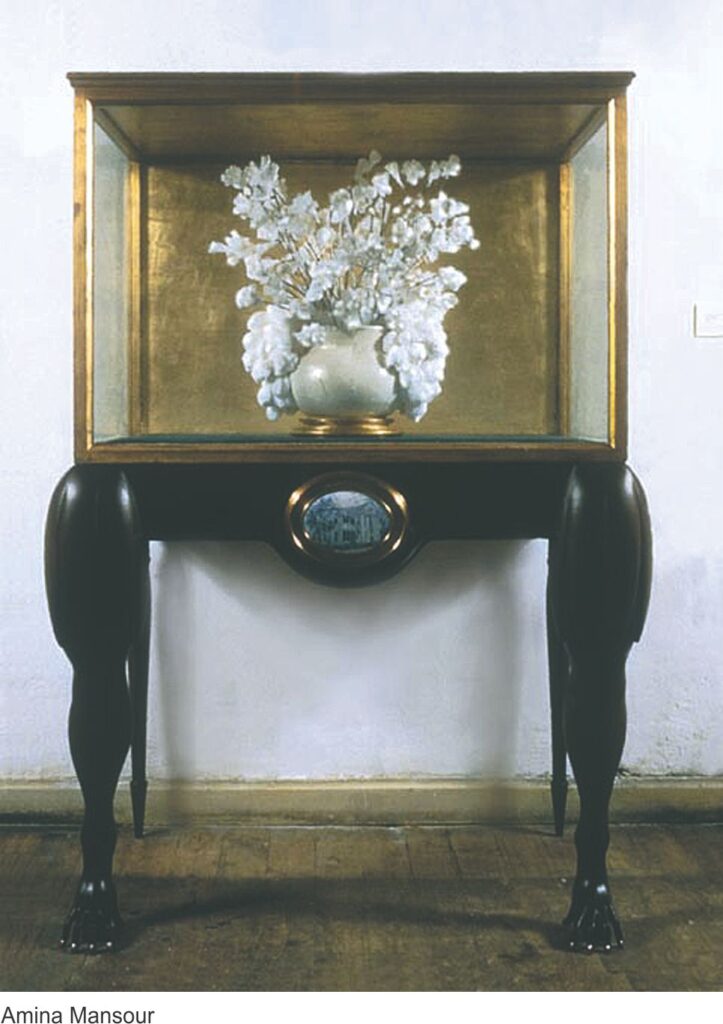
Amina Mansour is a self-taught, full-time artist living in Alexandria. Amongst her recent work is a collection of soft sculptures made from ‘cotton’. They seem to float delicately, some on tables, some on walls, and have an ephemeral beauty that is uncanny. One piece for instance is a small bouquet of flowers arranged in a golden vase, entirely made with cotton yarn and dried stems, and entirely white, encased in what resembles an antique mirrored side cabinet. At first, the cabinet is reminiscent of pre-revolution Egypt in the days of the Ottomans and the remnants of the furniture of Turkish Kings who lived before 1956, or even from the great mansions in the South of the United States before the Civil War. In fact, framed in the centre of this ghostly cabinet right below the glass is a picture of a great mansion that could either be in Egypt or in America.
Amina says: ‘The use of white in my work should not be stressed because the material itself is white. I didn’t do a dye job on the cotton: however, I do recognize how the use of colour has added to uncovering the more ephemeral aspects of the fantasy such as memory, age, nostalgia, [and] loss.’
The artist’s words in turn invoke a strong sense of history. Amina did her postgraduate studies in Alabama, in the American South. This is significant, because ‘cotton’ at first might appear to some onlookers as innocent material; she reminds us of the contrary. Cotton is laden with a distinctive meaning in her own Arab-Egyptian heritage and culture, and in the Southern part of America. An Albanian officer, who later became known as Pasha Mohammed Ali was the first to introduce cotton to Egypt as a cash crop, in 1822. The cotton that was harvested till then in Egypt was a local variety known as baladi. But as Europe needed a better quality of cotton, Moammad Ali was persuaded to cultivate a superior Ethiopian variety called maho in Egypt. Soon cotton began to be exported to Europe and money began to flow.
Needless to say, in later years, cotton was harvested at the expense of the majority of the people of Egypt, and in the process the ruling Turkish minority and Egyptian landlords, together with Italian and Greek feudal owners of Egyptian land, increased their grip on wealth and power. People, however rebelled in 1952, ending foreign and English interference, and ‘cotton’ eventually came to be known, as the symbol of the Egyptian soil, sacrifice and giving.
Strikingly, the same could be said of ‘cotton’ in the South of the United States. African slaves were bought by the rich feudal families of the South to cultivate cotton on their plantations. When Abraham Lincoln became president, he made a decision to abolish slavery in South. The South, of course, opposed this vehemently, as it meant a destruction of its economy and way of life. Cotton, slavery, and the Civil War are interchangeable in many American minds today, especially southern American and African American ones.
Amina Mansour in her art work brings out the similarity of the effect of ‘cotton’ on the fate of millions of humans in worlds wide apart. Her work is a tribute to the people who died in their pursuit of freedom.
A full-time artist who lives and works in Alexandria, Rehab El Sadek says that her motivation and philosophical concerns for each art project stem from the characteristics inherent in the project itself; however, by her own admission, it is often the ‘social issues’ prevalent in her ‘immediate’ working environment that affect her most: ‘It always depends greatly on which society I am working with. For example, the social issues I worked with in Holland or London were very different from the ones I worked with in Kenya or Pakistan. Sometimes, the political aspect may be part of the social issue.’ Also, she acknowledges that ‘gender issues’ have always formed a significant part of her artwork, especially in the last four years.
One of Rehab’s most striking pieces is Container, 2003. She came to make it through Wasla, in a two-week contemporary art workshop with 19 artists, both Arab and international. The artists were invited to spend two weeks in the idyllic and almost deserted setting of Castle Beach, four kilometers outside of Nuweiba. The location was opposite the Red Sea, in a place that nestled in the desert mountains of Sinai.
In the photographs the artist has taken of Container, both to document the work and to probably show them to people who have not been to Castle Beach, the object appears to be like an out-of-space air shuttle. Container is set amidst a barren Martian landscape. A magnificent doughnut-shaped object is positioned gracefully, if somewhat heavily on an expanse of dry desert sand presumably in scorching heat, and with rough mountainous terrain in the back. One is so tempted to ask: What is this?
Rehab recounts, ‘At first, the work site didn’t seem to be an encouraging place. But as time went by, my perception changed. On our way to Nuweiba I saw an old abandoned water tank rusting alongside the road. It did not occur to me that this tank with all its connotations would constitute the main part of my work. Later, when I visited a Bedouin family and spoke to its male and female members I realized how much a woman’s place in this home was very different from what I saw in my own. It was extremely restricted. This inspired me to speak with Bedouin men, and have them write the names of the women close to them (be they family members, friends, or neighbors) on pieces of canvas, which I then used to cover parts of the tank’.
Although by training Maha Maamoun is a Middle East historian (she has a postgraduate degree in the subject), since 1994 she has been working as a darkroom supervisor at a leading Cairo university. As a result, in most of her work she uses photography, and even in some of her installation work photography, both digital and analogue, is a major component.
Maha’s work deals with many issues; significant among them are the psychological complexity and insecurity often associated with modern city life, which is a state of being many around the world are familiar with, regardless of ethnic identity or nationality. In creating Cairoscapes, 2001-2003, for instance, she says that these images are a direct response to the ‘often intimidating nature of contemporary Cairene urbanity’. Yet what is interesting is that this is also applicable to the rest of her work, in spite of how overtly political some of it may seem.
In March 2003, on the day the Iraq War started, the Wasla workshop in Sinai (the same workshop in which artist Rehab ElSadek had participated) was inaugurated. There, Maha produced a small room installation (in a bungalow 130x 130 cm) about the issue of war, and the fear and strong feelings of insecurity and alienation associated with it. Maha recounts, ‘Wasla took me out of Cairo—the city where I live and the inherent subject of most of my work—to Nuweiba. Facing the Red Sea and almost totally surrounded by mountains, it felt alien to me—as a landscape, a work environment, and a subject matter. Add to this the awkwardness of the time: the first day of the workshop was also the first day of the US-UK invasion of Iraq. The work I would produce in this workshop was inevitably going to deal with this awkwardness of both place and time. The piece I worked on attempted to recreate the atmosphere of walking into the surrounding landscape. A fragmented image (photo-collage) of the nearby Fjord Lagoon and the mountains engulfing it was mounted along the four walls of a room’. Maha took tens of small pictures,10x15cm each, then lit the room with ‘green florescent bulbs, one on each wall, in reference to the night-vision war imagery shown on TV everywhere. The effect of fragmenting the landscape and green lighting simulated the acts of surveillance, mapping, and appropriation.’
After the Wasla workshop Maha returned to Cairo which was simmering with anger and frustration because of the war. She then did Riot Police 2003. Maha says, since ‘Riot police were a common sight on the streets, cordoning or cutting off certain areas and effectively obstructing demonstrations.’ So the artist, ‘took a picture of one of the riot police,’ and then audaciously, ‘ printed the image as a sticker.’
In the installation Maha put up images of the same policeman all around the room. And one life-size image stood guarding one side too. She then, ‘taped the rows of this one policeman with masking tape …so that one enters the room and feels surrounded by the police. The audience was told that they can take one of the strickers if they want and sometimes asked where they’d put it. A ruler and cutter were provided to cut off and take away the sticker. It was interesting to see the line of riot police being continuously broken as people took away their stickers.’
Zineb Sedira says of her work, ‘My work is informed by my identity as French, Algerian, and British. As mixed media artist I employ video, photography, text, digital technology and installation to investigate issues of gender, representation, family, language and memory.’ She goes on to say, ‘This multiple consciousness affords you a particular space when you are negotiating your place in relation to others. It’s a space which is often referred to as “in-between”. I don’t like to see it as a negative place; rather I see it as an active site of exploration that speaks of different histories and locates identity in a place which is endlessly remade through our negotiation of boundaries.’
Zineb Sedira’s Telling stories with differences, held in Manchester, UK, at Cornerhouse gallery, in February 2004 is her most recent solo. Telling stories featured new and recent work, and included Mother Tongue, a piece the artist had exhibited in regions as diverse as Sharjah in The United Arab Emirates, and Colorado, USA.
Done in 2002, the video projection consisted of three screens shown alongside each other, each with a subtitle. On one screen we see Zineb conversing with her own Arab mother in French. The mother replies in Arabic: Mother and I (France), shown on the other screen, has Zineb conversing with her own daughter in French, and the daughter replying in English because she was born and brought up in England: Daughter and I (England), broadcast on the third screen has the three of them together but the grandmother only able to speak in Algerian Arabic and a little bit of French to her grandchild who speaks English but is able to understand a little bit of French, while Zineb is standing behind the camera as a witness to this lack of verbal communication: Grandmother and Granddaughter (Algeria).

At one time Zineb said to an audience of Mother Tongue, ‘Don’t worry if you don’t understand the French and Arabic in the project. It is the point and you’ll see why.’ That was true when I saw the work for myself in Sharjah: it was not what the characters were trying to tell each other that mattered most rather than the principle itself; that they must relate to each other because of their familial bond, but are unable to through a direct and unified language. In the videos Zineb has shown us her protagonists, including herself, sitting at a white table in front of a starkly white background. The austerity of the surroundings– or rather lack of them– seemed to magnify and echo the loss one felt for this involuntary severance: three generations of the same family, traversing three lands, and three divergent cultures.
In an interview about her Cornerhouse Solo Exhibition Zineb is frank about her intentions, ‘Lack of communication is also a way of conveying meaning. My mother never learned French properly because she wanted to show her rejection of French language and behavior after the war of independence, even though she and my father lived in France for economic reasons. They experienced a lot of racism, and my parents felt a sense of failure because they had to bring up their children in that culture. They were angry that the French had managed to divide their Arab identity too, setting Algerians against each other by giving French citizenship to Algerian Christians and Jews but not Muslims, so that Arabs and Algerians would turn against each other.’ When asked about the autobiographical nature of her art and whether she intends her art to deal with such political issues, she replies, ‘Definitely, in the sense that the personal is political and—in a way—all artists are political and I deal with issues like immigration, colonialism and post-colonialism because they concern me.’
In 2000, The South Africa National Gallery in Cape Town invited Susan Hefuna to exhibit her work as part of the gallery’s contribution to the Cape Town One City Festival. She was also asked to run a workshop that would complement her exhibition at the National Gallery. So the artist led a five-week workshop titled Under One Roof. Her solo exhibition was titled Navigation Xculture. Until this year, Susan had a series of shows following that exhibition, which she titled Xcultural Codes. Noticeably, ideas about the signification and definition of ‘culture’ play a vital role in the artist’s oeuvre.
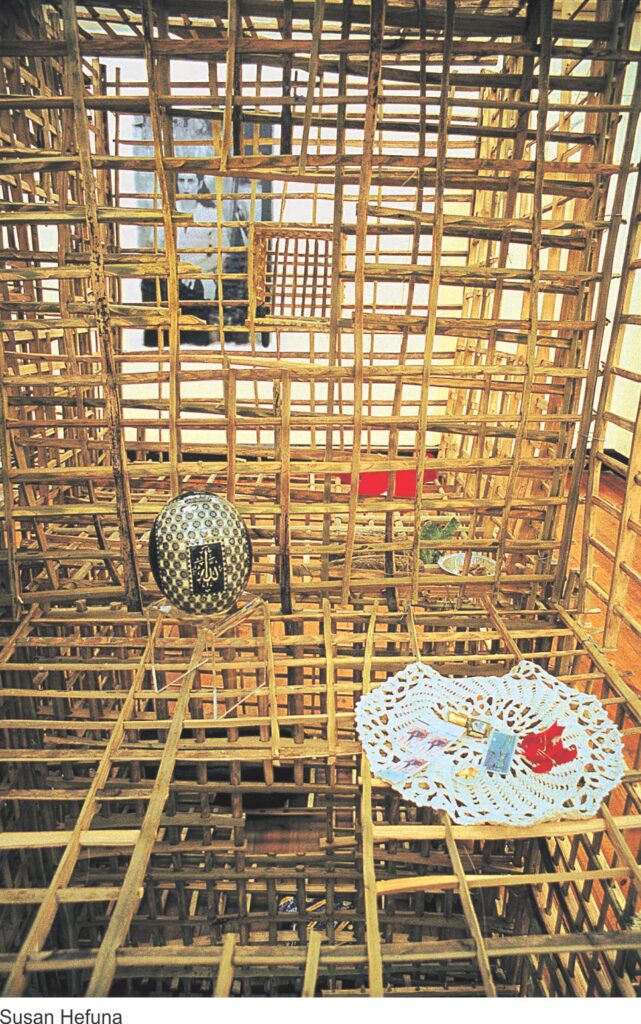
In Navigation Xculture Susan made Grid, 2000, a 2×2 meter cage, handmade of palm-wood. When interviewing the artist for her website I commented how upon viewing her work, it occurred to me that her installation was very similar to animal and bird cages that are often used by farmers, and also in local markets, where livestock is sold inside them. It seemed to me that Grid was a direct reference to Egypt; an unadulterated cultural sign. Susan replied, ‘They are ordinary cages on the street. To transport bread, birds, vegetables and fruit… I used the same material and technique, but of course of my own design.’ She goes on to explain that unlike the functional cages, she has ordered hers to have ‘entrances’ and ‘exits’. Some parts were left open or closed, like small shutters or doors or small windows. The piece, a somewhat large ‘cubic grid’, filled the centre of the exhibition hall, and was a beautiful organic shape. She comments, ‘I made my complete design, and then ordered the parts to be done by craftsmen. I ordered parts because the installation always has to be transported in parts, and then I installed the complete form in the exhibition rooms.’
Susan stresses the necessity of creating a history of travel for the fragmented work; the pieces must travel separately as individual pieces, before she actually assembles them and exhibits them as a whole. She stresses that her work must have an element of the ‘nomadic, like a tent’ which travels and can be assembled and dissembled: ‘It is absolutely important that the parts have to be originally made in Egypt and have to be transported. The invisible space and time, like the travelling from Cairo to Cape Town, is part of the work.’ This, Susan believes, ‘gives the work power,’ precisely because it’s not visible.
During her stay in South Africa, the artist noticed how life was actually like in South Africa, ‘People are still divided and have their divisions in their brains.’ Susan says. ‘I was inspired by the situation.’ And so what she did was something she has never done before or since, ‘It was the only installation I did where I included other people… people from the city of Cape Town were invited three weeks before the opening to put something into that installation [Grid]; something that was related to their own identity and not to the group they belonged to. It was called [the invitation to put something] Celebrate Difference, Celebrate Life. People reacted generously; they put things in from different religions and it became a kind of shrine.’
Wejdan Almannai is a visual artist, writer, and tutor at the University of Bahrain
A survey of eight Arab women artists, whose concerns, media and techniques, viewpoints, varied experiences, and observations are representative of the current beliefs existent amongst female artists of the contemporary Arab art scene To say that women artists are different from men artists opens up a polemic that arguably can never be resolved. For isn’t…