

spring harvest
The National Exhibition organized by the Bangladesh Shilpakala Academy is the annual showcasing of the most recent work done by Bangladeshi painters and sculptors. This year the panorama of 246 works by some 200 artists at the National Art Gallery in Dhaka has been a good harvest but not without raising questions about the choice and quality of some of the works
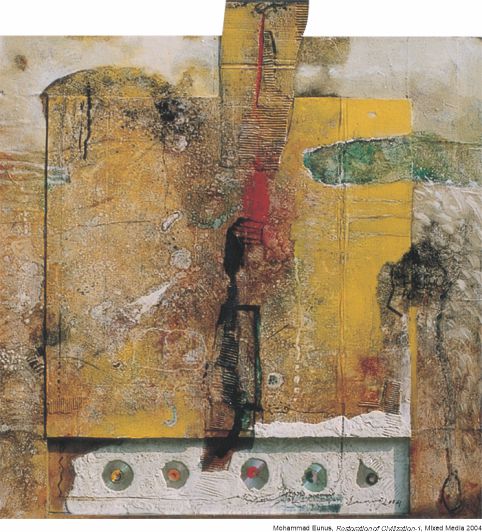
This year in the 16th national exhibition, the coveted Bangladesh Shilpakala Academy Award was won by Mohammad Eunus. Eunus is one of the very few artists of the country to have shown an unmistakable symbolic vision. His focus ranges across society and culture and covers an immense variety of pictorial techniques.
He began as a figurative painter in the late 1970s but his career moved in a new direction while he was doing his MFA at Tama Art University in Tokyo in the mid-eighties. His canvas during that period assumed the qualities of abstract expressionism with ‘all-over type of treatment’ and an emphasis on surface qualities. His affair with abstract expressionism, manifested in thickly laden swerving brushstrokes, continued to flourish throughout the 1990s. However, his intricate forms over the years gave way to simpler ones. His recent works are influenced by French art informel and his 2004 exhibition entitled ‘Evidence’ resembles works by Tapies in its treatment of the canvas and the use of forms—mixed with ‘assemblage’, popularized by Dubuffet. Eunus enjoys building up the surface of his canvas slowly. Sometimes it takes a year to complete a work (this is basically because of his preference for oil painting, particularly for linseed oil as a medium).
Thus the pair of his works at the national exhibition this year, Restoration of Civilization, has a marvelous density. It combines oil paint and marble dust; discarded CDs pasted at the bottom of the canvas and are visible through the transparent glass. He has superimposed two differently sized canvases on top of one another to create depth of field, pasted corrugated paper board and applied deep impasto to evoke a feeling of stress and concern for the present human condition. He does not give the impression of being lost in a romantic reverie but seems to suggest that it is in technology that we have to look for a way to repair the wounds of civilization. What is interesting about Eunus is that there is no ‘as if’ in his canvas—as one might expect from an artist who is experimenting all the time and is unsure about the newest mode of expression. His control of his medium and handling of colours convince the viewer of the integrity of his artistic search and his passion for work.


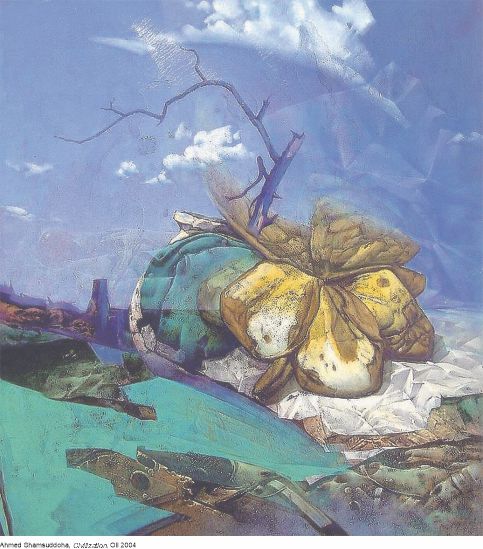
Of the five prizes, the Bengal Foundation Award was won by Ahmed Shamsuddoha for his imaginary landscape, Civilization. Surrealist leanings in his work are evident in his use of unexpected juxtapositions and the hyperreal clarity of the images. His dreamlike canvas depicts a heap of wreckages entwined with a giant yellow flower against a bright sky. A dead tree in the middle of the rubble intensifies the effect of an apocalyptic inferno. The painting displays Shamsuddoha’s technical ability and meticulous draughtsmanship.
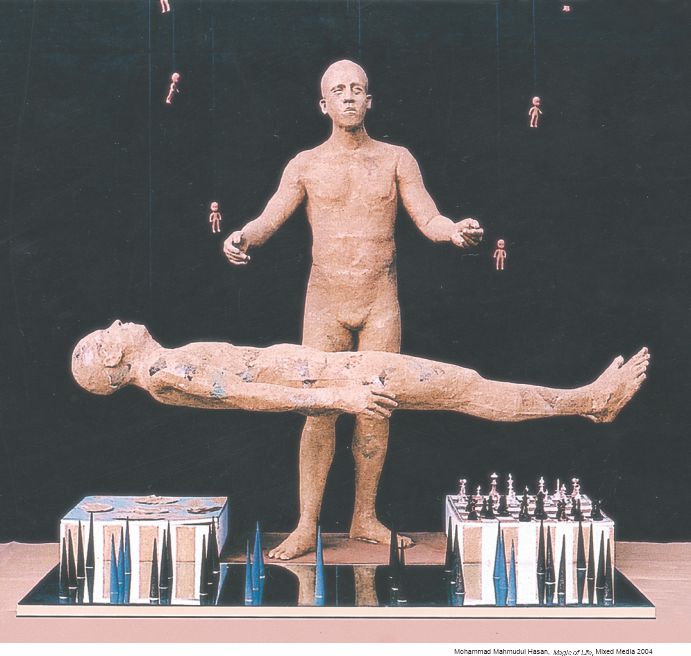
It is good to see Shamsuddoha paint his fantasy landscapes, although one feels that there were other and more deserving contenders for the award. Young sculptor Mohammad Mahmudul Hasan won the Grameen Phone Award with his mixed media Magic of Life, showing a magician performing the trick of levitation. Small dolls float around the magician. Hasan has taken to heart the phrase ‘magic of life’ literally and creates drama by inserting a chessboard and long, sharp nails underneath the gravity-defying figure. In portraying his feelings about life’s complexities and uncertainties and the strengths and vulnerabilities of humankind, Hasan shows his admiration for new-realist sculptors. But he does not however, stick to new-realist concerns and focuses on contemporary life, characterized by ‘the loss of the real’ (Jean Baudrillard’s phrase). The distinctions between the real and the imagined, between reality and illusion are, of course, eroded in this age of film, TV and advertising. Hasan interestingly interprets Baudrillard’s concept of ‘hyperreality’ as a reality created by an illusionist. Hasan’s Magic of Life is undoubtedly among the handful that stand out.
We have never had a great sculptural tradition and this fact was evident once again in this year’s exhibition. The works entered were eminently forgettable. The reason is twofold: sculptors hardly get any commissions and there is practically no appreciation for sculpture in our society. And sculpture, to a large extent, is still equated with idolatry in conservative Bangladesh. It was good to view Faruk Ahamad’s works in charred wood and brass plates with their themes of desire and waiting. They also evoke feelings of desolation and anger and give us a sense of the ravages of time. The worn-out patina look achieved with charred wood gives the painting, Composition-1, a wabi-sabi look. Faruk’s work, which won him the Arab Bangladesh Bank Award, demonstrates his fascination with surface texture and diverse media. In it wood planks collected from discarded carton boxes are inscribed with a small-print text. The brass plates having relief work create a powerful tension between beauty and decay. For its shadowy depths and stylistic verve Composition-3 too looks quite interesting.
Copious in producing commercially successful works, Jamal Ahmed has no rival in the contemporary Bangladesh art world. His passion for landscape and portraiture speak about his devotion to classic realism, but unlike most artists in the realist tradition he likes to build up his surface with symmetrical brushstrokes. His riverscapes are most popular among his buyers for their romantic representation of riverine Bangladesh. His portraits are also immensely popular. They stare at us with a calm but intense gaze. They clearly show that Jamal is not interested in the expression of intense human feelings. His approach is more like a photographer who is capturing different moments dispassionately.
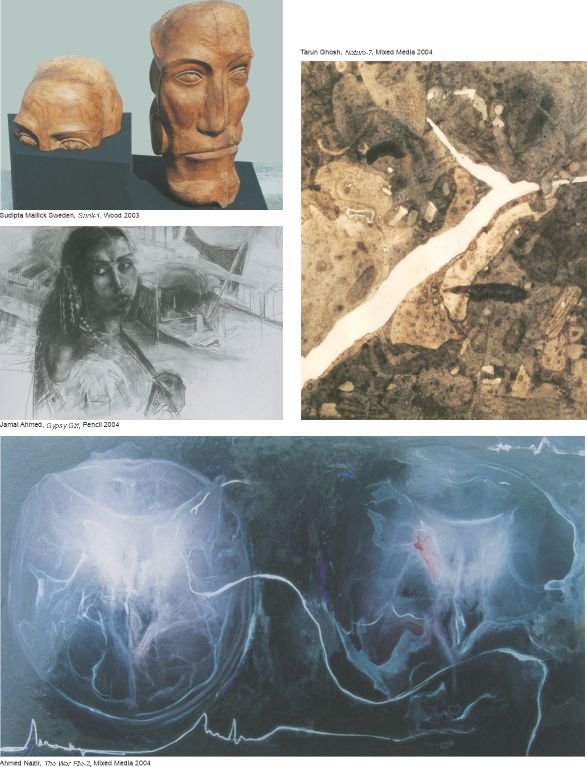
However, the pencil drawing, Gypsy Girl, that earned Jamal the Dipa Haq Award lacks intensity and focus. He has done a disservice to his reputation as a competent portrait painter with this work and also the other entry, In Dhaka City, where he fails to capture the helplessness of a pedestrian who is a newcomer to this hostile city. I have always felt that Jamal is at his best when he captures the mood of his sitters.


Reticent and media-shy Ahmed Nazir, who became a favourite of the critics in the 1990s for his deft handling of a range of diverse media (etching, lithography, mixed media and installation art), got the Honourable Mention for his haunting x-ray image in The War File-2. The picture rejects conventional ideas of composition and turns to new materials for inspiration. Nazir used digital prints of x-ray images to make relief prints to capture the horror and devastation of war that leave an indelible scar in the minds of the people. The picture with its x-ray images of the brain and blood clot at the centre of the section of the brain that preserves our memory is suggestive of internal sufferings inflicted by war. The theme of the picture is clearly Bangladesh’s war of independence. Like many other artists of his generation, Nazir feels that the amnesia regarding the war of independence has given birth to all the post-war evils of our society.
Sudipta Mallick Sweden draws his inspiration from classical busts to sculpt the heads (Sunk-1) in wood that capture despair and a sense of defeat. However, Sweden’s figurative sculpture is clichéd in expression and does not represent a great choice for an Honourable Mention.
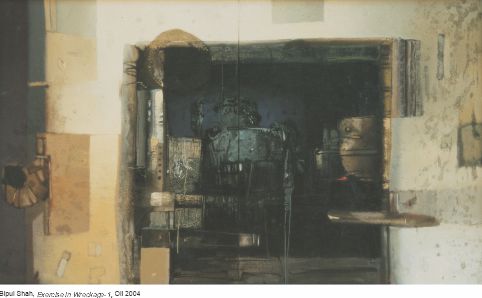
Compared to Sweden’s entry, Bipul Shah’s canvas was a breath of fresh air and deserved better than an Honourable Mention. The shadowy depths of Bipul’s Exercise in Wreckage-1 are intense and mesmerizing. The viewers’ attention is drawn to the squarish window at the centre of the painting through which a dark nightmarish image of wrecked metals is visible. The whole scene evokes an eerie atmosphere of death and destruction. Bipul applies paint flatly and uses dark, brooding colours to create an air of melancholy.
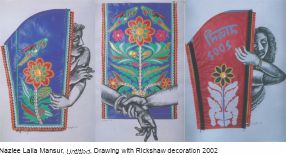
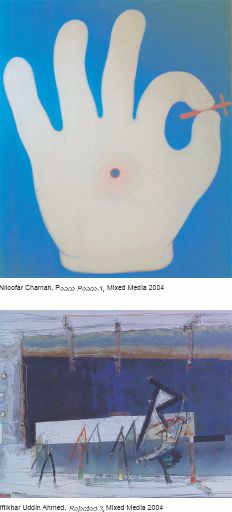
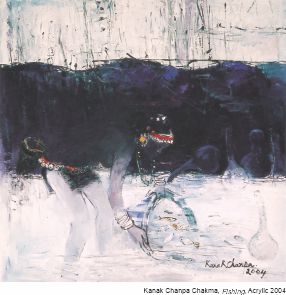
The awardees apart, those who stand out include Ranjit Das, Nazlee Laila Mansur, Niloofar Chaman, Iftikhar Uddin Ahmed, Laila Sharmeen, Fahamida Akter Kakoli, and Sheikh Mohammad Rokonuzzaman.
Laila Sharmeen, The Rhythm of Beauty-2, Mixed Media 2004
The National Exhibition organized by the Bangladesh Shilpakala Academy is the annual showcasing of the most recent work done by Bangladeshi painters and sculptors. This year the panorama of 246 works by some 200 artists at the National Art Gallery in Dhaka has been a good harvest but not without raising questions about the choice…