

contemporary swiss art in perspective
A survey of contemporary art scene in Switzerland
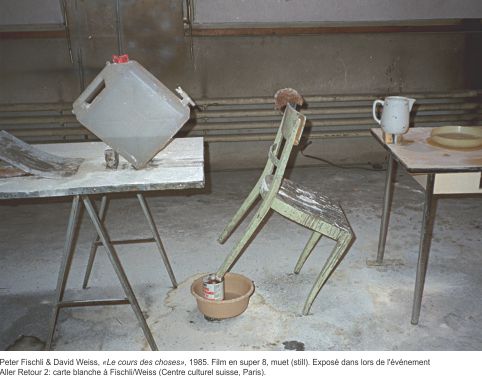
Among the artists invited by the last Biennial at Sao Paulo, 49-year-old Thomas Hirschhorn was featured. There, in characteristic fashion, Hirschhorn erected a monumental display which was called ‘Restore Now’ – a thought-provoking box in the guise of a hardware store full of tools and books made out of rudimentary materials – reinforced cardboard, adhesive paper and recycled items. However, he is always on the move for he is also being exhibited in Seville and in Long Island (NY), expected at the Walker Art Center of Minneapolis and then at the Museum of Contemporary Art of Miami (MOCA). At the same time, Hirschhorn’s fellow-countryman, 68 year old Roman Signer, born in Appenzell and resident in Saint-Gall, is the subject of a major personal exhibition at the Swiss Cultural Centre in Paris. The video-artist from Saint-Gall, 44-year-old Pipilotti Rist, is also exhibiting her works at the Contemporary Arts Museum in Houston. The duo from Zurich, Peter Fischli and David Weiss, 54 and 60 years old respectively, and known under the signature Fischli/Weiss, are for their part guests of the Tate Modern in London. Meanwhile, another fellow-countryman, 42-year-old Hugo Rondinone who is being exhibited in Berlin in 2006 and in Paris, is ending the year in Modena where he is showing his ‘Giorni Felici’ (Happy days).

Here then are five eminent Swiss artists sought after everywhere and whose value in the art market is rising steeply. Moreover, one could also speak of the Genevan, 58-year-old, John Armleder, alternating between the United-States and Japan to whom the Museum of Modern and Contemporary Art of Geneva, the MAMCO, is making its entire space available to house the giant exhibition, ‘Amor vacui, horror vacui’. Among the German-speaking Swiss, one must also not omit to mention the unassuming but renowned sculptor, 65-year-old Markus Raetz, to whom the ‘Carré d’art’ of Nîmes has just dedicated a major retrospective as well as the rapid international rise of 40-year-old Christoph Büchel whose projects were displayed within one year in Dusseldorf, Salzburg and Marseilles. The list is endless and indicates that throughout little Switzerland there is a remarkable blossoming, or even explosion, of artists. Given the size of the country, this is a strange phenomenon and one that has continued to gather speed over the last twenty-five years.
As well as the artists, let us also consider the exhibition organisers. Over the last fifty years, Harald Szeeman, the eminent art critic and exhibition organiser from Berne, has decisively influenced the interpretation and display of contemporary world art. However, if only to quote the Swiss, his death has not left a vacuum, but a framework. We now see Marc-Olivier Wahler as the Director of the ‘Palais de Tokyo’ in Paris and Michel Ritter radiating from the helm of the Swiss Cultural Centre which has now become a place of transversal expression. Simultaneously, in the New-York scene, the Swiss Institute led by Gianni Jetzer is enjoying prominence and is not limited by the small size of the country of origin. It is also playing a significant role whether they proclaim to be of this school or not, in bringing to light young Swiss talent in a cosmopolitan setting.
These few names of artists and promoters are only the visible tips of an iceberg and indicate to what extent contemporary Swiss art has spread beyond national frontiers and how it is making its mark in the global movement of works of art, personalities, tastes and ideas. Hasn’t the prominent Genevan businessman and collector Pierre Hubert just launched an arts fair in Shanghai? Consequently, the books, though, few in number that deal with the question, ‘Can one talk about Swiss art and how seriously challenge that very notion. Indeed it is futile and impossible to broach the works of the plastic artists who are so diverse in their expression and the means that they use, with tools designed for creations such as those of Johann-Heinrich Füssli (XVIII), Albert Anker, Arnold Böcklin, Ferdinand Hodler (XIX) or in more recent times Louis Soutter (1871-1942). Even more in the 20th century, when Swiss artists took full part in all Avant-Garde movements, such as Dada which was born in Zurich, the modern movement is deeply rooted in Switzerland there are no frontiers in current art.
Moreover, one is aware of a precise, well-researched output on the part of exhibition directors, gallery owners, international businessmen and collectors created by artists working in plastic materials, be they Swiss or not, sometimes operating in Switzerland, sometimes elsewhere, who are actively exhibiting in situ or abroad. Multiple, mobile, heterogeneous, porous, and global, contemporary art in Switzerland seems to have been helped in its forward surge by its Helvetic characteristics: extreme decentralization, cultural diversity in a very small territory and great economic prosperity. In 1981, an art historian and exhibition director of pivotal importance, Jean-Christophe Ammann, initiated a surprisingly lively interest in Helvetic creations. He had also made a considerable contribution by making the Kunsthalle of Bâle of which he was then the director, into one of the most brilliant platforms for contemporary international art and attractive and stimulating for the entirety of youthful Swiss creativity.
As well as outstanding museums such as those in Basel and Zurich and other numerous Canton museums of quality, the existence of a network of Kunsthallen whose purpose is to inform, to experiment and to discover, has resulted in a sound and solid artistic fabric. This has been reinforced over the last few decades thanks to the proliferation of alternative venues. Art-oriented open spaces dedicated to cross-sectional expression such as attitudes, Geneva hybrids and didactic exhibitions in Zurich have sprung up and asserted themselves. One is also witnessing the re-grouping of different protagonists of contemporary art; thus on the premises of the former Zurich inn, Löwenbräu, the adjacent Kunsthalle with the private museum Migros, with Daros, a foundation given over to Latino-American art, with various galleries including that of Hauser & Wirth. The latter is an institution founded in 1992 which has acquired an influential stature and is in the leading group of international art business. Finally De Puy & Luxembourg, linked with auctions has also dropped anchor there.
Switzerland has more venues for contemporary art in its territory than NewYork or Paris. It is not surprising therefore that the world art market has established its capital there: Art Basel, the biggest art fair in the world founded in 1970 by a group of gallery operators brought together by the prominent Basel businessman Ernst Beyeler, has become over the years an incomparable international meeting place for commercial transactions. It is similar to an international cultural event and even more dazzling than the most highly valued Biennials. In 2002, Art Basel, which continues to prosper, has created a sister American event, Art Basel Miami Beach, which has become a major cultural and social event aimed at the North and South of the American continent. The Swiss art scene benefits from the effects of the fair and in consequence derives from it a conspicuous global reputation.
One of its effects has been the revival of the traditional practice of ‘collecting’ by a number of eminent middle-class families which is growing in popularity among larger and new socio-economic groups. Several large museums have been created thanks to legacies from notable citizens and certain towns owe their new status to these patrons. Winterthour, already richly endowed has recently been gifted with a Fotozentrum. Basel has gained the Schaulager, a ‘depot’ of contemporary art of vertiginous beauty designed by the famous architects’ group Herzog and de Meuron. It was commissioned by the patroness museophile Maja Oeri who is connected to the industrial families involved in chemical-pharmaceuticals.
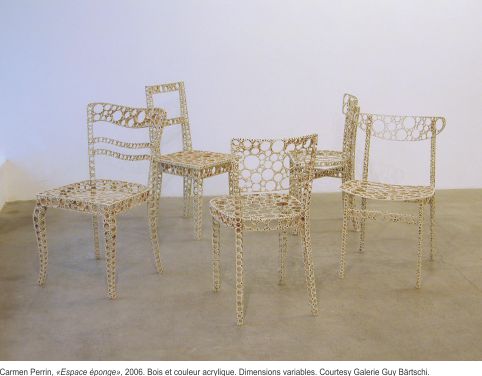
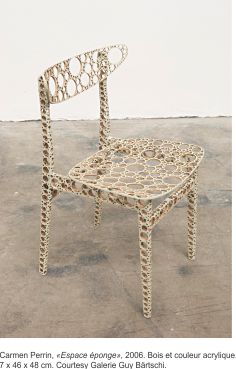
Contemporary Swiss art, however, would not know the vitality that one has observed without the adoption of new techniques for the training of current artists. Created some ten years ago, the ‘hautes Ecoles Spécialisées’, half-way between University and craft school, are developing teaching methods in line with current practices. In order to prepare their pupils for the realities of the profession and following the example of the School of Art of Lausanne, they invite artists who are in the process of completing their work to share their methods and their experience with students. One can measure the fruitful outcome of this type of workshop as was demonstrated by the example set by Chérif and Sylvie Defraoui, a couple deeply involved in research on plastics. Their teachings in mixed media in the 80’s and 90’s facilitated the birth of some sixty artists, quite distinct from each other. Notable among them is the 53-year-old Genevan Bolivian, Carmen Perrin, who works with bricks and light in her use of public open spaces.
The training mechanism operates through a complex but visibly effective system of encouragement which involve ‘communes’, ‘cantons’, and also the federal state as well as private foundations. Although the emphasis is on young talent in the first instance, there are also several types of ‘support’ enabling artists of all ages to develop their projects. This model which produced such fertile ground so beneficial to contemporary art owes much to specific structures of the country. It has its weaknesses but continues to develop and evolve. The artistic fabric of Germanic Switzerland is not of the same strength or vigour elsewhere in the country. Alongside Basel, proud of its prestigious institutions, Zurich has become an increasingly pro-active centre where one sees the polarization of artistic creativity and the art market.

In 1998, the exhibition directors Bice Curiger, founder and editor-in-chief of the influential international contemporary art magazine Parkett and published in Zurich, and Juli Steiner, currently director of the Zentum Paul Klee in Berne, attempted to break new ground the setting of which was the venerable Kunsthaus. Having searched for a long time throughout Switzerland, they displayed in the rooms of the Zurich institution which was already full of the great works of past centuries and classical modern art. The exhibition ‘Freie Sicht aufs Mittlemeer’ (Perspective on the Mediterranean) was dedicated to young Swiss art. The works of some one hundred artists occupied every available space, the toilets, telephone booths, the cafeteria, the street and even spilled over into the town space – and was challenging, thought-provoking, and eye-catching.

The event was an important historical landmark. Indeed, for once the contemporary Swiss art scene was gathered together to assess, measure and to look at itself. Artists who see each other at a regional and international, but seldom national level, are crossing each others’ paths. ‘Freie Sicht aufs Mittelmeer’ was a festive occasion for the realization of the diversity, strength and cosmopolitan nature of the youthful creative spirit. Since then, Christian Marclay, Syvie Fleury, Daniele Buetti, Stefan Banz, Eric Hattan, Olaf Breuning, though already known at the time, have asserted themselves. Fabrice Gygi, quite young then, has since that time, become well-known for her raw, harsh style. The couple, Gerda Steiner and Jörg Lenzinger, have brought enchantment to a countless number of gardens, such as that of the church of San Staë or a Venice Biennial or the beautiful baroque library of the abbey of Saint-Gall. Is one witnessing the crystallization of currents and trends in modes of expression? Far from it. The newcomers, for example, 37-year-old Didier Rittener who draws with acute perception, or 29-year-old Valentin Carron, who creates large, rough sculptures, may follow different methods but their common basis is the success which motivates them; and the art market, aware of young talents is heading in their direction.
Loretta Coen’s article is translated by Shahid-ur-Rahman from the French original
A survey of contemporary art scene in Switzerland Among the artists invited by the last Biennial at Sao Paulo, 49-year-old Thomas Hirschhorn was featured. There, in characteristic fashion, Hirschhorn erected a monumental display which was called ‘Restore Now’ – a thought-provoking box in the guise of a hardware store full of tools and books made…