

Vive la difference
By a happy coincidence the Alliance Français and the British Council have sponsored exhibitions of the visual arts in recent months–exhibitions that have engagingly (on the whole) varied the fare in our galleries. The French effort is decidedly the better thought-out. Under the catchy rubric of ‘Un Avril Francais a Dacca’ (‘A French April in Dhaka’), three nearly month-long shows ran in different galleries: one-man shows at the Bengal Gallery (Jean Dometti) and Shilpangon (Jean-Pierre Tingand), and a retrospective of prints by a bevy of modern masters at the Alliance Français.

Jean Dometti is a veteran at print-making and mixed-media painting, with an elaborate system of deploying techniques. Bernard Levy’s helpful introduction to the catalogue outlines Dometti’s creative method. Dometti starts with copious sketchbook drawings and studies, the most promising of which are transferred onto Japanese paper. Months and even years go into gathering a ‘pictorial vocabulary,’ of ‘sketches of ladders, railings, spirals, cones’ and ‘a variety of irregular forms which vaguely evoke animal, vegetal, mineral and embryonic figures.’
Next, he lays on natural pigments that he has himself made (‘granite, marble, schist, slate, cobalt and clay, in a huge variety of earth tones’) onto canvas or paper with broad, gestural brushstrokes. The paint builds up, with ‘overlapping tones’ lending a sense of depth. Strict geometric forms are deliberately avoided. Cut-out figures are pasted on or simply reproduced in pastel, oil or acrylic, then covered over with translucent or nearly opaque colours. Sometime later the surface is scratched to uncover the concealed forms.
The results more often than not are pleasing. Objects and figures suggestive of archetypal symbols are depicted against backgrounds evoking deserts, barren crags or cave interiors. ‘I do not represent the human figure,’ declares Dometti in a brief note, ‘but man is always present in my work through the tracks, signs, and symbols which are registered in each of his living spaces.’ Shamanistic objects, runes, fossils invoke a pervasive primitivism against which can be counterpointed the futuristic space-suited figure in ‘Seco’; the whole of human history is thus spanned. However, not all the paintings displayed are aesthetic successes; a few indeed are merely slick and do not rise above kitsch.
Jean-Pierre Tingaud shares with Dometti an interest in mankind’s cultural heritage, especially its archetypal symbols. More specifically, Tingand appropriates religious icons from different cultures, and achieves an effortless fusion. But for a few paintings, the works on show were all prints grouped under titles that underscore the religious dimension: Laudes (Lauds), Antiennes (Anthems), Mandalas, Totems. Tingaud’s images are sharp, unambiguous; his technique is assured.
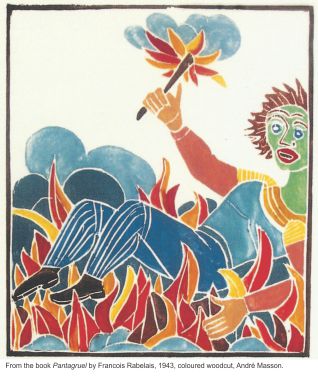
The show at the Alliance was of course the pièce de resistance of ‘Un Avril Français.’ It was a delicious retrospective of prints from a famous workshop in Paris. Set up in Montmartre in 1929 by Lacouriere, it hosted the great figures of High Modernism, who produced graphics to embellish limited editions of books ranging from the classic Gargantua and Pantagruel to modern masterpieces by the likes of Mallarmé, Lautreamont, Eluard, Réne Char.
The modern masters represented make an awe-inspiring list: Georges Braque, with evocative aquatints for Soleil des Eaux by Rene Char; Marc Chagall with charming coloured woodcuts illustrating his own poems; Salvador Dali with appropriately disturbing etchings for Lautreamont’s ur-surrealist classic, Les Chants de Maldoror; Andre Derain with amusing coloured woodcuts for Pantagruel; Alberto Giacometti, with etchings for Robert Lebel’s La Double Vue; Andre Masson, with primitivistic coloured etchings and aquatints for a book of Madagascan poems; Henri Matisse, with lyrical etchings for Mallarme’s Poesies; Joan Miro, with characteristically funky coloured woodcuts for Paul Eluard’s A toute epreuve; Henry Moore with masterly etchings for Elephant Skull by H. J. Seldis; and Pablo Picasso, with darkly haunting engravings for a book on bullfighting.
From the middle of the twentieth century the workshop was run by the Frelaut brothers, who hosted a new generation of artists, eleven of whom were represented in the show: Francois Bealu, Camille Bryen, Miquel Conde, Dado, Olivier Debre, Terry Haass, Hans Hartung, Zoran Music, Francois Rouan, Pierre Soulages, Zas Won Ki. My favourites among them are Terry Haass and Hartung, for the vigour of their abstract etchings and aquatints; and Pierre Soulages for the sombre beauty of his etchings, which once elicited Samuel Beckett’s eloquent appreciation in ‘Conversations with Georges Duthuit’, if I remember rightly.
Though Lacouriere and the Frelaut brothers are gone, the Montmartre workshop lives on. The catalogue lists eight artists under the rubric ‘Periode Actuelle,’ which is translated into English as ‘Actual Period’–a prize howler, which even one without any French would spot at once. The French ‘Actuelle’ is a polysemic word which, in addition to ‘Actual’, also means ‘contemporary.’ I was struck by the very recent etchings of Pierre Collin, which can wring a surreal atmosphere out of the commonplace, as in Les Buvards (Blotting Paper). Also noteworthy is Helene Belin’s evocative Proustian etching and aquatint Temps retrouve (Time Regained).
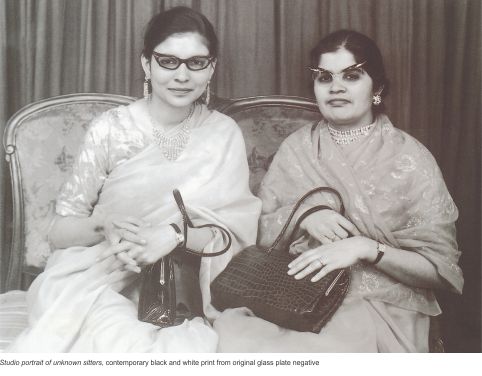
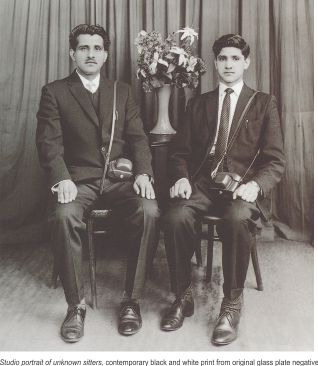
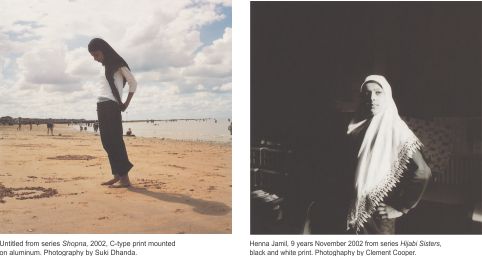
The British Council’s travelling exhibition of photographs, ‘Common Ground’ (22 February-6 March 2004) highlighted ‘Aspects of Contemporary British Muslim Experience.’ While this subtitle suggests a stodgy official desire for comprehensiveness, the photographs themselves are refreshingly evocative, poignant, quirky and at times even comic. They should help dispel some of the stereotyped notions that breed prejudice. Even Clement Cooper’s series of Black and White portraits, ‘Hijabi Sisters,’ far from burying the figures in anonymity, highlight their individuality. The subjects’ eyes look out frankly, often straight into the lens, sometimes archly to one side, always with an affirmative accent.
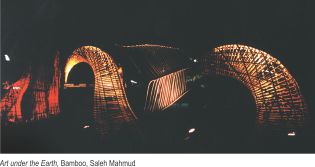
In the second half of April the Council grounds were taken over by an exhibition of outdoor bamboo sculpture titled ‘Project Air Bash.’ The puerility of the bilingual pun (bash is Bengali for ‘bamboo’) was matched by the unimaginative displays. There was no attempt to play around with the traditional forms used, except to an extent in Tarun Ghosh’s oddly titled ‘Man of Tree.’ Aesthetically, the most satisfying displays were the two by Mir Abdul Hamid, a traditional artisan. The idea behind the show was laudable, but a good idea doesn’t translate into good art unless there’s creative engagement with the medium chosen. Bamboo is at once pliable and sturdy and fragile, and has the added cultural significance of being a distinctive natural product of this region, but its capabilities have to be creatively explored, its limits tested, for the artistic experiment to pay off. The show, sadly, was an opportunity missed.
Kaiser Haq is a member of the Jamini Editorial Board
By a happy coincidence the Alliance Français and the British Council have sponsored exhibitions of the visual arts in recent months–exhibitions that have engagingly (on the whole) varied the fare in our galleries. The French effort is decidedly the better thought-out. Under the catchy rubric of ‘Un Avril Francais a Dacca’ (‘A French April in…