

Sanctuary in his soul
‘Love and Yearning: Mystical and Moral Themes in Persian Poetry and Painting’
Arthur M. Sackler Gallery, Washington D.C., February 2004
Ann Rosenquist Fee
‘First, and foremost, Majnun is a poet and that sets him apart from others. He is able to create a sanctuary in his soul, from which he re-creates his love in the poems he recites.’—Jean-Pierre Guinhut, The Man Who Loved Too Much: the Legend of Leyli and Majnun
Majnun, bone-thin on a rock, palm upturned. Anguish. Layli, untouchable across a dim threshold, silk-satin red under glass.
Majnun and Layli. Majnun sick with love, first for Layli, then for the Layli he conjures up once tribal law splits them in two: you with yours, Majnun; Layli with hers. Layli bound by her father and her tribe, in love with Majnun but confused and afraid when she sneaks to his side and he tells her, eyes closed in devotion no longer to her but to his idealized version of Layli: do not speak, you disturb me from my love.
Majnun in opaque watercolour, ink and gold, on paper smoothed and rumpled and smoothed again. Single-matted in cream, framed in thin black metal, hung lightly on the smooth red wall—one of eight in the honeycomb-shaped alcove deep underground in the Smithsonian’s Sackler Gallery. And in another alcove, Layli after Layli after Layli, a meticulous black-red pattern on silk and satin, under glass not ten paces from where Majnun hangs on paper. Linked by an open doorway and by the sung poetry—Hafiz, Hatef, Omar Khayyam, Sadi, Rumi—pouring into both chambers.
The Sackler’s exhibition ‘Love and Yearning: Mystical and Moral Themes in Persian Poetry and Painting’ was lauded in previews and reviews as ‘scholarly, thematic and elegant’ (Mark Jenkins, The Washington Post) and ‘charming, unassuming…exquisite in its simplicity’ (Souren Melikian, International Herald Tribune). Light-handed, yes. Intellectual, indeed. Curator Massumeh Farhad’s work warrants such praise for the long-running show—August 30, 2003 through February 22, 2004, featuring works from the Smithsonian’s permanent holdings and loans from several private collections and from the Textile Museum in Washington, D.C. The reviews are accurate but there’s more to say: that by design or by accident, the show also evoked the mystic rapture it explained.
The Sackler, together with the Freer Gallery of Art, houses the United States’ national collection of Asian art. The Sackler prides itself on innovative exhibitions that offer broad explorations of art and culture. The gallery sits just off Independence Avenue, in line with stately gray Federal buildings and a quick walk from the Metro—where at any time of day an inordinate number of riders are dressed in dark blue business suits. On a February morning the suits disembark en masse and hustle down the street past the iron gates that signal entry to the Sackler and six other Smithsonian buildings. There’s plenty of yearning in the crowd, but with sharp edges and political punchlines.
Inside the iron gates, not a suit in sight, late winter paints the Enid Haupt Garden in pointed earth tones: brick and stone, brown tangles and iron swirls. The Sackler sits just inside to the left and it’s elegant in gray pillars and glass. The building is about the size of the houses north of the Capitol, comfortable for a senator but certainly not enough to house 3,000-plus pieces of Asian art—ancient Chinese jades and bronzes, ancient Near Eastern metalwork, South Asian sculpture, and paintings and manuscripts from Iran and India. It’s only inside, past the security check and the information counter, that a staircase spills the secret: wide steps spiral deep down under the ground. One, two, three levels below Independence Avenue. First a calm hum. And then a hush.
‘If your mind’s eye were not diverted by extraneous interests, if nothing were polluting the mirror of your awareness and if you listened with the ear of attention, each creature could tell you of its unfulfilled desires and the pain it has suffered from this privation.’
—Izzidin Al-Muqaddisi, The Book of the Revelation of the Birds and Flowers
It’s a quiet glide down the hallway through ancient Iranian metalwork, then sculpture from South and Southeast Asia, to an opening in a far wall that announces ‘Love and Yearning.’ Dark colours spill out on the glossy hallway floor: smoke blue carpet, deep rust walls, and the hush. This seems to be its source. The gallery is two small alcoves, octagons with just one or two illustrated manuscripts on each wall. There’s no docent. No guided tour moving through. Only rust-coloured walls, gold and blue and red paint on paper, Rumi’s verse pulsing through the speakers. Majnun on one side, Leila on the other. The smooth beige hallways of the permanent collection dissolving into a gray shimmer on what’s now the outside—the rest of the museum. This is inside, the smallest gallery of the floor farthest underground, dark and sacred.
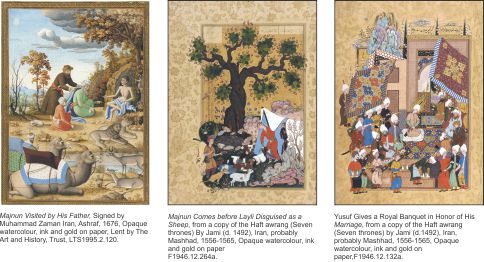
A few soft steps forward on the blue carpet bring ‘Majnun Visited by His Father’ (signed by Muhammad Zaman, Iran, Ashraf, 1676) into focus. Agony leaps off the page even without the benefit of the magnifying glasses that hang on cords near the entry. Majnun’s face, his skin, his ribs, his open arms. The curator notes that the landscape is desolate, ‘bathed in an icy, white light masterfully convey(ing) the pathos of the scene.’ Also brilliant is Majnun’s near-transparency—he almost fades into the landscape, dust to dust, withered by his pining. The blue, green, red, blue that arc in a series of objects from the garment on his knees to the camel’s blanket on the opposite corner of the page look like cast-off contact with the vibrant sensory world, in favour of a devotion that saps without pause.
Layli does not hang on the next red wall or the next one. Her absence is frustrating—perhaps intentionally so. It takes a glance around the gallery and then a walk to find her in the glass case just through the doorway to the second alcove. The tapestry, ‘Layla and Majnun in the Desert’ (signed by Giyath, Iran, Yazd or Isfahan, late 16th Century) is a pattern: Layla (or Layli) riding a camel, Majnun below her among wild animals. Layli forlorn but vibrant in rich scarlet silk and satin, black thread giving her weight and depth. Majnun’s threads shimmer and he looks worn, damaged, clearly from the tapestry’s use but suggesting a man obliterated by the force of his desire. Majnun fading, Majnun after Majnun after Majnun across the cloth under glass.
Farhad’s ‘Arts of the Islamic World,’ a brief introduction for Sackler patrons, recognizes the Islamic tradition of artistry in everyday objects: ‘As one of the main vehicles of artistic expression,…carefully crafted objects played a central role in the social, economic, and material life of the peoples of the Islamic world and provided a constant source of visual and intellectual pleasure and gratification.’ All of the objects displayed in ‘Love and Yearning’ are functional to a degree—illustrations of religious texts have instructive purpose outside the gallery walls. But the tapestry, well-worn and so obviously part of onetime daily life, carries a stronger echo of the earthly pleasure so central to this mysticism and its art.
Another piece in the second alcove has a similar effect—’Covers of a Binding’ (from a copy of the Khamsa (Quintet) by Amir Khusraw Dihlavi (1253-1324) Iran, Qazvin, ca. 1575-1600) is leather over paper pasteboards with gold and black stamping—the strong leather cover made to wrap around the delicate pages. Like the tapestry, it begs to be touched. It shows the rightful context for the manuscripts: pressed close between thick dark boards large enough to protect, edges held tight by a rust-red spine. Not, as they appear here in the alcoves, spaced comfortably and matted in isolation. The cover is certainly not the show’s most celebrated image but it completes the display; it puts final punctuation on the delicate red-orange, the teal-like tarnished copper, the lavender and the tangerine that rest lightly on the gallery walls.
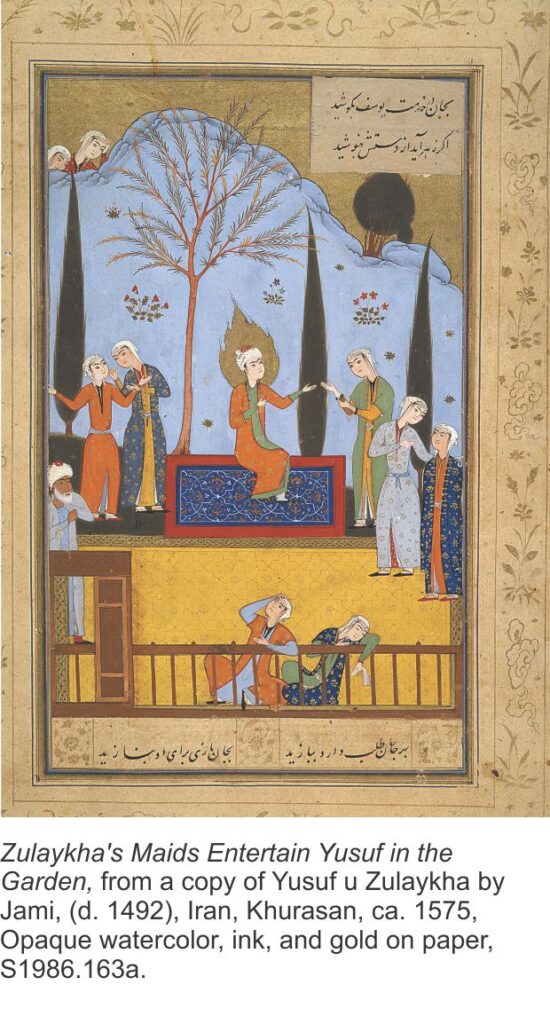
‘Zulaka’s Maids Entertain Yusef in the Garden’ (from a copy of Yusuf u Zulaykha by Jami (d. 1492) Iran, Khurasan, ca. 1575) is among the most vibrant of the manuscripts. Colour floods the blue sky and the gold floor and an impossibly deep red-blue throne, shapes that are more luxuriously open than most of the intricate illustrations allow. The figures are fragile, ethereal against smooth blue and gold. The scene speaks to the physical beauty that Sufism recognizes as a conduit to love for the Divine: ‘Yusef…personifies purity of soul and physical beauty…His unswerving spiritual devotion and moral strength are considered ideal qualities in both the lover and the mystic,’ the curator’s notes explain. Yusef’s beauty is enjoyed, consumed, by the figures on the page. And somehow the tilt of each face, the grace of each flawless hand, the painstaking patience behind the watercolour perfection all make it clear that the image speaks just as well to greater enjoyment of greater beauty.
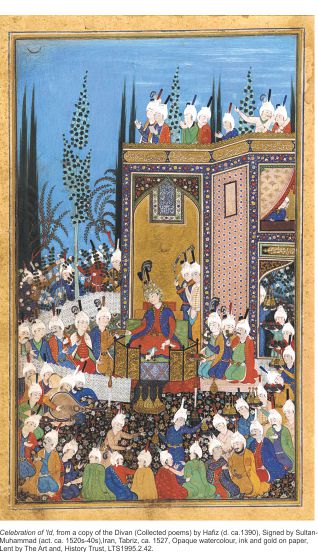
‘Celebration of ‘Id’ (from a copy of the Divan (collected poems) by Hafiz (d. da. 1390), signed by Sultan-Muhammad (act. ca. 1520s-40s) Iran, Tabriz, ca. 1527) shares the same rich blue expanse of sky. The number of human figures and the precise rhythm with which they appear are notable—more than twenty pale dressed heads and jewel-toned garments in a wide circle, drawing the eye in an easy dance along the page. Of all the pieces in the exhibition, ‘Celebration of ‘Id’ does the most to evoke celebration, anticipation, a life-beat. The occasion is ‘Idi Fitr, the end of the fasting month of Ramadan, beginning and ending with the sighting of a new moon followed by prayer. ‘According to popular lore,’ the curator notes, ‘once a person has observed the new moon, he or she should gaze into a beautiful face to ensure happiness for the rest of the month.’
‘A Prince Enthroned’ also speaks of the role of beauty in Sufi devotion. Two ornate pages draw upon the fifth book of Rumi (copied by Sultan Ali b. Muhammad al-Mashhadi, Iran, present-day Afghanistan, Herat 1458-59). The double-page frontispiece is displayed under glass in its book, the cover intact and lacquered. The image, a rare illustration of a Rumi text, doesn’t lift up one specific passage but represents concepts inherent in it—wine-drinking, dancing, ‘gazing at a beautiful male or female face as a means to divine union.’ The colours are cool and regal: lavender, pink, teal, with ornate borders. The figures, perfect and refined, appear to be as ardent as they are devout.
‘The defect [in most people] stems from the fact that they do not look at God with the vision of the lover; they look with the vision of knowledge, the vision of gnosis, and the vision of philosophy. The vision of love is something else.’
—from the Discourses of Shams-I Tabrizi (Mazalat-i Shams-i Tabrizi)
A simple white text painted on the red wall at the entry reminds Sackler patrons that this is a tenet of Sufism—that before the seventh century, Persian poetry was a secular, courtly art whose favorite theme was ideal love. Then, with the spread of Sufism by the twelfth century Persian poetry ‘acquired a new level of spirituality and devotional depth. The bond between the lover and the beloved could now be interpreted as a metaphor for the relationship of the mystic to God. Just as the ideal lover yearns for the beloved, the Sufi devotes himself to the quest for spiritual wisdom and relinquishes worldly pleasures in his pursuit of divine enlightenment. Thus, Sufism enriched the verbal and metaphorical language of Persian poetry by introducing a sense of ambiguity, as the verses now lent themselves to both a spiritual and temporal interpretation.’
The wine is wine, and also the intoxication of complete spiritual devotion. The dancing is dancing, and also the freedom that comes with enslavement to the Divine. The fact that the Sufi poets so gracefully appropriated an existing style and form, making it their own and at the same time leaving it intact, speaks to insight; to a groundedness and fine-toothed worldliness never suggested by Orientalism—by oglings of the faqir and the dervish, sensational tales of idolatry and intoxication. And the fact that this exhibition lies below the Sackler lobby, sophisticated and secure and unconcerned with what’s outside, speaks to the spirit of ‘Love and Yearning.’ The show is scholarly, charming, and unassuming. The show is the show. And also a quiet murmur deep underneath a bustling city: a sanctuary.
Ann Rosenquist Fee is a writer and director of publications for Minnesota State University in Mankato, Minnesota, USA
‘Love and Yearning: Mystical and Moral Themes in Persian Poetry and Painting’ Arthur M. Sackler Gallery, Washington D.C., February 2004 Ann Rosenquist Fee ‘First, and foremost, Majnun is a poet and that sets him apart from others. He is able to create a sanctuary in his soul, from which he re-creates his love in the…