

towards making a capital city
Merely reiterating the greatness of the greatest work of Louis Kahn was not the intention of the authors. Their mission was to turn the discussion and debate around the event and use it as a tool to question the recent history and development of Dhaka City
Time and time again history has shown that city planning departments alone do not guarantee a decent urban environment. The city is a work, a product of the people. On certain levels it is an artifact like any other: desired, designed and built. Dhaka, for example, is perhaps the country’s single biggest investment – if one chooses to see it this way – and above all everyone’s interest is at stake in it. While some of the highest stakes are ethical, cultural and architectural, they are not to be found in the books of urban theory or in the bank accounts of developers and property owners, but in the quality of day-to-day life on the street. The charge of having a healthy and enjoyable city cannot be left to planners and their bureaucratic methodologies alone. To improve the quality of life, the public and the government have to get involved and a debate in the public interest must be present.
The exhibition ‘Sherebangla-nagar: Louis I Kahn and the Making of a Capital Complex’ held at the National Museum in 2002 was an event whose goal was to open up such a debate about Dhaka’s architectural development. The curators focused their work on the history and identity of the work of a single architect, looked deeper than Sherebanglanagar itself, and examined its context, Dhaka, in the process. It was as though the city was seen through the lens of the Capital Complex. This was no ordinary feat; the work of Louis Kahn is usually shrouded in a lot of talk about monumentality, modernity, transcendentalism and other such abstract topics. Discussions hide behind the striking poetry of his designs, forgetting that even poetic architecture is not exempt from time and reality, and from the public and politics, from the weather and the city.
This exhibition was unmistakable in the radical sensibility brought to the project by the authors. The curators of the exhibition and authors of the catalogue, Kazi Khaleed Ashraf and Saif Ul Haque, took great care not to fall foul of putting Kahn on a pedestal–and thereby placing his work in a ‘showcase’ of history. Instead, through painstaking research and careful analysis the authors succeeded in uncovering the connections between the place, Dhaka, and the project, Sherebanglanagar. They were able to show the architecture’s greatness not only in symbolic terms but also in terms of its concrete on-the-street potential. However, merely reiterating the greatness of the greatest work of Louis Kahn was not the intention of the authors. Their mission was to turn the discussion and debate around the event and use it as a tool to question the recent history and development of Dhaka City.

While the show can no longer be seen, the catalogue is fortunately still available. It is a remarkable book that documents the show and provides essays that shed unusual light on the material. In the literature of architecture it is unique in that it examines the life of a masterly building within its context and not just the virtues of the building alone as though it existed in abstract space.
The unruly urban fabric of Dhaka city that is closing in on Sherebanglanagar today inspires a fear that a fate similar to that of the unfinished previous capital complex, Lalbagh, awaits it just over the horizon. This is the fate of being buried in a chaotic city that fails to recognize its order and presence, a city which instead of becoming an Isfahan of the east, developed into the urban jumble of Sadarghat, Wari and Nawabpur. The rulers of the city during the period that followed Lalbagh may not have fully invested in the quality of urban life in the city, and the consequent neglect of urban planning and building standards led to large deposits of bad buildings and streets around the old fort. The city teetered on the verge of being uninhabitable and the fort, never quite finished, fell into ruins. Perhaps a different course of the city’s development would have been possible had there been a critical public or a public body guarding the interests of public life. But this was in the past and its lessons, one hopes, were learnt. And it stands to reason that in present day Dhaka, the capital of an independent and democratic Bangladesh, this story would have a different outcome and the interest of the public would have been served by the emerging city.
When Dhaka emerged from the war of independence in 1971, it was by and large the same provincial city as that left behind by British rule. There was only minor development to show for its years as the capital of East Pakistan. The major urban development that was won by the struggle for self-determination of those years was still under construction. The immense Capital Complex of Sherebanglanagar slowly emerged from behind a veil of bamboo scaffolding at the edge of the city. It was a harbinger from the new era of independence and a guiding beacon for the capital city.
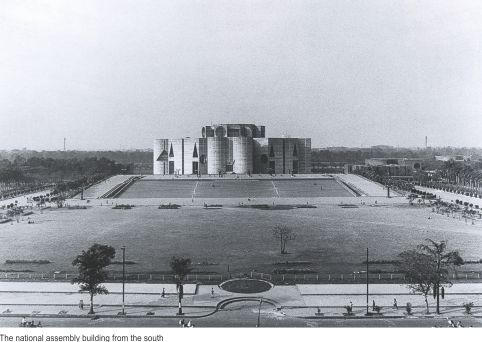
Over thirty years later and following long periods of aggressive urban growth, the city has grown well beyond the neighbourhood of Sherebanglanagar. Instead of being on the edge of Dhaka, the Capital Complex now stands well within the city. However, the urban growth is far from connected to its symbolic center. The Capital Complex stands alone as a poetic vision that integrates the light, water, air and vegetation of the city. It is an exceptional place where the public gathers to enjoy the park-like atmosphere and open greenery. None of these distinctive qualities appear to have been echoed by the city that grew around it and it is ironic that it is the very positive qualities which distinguish the Capital Complex that also separate it from the city. Indeed, the anomaly is that while Sherebanglanagar is physically inside Dhaka, in virtually every other respect it stands out as something quite other and from the outside.

The fate of Lalbagh is perhaps not as unique as we would like to believe. Rather, it would seem that an urban crisis of a similar kind is in the making. Slowly but surely the very development of contemporary Dhaka is heading with great certainty in that direction. But making demands for change is not likely to be enough to alter the course of the city – it is public awareness and debate that is the necessary starting point.
In one of the principal essays in the catalogue of the 2002 exhibition on Sherebanglanagar called ‘Capital Complexity: Kahn’s Architecture in Dhaka’, author and architect Kazi Khaleed Ashraf provides us with a foundation of historical facts along with cultural and architectural analysis, and deals from the outset with notions of inside and outside. Beginning with the commonly accepted historical fact that the complex is ‘one of the major influences on architecture of the region’ the author confronts us with a dilemma of inside and outside: how distant and separate is the architecture of the region in the first place that the Capital Complex should be considered an influence from the outside?
Kazi Ashraf does not get caught up in historical and academic arguments but in an innovative turn examines the many dimensions of the project for its connections with Bengali culture and the city of Dhaka. Surprisingly, the design process and the design schemes are rich in such connections. These range from the ‘hydrogeological’ conditions of the Bengali landscape, to the poetry and philosophy of Tagore, the relationship of the prayer hall with the assembly room and so on. Tracking these connections, the author identifies the project as the ‘closest (work of architecture) to approximate the philosophical and some of the social ideals of the Bengal Renaissance’ and further identifies the urban dimension of Sherebanglanagar as a ‘proto Bengali city’. What he finds is that the poetic and imaginative skills of the architect were able to leap across the barriers that one would expect to exist between an architect from Philidelphia in the USA and his commission half way across the globe, firmly planting his project in Dhaka’s cultural milieu.
The authors discovery is significant both in the Bengali context and beyond. In the worldwide roster of ‘super projects’, Kahn’s Capital Complex is almost unique in the extent to which it embodies the issues of its context and distinctive in its ability to articulate local cultural issues and aspirations. Kazi Ashraf does what few students of Kahn’s work has succeed in doing, which is to reveal the extent to which contextualism underlies the work of Louis Kahn, at least in the case of the Capital Complex. In the process he is able to show that Sherebanglanagar is more on the inside of Dhaka than we might have thought possible. It provided the lead in architecture and planning that the city needed in the years following independence, and that it still requires today, thirty years later. Clearly, the architect had perceived the role of the complex as a beacon to guide the city and country towards the goals of independence and was successful in fulfilling that purpose.

Saif Ul Haque in his essay ‘Kahn and Architecture in Bangladesh’ casts an eye towards the development of Dhaka city and its architecture in relation to Sherebanglanagar with these thoughts in mind. He provides us with a straight answer to the question of what difference the Capital Complex has made to the city of Dhaka. Without flirting with niceties he points out that the Capital Complex has had little impact on Dhaka and that Sherebanglanagar ‘is still waiting for its full significance to be discovered’. Furthermore, he points out that ‘the present architectural scenario (of Dhaka) is far removed from the ideas and beliefs of Kahn; in fact it can be termed to an extent a reversal’. The reader familiar with the contemporary context of Dhaka will hardly need to be told that to be ‘still waiting’ is not good enough, the message in Mr Haque’s essay is clear: the time to discover the full significance of the Capital Complex is now.
Avoiding the ‘Lalbagh effect’ should be a very high priority for the public and the government alike. The reasons are too numerous to list and too pressing. Giving the urban planning and design of Dhaka the country’s best effort is imperative. Without a doubt, in the actual debate that will unfold about raising the standards of the city’s development, the Capital Complex will appear as only one consideration amongst others. Kazi Ashraf points out that the Capital Complex was designed as a singular urban composition: ‘a self-referential urban order’, which is to say, it was not conceived as a nexus of an extended city. Sherebanglanagar will resist being integrated into the city by mere imitation; a great deal of analysis, imaginative planning and legislation wiil have to be undertaken to achieve that goal (see for example ’15 points for making Dhaka a City’ The Daily Star Aug 08, 2003 by K Ashraf & S Haque). What Sherebanglanagar: Louis I Kahn and the Making of a Capital Complex demonstrates is that in such a debate the leading role of the Capital Complex and the depth of its connections to Dhaka and to Bangladesh will be beyond question.
Timmy Aziz is Principal, DOMA Architecture, New York
Merely reiterating the greatness of the greatest work of Louis Kahn was not the intention of the authors. Their mission was to turn the discussion and debate around the event and use it as a tool to question the recent history and development of Dhaka City Time and time again history has shown that city…