

brave art: ‘rescued by the people’s hero’
My great-grandfather was a fireman—he maintained the wood-fired boilers and the ‘limelights’ on the stage at a theatre (this early form of lighting, whilst very useful, could be extremely hazardous, employing, as it did, a core of limestone heated to incandescence by a burning mixture of oxygen and hydrogen, both functions requiring constant individual attention). But he was also a firefighter, for when the cry went up, ‘Save me, mannie, save me.’ and the local fire chief rounded up his motley crew of artisans to man the steam-powered fire engine, great-grandfather, along with two brothers and several cousins, was amongst the first to the pumps. I mention this because John A. Walker, the noted art historian, in his meticulously researched and lavishly illustrated new book, Firefighters in art and media: a pictorial history, takes pains to draw a distinction between the terms.
The change in terminology came about partly because the, then termed, firemen wished to be distinguished from mere boiler stokers (although one must remember that there was always a stoker on the steam-powered fire engines!) but more importantly because there was an increasing incidence of female recruits to whom the male appellation would be inappropriate.
Why a book about firefighters? Walker has written numerous books aligning art and popular culture and in recent years has gravitated towards the cult of celebrity. He has however, by his own admission, become disenchanted with ‘vapid celebrity’ and wished to discover persons truly worthy of the nomen. A remembrance of paintings of firemen by the realist artists Millais and Courbet then set him on course to investigate a facet of modern celebrity the—up till then possibly undervalued modern hero—fireman. There are of course other illustrated histories of firefighting; what sets this book apart from similar works is that it is written by an art historian. Walker’s wealth of experience and knowledge, painstaking research and attention to detail allows him to analyse, interpret and, in every case where the information is available, correctly attribute the authorship of the works examined.
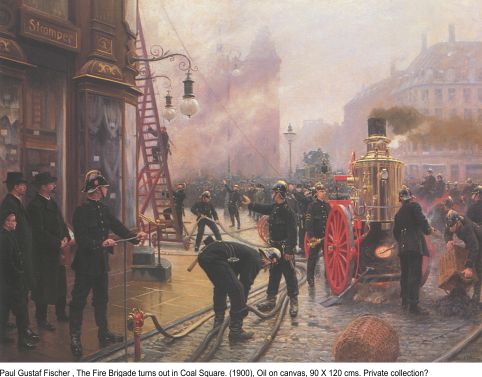
The academic approach shines with an analysis of the painting The Fire Brigade turns out in Coal Square (1900) by the ‘Copenhagen painter’ Paul Gustaf Fischer who, according to Walker, was an artistic polymath—’a minor but skilled, prolific and popular Danish painter, photographer, printmaker and sculptor ….’ There follows a lengthy and comprehensive (if obvious) description of the scene but then thanks to the author’s attention to minutiae we learn it is Company 113 attending; that the engine is named ‘Surtur’ and this is the name of a Norse fire giant; that the engine is now preserved in a particular museum; the man with the camera is a (then renowned) photographer and the building he is standing by housed his studio. Walker is nothing if not completely thorough. And he does not just describe, he analyses also—’At first Fischer’s composition seems complex because there are several centres of interest at different distances within the pictorial space to engage the eyes and encourage them to explore. Soon, however, one realises that everything is organised around a curve that starts on the left, sweeps round into the centre before exiting behind the shop’s corner.’ Furthermore ‘The officer (controlling the whole operation) is placed at the exact centre of the canvas.’ But this book is not just a study of high art. Aside from the many examples of painting, drawing and sculpture in this book, images of firefighters appear across many other (often bizarre) media from balloons small and big (Harold the Fireman floating over New York’s Thanksgiving Day Parade) through cartoons and comics, murals, monuments and memorials to tattoos and wallpaper via cigarette cards, postcards, playing cards and phonecards, toys, trinkets and teapots even to a penis pump (apparently!). Walker suggests over seventy different forms of media and illustrates examples of virtually all (although I failed to find the penis pump).
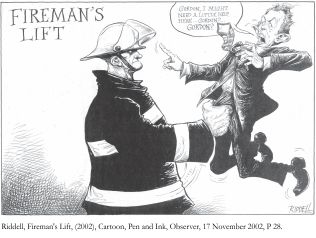
Neither is it just a canon of well-known names—which do range from Rowlandson to Rockwell—there are many worthy minor and even unknown artists examined and it is their inclusion which makes this such an engrossing compendium, broadening as it does our understanding of an art which might be seen to be exclusive to only some sectors of the community. Despite the artistic quality of the finished product varying considerably, Walker considers the emotional value of the works as important as any aesthetic value. Indeed, in an increasingly commercialised art world, Walker considers a measure of ‘naivete’ welcome because heroes are homespun and mostly modest. But what makes a hero? Were the firefighters of 18 November 1987 (the Kings Cross fire) any less heroic than those of 11 September 2001? Of course not, firemen have always been heroes and this is convincingly communicated right from the book’s cover image, Saved (c. 1890) by Charles Vigor through to one of the final images, Chris Riddell’s cartoon, Fireman’s Lift (2002) where an angry fireman representing the entire British Fire Brigade Union grasps a frightened Tony Blair by the genitals in an effort to elicit more wages for the underpaid fire crews.
Walker does not shirk from considering the flawed hero or more dubious examples. Individuals such as the Californian firefighter John Orr, given life imprisonment for causing fatal arson attacks or the collective racism expounded by Currier & Ives—’Printmakers to the American People’—in their series of prints of the ‘Darktown Fire Brigade’ (1885-87). The general impression they conveyed was that black firemen were ‘bumbling fools’ and the prints are now generally considered to present a false picture of ‘an affirmation of the racial superiority of white Caucasian firemen’ by the use of ‘caricature and coarse stereotypes lampooning blacks’.
Also examined are the varied and various faces of women in firefighter art—hero, both real (Danielle Cotton, Station Commander at Eltham) and imaginary (Josie in the television drama series London’s Burning), muse (the so-called ‘firebelles’ such as Lillie Hitchcock-Coit; this entry also provides a wealth of information on the early role of women in firefighting) and rescued victim (countless, all reinforcing the male heroic stereotype although Walker draws few inferences from this).
It is not just different media which are examined. As one peruses the entries, recurrent motifs become apparent and their evolution defined–the horn which evolved into the loud hailer; the changing styles of helmets; the hose shot; leaving the station; rescuing the child, and in many cases the young woman (old people don’t figure much!). All these are given the inimitable Walker analysis. Almost everything you could want to know about fires and the people who combat them is contained in this book. Complemented by a comprehensive index and exhaustive bibliography, the wealth of excellent illustrations set out chronologically (for that is the book’s format) an intriguing history from Fire at Tiverton (1612) to Ostroverhy’s The Fireman (2003), two hundred and eighteen illustrations later. Thus the prime aim of the book is fulfilled magnificently—it is after all a pictorial history. One must browse the pictures and then read the erudite commentary and opinion (part of his intention in writing the book was ‘to contribute to labour history.’) accompanying each entry. And how much work is involved in amassing such a volume of pictures? A great deal. I know for I have undertaken such research and have found that the files of notes and permissions can often end up considerably larger than the final tome. On this occasion, however, the author carried out the picture research single-handedly. A monumental undertaking, the scale and complexity of which can be gauged by comparing Walker’s analysis with others who have examined similar subjects.
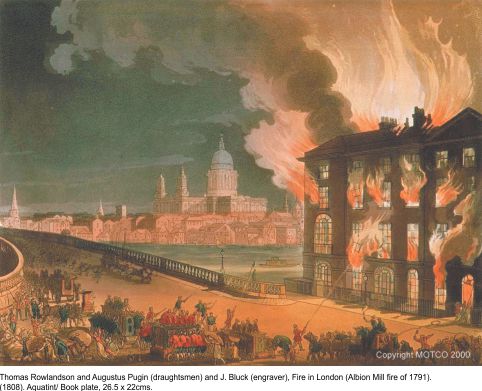
Take for example, Fire in London (1808): in his recently published book Firefighters the (admittedly) American author Jack Gottschalk illustrates and describes, what turns out to be, the Albion Mill fire of 1791. However, he assumes the fire is the Great Fire of London of 1666—despite identifying Wren’s St. Paul’s (here he curiously credits the artist with artistic licence in portraying, ‘a reconstructed version of the cathedral’) and even though the building burning is patently on the south bank of the Thames and the great religious edifice is unattended by the merest flicker of a flame, possibly because construction did not commence until nine years after ‘London’s burning, London’s burning ….’ All this despite the fact that he has an illustration on the previous page showing the fire raging on the north side of the river! Furthermore, and this is anathema to an art historian, he does not attribute authorship to any particular artist. Neither does he tell us anything about the Mill even though his prime concern is with the fire happening there. And this author had the services of a (obviously not very good) picture researcher.
Walker, on the other hand, with his painstaking personal approach correctly identifies the fire and informs us immediately that the aquatint was drawn by Thomas Rowlandson with additional architectural embellishment by Augustus Pugin and the plate engraved by J Bluck. We are given a detailed description of the scene with suggestions by Walker as to which fire companies are attending (based on the his observations of the colours in the painting and his researched knowledge of company liveries); a history of the Mill and its socio-economic drawbacks (based on analysis of other prints, paintings and contemporary histories) even down to the manufacture of the boilers (which might have been the genesis of the conflagration) and even a brief history of Blackfriars bridge (the presence of which should also have alerted the American as to his error as it too was not built until after the Great Fire). We are also given correct publication details and bibliographical references for further research. Thus the thousand words in this case really add to the one picture.
The point I am stressing is that whilst other histories of firefighting may have been illustrated by works of art the lack of art-historical knowledge and iconographic analysis of the images on the part of the authors can result in crass misinterpretations. No such misinterpretations for Walker; he approaches the images with an almost John Bergerian eye (the irony of course being that the images are predominantly male!).
Of course the most paradoxical fireman in cultural history must be Montag in Ray Bradbury’ short story The Fireman (1951) (later made more famous in François Truffaut’s 1967 film Fahrenheit 451—the temperature at which paper burns) where, in a 24th Century totalitarian world, firemen do not extinguish fires, they start them; specifically to burn books because, ‘Writing and books … cause mental confusion and foster critical thought ….”‘In our more enlightened age this encyclopaedic volume induces much of the latter with none of the former. But then Montag lives three hundred years hence and is the glaring exception. Mind you, my great-grandfather attended a fire at his own theatre, but in the days long before forensic investigations flourished no blame was apportioned!
Trained as a chef, and after a long and fairly undistinguished career in the British telecommunications industry writing technical manuals and customer information handbooks, Derek Manley is now a freelance art historian and picture researcher
My great-grandfather was a fireman—he maintained the wood-fired boilers and the ‘limelights’ on the stage at a theatre (this early form of lighting, whilst very useful, could be extremely hazardous, employing, as it did, a core of limestone heated to incandescence by a burning mixture of oxygen and hydrogen, both functions requiring constant individual attention).…