

the shuttered mills
Sudhir Patwardhan: The Complicit Observer by Ranjit Hoskote,
Publisher by Sakshi Gallery,
Pages: 207, Price: Rs. 2000.
And did the Countenance Divine
Shine forth upon our clouded hills?
And was Jerusalem builded hereAmong these dark Satanic mills?
200 years ago, Blake—a greatly eccentric interpreter of cosmic intention—wrote those lines as a call to arms against the massed forces of evil, forces represented in his case by the tools of industry. This was at a time when industry’s effects were only just beginning to be felt. Blake saw the situation in exceedingly clear terms: the Industrial Revolution was a threat to innocence, to jobs, to ‘England’s green and pleasant land.’ He saw himself as one of God’s trumpeters and his imagined Jerusalem as an idealized place free of disorder, commerce, and war.
If these lines—from the poem ‘Jerusalem,’ excerpted from the preface to one of his first ‘prophetic’ works, Milton—seem oddly quaint today, they have an eerie contrapuntal resonance in Bombay, where the mills of the textile industry, once the city’s lifeblood, are now silent. Unlike the mills of Blake, Bombay’s mills are dark, not because of the absence of moral illumination, but because they were shut down, their lights extinguished in the early 1980s. For the city’s countless residents, and for some of its artists, the mill was a symbol of possibility and renewal; and its demise is mourned even today.
Last month I returned to Bombay after six years away—and gently, by train; without the hyperventilation of air travel—everything was changed and everything the same: the old sense of decay, neglect and menace had not been displaced by the new highways, residential blocks, coffee-shops and restaurants. The highways are soaring modern constructions that reduce travel time, but they occur only in stretches; in between they are broken up by the old system of overcrowded streets, overworked traffic police and too many, far too many vehicles. Driving in the city is a gladiator sport: you cannot give an inch and you have to set aside any notion of courtesy.

One evening my wife and I went to a performance by a visiting European DJ. It was held in the Phoenix Mills in Lower Parel, in a cavernous space that had been transformed into a receptacle for a psychedelic sound and light show. Here the city’s younger set danced to the pounding beats of trance, house and electronica in a smoke- and sound-filled warehouse space; they watched fire-jugglers, Flamenco dancers, and stilt-walkers; they participated in a free-style painting exhibition; they shopped for CDs and played video games; they lounged on white couches arranged on a lawn. The Phoenix, true to its name, had come back to life in an unexpected way: it was a hub of light and activity in a formerly depressed part of the city.
As we wandered around the newly refurbished Phoenix, I could not help but recall the work of the Bombay-born artist Sudhir Patwardhan, who has painted the city’s mills—and specifically the superannuated mills of Lower Parel—over a career spanning three decades. His representations of these storied structures are indicative of one of the many transformations that have arrived in the city in recent years.
In a painting titled ‘Lower Parel,’ from 2001, the defunct mill that looms over a crowded streetscape is anything but a dark or gloomy presence: it is bright, cheerful, and, interestingly, it stands in contrast to the grim, grime-encrusted bridge and pedestrian walkway immediately below it. The mill and the bridge form a backdrop to scenes of street life—and this is a street informed not by random entrances and exits, but by the artist’s editing eye—scenes any Bombayite would know intimately: corrugated-iron awnings, inadequate lighting, ramshackle storefronts selling tomatoes and lemons that are small miracles of colour and shape, idlers who use the street as a meeting place. One of Patwardhan’s bisecting devices, a lighted streetlamp, tells us that it is early evening: the people on this street are not headed to work, they are strolling; they are headed home. In the lower right of the picture is an array of male figures; and there is something odd here—their faces are averted from the viewer. One stands with his back to us, his head bent, a hand held to his cheek; we don’t have to see his expression to know that he is the picture of dejection. On the left, a trio of men discusses something terrible, their faces in a shadow so dense as to be indecipherable. At the exact centre of the lower frame three women walk arm in arm, the woman in the middle supporting herself on the shoulders of her companions as she attends to their conversation, her smile sad and full of knowledge. And then we notice two schoolgirls, their blue and white uniforms starched and bright; and, talking to the vegetable vendor, the youthful figure of a woman in a pastel sari and matching blouse, her daughter’s yellow dress picking up and throwing back the yellow of the lemons; and it strikes us that the women in this picture are sources of hope. And where is the source of light? Above all this, looking down, are two monolithic structures—in Patwardhan’s universe they are two opposing monoliths—the disused mill and a new residential high-rise still under construction. The high-rise is a dark and featureless tower that fills the picture’s upper right-hand corner. And the mill, clearly, is not the Satanic engine of Blake, but an object, which, after the schoolgirls and women, is among the most light-filled in the picture.
‘Lower Parel’ occupies two pages out of 207 in Sudhir Patwardhan: The Complicit Observer, a lavish publication by Sakshi Gallery with a compelling new text by Ranjit Hoskote. The volume is book-ended by text, Hoskote’s and the artist’s. It documents thirty years of work and includes a series of fine, sensuously rendered drawings, a collection of rough terracotta heads, and various statements by the artist collected over the years. It offers a panoramic view of the city; also it offers glimpses, both stylised and improvised, of this artist’s development and his dogged creation of what is likely to become a major body of work.
In the early pictures, we receive aspects of—in Hoskote’s words—the artist as complicit observer. There are, too, revealing autobiographical elements. In 1980’s ‘Train’ a bemused, moustached figure—the artist—in striped bell-bottoms and a sling bag watches as a group of commuters struggles for space on a local train. Among them is a woman in an extraordinary sari, its gorgeous red flowers and yellow background an echo of the colors of the Bombay local. In ‘Town,’ (1984) the artist, wearing a white hat, red pants, and a black sling bag, is, for once, a participant in the drama of the street: he is making a purchase. In ‘Street Corner’ (1985) he returns to the status of observer: he is a figure in the picture’s bottom left, in a yellow kurta and a striped red and yellow bag, and he is watching the city’s residents on the multiple screen of the canvas. As in other paintings of this and later periods, Patwardhan’s Bombay tableaus are composites in which spatial logic is a fluid variable. But it is ‘Witness,’ (2003) that gives us the most telling self-portrait in the book. The picture, pure allegory, shows the artist standing in a stylised wasteland, staring directly at the viewer. He is nude, and in his right hand is his heart, freshly torn from his chest. Half of the figure stands in shadow, in the cold light of Europe, beside a Renaissance figure borrowed from Leonardo; the figure’s other half basks in the bright sunlight of Asia, near a damaged mural of a Mughal emperor on horseback. There has been an exponential growth of intent between the self-portraits of the earlier pictures—where the artist is a disinterested, ironic observer of life—and this later portrait of the artist as wounded witness to history. It is a journey Patwardhan has recorded in words: ‘I want to go beyond mere looking-on. I long for proximity.’
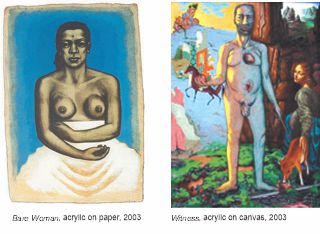
And it is in the middle and later pictures, with their stunning evocations of Bombay’s people and her landscapes, that the nature of this artist’s endeavour becomes clear. The monumental representations of specific Bombay locales announce that Ulhasnagar, Pokharan and Rabodi, to name just three, are fit subjects for art. For viewers raised on European reference points this is a momentous declaration. And there are more.
‘Irani Restaurant,’ reproduced on the book’s cover, shows us a man sitting at a marble-topped table. While the café’s other habitués crowd around tables talking, the man in the foreground, a squat, doughy fellow, sits stoic, still as a slab of stone; he is beyond conversation, beyond the comfort or possibility of language. ‘Overbridge’ made me —a Bombay resident for more than a dozen years—wonder if there really was a place so desolate. It is a Boschian vision of tumult, or hell, everything tilted at a precarious angle, the houses tumbling downhill, a precipice over which the viewer too must wobble. ‘Tree’ is a representation of an impossibly crowded street; and what is the American tourist doing with his backward ball cap pointing out of the bottom right of the frame? The picture, as Hoskote writes, is ‘animated by the helter-skelter movement of pedestrians, autorickshaw-drivers and train commuters: it boasts 26 human figures and a dog, yet no gaze intersects with another…’
Hoskote’s exhaustive, richly detailed essay places the artist firmly in a socio-historical context. He refers to a range of material; indeed it is so vast a range that some of the pictures to which he alludes are not represented by plates in the volume proper, but by reproductions in the margins of his introductory essay (for instance a 1984 portrait of the painter’s wife titled ‘Shanta in a Green Shirt’). Hoskote’s essay embodies a kind of close study and research that India’s painters deserve but rarely find, and there is no better writer when it comes to the complex correspondence between art history and contemporary practice. Though from different generations (the writer was born in 1969, two decades after the artist), Hoskote as much as Patwardhan is a chronicler of the city, which, tellingly, is referred to as ‘Bombay’ throughout his essay; as a poet, theorist and independent curator he has looked closely at Bombay, has celebrated it and mourned it. And as much as Patwardhan, he too is a complicit observer.
I must end with a mention of an odd phenomenon that occurs if you have spent an extended period of time looking at a picture, or a number of pictures, by Sudhir Patwardhan. You begin to see his work everywhere: you begin to look at scenes of Indian city life as if they were paintings by him, future paintings or imaginary ones. I was looking at The Complicit Observer in a coffee shop in Bangalore, and when I looked up after an hour or so of immersion in those images and colours, I saw through the square frame of the coffee shop window a scene straight out of a Patwardhan painting. A woman was preparing fresh ears of corn. She would peel off bits of husk and chuck the cob up onto a cart full of them; she was talking to herself, her mouth distended with a great plug of tobacco in one cheek, her green sari picking up the colour of the corn husks, her skin the exact colour of the woman in ‘Train’. The bottom part of the plate glass window frame was taken up by a collection of motorcycles; a man sat on one readying for his journey home; in the middle distance was a snarl of buses, autorickshaws, pedestrians; and above all this the solid tones of Indian sunlight. For a moment it was impossible to tell where the book in my hand ended and where the world around me began.
Jeet Thayil’s most recent book of poems is English (Penguin/ Rattapallax 2004). He lives in New York City where he works as an editor and writer
Sudhir Patwardhan: The Complicit Observer by Ranjit Hoskote, Publisher by Sakshi Gallery, Pages: 207, Price: Rs. 2000. And did the Countenance Divine Shine forth upon our clouded hills? And was Jerusalem builded hereAmong these dark Satanic mills? 200 years ago, Blake—a greatly eccentric interpreter of cosmic intention—wrote those lines as a call to arms against…