

an autumn quartet
Between October and December 2004, Dhaka staged a series of impressive art exhibitions. From the inventive and manically playful work of Tayeba Begum Lipi to the cool meditative serenity of Iftikhar Uddin Ahmed’s creations to the intense Freudian images of Ranjit Das, rendered in glowing sensuous colours, and the myths and legends and rituals of the region depicted by Kalidas Karmakar—there was an array of stimulation and provocation offered to the gallery-goers
Tayeba Begum Lipi: Interpreter of Maladies
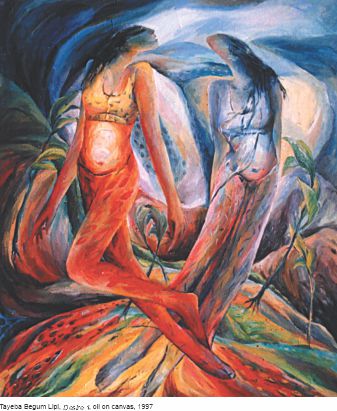
Born in 1969, Tayeba Begum Lipi did her MFA in 1993 from the Institute of Fine Art, Dhaka University. She mounted her first solo—a celebration of her sexuality and womanhood—in 1998 at the French cultural centre in Dhaka. From the very beginning of her career, Lipi has shown an awareness of herself as a woman and as an artist and expressed her fascination for figurative painting even if the dominant mode in Bangladesh art then was abstract expressionism.
Lipi’s early subjects are filled with lyric fantasy; a blend of Chagall and Matisse, they are manically playful. Her weightless levitating women figures, apparently in a trance, in the Desire series celebrate women’s body and sexuality. The canvases in the series do not allude to heterosexual relationships, thus creating a distance from the male perception and promotion of heterosexual practices as normal.
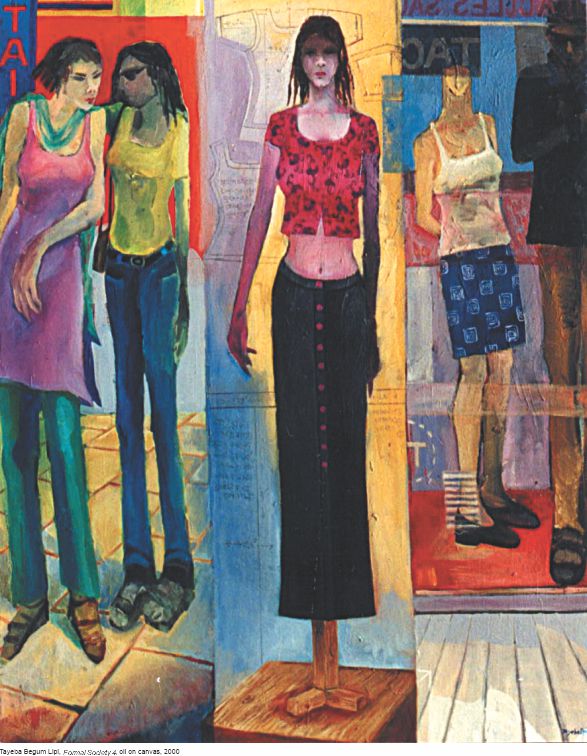
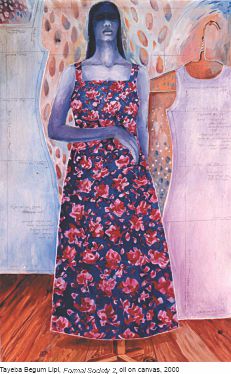
In the following years Lipi’s focus shifted from herself to the society she lives in. The works done in 1999-2000 are in the mode of pop art. The paintings of the Formal Society series are done in gaudy colours and reflect pop art’s interest in popular culture and advertising. Her figures in this series remind one of Hockney’s work in Domestic Scene, Los Angeles.
In Formal Society 4 she depicts how a conservative society gives way to consumerism and registers the rise of a new metropolitan ethic. She treats the canvas as a triptych and in the three sections of the painting displays a couple in trendy dresses, a mannequin, and a window shopping couple to create a consumers’ paradise—albeit portrayed in a wittily sardonic manner.
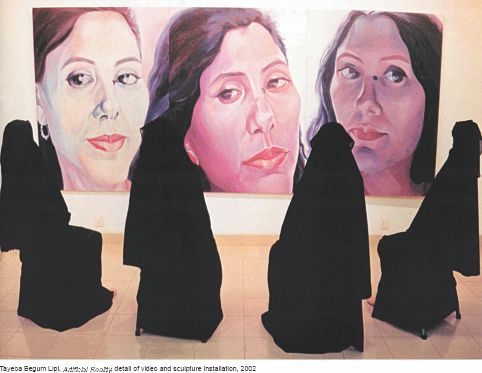
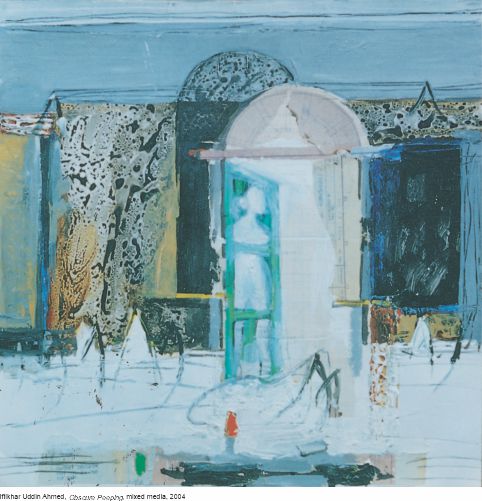
Lipi’s association with and marriage to Mahbubur Rahman, a talented artist who emerged in the art scene in the 1990s, and the couple’s involvement in the Artists Work Programme at IMMA in 2000 in Dublin has had a deep impact on her. The duo’s frequent visits to London and the annual Turner prize has been a source for inspiration. In London, Lipi found Tracy Emin’s work, nominated for the 1999 Turner prize, thought-provoking. Emin was catapulted into the limelight with her 1994 installation work Everyone I Have Ever Slept With, showing a tent embroidered with the names of every person with whom she had ever shared a bed, sex or no sex. The experiences the couple gathered at Dublin and in London, the urge to attack abstract expressionism and move into installation and performance, culminated in the 2002 joint show, Artificial Reality. A video and sculpture installation, the exhibition is a scathing attack on the system of traditional marriages in Bangladesh. The show was a sharp departure from her earlier work. It dealt with a content that is driven by metaphor and irony. She created a typical Bangladeshi wedding scene where guests are sitting in rows of chairs in front of the bride and groom to wish them good luck. A chair with a human head on the top and a pair of wings and a glittering garland dangling from the neck constitute the groom. Bedecked with a garland and sitting next to the groom is the burkha-clad bride with a tiara. A video clipping of a cow being slaughtered runs continuously in the background. The installation is a violent metaphor for what marriage is for a woman in Bangladesh. Her work at this stage has had an arte povera emphasis on materiality.
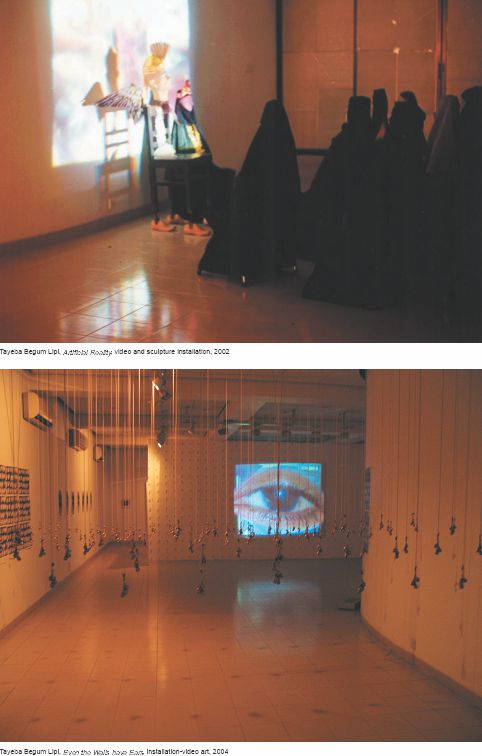
From this point on the politics of representation becomes an issue in all of Lipi’s work: what system of power authorizes some representations while suppressing others is the question she raises in her October, 2004 exhibition held at La Galerie in Dhaka’s French Cultural Centre. The first peak in Lipi’s career also came in 2004 when she was awarded the Grand Prize at the 11th Asian Art Biennale, Bangladesh. The award-winning work My Childhood, done in oil, features the portrait of the artist herself with a number of dolls hanging from the canvas. Lipi stares candidly out of the painting at us as if asking whether mindless consumerism can give her back her innocent childhood.
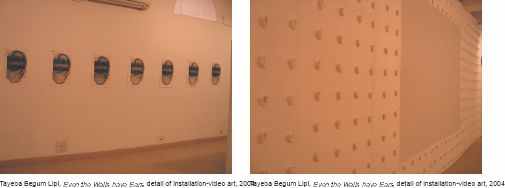
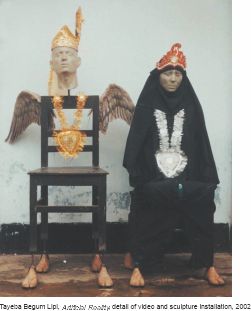
In her recent exhibition Even the Walls have Ears Lipi’s tone is bitter and jokey. The installation shows footage from CNN and BBC reporting on the US invasion of Iraq and Afghanistan. There are plaster of Paris models of the artist’s own ear and drawings of ears on the walls and scores of ankle bells hanging from the ceiling, which make the visit to the show a noisy experience for viewers. The title of the show is taken from a Bengali proverb that says however you try to hide anything you will never be successful. It is as if ‘the authority of representation’ which Derrida says, ‘constrains us, imposing itself on our thought a whole dense, enigmatic and heavily stratified history’ (Sending: on representation, Social Research, 1982) is being challenged and subverted in this piece. The work suggests that however the western media tries to silence the truth, it will ring its presence and human ears will catch the conspiracy of misrepresentation hatched by the media. The exhibition is a confirmation that Lipi has evolved as an artist with a distinctive voice, a nuanced outlook, and a witty perspective.
Iftikhar Uddin Ahmed:
The Enigma of Arrival
Juxtaposed columns, triangles, and compasses, faint images of human figures in soft and muted colours create a peaceful and mysterious atmosphere in Iftikhar Uddin Ahmed’s canvases. His paintings offer an interesting synthesis of the spontaneity of approach one sees in abstract expressionism and the order and harmony of the de stijl sensibility. Born in Dhaka in 1960, Iftikhar went to France to study painting at the Academy de la Grande Chaumiere in 1993-94. His works can be broadly divided into pre and post-Paris styles. His pre-Paris themes are mostly about his experience of the city he grew up in—prostitutes, rickshaws and cars crowd his early canvases.
Iftikhar began his career as a semi-abstract painter. His early rickshaw paintings had a delicate balance of abstract and representational imagery and showed a powerful control of hues and forms. His experience in Paris was a Naipaulian enigma of arrival that gave his canvas a new meaning. He embarked on a quest for the invariant elements among what he felt were ‘superficial’ differences.
In back to back 2003 exhibitions in Paris and Dhaka Iftikhar’s theme was space or more precisely how we occupy or define space. The Searching Space series evolved through complex DNA structures into ambiguous architectural structures faintly referring to colonnades, compasses and blocks with lingering mysterious shadows. In Iftekhar’s treatment of space and handling of composition one might sniff a concern for the metaphysical reality of the objects.
His latest exhibition held in December 2004 at Saju Art galley in Dhaka is the logical extension to his Searching Space series. Softly toned and sparse, the ambiguous imagery of the paintings suggests that he is still trying to analyze and interpret the nature and pattern of space the human imagination creates. Obscure Peeping shows, in his characteristically muted colours, a ruined building with a door ajar. Eerily still, the opening of the door leaves no hint of what is inside but tantalizes us with the mystery of the unknown. Subtly textured and well executed, the painting is suggestive of Iftikhar’s search for the structures that constitute the space of our imagination. In Composition, strong board strokes of yellow and brown construct a brick wall. Supported by two arches, there is a column at the centre of the wall. The sculptural quality of the composition is intensified with a blotch of red-green-black at the bottom of the seemingly weightless column. A clock-like object on the wall is perhaps keeping the record of the balance of the composition.
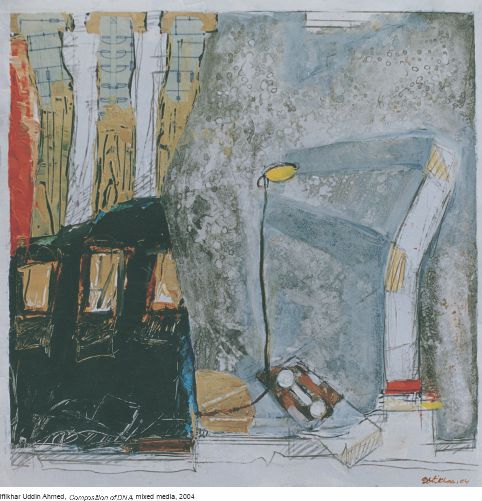
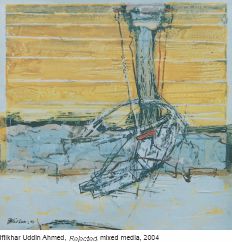
On the whole, this was a good show but it has to be said that the work displayed is uneven in quality. There are works in the exhibition that use geometric and lyrical forms to create a sense of mystery; on the other hand there are works that are representational, with a symbolism that is too obvious. A few paintings, particularly the one of a galloping horse with its saddle wrapped in the flag of Bangladesh is too naive in its bid to show the nation galloping to progress. The paintings in the representational mode fail to meet viewers’ expectation.
Ranjit Das: Heart of Darkness
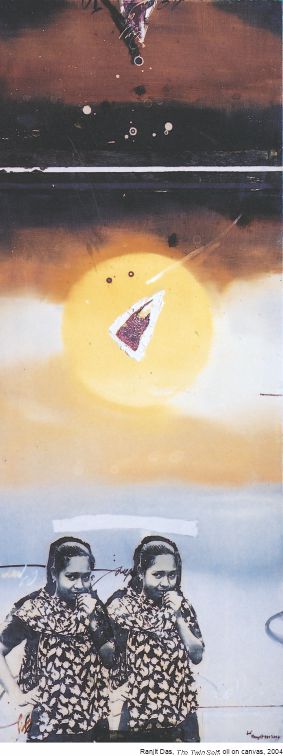
Spontaneity of feeling marks the work of Ranjit Das, who made his debut in the mid-1970s. He has shown neo-expressionist intensity in his work and in his November show in Dhaka this was blended with photo realistic figures. Ranjit’s interest has always been in the tensions of life and the hallucinations and apprehensions that haunt modern man. The surface of his expressive portraits is made up of a thick layer of paint and fluent but well thought-out brush strokes. He has also used the technique of pouring or dribbling the paint directly onto the canvas to create strong explosive patterns.
His work in the 1990s and early 2000s included a search for the ultimate expression of a mood or emotion, blending the abstract expressionist zeal for freedom from all artistic conventions and a certain rigour for balance and geometry. He is comfortable working with a large canvas, usually a square one, which he divides into a number of geometric segments. He develops each segment meticulously so that they smoothly overlap each other to give the whole an air of mystery.
The Philosopher, done in oil in 1994, shows a bald-headed philosopher (Foucault, perhaps) in deep thought, unconcerned about anything. From deep to light brown, yellow and white paint is applied with brush and spatula to suggest the mystery and silence of the thought process. In Man and Time, also done in his favourite medium, oil on canvas, in 1995, Ranjit delves deep into the human psyche, rendering it with nightmarish intensity. The painting evokes feelings of desolation and anger, and a sense of the ravages of time. There is another painting within the painting that elicits an eerie atmosphere of death and destruction with a half-hidden figure peeping through a window. The same year he won the Grand Award in the Asian Biennale held in Dhaka.
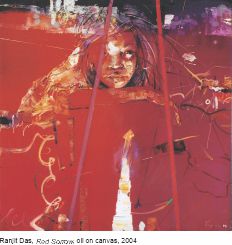
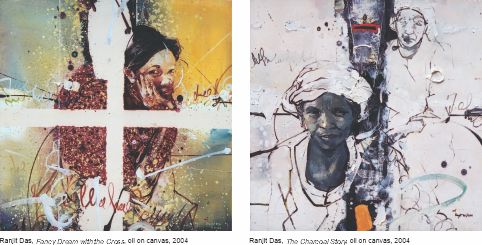
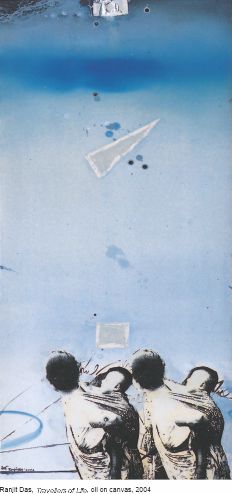
In his recent show at Shilpangan Gallery, Ranjit’s canvas has a heavily textured surface and the application of paint is free and not as pre-meditated as in his earlier work. Even if there is a touch of geometry, geometrical shapes are not as intensely rendered as in his earlier compositions. The mystery of the subconscious—the cobweb of the modern metropolitan psyche—is being replaced by an interest in the life of ethnic minorities in the Chittagong Hill Tracts. A neo-expressionist slant on the primitive is quite apparent here. Obviously, Ranjit is not interested in telling stories but is keen on capturing the mood and expressions of the marginalized hill people. His focus is always on the face of the people he paints. This is suggestive of the belief that the face is the window of the mind. He has exploited the full potential of ‘gestural’ painting stressed by the abstract expressionists while incorporating the intense expressive mood of neo-expressionism. In Green Hope of Her Life swirling brushstrokes, applied with verve and panache, mingle together in a multitude of vibrant greens, yellows, and whites. At the centre of the composition a tribal woman is walking engrossed in her thoughts. We do not know anything about the woman but can feel the confidence that exudes from her stride. Perhaps Rajit sees a new light in the dark marginalized life of the ethnic minorities of the country as his canvas appears to be moving from a personal to a more impersonal world. Kalidas Karmakar: Myth and Meaning
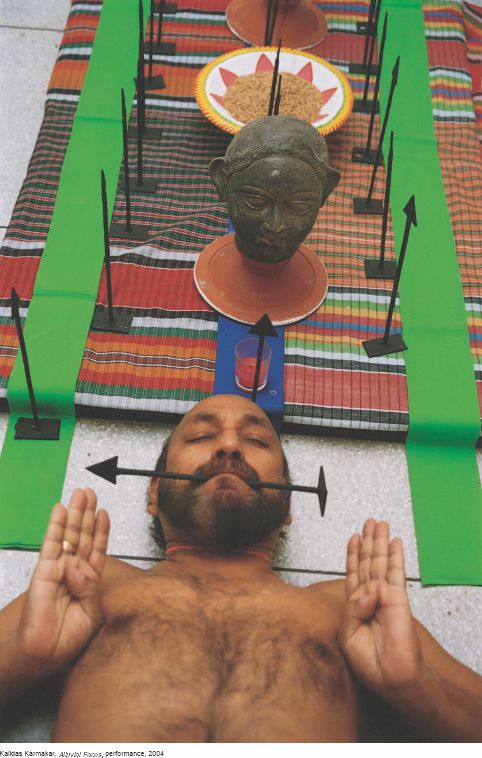
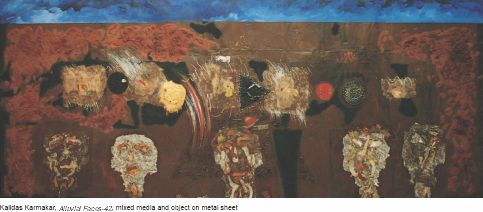
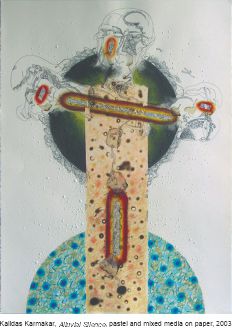
Kalidas Karmakar began exhibiting his paintings in the late 1960s which were full of glowing, sensuous colours and a constrained freedom in brushstrokes that linked his works to the art informel style. He has revealed his restlessness throughout his career—never settling into any particular style of expression, whether minimalism, installation, body art, abstract or neo-expressionism. This restlessness comes into full view in the works he put on in his December show at Galleri Kaya in Dhaka, entitled Alluvial Faces.
As with the earlier work, here too, the paint is handled in an intense personal style drawing on his favourite media and imagery that are mostly drawings of his own face and drawings inspired by the statue of mother figures found in the ruins of Mohenjodaro and Harappa. The variety of media in the show, as always, has been astonishing—wasi paper, made by the artist himself or mixed media achieved by combing different techniques such as etching, lithograph or aquatint and interactive work. The paint, made of powdered pigment, is applied in heavy layers. There is a tactile quality in most of his paintings with images that are embossed along with metals and objects used on the canvas.
The focus of the paintings is the artist’s own reaction to an experience, rather than the facts of the experience itself. Two recurring objects in his paintings are amulets and shells. In Bangladesh, as elsewhere in the subcontinent, Quranic verses, written on paper and put inside amulets, are given by fakirs and religious leaders to their disciples for various reasons, from healing diseases to working as charms to ward off evil or overcome life’s shortcomings. And shells, once used as currency in ancient India, are used in magic shows in Bangladesh and West Bengal. Kalidas deftly appropriates these popular practices and makes them central motifs of his work.
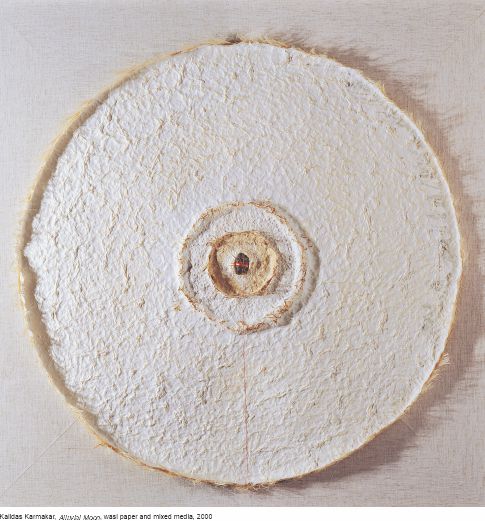
In different phases of his career Kalidas has done circular-shaped paintings. In a way these paintings are his personal mandalas. Alluvial Moon, done in self-made wasi paper and mixed media, shown in his major one-man exhibition at the Bengal Gallery of Fine Arts in 2003, depict a circular painting featuring two more circles-within-circles with a black stone, wrapped in red thread, placed at the centre. The stone and the way it was wrapped suggest votive offerings at temples or mosques.
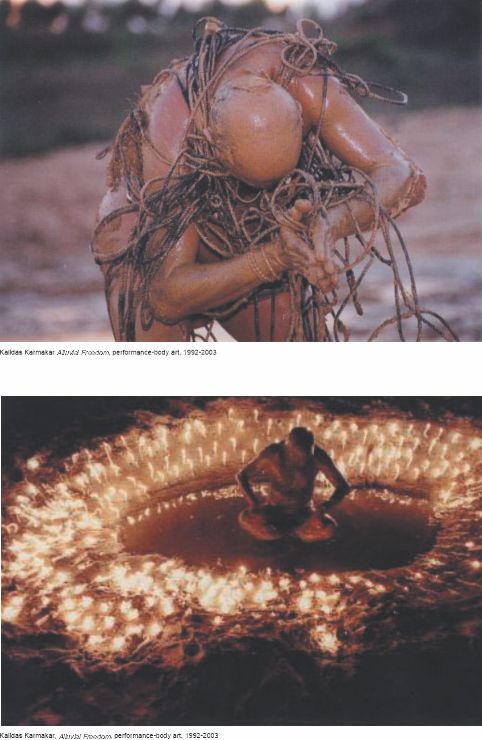
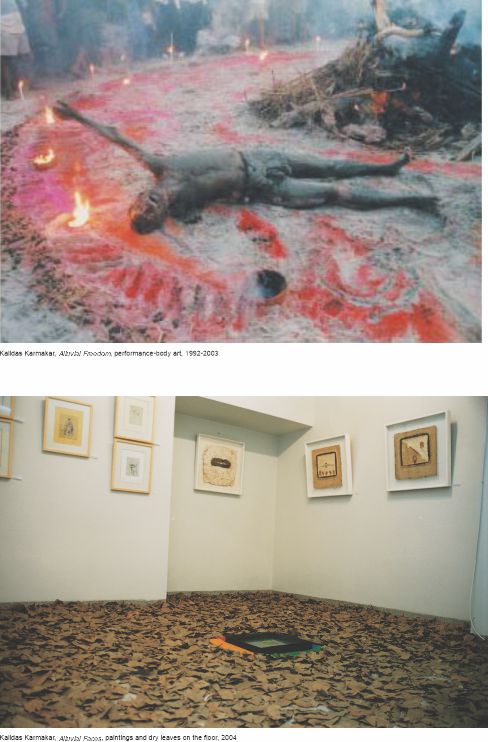
Between 1992 and 2003 Kalidas has done a series of three performance-body art. The series, Alluvial Freedom, performed in the Sundarbans and Chittagong, was inspired by sun and fire worship services of ancient India. Kalidas rubbed his body with mud and wrapped himself with ropes before doing his namaste to the sun evoking the ancient gods. In another performance he did a mud bath in loincloth, created a circle with heavy pigment, and lit candles on the line of the circle before embarking on his communication with the forces of nature. Yet another ritual was performed at night amid a circle of burning candles, with the artist in loincloth once more and in a posture of meditation.
Jung believed that the circle or mandala is the archetype that was the underlying reality manifesting itself in the various systems of monotheism. The self, therefore, is the god within and the individual, in seeking self-realization and unity, becomes the means through which ‘God seeks his goal.’
Do Kalidas’ madalas manifest the Jungian meaning? That is to say, are they symbols of the self and the archetype of unity and totality that he is seeking in his creation?
Ziaul Karim is the Executive Editor of Jamini
Between October and December 2004, Dhaka staged a series of impressive art exhibitions. From the inventive and manically playful work of Tayeba Begum Lipi to the cool meditative serenity of Iftikhar Uddin Ahmed’s creations to the intense Freudian images of Ranjit Das, rendered in glowing sensuous colours, and the myths and legends and rituals of…