

The romance of the Painted photograph
The infatuation was instant. I was intrigued. The sensory within me was stimulated by the sheer visual impact of what I saw in print. Then in the summer of 1999, while in London, I got to see a rare collection of original mid-19th to early 20th century specimens of the painted photograph. The experience was gratifying to say the least.

Once viewed with disdain as mere ‘bazaar art’, and dismissed as garish and unsophisticated by most Westerners, particularly during the British Raj, the unique genre of composite art that is the painted photograph, has indeed come of age and is today enjoying a revival. In India and the West, it has of late attracted the attention of the connoisseur, photo-archivist and art historian.
This form of composite art is still neglected in Bangladesh, where prized samples of painted photographs, particularly of the mid-19th to early 20th century variety are indeed rare. Luckily however a rich ‘treasure trove’ of that period has survived both in India and the West, mostly in private collections and archives. Consequently, quite a bit of information in print and on websites about painted photograph have emanated in recent years. Also, some well-curated exhibitions have been held abroad, notably from the Alkazi collection at Sepia International in New York, U.S.A., drawing attention to this fascinating but long-neglected artistic genre.
For a better perspective on the painted photograph, it is necessary to provide a brief history regarding the advent of photography in the Indian subcontinent. It is surprising to note that in January 1840, less than two years after the appearance of commercial photography in Europe, photographic equipment and supplies were being sold in Calcutta and Bombay. The excitement of the new visual technology was evident in photographic societies in Bombay (1854) and Bengal (Calcutta, 1856), where amateur and professionals alike met to share and discuss this new medium. By 1860, there were numerous Bengali as well as European photographers who had taken up the vocation seriously. Famous and popular professional photographic studios, both European and Indian, were established in all major cities and hill stations during the British colonial period. These studios catered mostly to the British and Indian elite. By the turn of the 19th century the newly emergent Indian middle class, still relatively small, but quite status and fashion conscious also took to photography ardently.
In subtle ways photography revolutionized Indian life. Its societal impact was manifold. Interestingly, it was actually the bazaar environment, the commercial hub and pulse of society, which played a pivotal role in providing the necessary support for photography. In the beginning, bazaar photographers established a regular clientele among both the upper and middle classes. Later, cheaper innovations made it affordable to the ordinary masses of people. The bazaar helped put photography into the collective Indian consciousness and social structure, giving it an appropriate place, role and function. No other foreign technology till then had been so readily embraced and assimilated into Indian society and culture. In fact, so strong was the attraction of photography and the societal craving for self-memorialization, that it managed to make successful inroads into even orthodox Hindu and conservative Muslim households.

Photography has been hailed a great social equalizer, a vehicle of modernization and the harbinger of democracy and social change. On the surface, it cuts across race, ethnicity, religion, colour, caste, and social class. For example, it was not unusual in the 1920s – 1940s to see in studios and shops in the bazaar, photographs of Indian royalty, British viceroys, cinema stars and entertainers displayed and sold alongside gaudy oleo graphs depicting a plethora of gods and goddesses of the Hindu pantheon. This would have been unthinkable before. Therefore, with the commercialization of art, we find society coming to terms through photography where the sacred, divine and traditional fused together to conform to popular taste and demand. Indeed, it was photography that heralded the birth of Indian celebrityhood and stimulated a taste for voyeurism.
The introduction of photography during the second half of the 19th century dislodged the traditional Indian miniature artist and the court painter from their preeminent position as social recorders. Photographers emerged as the revolutionary social chroniclers realistic, providing visual and sensory impressions of people and events. They began to record instantly and with precision fleeting moments, both mundane and important, for posterity.
The advent of photography inevitably elicited a strong positive response from the Indian elite. Although image taking had become both fashionable and a conscious attempt at self-memorialization, yet it left something essentially unfulfilled in Indian sensibility. The hand-tinted, gelatin silver prints, daguerreotypes, lantern slides and the popular negative-positive of Fox Talbot, commonly known as the black and white photograph (calotype), though realistic in visual representation, were still somewhat stark and dull images, devoid of colour, the very essence of all things Indian. And it was precisely this important component, that intrinsic part of Indian life—the magic of colour, which was missing in these photographs.
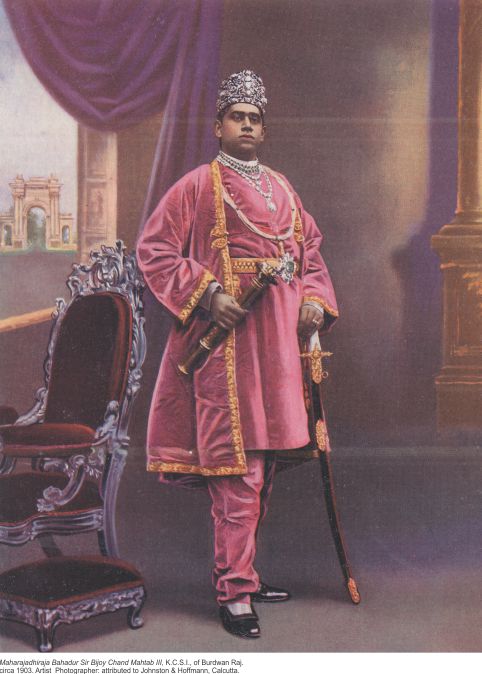
Nowhere is the artistic application of colour more evident than in Indian photographic portraiture. The colours came in both pleasant, aesthetic hues and in strong gaudy strokes. Miniature artists and portrait painters were commissioned for the purpose. This encounter between photography and the artist (painter) in the 19th century produced the concept of the ‘artist photographer.’ Although freelance artists were available for a fee, yet the best ones were obviously retained by leading photographic studios. These artists infused the photographic portraits of their clients with colour and detail, although too often they projected them in an overly idealized setting. The pose, poise, props, gorgeous costumes, resplendent jewellery, opulent setting and romanticized backdrops in these stylized photographic portraits of the elite came to life with the added vibrancy of colour. It seemed that a new lease of life was given to otherwise stark, studied and colorless photographs. They now exuded warmth, and looked familiar to Indian eyes.
During the second half of the 19th century, the expertise of the miniature artist was involved in the painting of photographic portraiture. Sometimes more than one artist would be involved in the process. This transformation produced a unique artistic genre. The painted photograph at this stage was primarily a fusion of photography and traditional miniature art.
At this juncture of interaction between photographer and painter an interesting thing occurred. It was perhaps both accidental and deliberate. The miniature artist in the process of applying colour sometimes seemed to have completely obscured the photograph. I have seen examples where even a trained eye would have difficulty in discerning that what they were seeing were actually original photographs which had been painted over. There was a progressive eradication of photographic effects. In certain instances, the products may have been the result of the unintentional activity of the artist in the process of painting. The photograph was used simply to facilitate the act of the artist.
On the other hand, it is also quite possible that in some cases the artist deliberately obscured photographic effects to establish his preeminence over the photographer, whom he viewed as an upstart in the image trade, an interloper and competitor. After all, the miniature artist was the proud inheritor of a glorious tradition perfected through centuries of patronization by the grand Mughals and other Indian royal courts. His was a great heritage not to be trifled with by some mechanical box-wallah (cameraman) creating instant images which in the traditional sense did not qualify as art.

Another important phase of the painted photograph comes to light at the turn of 19th century, with the increasing popularity of photography and the commercialization of art. Some painted photographs (portraiture) of this period, mostly done by bazaar painters, look like highly finished, coloured oleographic prints. Here again the eradication of the original photographic effects are rather pronounced. The convergence of the traditional, devotional and popular styles as exemplified by the increasing commercialization of art employed a more vernacular or accessible style, markedly different from the painted photograph done earlier by miniature artists that adhered to a more tradition-bound, delicate and grammatical format.
In retrospect, the painted photograph of the mid-19th to early 20th century begs the question: was it photography or painting that was the primary form of expression? The fact is that, the painted photograph blurred the privileged relationship of photography to truth. Therefore, it is best to conclude that the encounter certainly produced a fascinating composite art, a unique genre. It was perhaps a subconscious collusion of the Indian patron-client and the painter in projecting a natural inclination for colour. In the process they Indianized photography and made it their own. It can also be argued that the painted photograph of that period was a distinct Indian response to photography as opposed to a strong European response to the panoramic Indian landscape and their obsession with all that was deemed to be picturesque.
Waqar A. Khan is a writer and researcher
The infatuation was instant. I was intrigued. The sensory within me was stimulated by the sheer visual impact of what I saw in print. Then in the summer of 1999, while in London, I got to see a rare collection of original mid-19th to early 20th century specimens of the painted photograph. The experience was…