

Embroidered beauty: the art of the nakshi kantha
Shila Basak, Banglar Nakshi Kantha. Cover design Krishnendu Chaki, Embroidery Suryabarta, Santiniketan. Ananda Publishers, 2002, Rupees 1000, pp 326.

Shila Basak’s Banglar Nakshi Kantha has fulfilled the need of those who have bought a kantha and would like to know more about it or have bought a book on kanthas and would like to have an embroidered kantha by using a piece of kantha embroidery for the cover. The red cloth cover, embroidered with common kantha motifs such as dancers, men on horseback, birds and peacocks, the tree-of-life, fish, the muchri or golok dhanda, and border patterns, provides both visual and tactile pleasure. As in kanthas, the areas left bare have been covered with lines of running stitch. The title and the writer’s name have also been worked in a close running stitch using black yarn on a white background..
In her book Basak focuses on the nakshi kantha as a form of embroidery—as distinguished from other studies which favour the symbolic and ritual elements of this art form. For example, Stella Kramrisch’s study—from which Basak quotes—highlights the esoteric meanings of the kantha as well as the magical elements involved in its being made of rags. While other writers such as Gurusaday Dutt, Ajit Mookerjee and Kalyan Kumar Ganguli discuss the embroidery, especially when referring to the dorokha kanthas—where both sides are so finely stitched that the back cannot be distinguished from the front—few have gone into such details as has Basak. Perhaps the first book that discussed kantha stitches and borders and provided names of stitches and borders was The Art of Kantha Embroidery (Shilpakala 1981; University Press Ltd., 1993). Basak has, of course, gone into greater detail.
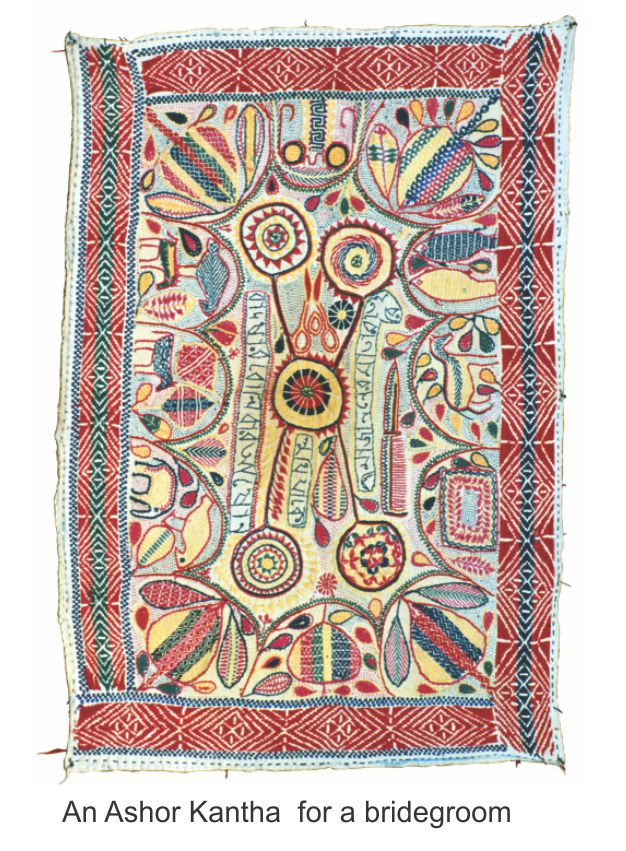
Basak has included Bangladesh and West Bengal in her study, as well as compared the kantha to other regional forms of quilting and embroidery. Perhaps the most valuable section of her book is, however, the exhaustive list of museums and private kantha collections that she provides with the number of kanthas in each. She has also given descriptions of the kanthas in the different collections. Basak’s list includes Gurusaday Museum (202), Ashutosh Museum (29), Indian Museum (5), Victoria Memorial Hall (1), Academy of Fine Arts (4), Government Industrial and Commercial Museum (5), Regional Design and Technical Development Centre ( 7), Birla Academy of Arts and Culture (1) Rabindrabhavan (1), Kalabhavan, Visa Bharati ( 33), Bangiya Sahitya Parishad (1), Ramakrishna Mission (6), Rajya Pratnattva Sangrahashala (3), Karuangan (10), Sundarban Anchalik Sangrahashala ( 4), Loksanskriti Bibhagiya Sangrahashala (4), Akshaykumar Maitrey 0 Raja Rajaram Sangrahashala ( 1), Acharya Yogeshchandra Purakirti Sangrahashala (2), Anandaniketan Kirtishala (13), Tripura Government Museum (23), Crafts Museum (14), National Museum 10), Calico Museum of Textile (17), Bangladesh National Museum (Basak notes that there are 937 kanthas in the collection; has described 5), Folklore Museum, Bangla Academy (7), Bangladesh Folk and Crafts Museum, Sonargaon (109), Bangla Ghar, the late Tofail Ahmed’s collection (17), Chittagong University Museum (1), Victoria and Albert Museum (“a large collection” of which she has described 6), Philadelphia Museum Art (50, of which she has described 18), and 15 private collections.
Of the private collections, that of Mohammad Saidur, former collector of the Bangla Academy, has 350 kanthas, of which Basak has described 100, while the collection of the late Zainul Abedin has 37 kanthas, of which Basak has described 8. Mohammad Saidur’s kantha collection is impressive, though most of the kanthas are “folk” unlike the smaller collection of the late Zainul Abedin which contain some of the finest examples of embroidered quilts.
Basak’s detailed list of museums and private kantha collections should aid any serious kantha researcher. A few more names, however, may be added to this already impressive list: Smithsonian and the Textile Museum, Washington D. C., and AEDTA, Paris. Though the Smithsonian possesses only one kantha—a gift from India—it is a magnificent specimen of this art.
Shila Basak’s descriptions of kanthas will also aid in the study of kanthas, specially as many collections do not allow photographs. However, one would have liked more examples of kanthas from the Bangladesh National Museum collection rather than the mere five that Basak had described. Perhaps Basak was unable to access the other kanthas—of which there are not the 937 mentioned by Basak but 994, according to Perveen Ahmad in The Aesthetics and Vocabulary of Nakshi Kantha: Bangladesh National Museum Collection (Bangladesh National Museum, 1997).
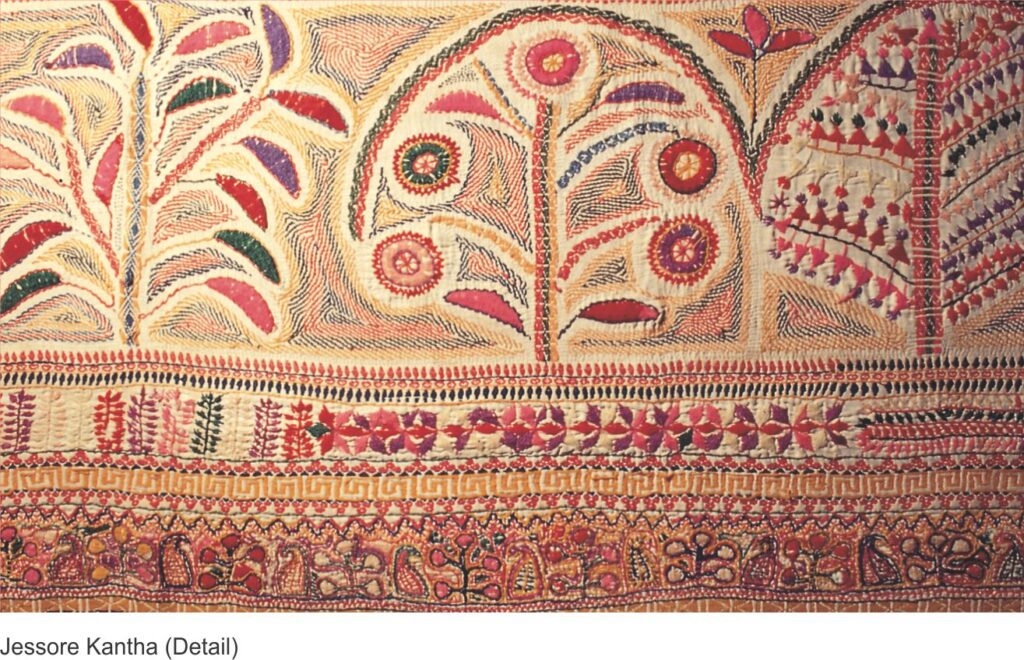
Banglar Nakshi Kantha is profusely illustrated with line drawings and photographs. There are 30 pages of photographs interspersed through the text and a 62-page kantha album at the end of the book. The line drawings of stitches, motifs, and borders should prove helpful to kantha makers, amateur and professional, as well as designers. The actual text of Shila Basak’s book is slightly over a hundred pages, not counting the pages listing the museums and private collections.
Basak provides a general history of needlework and of the kantha in particular. She refers to the excellence of needlecraft in Bengal in the sixteenth century as evidenced by the Indo-Portuguese quilts from the Satgaon region in Hughli. Basak, however, does not analyse whether these Satgaon quilts influenced the nakshi kantha, but is satisfied to point out that these quilts prove that there was a flourishing needlework industry in the region. Other chapters are on the features and characteristics of kanthas, the material and manner of making kanthas, kantha stitches, kantha borders, different types of kanthas, the relationship between alpana and kantha, different kantha articles such as sujni kantha, lep kantha, bayton, etc. Basak also examines different forms of embroidery and quilts from other regions of India such as Kashmir, Gujarat, and Rajasthan as well as the relationship of the nakshi kantha to the nakshi pitha ornamented rice cakes and gayna bori (literally jewellery balls), lentil balls made in designs resembling gold and silver ornaments.
Basak’s tenth chapter traces literary references to kanthas. Beginning with two references to kanthas in Chaitanyacharitamrita, she quotes from Chaitanya Bhagavat, folk songs, Baul songs, oral rhymes, Rabindranath Tagore, Kazi Nazrul Islam, Jasimuddin, modern poetry and marriage songs. It may be noted, however, that it is only in Jasimuddin’s poem Nakshi Kanthar Math and in the modern poem and marriage song that the term “nakshi kantha” is used. Whether references to kanthas is as a poor man’s winter blanket, a fakir’s hold-all or an example of women’s art, the term used is simply “kantha.” Thus, in the example from Rabindranath’s short story, “Panaraskha,” the narrator describes how Rasik uses threads of different colours to embroider a variety of motifs in a kantha not a nakshi kantha which she is making for her friend.
Basak also has a chapter on the kantha revival in Bangladesh and West Bengal. She enumerates the different organisations that have revived the kantha, albeit in non-traditional forms. Basak also includes the names of individuals who are actually involved in making kanthas in both Bangladesh and West Bengal and provides photographs of the craftswomen as well as the kanthas made by them.

Basak’s book is an excellent addition to the slowly growing number of books on kanthas. It is perhaps most valuable in that it is available in Bangla and is also profusely illustrated. However, one would hope that in a future edition of the book, Basak would also trace the growth of the term “nakshi kantha” for this art form. Kramrisch, Dutt, Dineshchandra Sen and others use the word “kantha” even when referring to embroidered ones. It was poet Jasimuddin who perhaps first used the term “nakshi kantha” in his ballad Nakshi Kanthar Math. In the several examples that Basak has given from oral literature and songs which predate Jasimuddin’s poem, the term nakshi kantha is not used. The marriage song she quotes from is one she heard in Bangladesh in 1990. In other words, it was probably the popularity of Jasimuddin’s poem that led to kanthas being called nakshi kanthas—and as those of us who are familiar with the term from the 60’s know, it was then used for red, cross stitch Rajshahi quilts. It was only after the kantha revival in Bangladesh that the term “nakshi kantha” started being used for kanthas using the running stitch. The term has become popular in West Bengal as well, but the debt to Jasimuddin and Bangladesh is not acknowledged.
Basak could also have been a little more analytical, instead of remaining content with narration, description and quotation. For example, she quotes Stella Kramrisch’s reference to the “magic” of rags. However, Basak makes no comments on this, and neither agrees nor refutes this. It would be helpful to readers if she had noted whether the people who use kanthas believe in the magic of kanthas or whether this is merely a westerner’s idea.
An English version of Basak’s book would be helpful for readers who do not know Bangla as the kantha has by now spread beyond the land of its birth. Quilting books and embroidery books give details about making kanthas—unlike in West Bengal and Bangladesh, in the West needlework is a hobby for many people, rather than a form of livelihood for the poor and disadvantaged. A folk arts and crafts seminar organised by the Shilpakala a few years ago brought in a young Australian woman who did needlework inspired by kanthas. An English edition would help readers and kantha makers like this young woman.
Niaz Zaman is Professor of English at the University of Dhaka
Shila Basak, Banglar Nakshi Kantha. Cover design Krishnendu Chaki, Embroidery Suryabarta, Santiniketan. Ananda Publishers, 2002, Rupees 1000, pp 326. Shila Basak’s Banglar Nakshi Kantha has fulfilled the need of those who have bought a kantha and would like to know more about it or have bought a book on kanthas and would like to have…