
an art of survival the landscape architecture of kongjian yu
text and photographs from the office of turenscape
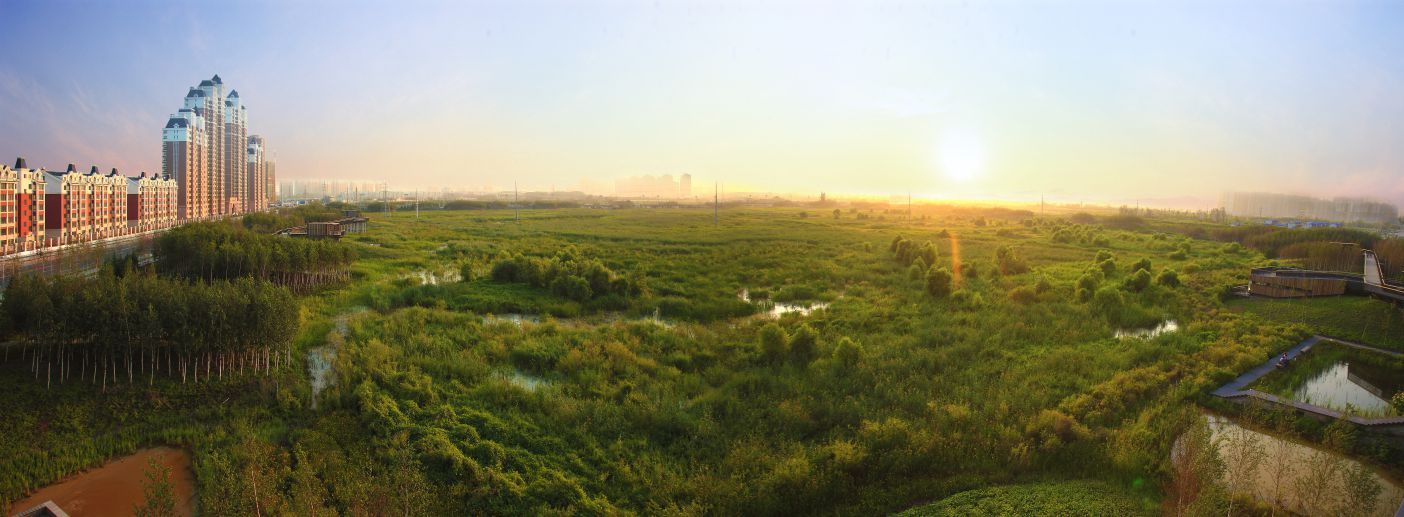
Kongjian Yu and his office Turenscape are beyond doubt the foremost landscape architecture practice in China today. To many, writes William Saunders in Designed Ecologies: The Landscape Architecture of Kongjian Yu, Kongjian Yu is the Frederick Law Olmsted of China. The vast scale of China and her apparently boundless growth have enabled Yu to test many ideas that are still largely theories in the Western world.
Kongjian Yu describes landscape architecture as an art of survival. This is particularly relevant for China with its explosive urban growth and its consequences, especially catastrophic effects on the environment. In an interview with Time Magazine, Yu declared that China misconstrued what it means to be developed. In the changing relationship between land and people, there is an urgency in China to develop a new system, a new vernacular to express that relationship.
“The new language,” Yu declares,“should be native in terms of material and plant use. Secondly, it must be for the common people, normal people. We should not consider this high-culture, traditional landscape gardening as the solution for modern China. We should find a new solution, which I call the vernacular – a new technology for common people from local vernacular materials.”
Yu calls his practices Turenscape. “Tu-ren is two characters in Chinese. Tu means dirt, earth, the land. Ren means people, the man, human being. Once these two characters come together, it actually means earth man, which also expresses my understanding about land and people. It’s a relationship between land and people. The firm’s ideology, or the firm’s concept, is to create harmony between land and people. Turen and scape. It’s dirt man landscape, or earth man scape. Earth man landscape.”
The new language should, instead of being ornamental or geared towards pleasure making, address the issue of survival. The question of “survival” is especially relevant for China, as well as other Asian nations. Citing a crisis of energy, serious shortage of water, and pollution of whatever water is there, and sounding apocalyptic, Yu points out that we are at the edge of survival, because we all have only 7 percent of natural resources – water, energy – but we have to take care of 20 percent of the world population.
In China, the issue of survival affects not only the higher classes but common people, including farmers, or a class defined by “low culture.” Since it is the so-called low culture that is far more effective with survival skills in a precarious environment, Yu proposes developinga new set of survival skills based on that culture. In his book, The Beautiful Big Foot, Landscape as Ecological Infrastructure, Yu argues for an ecological ethic that is messy, fertile and organic – characterized by the beautiful big foot – seen in contrast to the aesthetics of the little foot favored by China’s privileged class for thousands of years that sacrificed function in pursuit of ornamental and cosmetic values. Calling it ‘Little Foot Urbanism,’ Yu sees its manifestation in newer landscapes, cities and buildings that are unhealthy, deformed, and deprived of functionality. The path to well-being and healthy environment is through the ethic of the beautiful, big foot.
KA
text and photographs from the office of turenscape Kongjian Yu and his office Turenscape are beyond doubt the foremost landscape architecture practice in China today. To many, writes William Saunders in Designed Ecologies: The Landscape Architecture of Kongjian Yu, Kongjian Yu is the Frederick Law Olmsted of China. The vast scale of China and her…