

12th asian art biennale bangladesh, 2006 the good, the bad, and the indifferent
The 12th Asian Art Biennale, Bangladesh 2006, held from 5 to 31 March, is undoubtedly the biggest art event of the year in Dhaka (the exhibition doesn’t travel outside Dhaka). In a country where art and culture is usually a low priority item in the government budget allocation, the Biennale is given generous funding and a high profile. No less a person than the Prime Minister inaugurates the event and gives away cash prizes to the top award winning artists. In addition to the art galleries of the Bangladesh Shilpakala Academy, the host organization, two other venues display the art works. A two-day seminar is also held as part of the Biennale calendar. This year the focus of the seminar was on ‘Gender Perspectives in Asian Art.’ The seminar was fairly well-attended, and some very fine papers were read out, followed by the usual Q & A sessions

The term ‘Asian’ is, however, increasingly becoming a misnomer, as countries as far away from Asia as Cuba and Brazil are taking part. This year, out of 33 participating countries, as many as 11 were from outside Asia. The time has come, therefore, to rename the event. How about ‘Dhaka Biennale’?
Besides renaming though, the Biennale also needs some rethinking. The event began in 1981 rather modestly, but with full participation from India and Japan, along with a few other countries. Over the years, however, the focus shifted from quality to quantity, with the result that even countries from two continents away were happily accommodated under the rubric ‘Asian.’ The expansion beyond Asia was initially a move to include Australia and some Pacific countries ‘as a gesture of friendship.’ But with such a generous exhibition roster, the Asian focus was lost, and the exhibition became something of a mishmash. Today, the Biennale has no particular focus, no philosophy, and no specific aim. It is perhaps the only uncurated Biennale in the world, and quite expectedly, there is a wide variation in quality (there are always some entries that would be hard-pressed to find a place in an undergraduate art college exhibition). For the host country, the Biennale’s door is open to just about any artist active on the art front. This year the number of participants from Bangladesh was 168, with one artist contributing a banal landscape in glaring colours. Why was this work chosen is a big question, but its inclusion suggests that the selection process is not free from outside influence. The rather vague nature of the Biennale rules regarding media and materials allow participating countries to send art works of their choice. Thus, this year, Cuba and Australia sent photographs, although Bangladeshi artists are discouraged to submit them.

An important feature of the Biennale is the prominence given to installation art. It was Japan which first introduced this brand of art work in one of the first Biennales which caught the imagination of our younger artists. It won’t be out of place to mention here that the enthusiasm for installation art in Bangladesh owes much to Japanese inspiration. This year, the two top prizes went to installation art–one by a Japanese, and the other by a Bangladeshi artist. Japan has been providing consistent support to the Biennale, sending imaginatively-curated exhibitions and taking meticulous care in mounting the displays. India, the other country that took the Biennale seriously in the beginning but scaled down its involvement in the last few events, stayed away from this year’s exhibition. Why it did so is anybody’s guess, but one hopes that it was not because India feels that the Bangladesh Biennale has lost its character or its initial promise. One may point out that the Delhi Triennale, India’s premier international art show, fares no better: the same eclecticism, the same mismatched entries, the same lack of focus, and the same emphasis on the number game.
Coming back to installation art: this year’s Biennale featured quite a number, and one could see how intelligently some of these have been created. Installation art has a strong conceptual base, and increasingly, it is seen to highlight contemporary issues. One such issue is the environment, which is daily ravaged in the name of progress. Hiroshi Fuji’s Installation brings environmental concerns to the fore. Fuji’s use of waste materials and plastic collections in the formal arrangement of the work, however, also points a way out: recycling, or re-configuration. If such a fine work of art can be made out of the throwaways of an omnivorous consumer culture, then it is also possible to convert the spoilers of the environment into preservers. The other Japanese artist in the exhibition, Teruya Yuken, has also used waste materials (discarded plastic bags and various junk items) to depict a consumer society that can neither give up its wasteful habits, nor wake up to the dangers of over-exploitation of the environment. The curator of the Japanese exhibition, Roger McDonald, writes in the introductory note to the exhibition that the two installationists have touched upon ‘the concerns of the French Situationists and their theory of detourne, of re-directing the energies and uses of everyday things for different purposes.’ McDonald also points out that the work of the two artists represents ‘forms of contemporary practice.’ Their work takes ‘multiple forms including the aesthetic, but move beyond into areas of social critique, community-making and system-building.’ He terms this form of art practice ‘socially engaged art.’ Indeed, looking at the installation pieces in the 12th Biennale exhibition, the term ‘socially engaged art’ comes easily as a descriptive label.
The largest contribution to installation-displays in the exhibition came, understandably, from Bangladesh. Dhali Al-Mamoon, one of the Grand Prize winners and a recent convert to the sub-genre, has been doing very thoughtful work. His 2004 work, Water is innocent was about the large-scale destruction of the ecology of the Chittagong Hill Tracts when a dam built there resulted in the inundation of huge tracts of land. Water spilling from the dam submerged entire valleys. Kaptai lake, thus created, not only subsumed crop lands and habitations, but also led to the destruction of ethnic cultures. Hauntingly evoking the trauma of loss, Al-Mamoon’s work forced the viewers to look back on the whole history of exploitation and violence in the Hill Tracts. In the 12th Biennale, Al-Mamoon’s contribution, Dialogue, is not about the environment, but about the need to communicate. With a series of metal cylinders that look like blow-horns (which act as loudspeakers) hanging over inverted bowls and pictures of human heads on a tin panel cutting across the composition, the installation piece reminds viewers of the need to reach out to each other. Conversely, the composition may also suggest a dialogue in progress, in which case, it is the viewer who becomes a party to it.
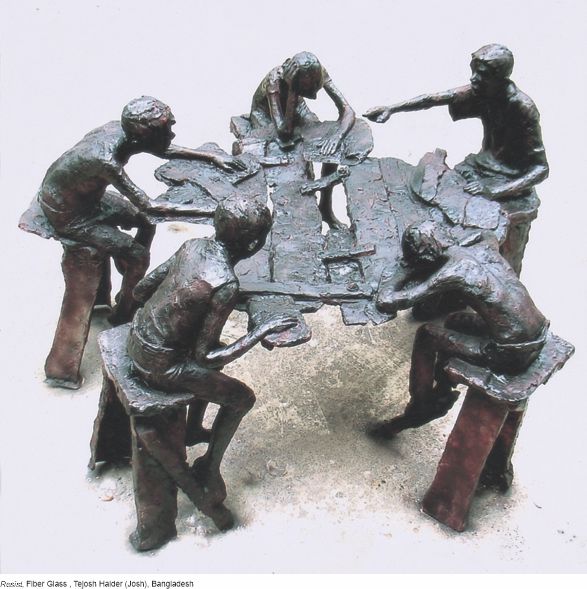
The other installation pieces that combine art and social criticism are Ashok Karmakar’s Shattered Image, Tayeba Begum Lipi’s The Game, Saidul Haque Juise’s Black Box and Mahbubur Rahman’s The Length of Time (the last two grouped under mixed media). Each of these works tells a different story. Karmakar, for example, is concerned with the threat of terrorism that seems to cripple creativity, while Lipi indulges in one of her favourite themes: the increasing marginalization of women by the patriarchy. Collectively, the works show an interpretive ingenuity, creating multiple meanings and questioning the aesthetics pursued by the establishment. For ‘establishment’, read both the male dominated social hierarchy and the conservative artistic traditions and practices that look askance at radical innovations. It was indeed heartening to see how the installation assemblages have abandoned an earlier preoccupation with size and dimension (rather sentimentally associated with ‘power’ and ‘impact’) and instead concentrated on meaning. As space and dimension are easily negotiable, viewers can relate more intimately with the works’ composition and take on their intended message and meaning. Mahbubur Rahman’s use of a short video loop adds to the interpretation of time he is aiming at. Rahman himself suggests that the work represents time and the human body –more precisely, how the body, both inside and outside, is affected by time. If the installation pieces ensured an imaginative response from viewers, the sculptures–dominated by Bangladeshi artists–by and large failed to do so. Most exhibits were uninspiring, some even insipid. One Bangladeshi artist managed to submit a piece (Musical Chair) that is clearly an imitation of the signatured style of a senior sculptor, Hamiduzzaman Khan. The sculptures, except for a few, show a lack of originality. Hardly any work challenges traditional thinking about surface construction–the formal arrangement reflecting the alignment of mass and volume, for example. If a sculptor doesn’t journey beneath the surface of a work and release its energy and provide a direct version of perception, it tends to become bland, and remains confined within its dimensions. A few artists, however, have been able to infuse dynamism in their work through a forceful arrangement of form and shape. In the glass fibre piece Resist by Tejosh Halder (Josh), the five figures sitting around a table are locked in a symmetrical design, but the angularity of the figures and the broken contours of the table lend a certain intensity to the whole design. In the composition, the five boys satirize the adult preoccupation with lengthy and futile discussions on just about everything. There is a mixture of agitation, listlessness and lethargy in the boys’ gesture, but Halder has skilfully distributed the weight of the composition among all the five figures to suggest an impasse. Resist is an excellent example of how conventional arrangements can be made to serve a complex idea.
Ivy Zaman’s Dream in stainless steel and Sudipta Mallick Sweden’s The Last Part of Drama-2 are good examples of what a touch of innovation can do to otherwise ordinary compositions. Zaman’s use of paint and Sweden’s surgical stitchwork along the face of one of the figures highlight their themes. The sculptures by Abel Ramirez Aguilar of Mexico (Genesis, bronze) and Sharada Man Shreshta (Humanities . . .?, fibre glass), Laya Mainali (Lotus, aluminum) and Pushpa Sherchan (Peace Dance, bronze) of Nepal are not much different from what art shops in those countries have to offer. ‘Sculpture’ is perhaps, too much of a loaded term for these and many other works on display in the exhibition. To be fair to the artists, many of them submitted small, intimate and unpretentious art works in wood, bronze or ceramic, which then were classified under ‘sculpture.’ A better description could perhaps be metal or ceramic or wood work.
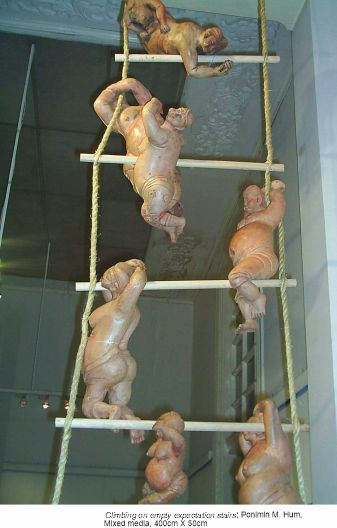
However, when it comes to mixed media, which allows a degree of freedom to the artists to mix and match and range across media and materials, the Biennale displays showed a lot of promise. The list of really exciting works begins with the Indonesian artist Pronimin M. Hum’s Climbing on empty expectation stairs, where Fernando Botero-like figures attempt to climb a rope ladder. The figures are variously placed, but each shares the same empty zeal for success suggested by the sameness of their anatomy, their nakedness and their vacant looks. Kuhu of Bangladesh with her King of the road, has made a spoof on the fearful trucks, considered the most dangerous vehicle to ply on our highways. Her wooden bench looks like the front part of a truck, and is heavily painted over a la truck art. Kuhu thus appears to domesticate the king of the road and dispel the notion that trucks are killers, but the addition of a steering wheel on one side of the bench ironizes the idea of repose, and induces anxiety. In a similar vein, Pranab Mitra Chaudhury (Millenium Window-2) and Abdullah Al Mahmud (Sin in my feeling and position, which is basically a wooden chair) show the possibilities the media offer when one is willing to think through an idea to its abstracted end.

Increasingly, in Biennales and other prestigious art exhibitions in the West, video installation has beens replacing painting and graphic art, or at least claiming a bigger share of the display space. The 2005 Venice Biennale is a case in point. The art establishment here in Bangladesh is still reluctant to accept the claim of video installation as art, although quite a few younger artists have turned to the art for the challenges it offers. When in the last Asian Art Biennale, one of the top prizes went to a video installation, a newspaper article denounced the choice fearing that this would ‘open the floodgates of gimmick art.’ A visit to the galleries of the 12th Biennale should have reassured the writer of the article that nothing like that is happening; at least not yet: the overwhelming focus is still on the painterly tradition. Video installation in the scale seen elsewhere appears as distant a prospect for the time being as, say, action painting, which has no practitioner in Bangladesh.
As the Biennale rules leave the entire selection process to participating countries, there is often a whole country-exhibit where not a single artwork stands out. It was disappointing to see poor participation from such countries as Maldives, Myanmar and Mexico. I wonder why Mexico sent such uninspiring specimens of what appears to be purely academic work. For a country whose modernist art tradition has been enriched by the likes of Frida Kahlo and Diego Rivera, just to cite two names who enjoy a good following here in Bangladesh, such downscale participation points to either a lack of enthusiasm for overseas exhibitions (particularly in a ‘developing’ country) or a lack of young talents to choose from. Knowing the rich history of modern art in Mexico, one would easily conclude that the former is the case.
Some countries, such as Mongolia and Bhutan, have sent in art works that are squarely placed within tradition. The two mixed media entries by Kama Wangdi of Bhutan, Mudra I & II are reminiscent of Thanka painting, and are well-executed. However, once the artists stray into modernist terrains, the result is anything but happy. An example is Maiyesh Tamang’s poorly done expressionist piece in acrylic, Cold Fire. Again, well-thought out curatorial policy could have denied space to such exhibits.


The exhibits from Kenya, Brazil and Pakistan have also been disappointing. Kenya sent in a series of small paintings, all depicting various life-scenes, but none deserved a second look. Brazil was a dark horse as none of the contemporary Brazilian artists have ever been exhibited here. But if the works in the Biennale are any indication, the country must be passing through a crisis in creativity, although the short introduction to the Brazilian exhibition by Antonietta Tordino claims that there is ‘vigorous creativity’ on the Brazilian art front. Except for Jose de Quadro’s Maria Rosa (in acrylic) the other works are eminently forgettable. One naturally suspects that Brazil too, like Mexico, hasn’t taken the Asian Art Biennale seriously.


If India disappointed us by its absence, Pakistan did so with its meagre presence. Except for Gulgee, who is considered a master-painter in Pakistan, the onus of the country’s participation had to be borne by Sumaira Tazeen and Ali Kazim, since the work exhibited by the other artists were uninspiring. Tazeen’s series in mixed media explored love, desire, the male and the female etc. Done with imagination and vigour, the works display her sure grip on style and form. Kazim’s two watercolours are superbly done, revealing the influence of AR Chugtai and the orientalist tradition. But the question remains: where are the talented young artists, many of whom, in recent years have earned international acclaim? And where, pray, is the curating standards of the like of Selima Hashmi?

Jordan too had sent better works before. So had Sri Lanka.
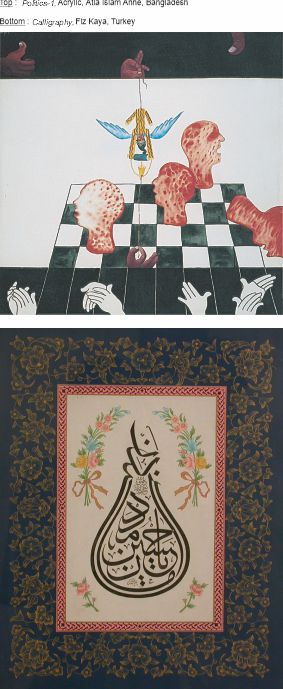
Iran’s Sedaghat Jabbari won a grand prize for his Holy Names. Nothing original–just a new mixed media rendition of old style calligraphy. One wonders if the painting was not rewarded more for the content than its total impact as an artwork. To this viewer at least, the work looked pretty ordinary. In contrast, a couple of calligraphies by the Turkish artists Sahahat Ozcan and Halil Asikgo looked far more composed and intriguing (the way the artists use loops, floral designs embellishing the script, and diacritical marks suggests their insightful understanding of the tradition of calligraphy).
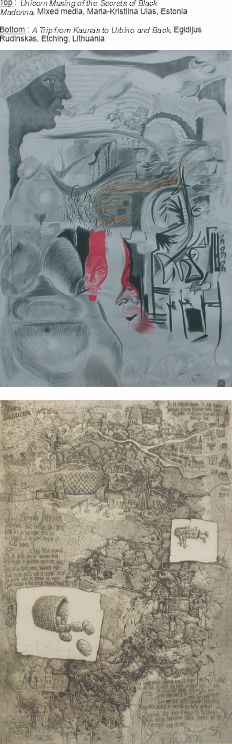
As far as other countries are concerned, Lithuania and Korea clearly had the edge. Lithuania sent prints–etchings, etching/aquatints, woodcuts–that show a mastery of technique and composition. From Korea, the mixed media work Seasonal by Ae Jae Lee and Time escape-lamp by Chang Kyeun Jung display a fine balance between content and form. Lee’s work takes its organization from nature and the seasonal cycle but garnishes it with traditional motifs. Its formal simplicity and its reiteration of the soothing powers of nature turn the work strangely evocative.


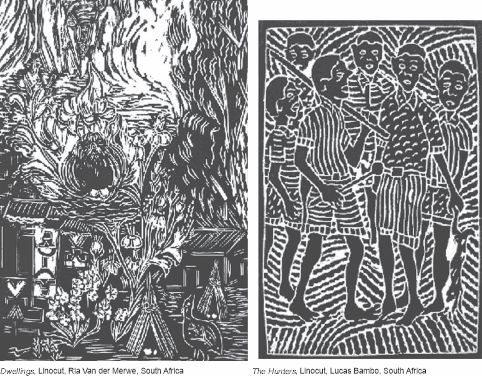
There were other works too, that invited more than a cursory glance. The two linocuts from South Africa, for example (Dwellings by Ria van der Merwe, and The Hunters by Lucas Bambo) evoke pictorial traditions with roots in the community. The linocuts are powerful and dynamic. Unfortunately, the same cannot be said about other works on display from that country.
The Bangladesh section was certainly the most prominent, both in terms of the number of exhibits and, to some extent, quality. All entries in the Biennale compete for prizes which works as an incentive for the artists to submit their best. Some of these were certainly of high calibre. Younger artists–those in their 30s and 40s– occupied the bulk of display space, and many were quite competent. Overall, the exhibition reflected the artists’ ability to relate to changing trends in art worldwide, and where necessary, assimilate them and use them to suit their own expressive skills.

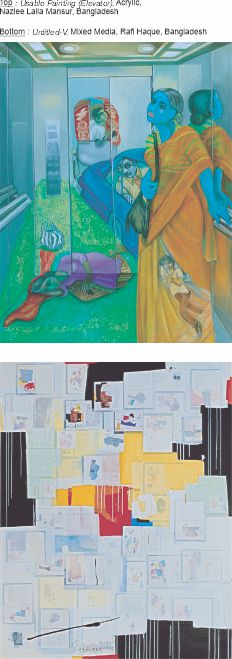
If one considers the development of Bangladeshi art in the last twenty-five years (when the Biennales first started) one notices a resurgence of narrative tendencies and a renewed predilection for figural representation. Abstract expressionism of the kind practiced in the 1960s is on the wane. There is a markedly postmodern sensibility at work, reflected in the depiction of shifting identities and in the questioning of the metanarratives of our time (including power structures and entrenched traditions). There is a fusion of folk and urban themes, resulting in some kind of urban folkism ( an example is Zahed Chowdhury’s mixed media work, An exclusive moment of “Arabian Night”). Art today also contains a fair degree of social criticism and highlights issues of ethnicity and gender. The 12th Biennale highlighted most of these trends and preoccupations. The works by Nazlee Laila Mansur’s, Usable Painting (Elevator) and Usable Painting (Swimming pool), and Atia Islam Anne’s Politics I, also in acrylic, stand out for their mixture of irony and social criticism, their flouting of conventions and, in the case of Mansur, her incorporation of folk design elements to make a statement on the sordid nature of our existence. Shulekha Choudhury’s My Time-17 (acrylic) conveys a feminist vision, while Kanak Chanpa Chakma’s mixed media work Bain-2 uses different ethnic implements of weaving (including yarn balls and weaving needles) to recreate a tradition fast losing out to machines. Wakilur Rahman’s Water, Script in watercolour is a brilliant work, reestablishing the appeal of the written word. Two intriguingly beautiful works are Mohammad Fokhrul Islam’s Image (1) in oil and Ranjit Das’s Bridge to the Door-IV in mixed media. Nasreen Begum’s Eternal Bangla (acrylic) is profoundly evocative, even nostalgic, in its simplicity. Ahmed Nazir’s The war file 9 and 10 are mixed media reconstructions of X-ray plates showing shattered skulls. These are self-explanatory. A few abstractions also stand out M. Mominul Islam Reza’s Painting 2 (oil), Nasim Ahmed Nadvi’s Fragile-1 (acrylic), Rokeya Sultana’s Door of Heaven 2 (tempera), Gulshan Hossain’s Ancient Poem (mixed media) and Biswajit Sarker’s Affection and Flying Dream (acrylic), for example. Rafi Haque’s Untitled V in mixed media, Nagarbashi Barman’s Harmony 1, also in mixed media, Kazi Salahuddin Ahmed’s Urbanization 2, Nazia Andaleeb Preema’s Inside Dialogue using digital painting and illumination, and M. Sazzad Hossain Khan’s Self investigation 2 in mixed media are also talented works, showing how ideas and sensibilities can be imaginatively translated into enduring images.
The Bangladesh exhibition yielded a fine crop of graphic and print works. Of them, Mokhlesur Rahman (Secretion of water meadow 3, woodcut), Rashid Amin (The time of chaos and peace-1, dry point), Md. Anisuzzaman (Complexity-42, woodcut), Sheikh M. Rokonuzzaman (A journey from one reality to another, lithograph), Farah Yasmin (A happy dream-2, dry point) and Proshanta Kumar Buddha (Life-2, 3D print) have contributed richly executed pieces. Ibrahim’s Untiled 7 and Untitled 8 in pen and ink are simply breathtaking for the sharpness and poignancy of their composition.
A brief note on the photographs from Australia and Cuba: I remember seeing better photographs in the Chhabimela, an international photographic exhibition organized by Drik last year in Dhaka. Why not go for the best, especially if it involves a biennale?
Another brief note, this time on the ‘Invited Artists’ from Bangladesh: This is a well-meaning, but largely ineffectual, and therefore unnecessary, appendage to the main exhibition. The intention was to showcase some of our senior artists who wouldn’t take part in the competitive exhibition. This exhibition within an exhibition has no focus and is highly patchy. This year, one rare treat, however, was Shafiuddin Ahmed’s Rhythm of Line (mixed media), since he hasn’t participated in exhibitions in a very long time. One can form an idea of how the octogenarian is faring these days. Certainly he seems to be thriving by concentrating on line and angular forms.
I’d like to end my review with a pious hope:
Let the next Biennale see a much leaner, trimmer, more focused and, of course, curated display of works from home and abroad. Bangladeshi art has picked up the latest trends in modern (and postmodern) art as practiced in the world’s art capitals. It is time the premier exhibition of the country also picked up the practice of curating, without which no one can think of mounting such a major art exhibitions.
Syed Manzoorul Islam is a member of the editorial board of jamini
The 12th Asian Art Biennale, Bangladesh 2006, held from 5 to 31 March, is undoubtedly the biggest art event of the year in Dhaka (the exhibition doesn’t travel outside Dhaka). In a country where art and culture is usually a low priority item in the government budget allocation, the Biennale is given generous funding and…