
alive and kicking
Theatre is alive and kicking in Bangladesh. The lack of theatre infrastructure and other impediments have not been able to hold back theatre groups and they have consistently displayed burgeoning diversity and a firm commitment to theatre
Theatre critics and others involved with the theatre pinpoint Drama Circle as the pioneer of the theatre movement in Bangladesh. The Circle was the first to realize that theatre involves more than staging an annual office play, that it has its own language, different from that of other forms of art, and that it can be a wonderful platform to highlight the contentious issues and concerns of society. It is apparent from their productions in the early 1950s such as Oedipus that they made a conscious effort to break away not only from rank amateurism but also from the cheap commercial theatre that characterized Dhaka in those days.

Drama Circle’s early 1960s productions such as Raja and Raktakarabi by Rabindranath Tagore and the absurdist Milepost by Syed Ahmed speak volumes about their effort to connect themselves with contemporary theatre trends. In retrospect it might appear that the group was only trying to imitate western theatre patterns uncritically, but their contribution in salvaging theatre from the rut of commercialism can’t be written off. Bazlul Karim and Nasimus Saleheen, the main torchbearers of Drama Circle, understood that mere props and a storyline could not create theatre. They were aware the dramatic medium is unique and has to be handled sensitively.
Back in the 1950s Dhaka’s Purana Paltan was the nerve centre of theatre activities, mainly because Drama Circle’s office was located there. The stream of theatre enthusiasts to the Circle’s office and the rounds of rehearsals created an ambience new to the fledgling metropolis. The culturally alive atmosphere of Purana Paltan not only attracted theatre enthusiasts, it drew musicians, poets and writers as well.
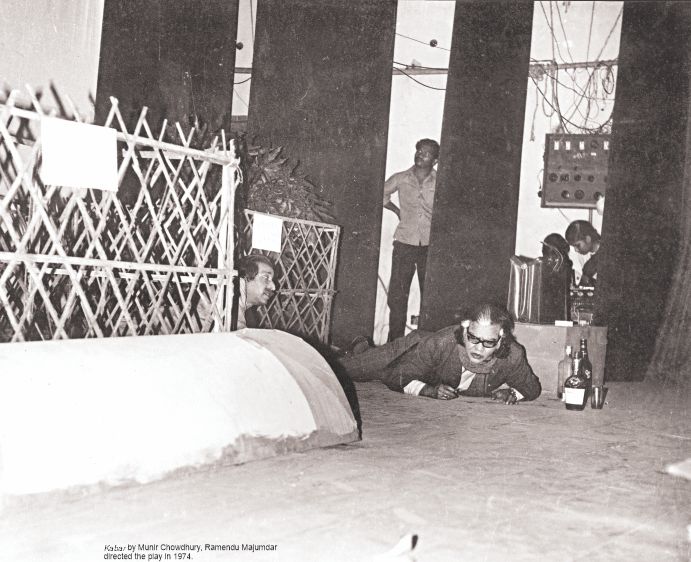
The changed atmosphere has had its impact on the television which came to Dhaka in the early 1960s. The enthusiasm and adrenalin rush associated with the theatre affected television plays as well. People who were actively engaged in the theatre also produced plays for television. One of the all-time hit television plays is Mukhara Raman Bashikaran, a television adaptation of Shakespeare’s Taming of the Shrew. Television suddenly provided actors of the theatre a new possibility to reach a greater audience and a sure road to stardom. The new medium attracted leading thespians who were excited at the possibilities and scope of experimentation on television. Kabar by Munir Chowdhury, a symbolic play protesting the killings and military excesses of the Pakistani regime, was successfully produced on Television. This suggests that television was not only perceived as a medium of entertainment but could also be a platform to express political and social concerns.

In the late 1960s another bunch of energetic theatre activists formed Nagarik. They felt the need for a professional theatre and began to organize workshops to approach theatre with professional dedication and to give attention to physical fitness and body language. The modern concept of the kind of training necessary to become an actor was taken up seriously by the group. Theatre activists would at that time be seen carrying works by Stanislavski and trying to understand the theatre intellectually.
The ‘breathing exercises that we do today were introduced originally by Drama Circle,’ says eminent director and theatre activist Nasiruddin Yousuff Bachchu. ‘The rehearsal notes of the Circle that I have had the opportunity to read focus on breathing exercises and physical fitness, just as we do today. The concept of group theatre was also introduced by the Circle. Theatre is ultimately team work and that a team should work together to achieve its goal was the motto of the Circle.’
During the same time there were brilliant individual attempts at the appropriation and incorporation of stage techniques and the structure of western theatre. Some of the stalwarts of the new theatre were Anis Chowdhury, Ashker Ibe Shaiek and Nurul Momen. Nemesis by Nurul Momen or Manchitra (‘Map’) by Anis Chowdhury were a breath of fresh air in the theatre scene of Bangladesh. But a concerted effort towards a theatre movement and the commitment to take theatre to the common people with a specific agenda is a post-independence phenomenon. The theatre movement in the true sense gained momentum after the war of independence.

Dhaka University became the cradle of the post-independence theatre groups and the group that played the pivotal role in the nascent theatre movement of the new-born country was Natya Chakra. M. Hamid has been the pied-piper in this process. With his mercurial organizing skills he managed to attract people to serious theatre. Bachchu recounts: ‘Those of us who had an interest in theatre but never thought of taking it up seriously were drawn to the stage. M. Hamid had something magnetic about him. I always knew that theatre is the medium through which I would be able to express my ideas and concerns and during the war after a guerrilla operation in the vicinity of now Bangabandhu Avenue I visited film-maker Syed Salauddin Zaki and at one point told him I would become active in the theatre movement after independence. That might have seemed like a very romantic idea at that time but Hamid was the person who assembled us so that what seemed once a dream soon became the nucleus of a new theatre.’
Significantly, most of the theatre groups who charted the new course or injected new ideas into the theatre movement were established in 1972-73. The euphoria of winning independence in ’71 and the attendant hopes and aspiration associated with building a new country must have been the driving force behind the electrifying activities in the theatre world in Dhaka in the seventies. There was a strong desire to reinvent and redefine the traditional theatre practices of pre-independent Bangladesh. Theatre groups were particularly on the lookout for a fresh idiom and new cadences to express and communicate their new-found freedom to the audience. Language was one of the major concerns in the early years of the theatre movement as also was visualization, i.e. stagecraft. The groups were consistent in their experimentation with forgotten traditional theatre or the appropriation and adaptation of contemporary European techniques. 1972 was also witness to the publication of Theatre, a quarterly, edited by Ramendu Majumder, which created a platform for intellectual discourse on the issues and challenges of contemporary theatre.


‘I never knew that I would be involved in directing plays, comments Bachchu. ‘After independence when Bazlul Karim reopened Drama Circle I immersed myself in the theory and practice of set designing and learned a great deal about stagecraft while working with him for his production of Arms and the Man by George Barnard Shaw. Raisul Islam Asad and Bulbul Ahmed, two men who would leave their mark in the stage and on television, acted in the play. The experience we gathered at Drama Circle proved crucial, when, drawn by the magnetic personality of M. Hamid, we formed Natya Cakra in 1972.’
There were two very important factors that helped the theatre movement to gain momentum at its nascent stage. The first was the wholehearted support of the student organizations of Dhaka University. Student leaders were easily convinced that theatre was important for a newly-independent country. The second crucial factor was the interest that university teachers took in the theatre. Organizational support is always crucial in any arts movement and the enthusiasm that greeted the early endeavors of the theatre movement provided great impetus to the cause of theatre in independent Bangladesh.
During the same time Mamunur Rashid staged Kabar (‘Grave’) by Munir Chowdhury at Bangla Academy. In February 1972 the Bahubachan theatre group was formed and they brought to the stage Farhad Mazhar’s Prapatir Lilalashya. It was also the first play in the history of Bangladesh theatre that charged entrance fees from theatre-goers. They brought three more plays to the stage in ’72, Shabhapati Balben, Aami Raja Habo Na and Selim Al Din’s Sharpa Bishayak Galpo.
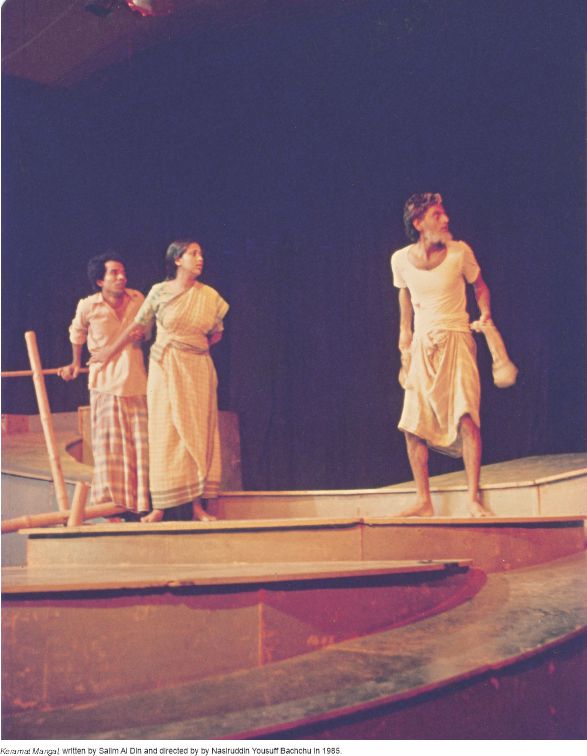
All the important innovations in post-independent Bangladesh drama were made by groups with strong feelings about language and the theatre. Bahubachan declared that ‘For us drama is not just theatrics. Our drama is a rebellion against the age-old structure of the theatre.’ Established also in February 1972, the theatre group Aranyak Natyadal believed that the history of the arts is as old as the history of human struggle. They have a common aim and they complement each other. ‘As a theatre group we are loyal to art, but our loyalty is even greater to our people.’ Aranyak’s loyalty to the portrayal of human struggle is as strong as it was in its formative years. Their recent production Rarang bears testimony to that loyalty. Written and directed by Mamunur Rashid, Rarang is about the 1855 armed resistance against the British Raj by the ethnic tribal group Santal. This was the first recorded resistance against the British colonial power in the sub-continent. Rarang, a Santal word, meaning drum beat.
Formed a year later in 1973, Dhaka Theatre stands out amongst post-independence theatre groups for initiating a radical self-examination of contemporary theatre. The group, led by director Nasiruddin Yousuff Bachchu and playwright Selim Al Din providing experimental dramas, is concerned with the elaboration of theoretical structures and the staging of plays that contest the dominant western ways of staging things. In fact, through their productions they have sought to blend indigenous theatre with western theatre. They have challenged the norms of colonial theatre and resurrected traditional Bengali theatre which dates back to a thousand years. They argued as early as 1973 that the best hopes for the future of Bangladesh theatre lies in the possibility of a revival of deshi theatre seen through contemporary eyes and have expressed their commitment ‘to the staging of deshi drama because that mirrors the life of the freedom-loving people of the country. Our aim is to construct a national dramatic style.’ Extraordinarily inventive, the plays staged by Dhaka Theatre challenged the limitations of the medium and reinvented a style suitable for the urban recreation of folk elements.

Dhaka Theatre has also experimented with the language of the ethnic theatre of Bangladesh and set up a village theatre organization to revive traditional theatre. With over 200-member organizations, the village theatre movement launched by the group has spread its wings to the remotest corners of Bangladesh.
Char Kakrar Documentary in 1977 by Dhaka Theatre is important in many aspects. In the play, Salim Al Din brought in elements of magic realism. In directing the play, Nasiruddin Yousuff Bachchu moved away from the presentation of linear storytelling and broke down Stanislavskian modes based on the logic of continuity. The duo’s later plays were instrumental in establishing a new theatre language outside the paradigm of Western theatre. One of the street dramas perfected by the play, Char Kakrar Documentary thus tells the story of a fisherman who is a stranger to the metropolis; his story has a compelling strangeness for city audiences. The protagonist tells the audience that the killing of fish draws the wrath of the sea and the resulting typhoon is the reason for their sorry plight. The drama was acted at various locations in the city. ‘We wanted to perform plays for office returnees, to create awareness about theatre, and to show that theatre speaks the language of common people. And also to protest against the military regime of the time,’ says Bachchu. Quite understandably, Bachchu and four others were arrested for performing Char Kakrar Documentary on the streets.

Then in 1981 a major event took place, making the use of the word avant-garde entirely relevant to Bangladesh theatre. Bachchu brought Salim’s Kittankhola to the stage and the play split the barriers erected between the arts, introduced stylistic impurity as a desideratum, and shook up ideas of stable forms. Kittankhola was the culmination of Salim and Bachchu’s long engagement and exposure to traditional Bengali art forms. The drama dismantles the Western notions of climaxes in plots; instead of the linear progression of a storyline a number of disjointed stories run parallel in this truly groundbreaking drama. A village called Kittankhola where a fair takes place is its setting. The fair draws a bevy of people of different castes and creeds, each of whom has his or her story to tell. Stories, legends, myths cut across, mingle in the drama which apparently has no centre; songs, jokes, and vaudeville techniques dominate narrative becomes tangential. For the play Bacchu conceived the whole of Dhaka’s Mahila Samity auditorium as the stage and imaginatively used all its entry points and passages so that they resembled roads leading to the fair.
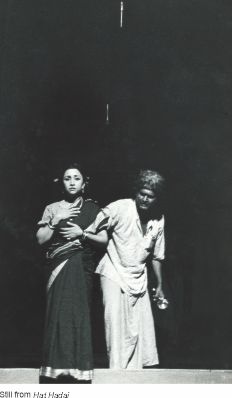
Without a doubt Kittankhola posed a serious challenge to the concept of old-fashioned proscenium theatre. The group’s subsequent productions are also notable for their bold attempt at de-centering and de-westernizing Bangladeshi theatre. Reflecting on the vacuum in Bengali theatre after Rabindranath and the drought that continued till the post-independence resurgence Salim Al Din says, ‘We have failed to bring onto stage one of the our most gifted novelist and playwrights Syed Waliullah. His drama Ujane Mrittu is a brilliant commentary on the existential crisis of human beings. Our theatre movement would have richly benefitted from a dramatization of his works.’
Nagarik Natya Sampradaya is perhaps the most eclectic of the country’s groups. It has experimented, adapted, and staged a rich variety of European and contemporary Bengali dramas. They are known best for their brilliant adaptations of Beckett’s Waiting for Godot and Bertolt Brecht’s The Good Woman of Setzuan and Galileo. Over the years they have tended to perform plays that are poles apart from each other in content and character. On the one hand they have adapted plays by Edward Albee, Samuel Beckett, Bretolt Brecht and Albert Camus and shown a preference for works that make an absurdist commentary on life, and on the other hand they have expressed their love for Shakespeare, Moliere, Chekhov, and Rabindranath Tagore. Though Nagarik was established in 1968, their first stage production was in 1972, the most significant year in the history of the Bangladesh theatre movement. For the group ‘Good dramas are not bound by time or a location or a boundary.’ Their allegiance to all-time classics as well as contemporary European experimental dramas has added a rich and colourful variety to their productions over the past three decades.
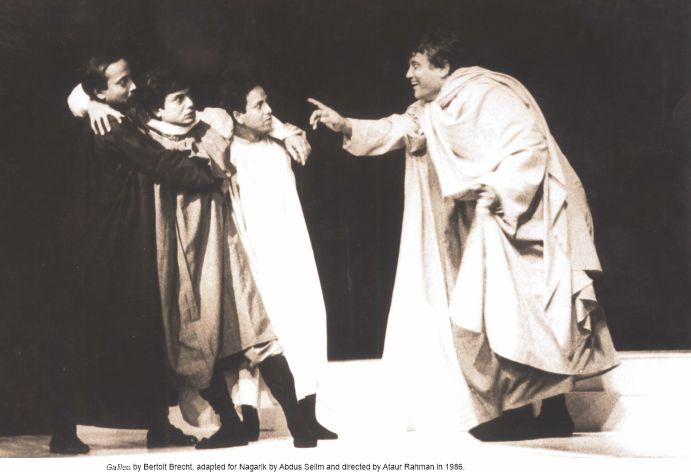
Unlike Dhaka Theatre, Nagarik’s focus has always been on appropriating and adapting European plays and on staging classics. Challenging western norms has never been their preferred area of intervention. However, they have also successfully brought onto the stage works by Bangladeshi playwrights such as Syed Shamsul Haq, Humayun Ahmed, Sayed Ahmed, and Nasreen Jahan. The 1983 production of Syed Shamshul Haq’s Nuraldiner Sarajiban is an extraordinarily experimental work by Nagarik. Set in nineteenth century Bengal, the drama tells the story of an obscure peasant rebellion against the British Raj that took place in the remote district of Rangpur in northern Bangladesh. Using the local dialect as the basis of the dialogue, the play reincarnates a true subaltern hero, Nuraldin. The speeches of the characters in the play are inspiring, quaint, comic and convincing, effects which has been possible because of the careful observation of colloquial habits by Haq. It is a brilliant example of the success that can be achieved by the theatrical exploitation of local dialect and a notable experiment in Brechtian epic theatre. Syed Haq, an outstanding poet as well as a dramatist, in an earlier play called Payer Awaz Pawa Jay written for Theatre (Bailey Road) had first used local dialect and made a significant attempt uniting poetry and drama in the Bangladesh theatre. Set against the war of independence in 1971, Payer Awaz Pawa Jay captures the strong emotions of that turbulent year of our history. Though the play enjoyed phenomenal success and had 110 shows its union of poetry and drama did not inspire subsequent playwrights. Syed Haq thus remained unique, inhabiting a territory he has pioneered in this country. One reason must have been that no other major poets were drawn to the theatre. Haq feels the same way Eliot felt about poetic drama and argues, as did the English writer in 1928, that ‘The human soul, in intense emotion, strives to express itself in verse.’

Theatre (Bailey road) started as did other well-known groups in the magical year, 1972, but began to put on regular shows a couple of years later with Subachan Nirbasane, written and directed by Abdul Al Mamun. An instant hit, the play is particularly scathing about the moral degradation everywhere evident in post-war Bangladesh. The group has been, from its very inception, committed to the notion that drama is the portrayal of contemporary life. ‘The life we lead everyday should be the content of drama. The crisis of the time should have a reflection in plays and we have over the years tried to depict the life that we see everyday around us. Even when we have adapted plays like Dream on Monkey Mountain by Derek Walcott or Lee Blessing’s Independence, our major concern was finding their relevance for our society,’ elaborates director-member of the group Ramendu Majumdar. ‘We are aware that repetition is a deadly enemy of creativity and you will see we always invite young directors to take care of our productions. This is one way to inject new ideas into style and presentation,’ adds Majumdar.
Padatik Natya Sangsad, a younger group, started off their journey into the world of the theatre with Jasimuddin’s Sojan Barider Ghat. In a world that is fast changing, Padatik is for progress. The group takes its nourishment from local culture but is open to newer innovations in the west. The group’s recent production Jalbalika is a rendition of a family’s struggle to stay alive in a dinghy caught in strong flood currents. At one point the head of the family Joy Baul sacrifices his daughter and saves his son. The climax of the drama highlights the treatment of the female child in our society. Written by Masum Reja, the drama was directed by Shamsul Alam Bakul.

There has been organizational effort to connect Bangladesh theatre to the international mainstream and the establishment of the Bangladesh Centre of the International Theatre Institute (ITI) with Ramendu Majumdar as its president in 1982 was a landmark event in the country’s theatre movement. It has enabled Bangladesh theatre to set up links with world theatre and since its formation Bangladesh ITI has organized several international seminars and theatre festivals in Bangladesh. The biannual publication of the Bangladesh ITI World of Theatre, a survey of the contemporary world theatre scene has proved to be a comprehensive guide to world theatre.

A major impediment and a stumbling block in the healthy growth of theatre movement was removed in 2000 when the century old black law of censorship of scripts was annulled. This has been the result of the movement initiated by the Bangladesh Group Theatre Federation from its very inception as the apex body of theatre groups in 1980. It has nearly 300 theatre groups as its members and they all have the common goal to improve the overall condition of the Bangladeshi stage and to fight against all obstacles faced by the theatre groups of the country.

The most heartening aspect of Bangladesh theatre movement is that while the older groups who pioneered the movement are still active and keen on experimenting with new forms and ideas, the newer groups are contributing regularly to an ever-vibrant theatre scene. The search for a deshi theatre language initiated by Dhaka Theatre or the eclectic and sophisticated style of Nagarik or Theatre’s ( Bailey road) interpretation of the contemporary have given great variety to the Bangladeshi theatre scene in the last three decades; what the theatre language of the groups of the country will be in the coming years remains to be seen, but one thing is sure: the passage to the new world of theatre in this part of the world will continue to be exhilarating for everyone concerned with it.
Ziaul Karim is the Executive Editor of jamini
Theatre is alive and kicking in Bangladesh. The lack of theatre infrastructure and other impediments have not been able to hold back theatre groups and they have consistently displayed burgeoning diversity and a firm commitment to theatre Theatre critics and others involved with the theatre pinpoint Drama Circle as the pioneer of the theatre movement…