
the festival of the street
The conflict that I had half-witnessed in my childhood gets enacted in A Suitable Boy when the tazia procession and the Ramlila procession clash violently. This is what Seth writes of the conflagration and we can easily see how the festival will give way to marauding mobs and the unholy consecration of houses to fires lit by kerosene and petrol

While festivals might be celebrated in tiny prayer rooms or in living rooms of different sizes, and in churches and temples of varying designs, their real life is on the street. The deeper truth that has lodged itself in some corner of my mind, ever since my childhood in small-town Bihar, is that it is also on the street that we witness the expression of the opposite of a festival–communal religious riot.
In Vikram Seth’s A Suitable Boy, the geography of the street as a site of religious festivity as well as conflict is wonderfully mapped out. Seth is describing the events of the ninth day of Moharram:
‘The routes of the tazia processions had been charted out with great care by the organizers and the police together. Hindu areas were to be avoided as far as possible, and in particular the area of the contested temple; low-lying branches of pipal trees were measured in advance against the heights of the tazias, so that neither would be damaged; the processionists were enjoined from cursing the caliphs; and timings were matched so that by nightfall all the processions throughout the city would have arrived at the central destination.’
In the novel, the ninth day of Moharram is also the day on which Bharat Milaap is being celebrated, the final day of the Ramlila, when Ram, Lakshman and Sita meet with Ram’s younger brothers Bharat and Shatrughan at the end of a fourteen-year exile. In Seth’s story, the scene is to take place on the street of a small town. As one of the characters puts it, ‘Everyone lines the lanes, cheering and weeping and showering flowers on the procession. Rama and company from the left, Bharat and company from the right.’
I was six years old when I saw such a procession for the first time. My father was a district administrator. Even at that early age, I was aware of the tension in the air. The previous year, Hindus and Muslim mobs had clashed during the Ramnaumi festival. The police had fired on the rioters. My father had felt that the firing was unnecessary. But he was blamed for the deaths. The facts are still not clear to me. But I passed many years of my childhood thinking of this experience as a taint on my father’s name.
The conflict that I had half-witnessed in my childhood gets enacted in A Suitable Boy when the tazia procession and the Ramlila procession clash violently. This is what Seth writes of the conflagration and we can easily see how the festival will give way to marauding mobs and the unholy consecration of houses to fires lit by kerosene and petrol:
Both sides were now filled with the lust to kill–what did it matter if they too suffered martyrdom? to attack pure evil, to defend what was dear to them. What did it matter if they died? whether to recreate the passion of Karbala or to re-establish Ram Rajya and rid the world of the murderous, cow-slaughtering, God-defiling devils.
‘Kill the bastards finish them off the spawn of Pakistan’
‘Ya Hussain! Ya Hussain!’ It was now a battlecry.
During a recent summer, I was visiting the Golden Temple in Amritsar. As the karsevaks moved about in the intense heat, splashing the marble slabs of the temple’s courtyard with water from the lotus-pond, I read the small plaques that had been donated by the families and regiments of Sikh soldiers killed in India’s wars with China and Pakistan. The world of warfare was not wholly removed from the world of religion and worship. This was clear even to those who might not remember Operation Bluestar, the military operation that Indira Gandhi launched inside the Golden Temple, with fatal consequences not only for the militants inside but also, some years later, for herself.
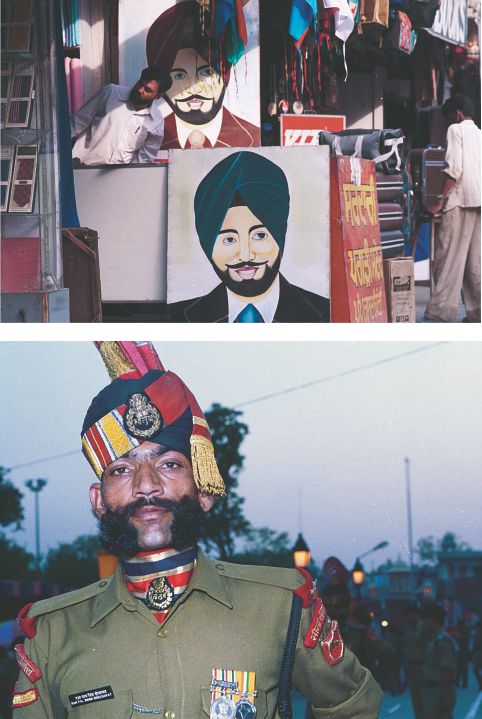
When I came out of the Golden Temple, I saw the rows of shops that sold cloth for turbans. The streets were lined with painted portraits of dapper Sikh men. Fashion, in this instance, had its roots in religion and warfare: the birth of the Sikh religion and the injunction for all men who joined the Panth that they don a beard and a turban. That same evening I drove out to Wagah, the town at the India-Pakistan border, and watched the ceremony called Beating the Retreat. Tall, mustachioed soldiers of the Border Patrol participated in the military march, disciplined and fervent devouts in the festival of war.
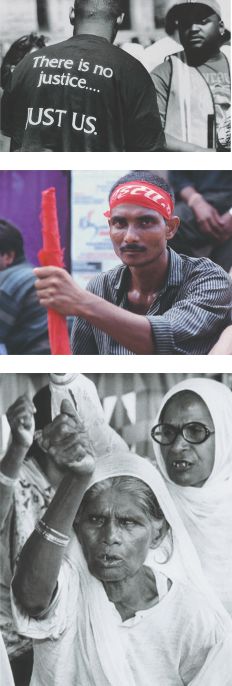
However, what makes the street the site of a real festival is the display of protest. A particularly useful example of what I have in mind is the picture I took, way back in 1991, on the street outside the Supreme Court in New Delhi, of an old woman with her fist raised, a protester who had been a victim of the Union Carbide gas leak in Bhopal. For those who have been denied a voice, the street becomes a parliament and a newsroom.
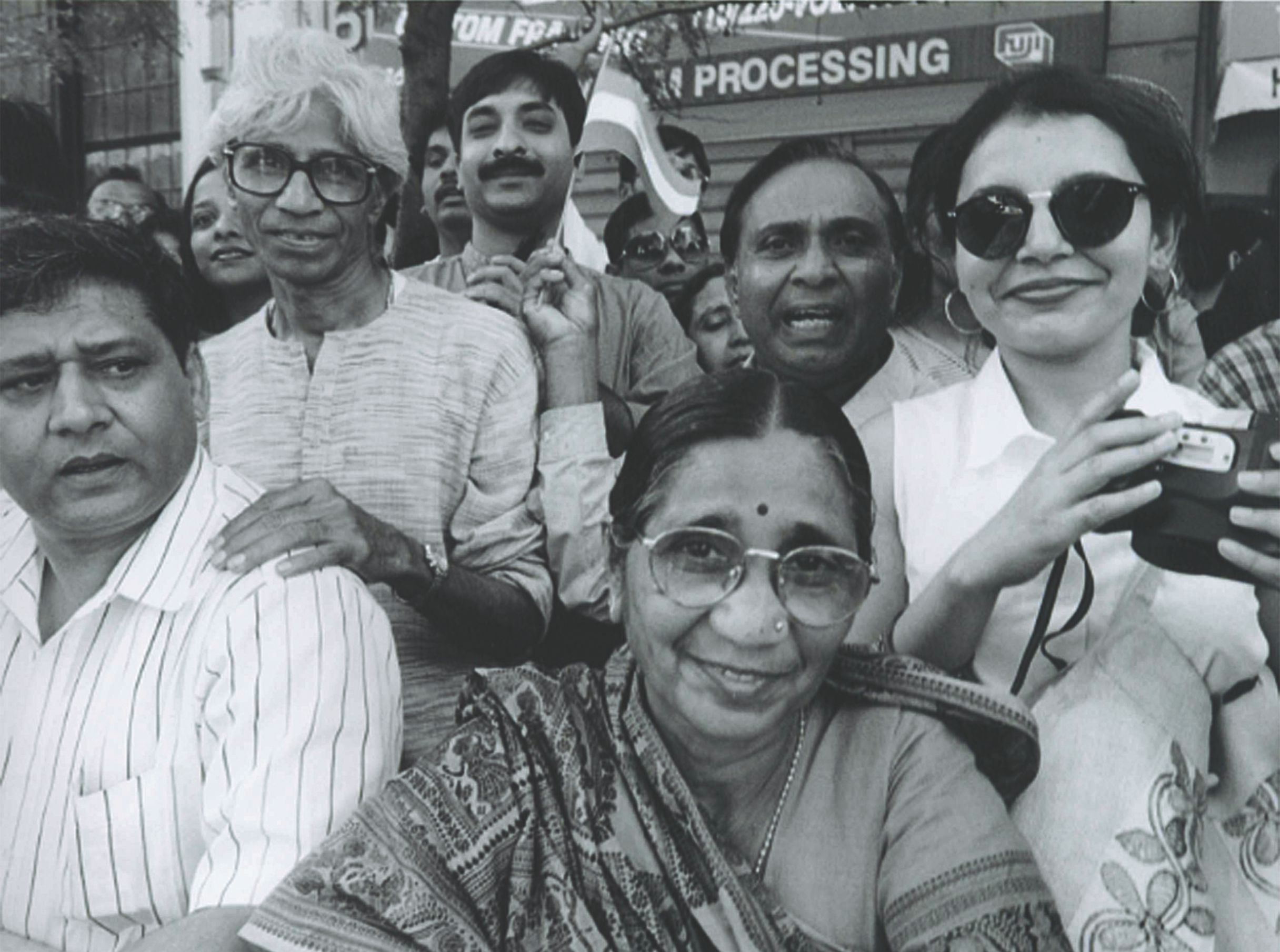
The youth with a red band around his head is protesting the nuclearization of India; he would rather have a job than the empty boast that he has the bomb. I also want to share with you two pictures I have taken in the U.S., where I have been living for the past decade and a half. The first picture, from the early nineties, is of a T-shirt (‘There Is No Justice, Just Us’) worn by a black man to protest the verdict in Los Angeles that set free the police officers who had brutally beaten Rodney King. The second picture is from New York City. I took it on Madison Avenue, while the India Day Parade was passing by. It was 1997, the fiftieth anniversary year of Indian independence, and the parade was marked by controversies over several protests from gay and lesbian groups that had been excluded that year.
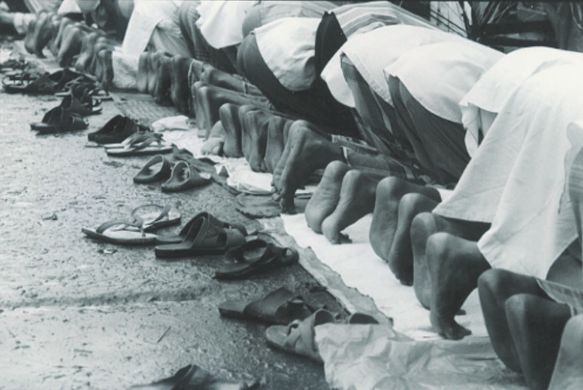
I want to end with a picture taken on the streets of my hometown, Patna. Mohammed Tufani hurried through the business of cutting my hair and, as the azaan sounded from the New Market mosque, quickly joined the ranks of the faithful who had spilled out into the street. This scene is poignant to me. More than any real place, it returns me to my childhood and to a place in my heart, a place of apprehension and prejudice and naked fear.
Amitava Kumar is the author, most recently, of Bombay-London-New York (2002). He teaches English at Penn State University
The conflict that I had half-witnessed in my childhood gets enacted in A Suitable Boy when the tazia procession and the Ramlila procession clash violently. This is what Seth writes of the conflagration and we can easily see how the festival will give way to marauding mobs and the unholy consecration of houses to fires…