
The 'Esala Perahera' sri lanka’s river of faith
‘Esala’ is the month of July/August in Sri Lanka’s age-old calendar. It is in this period that for ten nights, before the moon waxes to an unreal brilliance, that people from every corner of the island converge on Kandy, the central capital, a city of kings, renowned as the home of artisans and craftsmen and for its unique architecture and stirring Kandyan dance forms
Today, despite the grandeur, the absolute magnificence of Kandy’s Esala torch-light spectacle, I sit at home and consider my living-room aquarium, think weird thoughts. A fish tank. Let it be, in my mind’s eye, the city of Kandy. In the water, angel-fish dip and glide and guppies with bright tails weave among the water-plants. There are gouramies with tails of sheerest lace and a few gaudy bards and marbled mollies. It’s a nice watery world and the fish–why, they are the residents of Kandy! Then, as if it is all too good to last, comes an infestation of sleek, black snails. They swarm, breed, and the world falls to pieces. The aquarium accepts this unbecoming tide. Afterwards, the clean-up.
I suppose this is true of every public festival the world over. Kandy weathers an environmental crisis of sorts every year, but does so with aplomb. Millions roll in–rustics and peasants from far-flung villages, people with only one goal: to express their faith, their devotion, and be an insistent part of the pageantry of the ages. Theirs is only one thought; to witness the Esala Perahera procession. That they add their tons of litter, soil the streets, pollute the gem-like central lake and all else matters little. They come in their thousands, impelled by a greater vision–the simple faith of a simple peasantry that has stood the test of centuries!
The Kandy Perahera–to the millions who come to witness, to raise their hands in obeisance, to enter a crush of thousands that line the route of the perahera, it is not only a matter of faith; it is carnival and picnic and so many side-shows to make their yearly pilgrimage a many-splendoured thing. A gala actually.
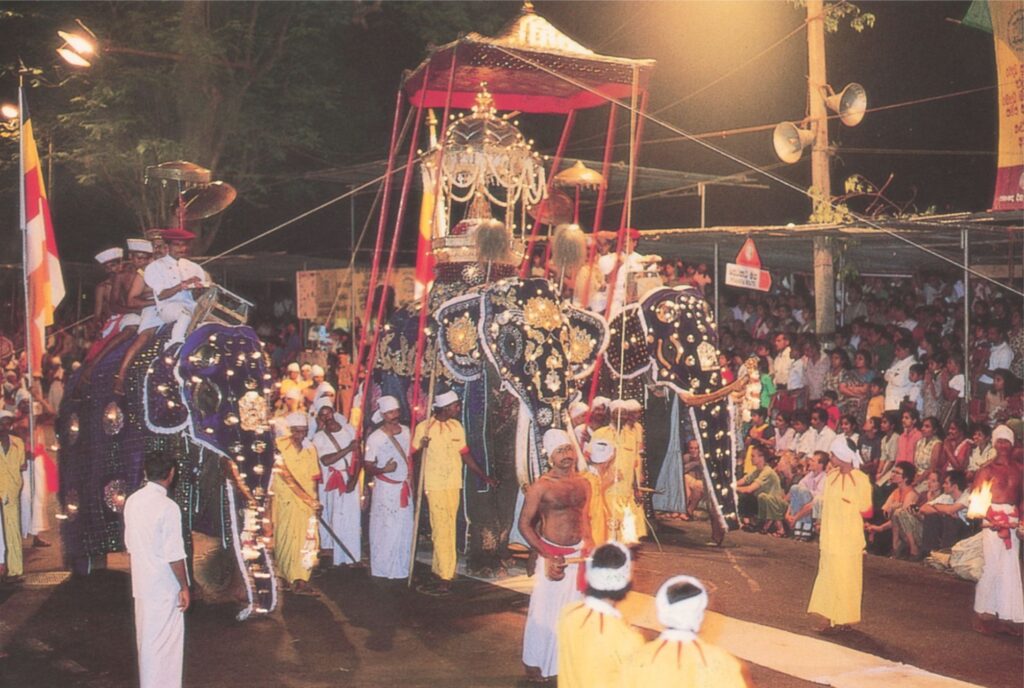
Kandy accepts this infestation. It can do little else. Every roadside pitch is packed, every balcony groans under the press, every pavement a sea of heads upon a crush of bodies. There is the stupendous awareness of the patience, the eagerness of people who move into place as early as ten in the morning to witness a pageant that will propel them forth as dusk thickens into night. They wait. Some will faint in the crowd-press, many will lose their children and beat their way frantically, unable to move in any desired direction. Special ring-side enclosures will hold high-paying tourists and vendors will peddle everything, from balloons to sweets, cigarettes to little Buddhist flags, bottled water, peanuts and boiled gram, popcorn and bangles. Yet, Kandy puts on its best face and the great Temple of the Tooth Relic of the Buddha bathes in floodlights and all along the streets, speakers voice Buddhist songs, even advertisements by the many commercial houses. On the circling hills, the lights of many homes lie reflected in the water of the central lake. A ten-day perahera, and many will not miss a single day while easily a million more come in on the final days–the climax of this heart-stopping spectacle. This is when Kandy simply flows: a river of faith that cannot be held back.
To tell of this festival is to go back to the cremation of the Buddha, to the account given us in the Dathuvamsa of the history of the Tooth Relic:
‘..one Khema removed the left eye-tooth direct from the pyre … and took it to the Kingdom of Kalinga, south -west of Calcutta, where…. it received devout worship; thenceforth the capital of Kalinga was called Dantapura, (city of the tooth) and a great festival (in its honour) was celebrated annually…
‘In the 4th century, a later reigning king, beset by foes, bid his daughter, the Princess of Kalinga, conceal the treasure in the coils of her hair and make her way to Lanka. This was successfully accomplished and King Kirthi Sri Megawarna received it with great reverence and enshrined it in Anuradhapura..’ (the north central capital city of the time).
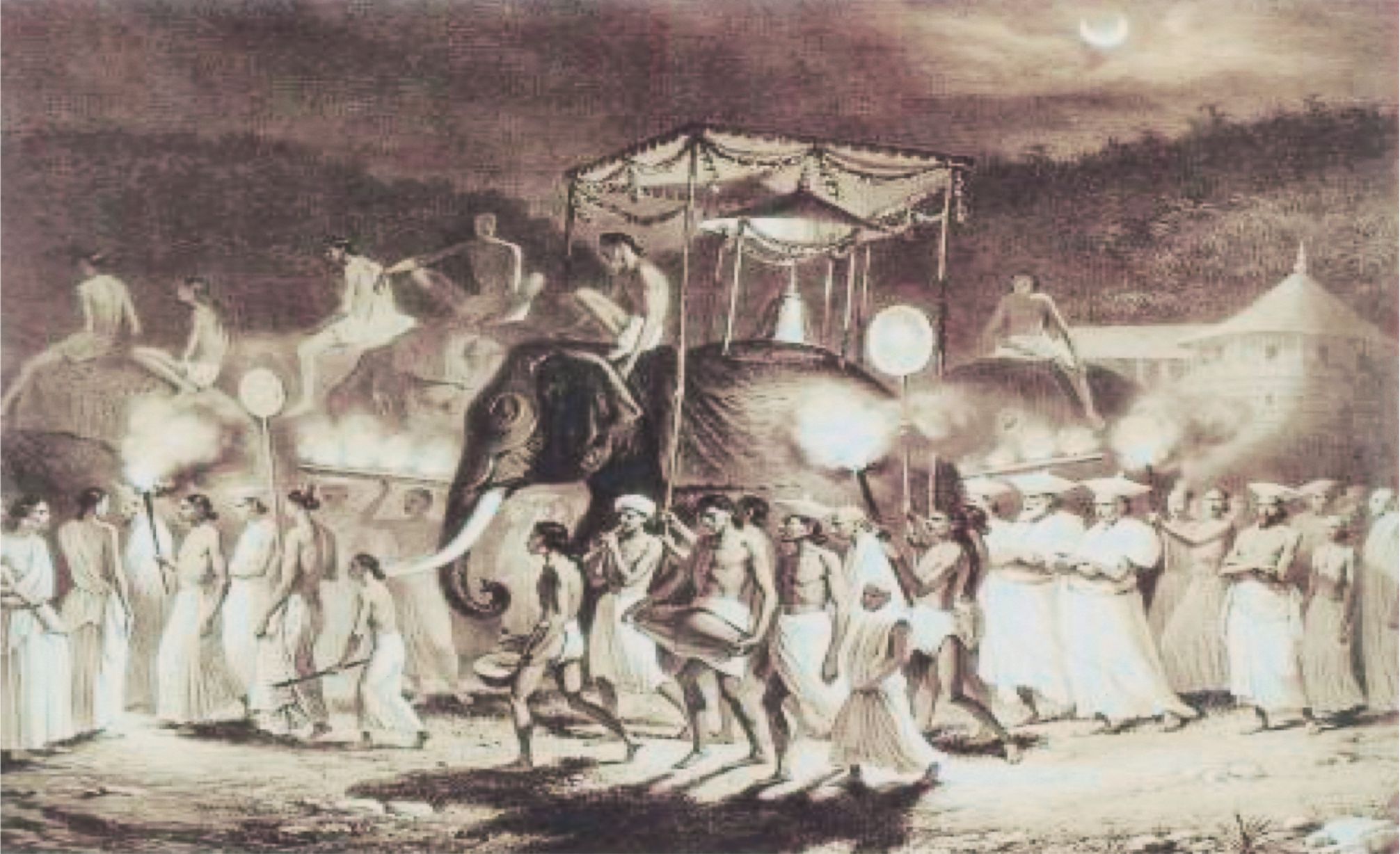
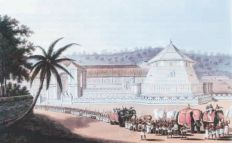
In 1590 the relic was brought to Kandy and save for a short period it has remained in this city. Taking this little story a step or two farther, the British annexed the Kingdom of Kandy in 1815 and the relic was secretly removed from its temple in Kandy during an abortive rebellion in 1817. It was recovered by the British and taken into custody. On May 29, 1828, it was given a public exposition where the British Governor, Sir Edward Barnes, was present. We have this comment by an eye-witness, Major Forbes:
‘In the brilliant pageantry of this festival, the rich altar and resplendent ornaments of the relic, the great size and elegant decorations of the temporary buildings, the peculiar and picturesque dresses of the Chiefs, the majestic elephants and dense mass of people threw an air of imposing grandeur over the spectacle, to which the old temple, sacred trees, and the wild and beautiful scenery of the Kandyan capital formed an appropriate landscape.’
One could conjure a stirring picture. The temple elephant with the karanduva–the relic casket–other elephants in two lines, facing each other; the cries of saadhu, saadhu that swell to a booming chorus of adulation; the elephants of the honour guard kneeling as the relic casket is borne between their ranks, the multitudes bowed in obeisance.
The Esala moon rises in late July or early August. This is what the world waits for, the populace of Kandy wait for, the millions island-wide wait for. This is so age-old. The ritual of the perahera has been even given to us by Fa-Hien, that intrepid Chinese traveler, in his book of the 5th century. In it he tells of the decree of the king:
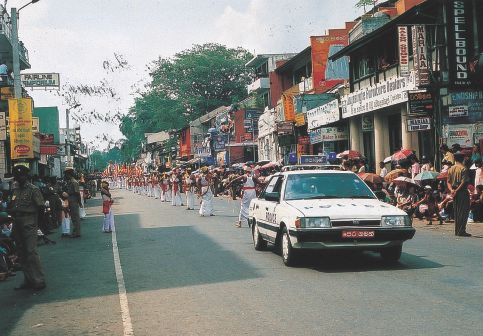
‘Let all ecclesiastical and lay persons within the kingdom who wish to lay up a store of merit, prepare and smooth the roads, adorn the streets and highways: let them scatter every kind of flower and offer incense in religious reverence to the relic.’
The Perahera, as we know it today, was instituted by King Kithsiri Rajasinha in 1775. It is also, as one tries to take in its immense scope and grandeur, a march of history, a striding god-step, where the Hindu deities, Natha, Vishnu, Kataragama and Pattini make the river of faith swell gloriously. It is a massive meeting and melding of faiths–Buddhism and Hinduism–and the people of Sri Lanka will always manifest their confidence that Natha is ever the guardian god of Kandy; Vishnu will be, for all time, the protector of the Island; Kataragama will ensure victory and Pattini will ever be the goddess of purity.
Religion plays its part, true, but commercialism raised its deformed head when the world began to seek after this drama of Asian faith. Kandy was catapulted into being a tourist ‘Mecca’ of sorts and, to this day, every hotel in the city will gleefully calculate how much could be earned from ‘Perahera bookings.’ Like all travellers’ tales, the marvel of the perahera spread. Take D.H. Lawrence. True, he watched another perahera in Kandy on a night in March 1922, but he did write to Lady Cynthia Asquith, as he sailed for Australia on board the Orsova, that even that festival organized in honour of Edward, Prince of Wales, was to him, an ‘enormous impression.’ Of course, he was not particularly enthusiastic about the crowds and referred to the people as ‘silly, dark-faced, cotton-wrapped… a countless host on the shores of the lake, like thick, wild rice by the water’s edge.’ Allow me to quote a little more:
‘It was night. And flaming torches of cocoanut blazing, and the great elephants in their trappings, about a hundred, and the dancers with tom-toms and bagpipes, and half-naked and jeweled, then the Kandyan chiefs in their costumes, and more dancers, and more elephants, and more chiefs, and more dancers, so wild and strange and perfectly fascinating, heaving along by the flames of torches in the hot, still, starry night…. it was wonderful, gorgeous and barbaric…’

That, mind you was a mere Raja Perahera–royal perahera. I leave you to imagine what the real Esala Perahera can be! But, as I have said, the run for the money has soiled the very soul of this event and the bad smell of greed is hard to dispel. Municipal authorities make a tidy packet selling pavement stretches to those who wish to erect ‘viewing points’ with crude GI-sheet roofs and wobbly wooden benches. Photographers are required to pay a fat fee for the privilege of walking beside the performers and shooting miles of film. Tourists are required to pay through their noses (and the longer their noses, the better!) while being tormented by touts, beggars and street urchins. Hotels rent ‘viewing space’ on every available street-side balcony and the ‘perahera rates’ for rooms, food, whatever, goes beyond the moon. To everyone who is anyone, the perahera is the ‘main chance’. This may not be what the ordinary citizen expects but, like the good, the bad and the ugly also move in–even women of easy virtue and those of unconventional sexual leanings–and every bus operator will also raise rates. As the moon grows bigger, so do prices of just about everything!
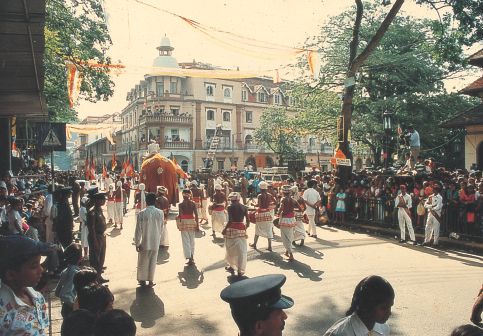
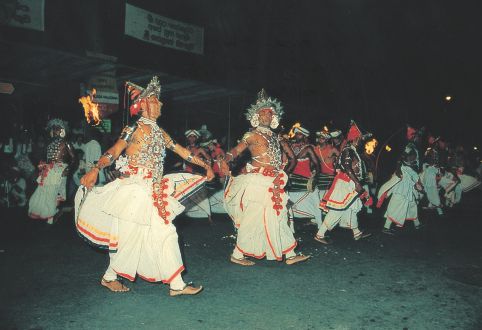
But the river of faith will not be fazed. Come with me. Find a place, mingle and be mangled and wait for the boom of the cannon that signals the start of the mammoth procession. Whip crackers, flag bearers and the lead elephant that carriers the old man who holds the register of all the temple lands and those who must serve the temple. This is not one but five processions with the leading Maligawa (Palace) perahera followed by those of the four Hindu deities. Here come the drummers beating javelins into your head–martial drumming too and with a tempo to make every star throb. Then the Royal Keeper of the Elephants carrying a silver ankus followed by more elephants, more drummers and dancers. The whole has its moments of stateliness but performance is something every participant needs to be proud of. Jugglers, acrobats, the wielding of folded umbrellas, fans and spears. Dry-copra torches burn brilliant tunnels through the trees, rhythm in movement, whirling flames, temple officials with measured tread.. A riot of colour and sound and whirling bodies and the high-voiced songs of girls in flowing white, cymbals and tambourines and dancers tossing their heads, advancing and retreating, banners and clacking sticks and the spin, spin, spin of flames wielded expertly by young men seemingly impervious to fire that licks at their arching bodies.
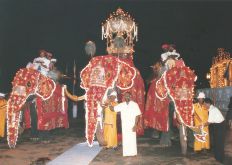
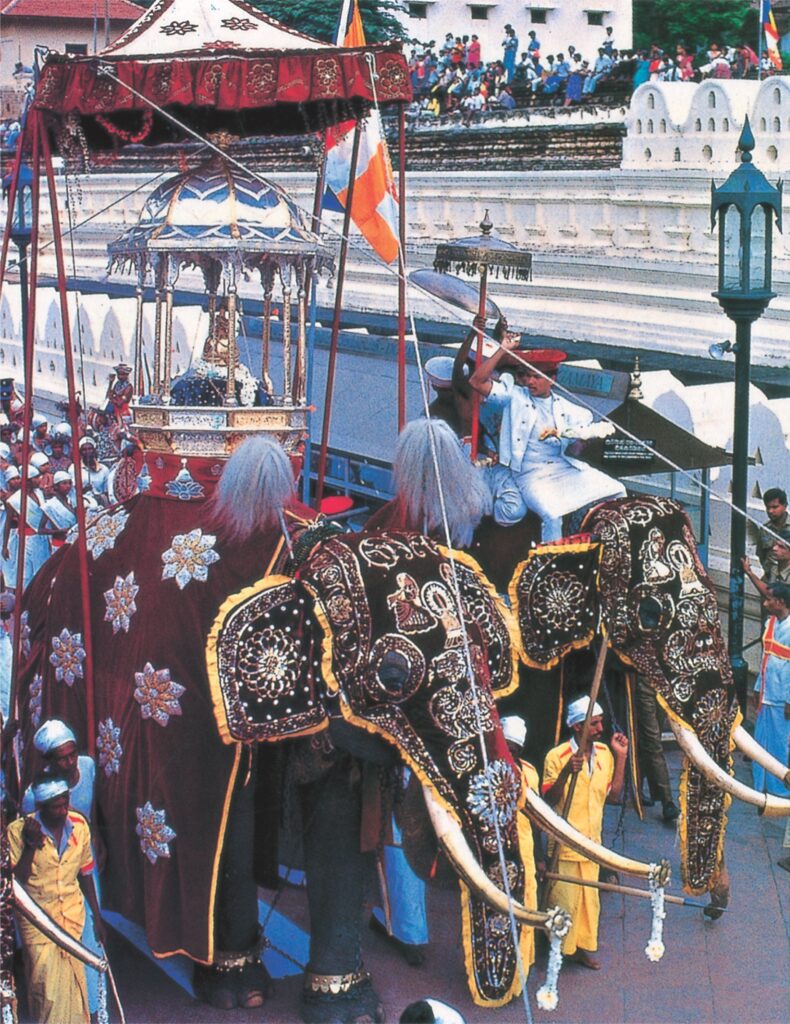
Every elephant–and one can count up to a hundred–is gorgeously caparisoned with none more impressive than the huge Maligawa tusker who carries in a golden casket a replica of the Sacred Tooth Relic and some relics of Buddhist saints. No, the true relic can never leave the temple. That would be unthinkable. But what does it matter? The tusker is a plodding mountain of light, of jets, of bells, his head covered in rich brocade, a decorated cloth draping his trunk. He wears ear whisks and anklets as well as a protective harness.
To return to D. H. Lawrence, these lines from his poem ‘Elephant’, written in Kandy in 1922, are apt:
But the best is the Pera-hera, at midnight, under the tropical stars…..
flambeaux aloft in the tropical night, of blazing cocoa-nut,
Naked dark men beneath,
And the huge frontal of three great elephants stepping forth
to the tom-tom’s beat, in the torch-light,
Slowly sailing in gorgeous apparel through the flame-light.
Like all immense undertakings, the festival begins ordinarily enough. Many preliminaries need to be meticulously carried out: the cutting down of an Esala tree (Cassia fistula) and lengths planted in the four Hindu temples. This is a vow, a surety that the perahera would be held. Small processions are first conducted within the premises of the temples. Then comes the Kumbal or Anthill perahera and the five processions first emerge in the streets, but in a restricted route on the sixth night. The build-up begins. Every night thereafter, more elephants are added and more performing troupes add their weight. Grander, bigger, more colourful. Then the peak–the Randoli (Golden palanquins) where the temples bring out the palanquins of the consorts of the gods. Five more scintillating nights that make Kandy a Kailasa of man and beast, each a ripple of light and flame in a boundless river of faith.
Performance is all, and if needs be, a torch spinner will take that swig of hard alcohol that will give him the spirit to hurtle along with the fire twisting madly around him. He will do all he can, then tumble out of line to lie down and dream of his moment of glory. In the hotels, stewards shake cocktails furiously. Rich clients on the balaconies, Campari and Scotch and twenty-year-old arrack. They will look down on a very ganga of heads and weaving bodies and wonder at the strange, ornate headgear of dancers who perform the wes–a dance of exorcism. These are received with roars and exclamations of approval even if the new renditions are highly vulgarized and grossly exaggerated.
You will feel a tad sorry for the chieftains, each in their four-cornered hat, gold-embroidered jacket, gold-lace belt, wrapped in seven yards of cloth, frilled trousers, forehead plate, carrying a knife, staff and sword. They have to be as of old–large-bellied too and wear turned-up shoes. And they walk–portly or put-on portly, uncomfortable, gamely enough, for this is their public ‘coming-out’ and after all, it’s only once a year!
One wonders at the elephants. Once upon a time, one ran berserk, charged the crowds, thudded into a bye-way and had to be shot. The risk remains but it is also known, universally too, that the elephants are the perahera. Fatuously enough, locals are quick to tell tourists that the elephants have tears in their eyes, that they weep in sadness when the perahera is over. Such a pity that one has to be regaled with such tripe. In truth, the whole performance on ten nights is a trial of sorts for these noble beasts. An elephant is never a nocturnal animal. It likes to sleep and any naturalist will confirm that an elephant will seek rest at sunset. The torch fire, the enforced night march and, what is more, the journey that they must also make at night to their homes after the perahera ends, must take its toll. Tears of sadness or eye-strain? Who can tell? In every vast show of faith, everything becomes miraculous. See! See! Even the elephants weep! Yet, the beasts are as the round, sturdy rocks in this huge river of faith. A perahera without its beloved elephants? Unthinkable!
Kandy is so tired when it is all over. Yet, to the millions now going back to their villages, to other towns, other lands, it has all been a time of fulfillment. Blessings surely came upon those who joined in paying reverence to the Sacred Tooth Relic of the Buddha. Suddenly, the whirling dancers are again small, tired boys. Now the city can return to its fish-tank days, free of the infestation of so many who, like the snails, crept everywhere, then crept away. The lake smells foul, the streets smell, the litter, if it could vocalize a grim hymn of havoc, would surely climb several notches on the Richter scale. Every drain is clogged with polythene, every shop front strewn with the ‘droppings’ of the snails, but then, it was festival time, and the world came to delight in, gasp at, marvel at the pure, raw energy of it all.
In the Temple of the Tooth Relic, the lay custodian can think of what more could be done the next time around. He has reported the success of the event to the president of the country. Duty done, it’s time to rest.
The Esala Perahera–Sri Lanka’s greatest ‘happening,’ ends with a soothing murmur as in the four participant temples pirith is chanted (Buddhist sutras to generally ward off evil), and in the temple of Vishnu a Wali Yakum ceremony is held–a ritual that will counteract evil eye.
The tourist coaches speed away. The spell of the perahera is carried away too, in hundreds of film rolls to be developed, studied, considered with awe and delight in lands far away. Kandy and the Easla Perahera! For two weeks every year, the city becomes a distillation of all that is Sri Lanka. The Tooth Relic has always been a symbol of the people’s piety and culture; people from every corner of the island who, for ten days, stood sardine-tinned, uncomplaining and with such eager light in their eyes; standing in rain or shine to sing their saadus and receive the blessings of the gods. This is the real essence of the festival, the simple people from their huts of thatch, wattle and daub, tired hands of men, women and children clasped in reverence. It is sad to think that as the festival becomes more of a carnival in the years to come, these whispers of saadu may also become inaudible. Even now, performers in the perahera expect to receive payment and prizes! That, sadly, is what the world has come to but why worry ? The sacred relic has been duly honoured, the gods propitiated and the pin pettiyas (alms boxes) of every temple are full to overflowing. The Kandyan chiefs have not developed corns after their long march and the elephants will trundle away the tear streaks heavy on their mottled cheeks. Over the lake, the wind chants a benediction. Sri Lanka’s greatest oriental spectacle has once again dazzled the world. Come to think of it, and as every travel agent will agree, that is all that matters!
The river of faith will break its banks every year. It will not be many years hence when the swell and rush will make its own organ sounds of spinning cash registers and the cacophony of shopkeepers, drowning the litanies of the faithful, but the awe and inspiration remain–a gleaming relic casket, a magnificent tusked elephant with its trappings of gold and fairy lights, the lithe moon-dappled mahout, his dark body like a Rodin sculpture. That is what matters. After all, in this land of many gods, the symbol matters most of all!
Carl Muller is author of Children of the Lion. He lives in Kandy, Sri Lanka
‘Esala’ is the month of July/August in Sri Lanka’s age-old calendar. It is in this period that for ten nights, before the moon waxes to an unreal brilliance, that people from every corner of the island converge on Kandy, the central capital, a city of kings, renowned as the home of artisans and craftsmen and…