
the connoiseur’s choice
Among the first generation of modernists in Bangladeshi painting—Safiuddin Ahmed, Zainul Abedin, and Quamrul Hassan—Safiuddin is undoubtedly the most underrated. Abedin staked his claim to lasting fame through his unforgettable famine sketches in 1943 and his leadership of the art movement in Dhaka after the partition of the subcontinent, Quamrul Hassan’s flamboyant canvas and personality and stance as an engagé has kept him in view for decades now; but Ahmed’s preferred mediums—engraving, etching, and dry point—and his quiet presence in Bengali art for more than two generations have made him a favourite only of the connoisseur. Surely the time has come for a major retrospective of an extraordinary man and artist; all this essay can hope is to tilt art lovers of the region to a complete revaluation of his importance and true stature
Safiuddin was born in Calcutta on 22 June 1922. He enrolled in Calcutta’s Government School of Art in 1938, apparently in order to master draughtsmanship and to position himself for a government job. But his creativity soon drew the attention of Mukul Chandra Dey, the principal of the college, who transferred him to the Fine Arts department of the institution. When Safiuddin appeared to be unsure of himself in this new setting, Abdul Moyeen, a gifted young teacher of the institution, went out of his way to befriend him and encourage him to become an artist. With the help of Moyeen and Romen Chakravarty, another teacher of the college, he became proficient in printmaking and wood engraving.
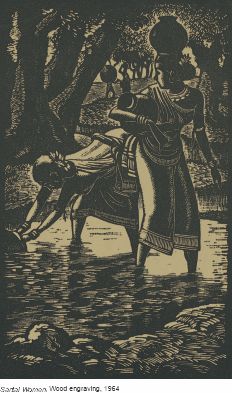
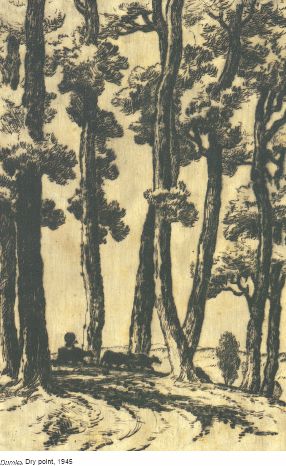
Even as a student, the city-bred Safiuddin felt drawn to subjects taken from nature. He used to go outside Calcutta whenever he got the opportunity to sketch villagers as they went about their daily activities. In his second year as a student of the art school he won a prize in an exhibition for a work that depicted fishermen at work with their nets. He travelled to Dumka, a remote part of northwestern Bengal to paint the Santals of the region, attracted by the innocence of these indigenous people. He found in them inspiration for some of his most romantic work. In recording the poetry of the lives of the Santals in pen and ink, charcoal, wood engravings, dry point, etchings, and oils from 1937 to 1948 in works such as Dumka, Santal Women, and Near the Mayurakhi, he showed a love of unspoiled nature, a predilection for the rhythms of everyday life, and love of chiaroscuro. Still later, he began to do etchings of the wide-open spaces around Rabindranath’s Shantiniketan. He also painted in oil the lives of farmers and fishermen, focusing on the difficulties of everyday life in a manner that is expressive and distinctive. But he also showed a penchant for portraiture, as can be seen in his memorable depiction of a fellow artist, Dilip Dasgupta.
Saifuddin’s unique treatment of the lives of rural people soon drew the attention of India’s art world. In 1945, he was awarded a gold medal by the Calcutta Academy of Fine Arts for a painting entitled Dove . In 1946, Saifuddin, now a lecturer in Calcutta Government School of Art, got another award for his Dumka sketches. Later that year, he became a member of the India Fine Arts and Craft Society, a distinction conferred on an artist who had imposed his presence not only in Bengal but beyond. In 1947 he received a gold medal in another exhibition held in Patna. In 1946 he was part of an exhibition in Delhi and in 1947 took part in an exhibition held in Paris, the first time his work was shown outside India.
But 1947 was also the year when India was partitioned after much bloodshed. Calcutta was the centre of communal riots that had left its citizens traumatized and divided. The Muslims of the city felt increasingly vulnerable in independent India. Upset by what he had witnessed, Safiuddin opted for Pakistan and came to settle in Dhaka, risking obscurity since Dhaka had no art scene to speak of, and leaving behind the solid reputation he had established in less than a decade of work in Calcutta.
In 1948, Saifuddin became one of the founder members of the Government Institute of Art in Dhaka, East Pakistan. Except for the number of years he was to spend in England studying art, he would serve in the institution as Head of the Department of Printmaking till 1979, by which time it had become, first, the Govt. College of Arts and Craft, and ultimately the Institute of Fine Art of the University of Dhaka. From 1979 to 1993 he would continue to teach in it as a supernumerary teacher, revered by generations of students. When Safiuddin arrived in Dhaka with Zainul Abedin and Quamrul Hassan there was not much going on in the art world of the city that had become the capital of East Pakistan. He found the quiet, small and relatively conservative city completely different from bustling, sprawling, and westernized Calcutta. Moreover, he did not have access to a printmaking machine till 1955 when he was able to bring back the machine he had left behind in Calcutta. For all these reasons his artwork was now transformed. The mediums and methods that he chose for expressing himself were drawing, oil, and engraving. In retrospect, it can be said that the years between 1948 and 1956 constituted a transitional phase of his life as an artist. He then seemed to be favouring a mode that would make him a Bengali heir to the legacy of post-impressionists such as Cezanne in works such as Empty Basket, Lemonade Stand-1, Fishing and Carpenter. However, he continued to paint the lives of Santals in oils such as Thrashing Paddy or in wood engravings such as Returning from the Market in the romantic vein he had struck when in Calcutta
Along with Zainul Abedin and Quamrul Hassan, Safiuddin began to play a prominent role in nurturing the art movement in East Pakistan. He was also active as a member of a group of painters called the Dhaka Art Group who organized the first art exhibition held in East Pakistan in January 1951. He was also a key participant the second exhibition organized by the group which was supposed to be held in Dhaka from February 22, 1952. But before the exhibition could begin, there was bloodshed in the city on February 21 when police fired on demonstrators protesting the imposition of Urdu as the state language of Pakistan and upholding the claims of Bengali. The long-term impact of the event on the sensitive artist can be seen in the sombre tints of his 1987 engraving The Language Movement. In other ways too, the life of the people of East Pakistan and the environment of riverine Bengal as opposed to the drier lands he had encountered in the interior of West Bengal impacted on his creative output. In particular, he was affected by the severe floods of 1954 in and around Dhaka. He now produced a series of works on floods, fish and fishing, boatmen, and aquatic life, as if to announce his arrival in riverine Bengal. These are subjects he would return to again and again in subsequent years, veering towards the real world and away from the idyllic, pastoral scenes of his early life, even though he was never one to regress to straightforward realism in his art at any stage of his career.
In 1956 Safiuddin decided that he would go to England for advanced studies in art in general and printmaking in particular. At London’s Institute of Art and design he studied printmaking under the supervision of Merlyn Evans. He took part in major exhibitions held in the city, such as the seventy-seventh annual exhibition of the Royal Society of Painters and the hundred and ninety first exhibition of the Royal Academy of Arts organized in 1958 and 1959 respectively. He also travelled widely on the continent, taking every opportunity to view the classics of western art in museums and galleries in every city that he went to.
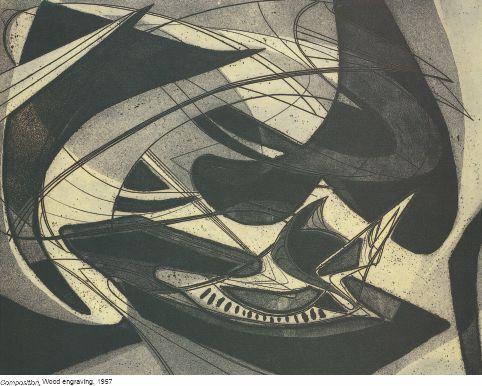
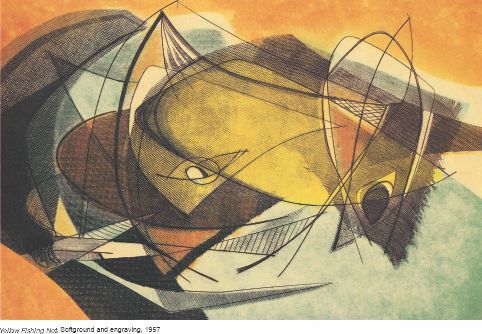
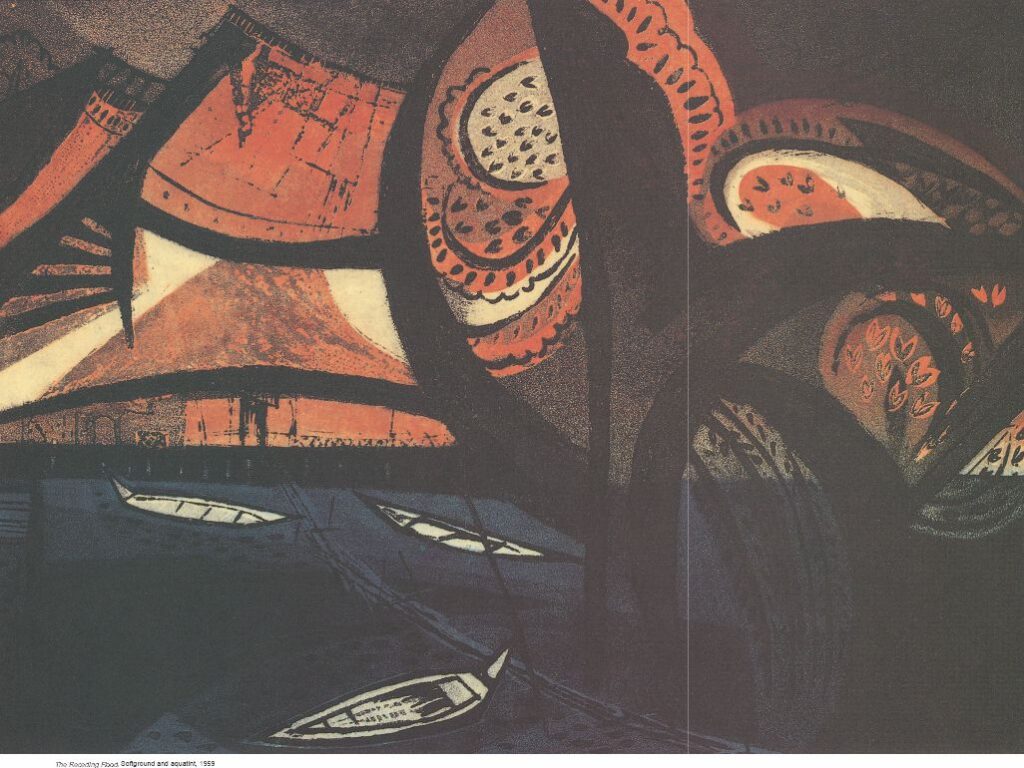
Several of Safiuddin’s masterpieces date from the London period. They include Flood, The Receding Flood, The Bridge Across, and Fishing Time where he drew on his recent exposure to the life in the delta world of East Bengal and Composition, works done either in etching aquatint or aquatint. He also composed some remarkable engravings in this period such as Yellow Fishing Net and Towing Rope, confirming his mastery of the medium. These compositions show his fascination with the everyday life of working people, his ability to combine indigenous elements with techniques learned from the great impressionists and expressionists and his determination to blend the timeless rituals of Bengali life in a contemporary medium so that traditional themes and scenes are treated from new perspectives. The art of the period also shows that he has decided to be more and more experimental in his work, a greater readiness to defamialirize and break up form, and to move towards greater expressiveness.
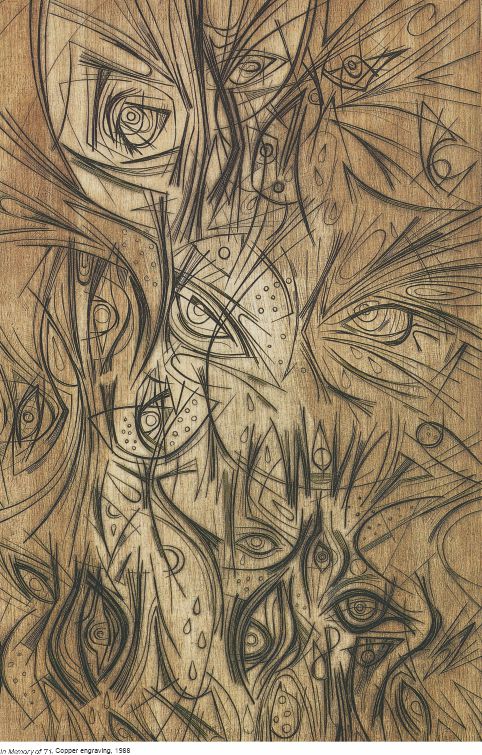
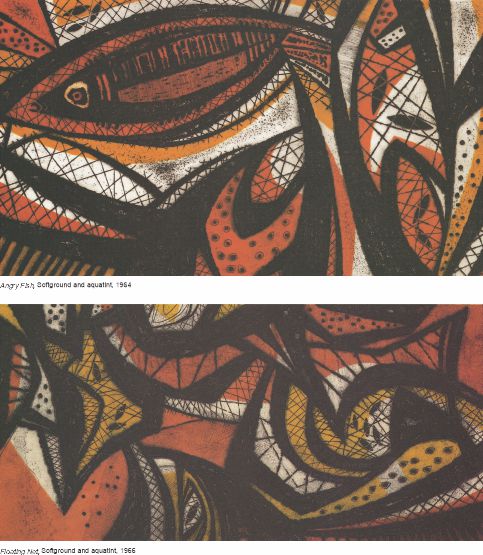
Safiuddin came back in 1959 to an East Pakistan chafing under the authoritarian rule of West Pakistani army officers. His response to repression is to be seen in a composition such as Angry Fish (1964), rendered in etching aquatint, where the fiery eye and the preponderance of red articulate his indignation. From this time onwards, the artist’s work reflects his sensitivity to the tumult of politics and the stress of living under repressive regimes. Moved by the death of many people in the almost year-long liberation war that led to the birth of Bangladesh on December 16, 1971, Safiuddin painted one of his most famous works, In Memory of ’71, a copper engraving done in 1981 which is made unforgettable by his use of the human eye to reflect the pain suffered by his people during the struggle for independence. This is a theme he would return to in another impressive engraving done in 2002 titled, Memory ’71, where sorrow at the losses suffered in that painful year is rendered vividly through eyes that shed tears all over the composition.
After his European stint, Safiuddin showed that he was also willing to work in newer mediums. He now began to produce works in crayon, charcoal, India ink and mixed media. Witness, for example, the series of drawings he produced from 1959 onwards, sometimes in carbon pencil, at times in charcoal and crayon, and occasionally in crayon and conte. These drawings demonstrate his intense interest in everyday street scenes—a man selling balloons, or hawkers selling clothes or a lemonade stand. These drawings range from semi-realistic works to expressionistic ones, revealing an artist who has in his quiet way been opting for variety and who has been altering his style and medium repeatedly in an unending search for greater expressiveness.
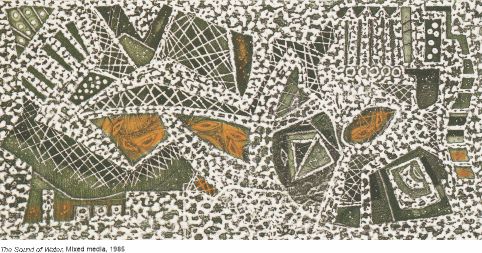
In independent Bangladesh Safiuddin continued to develop as an artist moving away from romanticism and realism to art that depends on patterns woven from colours or rhythmic lines. Thus it is that Safiuddin turned again in the seventies to oil, giving us his favourite subjects—stalls on wheels, flood, fishing, the memories of 1971—but transformed through his innovative use of colours and unconventional ways of seeing the life around us. But oil is only one of the many mediums he has worked with successfully in the last three decades, and the striking mixed media work of 1985, The Sound of Water and the many high quality engravings he has continued to produce in his mature phase testify to his versatility.
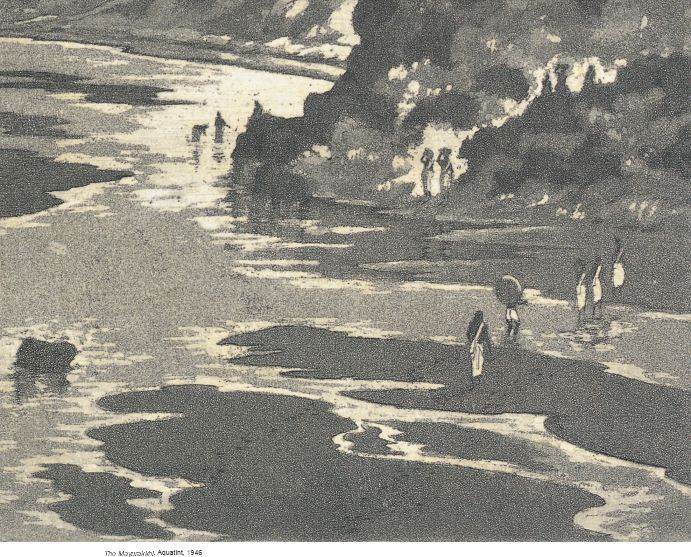
Although now in his eighties, Safiuddin has persisted in treating his favourite subjects in vibrant ways. He seems to have overcome a dark mood that made him prefer dark or gray colours in the oils he did in the nineteen nineties and came back to his favourite colour, blue, in the soothing compositions he did in the millennium year, Blue Water, The Melody of Nature and The Sound of Blue as if to signify an autumnal harmony in his most recent art.
In all the years that he has been a presence in the art world of Bengal, East Pakistan, and Bangladesh, Safiuddin Ahmed has never attempted to attract attention by strident techniques or outlandish gestures. The man and his art are one in being quiet and yet self-assured, controlled and yet focused on the present, soothing and yet containing depths of feeling, elegant and yet part of ordinary life. He has been awarded the highest honours conferred on artists in Bangladesh such as the Ekushey Padak in 1978 awarded for outstanding work in the arts and the Independence Award in 1996 given for his exceptional contribution to national life. Yet one feels that only connoisseurs of art and fellow painters will recognize his true greatness; he is, surely, eminently unsuited for popularity although his classic quality has always been obvious to the initiated.
Fakrul Alam is a member of Jamini editorial board
Among the first generation of modernists in Bangladeshi painting—Safiuddin Ahmed, Zainul Abedin, and Quamrul Hassan—Safiuddin is undoubtedly the most underrated. Abedin staked his claim to lasting fame through his unforgettable famine sketches in 1943 and his leadership of the art movement in Dhaka after the partition of the subcontinent, Quamrul Hassan’s flamboyant canvas and personality…