
mohammad kibria painter and printmaker extraordinary
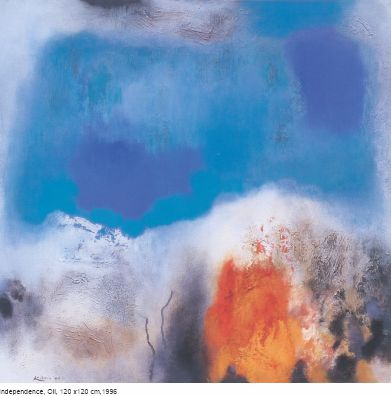
If there was an opinion poll on the Bangladeshi art scene, chances are Mohammad Kibria would be singled out for steadfast commitment to art. Unlike many of his peers he hasn’t made himself visible as a social or political activist, nor has he dabbled in any aesthetic activity other than his chosen one. ‘Painter and printmaker extraordinary’ just about sums up everything the average art-lover needs to know about this austere celebrant of form, colour and texture
Though the opposite of a self-publicist, Kibria didn’t have to wait long before word of his excellence spread among art fanciers. Since he has always been a fastidious artist who has chosen a mode that depends on the slow and well thought-out build-up of pigment, rather than the rapid, spontaneous, alla prima type of painting, prospective patrons have often had to wait in a queue, so to speak. Sometimes—or so the story goes—they reserve blank canvases, confident that whatever the artist painted on them will be completely satisfying. This is a major reason why Kibria has had relatively few solo shows—nine in all, from the first in 1960 to the most recent in 2002—and why only three of these have been at home. Three of the solos have been in Japan, a country with which Kibria has a special intimacy.
Critical opinion is unanimous in according Kibria the highest distinction among Bangladeshi artists. Substantial essays on his work have been written by diverse critics, among them Syed Ali Ahsan, Borhanuddin Khan Jahangir, Moinuddin Khaled, and most recently, Syed Manzoorul Islam. Islam has provided an indispensable essayistic accompaniment, ‘The Art of Mohammad Kibria’, to the more-or-less representative selection of reproductions in Mohammad Kibria, the ninth volume in the Shilpakala Academy’s ‘Art of Bangladesh’ series (Dhaka: 2004). The present writer will unabashedly draw on it for biographical information and, in due course, animadvert on some of its critical pronouncements. Also useful is Islam’s note ‘Long Day’s Journey into Light’, which introduces the catalogue and leaflet accompanying Kibria’s two most recent shows: at the Bengal Gallery in 2000 and in Tokyo in 2002.
Born in Birbhum, West Bengal, in 1929, Kibria showed artistic promise as a schoolboy, and in 1945 went up to the Kolkata Art School. The school’s faculty included a number of distinguished figures, among them Zainul Abedin, lately famous for his famine sketches. A formative influence was Basanta Ganguly, who taught Kibria how to balance the composition around a strong centre, how to bring out what he called a painting’s ‘inner structure’, how to use line to explore depth.
It was no doubt all to the good that students felt the pull of two dialectically opposed influences. On the one hand was that of a Western academicist curriculum, with an emphasis on life drawing and outdoor sketching, and a preference for still lifes, landscapes and portraits done in oil. On the other hand was the influence of the hybridist neo-Bengal school of Abanindranath Tagore and Nandalal Bose, which had popularised a mannered reincarnation of Mughal and Rajput art, crossed selectively with foreign influences, both western and oriental. Talented students like Kibria engaged with both influences, assimilated them, and became in the process keenly aware of their limitations. They could then transcend them, each in their own way.
Leaving aside his apprentice days, Kibria’s artistic career, according to Islam, falls into four phases. The first lasts from his graduation from art school in 1950 till 1959, when a scholarship took him to Tokyo to study for three years at the University of Fine Art. The second period covers his Tokyo years; the third starts on his return home in 1962; and the fourth, which began after he recovered from a life-threatening illness in 1998, is still continuing. However, as Islam admits, whether the fourth should be taken as a distinct phase or merely as a continuation of the third is perhaps a matter of opinion. There is no rupture between the third and fourth phases, but there is, arguably, a slight change in temper, the appearance of a new nuance.
In 1951 Kibria decided to become a Partition émigré and made Dhaka his new home. After a stint as a high school art teacher he joined the faculty of the recently established Dhaka Government Art College in 1954. He eventually became professor of graphic art, and retired in 1997. Then, as long as health permitted he taught part-time. He has received all the major awards in the country as well as a couple in Japan. He has been a major influence on younger Bangladeshi artists, both directly and indirectly as an inspirational presence, ever since he attained his distinctive signature as an artist.
The watershed is clearly the period of his Japanese sojourn. What has been demarcated as his first phase still shows him before he became ‘Kibria’. Islam of course generously tries to show that despite ‘the influence of the Impressionists, miniature painting, Jamini Roy, and sometimes, the Neo-Bengal School,’ Kibria ‘worked up a style of his own.’ But Islam isn’t quite convincing, and seems to be shooting the line when he sums up thus: ‘In his first phase, Kibria’s style emphasised expressive contents, gave colour an independent identity and exploited the potentials of line. It was a time when Kibria was beginning to narrow down his focus on the individual, and discovering the complex, interior spaces of mind.’ The two paintings from this period reproduced in Islam’s book, ‘Water Sport’ (1953) and ‘Full Moon’ (1957), are revealing. Both refract the languid aestheticism of neo-Bengal—note the doe-eyed females, the predominance of a dreamy blue—through the prism of what T. E. Hulme and Juan Gris dubbed ‘analytical cubism’, in which there is a movement from representation towards abstraction through the break-up of realistic forms into geometric shapes. This was a favourite mode among modernist Bangladeshi painters in the fifties. Kibria’s contemporaries, Aminul Islam and Quayyum Choudhury for instance, were also producing work of this sort.
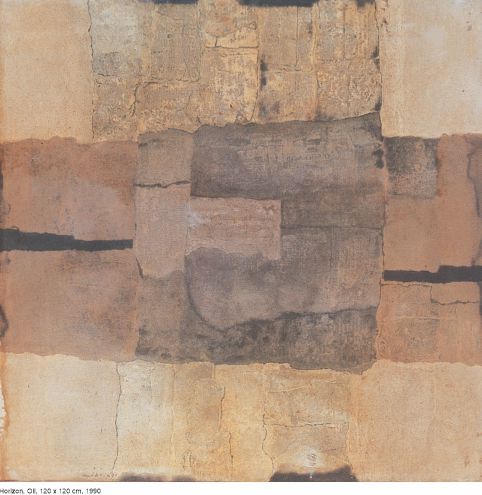
Islam draws our attention to a number of key influences that Kibria assimilated in Japan; these seem to have helped him to make a breakthrough. What Islam says about Kibria’s fascination for Japanese gardens, and the impact of the teaching of the Japanese artist Hideo Hagiwara, seems to me crucial to an understanding of the mature Kibria. According to Islam, Kibria ‘considered each garden an aesthetic composition whose sentient or inert forms (trees, ponds, bridges, mounds) existed in a close interrelationship with each other. His canvas at the time was typically a composite of clustered or staggered forms which, at a deeper level, opened up to each other, thus giving the composition a fine balance.’ Although Islam does not explicitly say so, it is clearly implied that Kibria’s compositional sense was remoulded by his appreciation of the aesthetics of the Japanese garden. It may not be too fanciful to see in the abstract paintings that henceforth became Kibria’s major creative mode an attempt to translate the Japanese garden into the language of abstract expressionism.
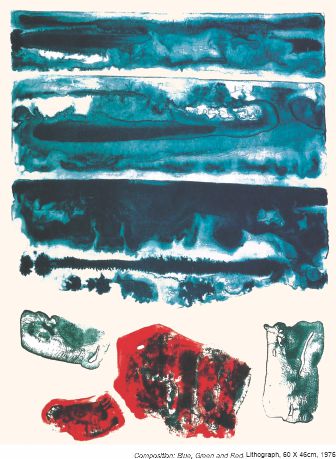
Kibria’s academic work in Japan covered several media: lithography, woodcut, watercolour, in addition to oil painting. Islam thinks Kibria’s handling of all these was decisively influenced by the teaching of the masterly Hideo Hagiwara: ‘In Hagiwara’s own works such as The Stone Flower series, image and idea stood in perfect balance while texture contributed eloquently to achieving significant form. Kibria too found in texture a whole new world of possibilities.’ Texture would henceforth become a major focus for Kibria, especially in oil painting. In woodcuts, which were Hagiwara’s speciality, Kibria learned to work ‘the original texture of wood…into the compositional scheme of the final print’, and to juxtapose ‘black and white lines/surfaces’ to express ‘elemental conflicts’. Kibria also perfected his ability to arouse this sort of compositional drama into what is probably his favourite graphic medium, lithography. One can readily discern a synergetic connection between Kibria’s graphics and his painting.
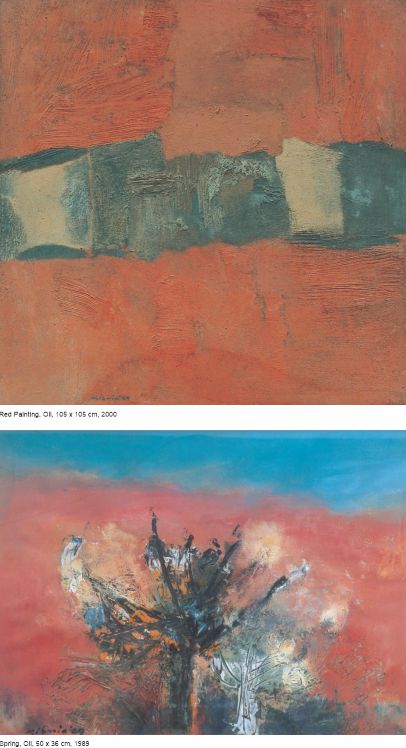
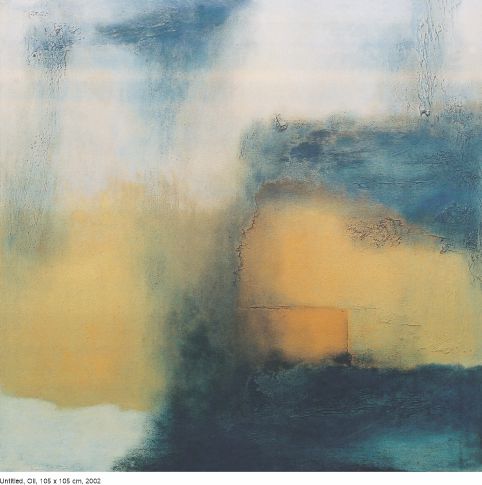
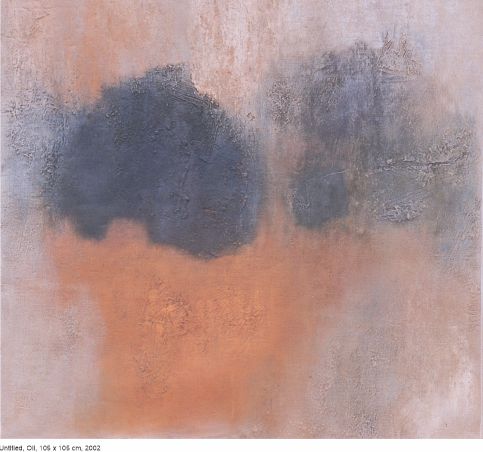
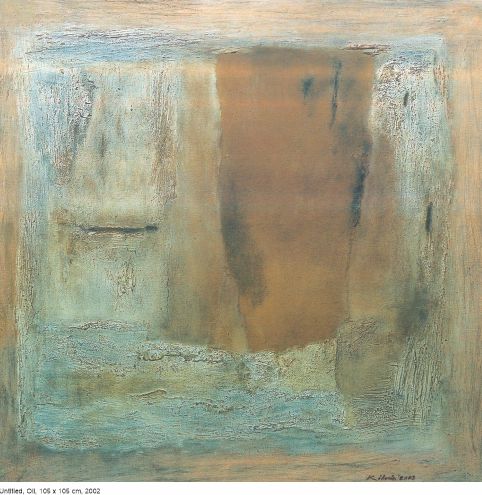
Kibria’s most outstanding works are undoubtedly the abstracts in oil that he has produced since his return from Japan. In these he seems to have hit upon a mode of painting that can comprehensively accommodate his most deeply felt response to both inner and outer reality. Kibria’s penchant for abstraction seems to extend to his titles: he probably has more works titled ‘Untitled’ than any other artist. In relating these works to the global context the obvious comparison that suggests itself is with American abstract expressionism; not the gestural variety of Jackson Pollock and De Kooning, but colour field painting, especially the work of Mark Rothko. The similarities are plain. Both Rothko and Kibria exploit the resonances of colour through the careful juxtaposition of indeterminate shapes. But the divergences, though less apparent, are perhaps more significant. Ziaul Karim in a brief note appended to the leaflet published on the occasion of Kibria’s 2002 solo in Tokyo quotes the artist as saying quite categorically, ‘Rothko is more geometric than lyrical. And he doesn’t engage himself in textural play.’
I cannot relate the first part of the statement to whatever I have seen of Rothko, but the second part is an apt observation. I would go further and interpret this difference not merely as a matter of choice of technique, but as an index of divergent philosophical attitudes. Rothko was obsessed with transcendence; Kibria is interested in values that are immanent in this world. ‘There was a deeply rabbinical streak in Rothko’s character,’ comments Robert Hughes; ‘he was a Russian Jew who wanted to be a great religious artist…In effect, he wanted to recapitulate the sense of awe, dread or numinous presence that had been associated with the human figure in art (and lost, he thought, in the Renaissance); but to do it in an abstract manner.’ One critic has accurately pointed out that Rothko’s canvases look dyed rather than painted. Rothko’s eschewal of texture (which incidentally interested fellow American abstract expressionists lacking his religious aspirations, e.g. Pollock or Still) is part of a technique designed to produce a ‘luminous blur’ that he hopes will induce in the viewer a sense of religious transcendence. Kibria, on the other hand, is happily rooted in this world. It is significant that in the very opening sentence of the note titled ‘A Long Day’s Journey into Light’ Manzoorul Islam declares that Kibria’s two recent shows might well be titled ‘Colours of Earth’. He rightly goes on to describe Kibria’s recent work as a celebration of life and points out that unlike most abstract artists Kibria derives his colours from nature. I may recall here a conversation with the poet Shaheed Quaderi in course of which he waxed lyrical about some of Kibria’s paintings from around the mid-seventies. Looking at them, he said, he experienced an epiphanic recognition of the subtle colours and textures of the chars or sandbanks that flank Bengal’s many interlinked rivers.
This is not to say that Kibria is all celebration and no angst. Indeed, it has long been averred that abstract art is an anguished response to a dehumanised, metaphysically denuded world. This may be an oversimplification, as Herbert Read’s essay ‘Realism and Abstraction in Modern Art’ would suggest, but is certainly not without its grain of truth. Kibria, as Moinuddin Khaled has pointed out, demonstrates in his work of the late sixties and seventies a familiarity with the depressive mode of being, with an entropic view of the world. Then again, if one studies the colours that Kibria has insistently used, one sees that many evoke the darker moods. One can find melancholy blue, despair-soaked—or shall we say nihilistic—black, sombre brown and grey.
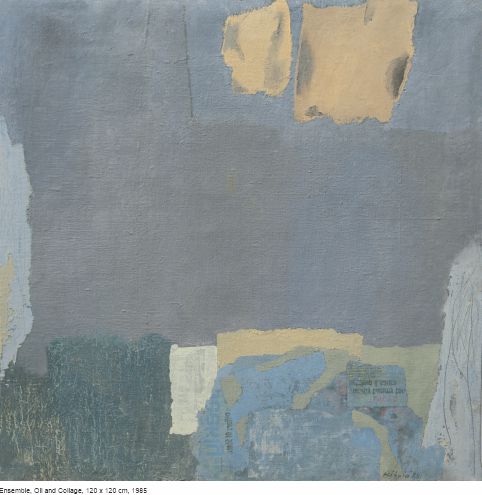
The mood of the most recent works, though, is life-affirming, celebratory, even cheerful. However, one has to make the caveat that the paintings in oil on paper are not—indeed they cannot be—as satisfying as the ones in oil on canvas. Kibria’s artistic temperament, as I have already suggested, is not compatible with the alla prima style, which would be appropriate for oil painting on paper. The kind of slow build-up of paint and lively play with texture that are Kibria’s hallmark is achieved best in oil on canvas. One can understand that after a bout with a serious illness Kibria probably felt that he was in a race against time. But as one of his many admirers I would like to assure him that he need not deviate from his habitual slow and steady method of working. Even if it means that he may produce little the value of the work will not suffer, for it is often the case in the arts that less is more.
Kaiser Haq is a member of Jamini editorial board
If there was an opinion poll on the Bangladeshi art scene, chances are Mohammad Kibria would be singled out for steadfast commitment to art. Unlike many of his peers he hasn’t made himself visible as a social or political activist, nor has he dabbled in any aesthetic activity other than his chosen one. ‘Painter and…