
concept of time and identity in the works of abdul rashid gapur square roots and aluminium sheets
The island republic of Singapore, located slightly off the north of equator in Southeast Asia, is home to about four million people. Almost all of them come from migrant families. As such, issues of national, personal, ethnic and social identity imprint themselves on their psyches. Displacement, migration, exile and diaspora define them. There is a great deal of interest in ideas of the self, subjectivity (sexual and existential) and the politics of representation in relation to community, family, and native states.
Has time played a crucial role in aiding the formulation of the self and subjectivity? Does the short history of modern Singapore, created as an economic state in 1819, have an influence on the process? Where does one turn to while seeking points of referentiality for it? One approach would be to look for reference points from the majority of Singapore’s population since they are central to the formulation of the identity of the silent minorities. It is this perspective that I find explored creatively by Singapore artist Abdul Rashid Gapur in his work.
Thirty-four year old Rashid was educated in fine art, first in Singapore, and then at the Royal Melbourne Institute of Technology. Still a young installation artist, Rashid already has had exhibitions in Canada, Japan, Korea, Australia, Malaysia and Singapore. Equally adept in two-dimensional work, Rashid creates installations with the intent of negotiating personal space and social space, formulating in the process a sense of life in a new society like Singapore. But, then, Singapore’s society is hardly a new one. In fact, it consists of old societies re-inventing themselves in new forms as a consequence of economic migration. As such, Rashid’s works draw on the following common denominators: Islam, the metal aluminium, the concept of time, and the technique of minimalism.
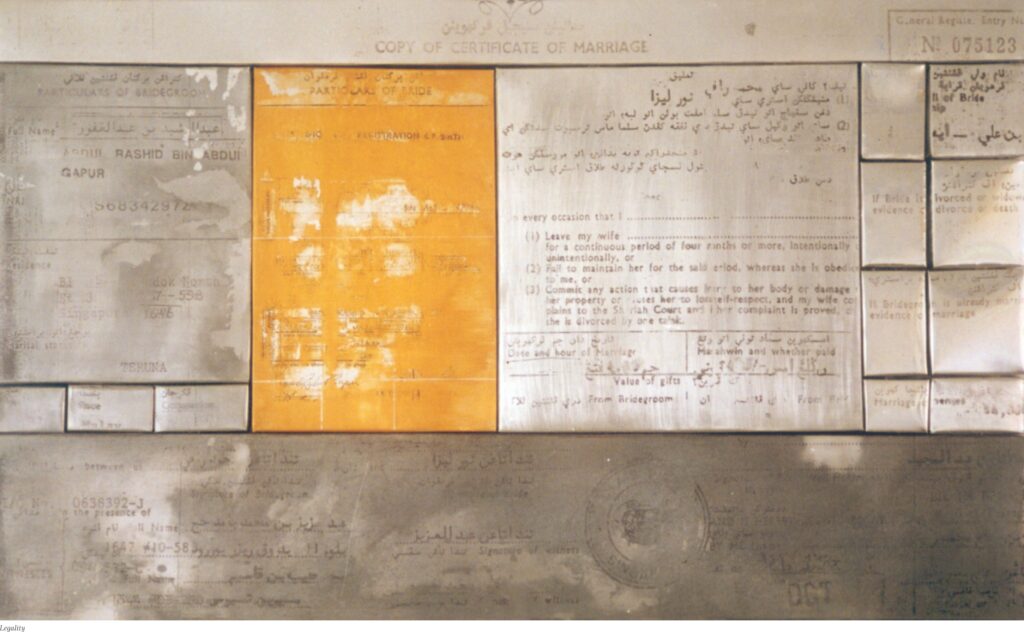
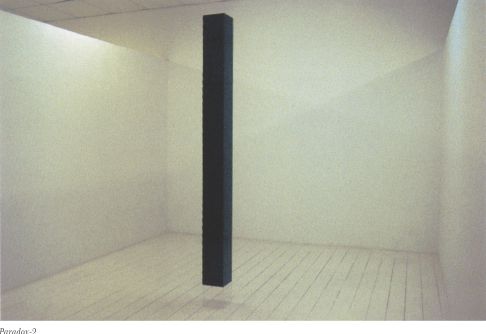
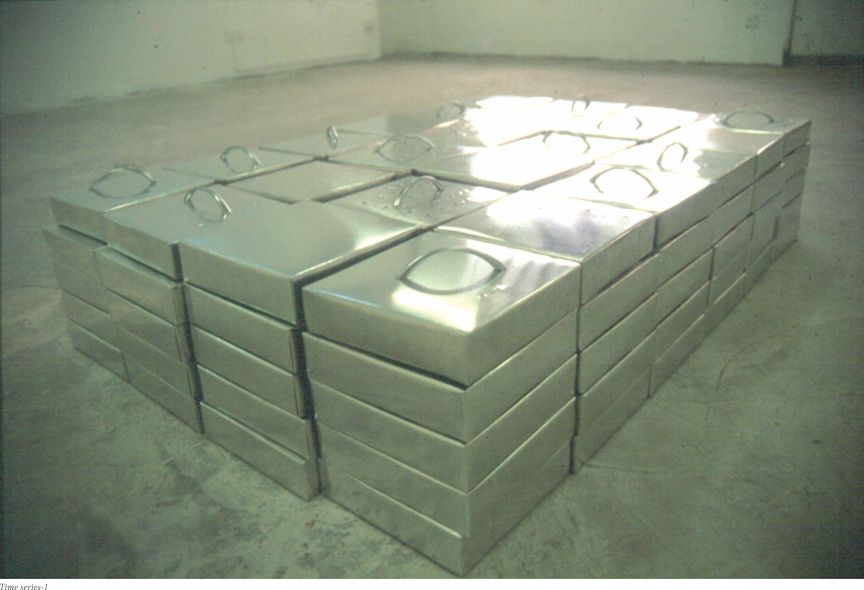
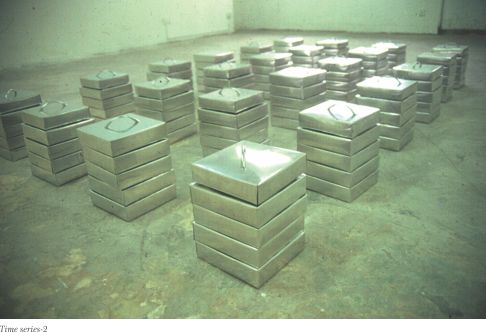
Islam is a major religion in Southeast Asia and Rashid’s works turn to Islam in a number of ways. For instance, this artist positions himself as an instrument of the divine. ‘Old’ Islam informs his installation work, adding vigour to his ‘new’ minimalist approach. This approach highlights the dilemma of the individual in Singapore in need of letting go of his/her past; if not for any other reason, at least to relate to current social conditions. In ‘Legality’, (1996), for example, Rashid Gapur transfers an imprint of a marriage certificate onto an aluminium sheet. Gold and silver are set against each other, reinforcing the gender divide. But the imprint harbours the irretrievable past, frozen in time. The overt aluminium sheet enforces a gendered reading of the past – that of the male artist. This is also one of Rashid’s most intense works. It signals his personal imbrication in history and his cultural legacy. His later works have a lighter touch as they begin to embrace an economic and clearly minimal approach. Aluminium as a material is fascinating and yet greatly undervalued. A common material in Singapore, it symbolizes construction, quick industrialization, clinical facilities and smooth business transitions. In Rashid’s works aluminium takes on a gendered role expressive of masculinity. In his ‘Time’ series, (1997), square aluminium pieces of varying sizes with handles are arranged and re-arranged in a formal, structural manner. Says Rashid. ‘For me this work is about arranging spiritual time and finding our own path to arrange and re-arrange our lives.’ Not merely the artist in him but also the male ego he has seeks the right to shift and rearrange. The shine on the aluminium is muted by repeated use, becoming in the process a critique of the male world on which the contemporary world of Singapore is based.
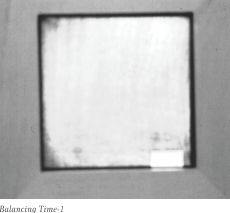
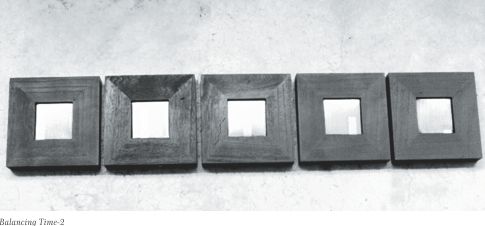
Time is of essence to Rashid. In his works, presentation of time is obsessively square, square-rooted, and multiple. The holy Kaabah in Mecca drives the correlation between the square and time for this artist. His works take on an obsessive formalism, which is undeterred in its ordering and precision. But the mathematics of his time is not unfamiliar within the tradition of Islamic aesthetics where it is noted that the mathematical precision is symbolic of the Creator, the perfection of Beauty, and the unknown (al-gahib). Exactitude leaves no room for subjectivity and it is precisely at this point that Rashid’s works seek an affirmation of the centering and calming of the mind in a Singapore setting where economic fundamentals are wild and tumultous. The square root of the ‘one’ is best developed in his series, ‘Balancing Time’, 1998, in which aluminium squares are placed within heavily set wooden frames. The main feature of this work is its representation of the ritual of prayer as a solemn act of calming the mind.
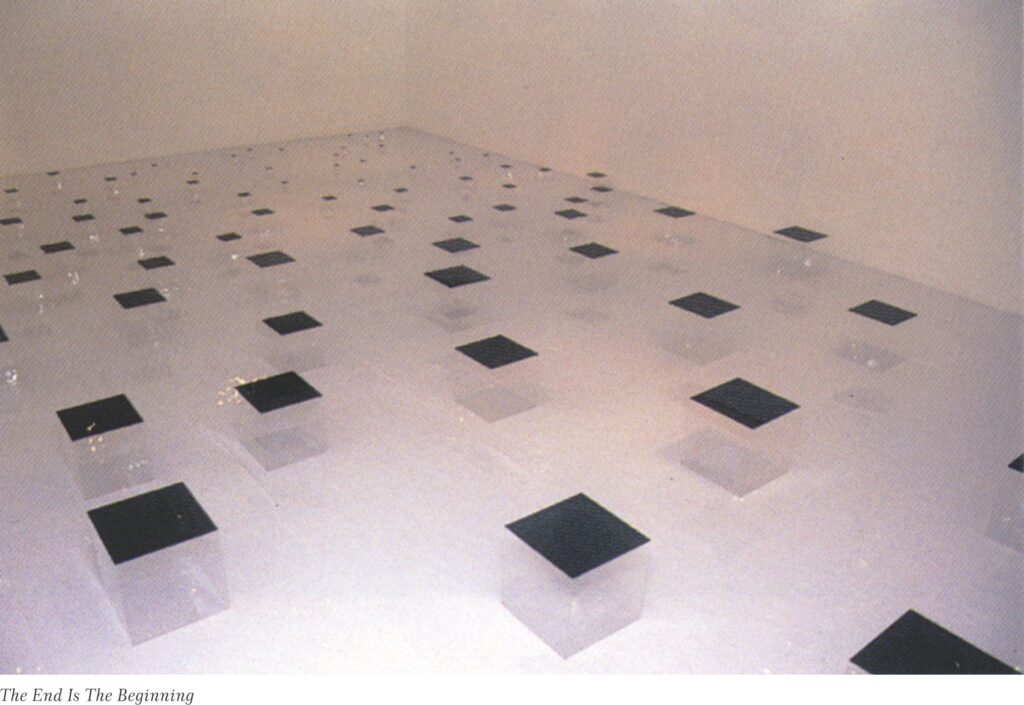
‘The End Is The Beginning’, (1999), reveals the culmination of the personal journey of this artist. The placement of seventy-seven transparent and black acrylic boxes suggestively tracks the revelation of time. Its square roots take their cue from the circumambulation of the Kaabah seven times. The lightness of the acrylic boxes has a Zen-like quality, and suggests powerful metaphysical presences. This installation can be considered as one of the more powerful works that have come out of Singapore in recent times for its questioning of self and identity. Rashid here embraces minimalism, fleshing out the essential qualities of his concept of time into linear binaries. This work was selected for the President’s Young Talents Exhibition at the Singapore Art Museum in 2001.
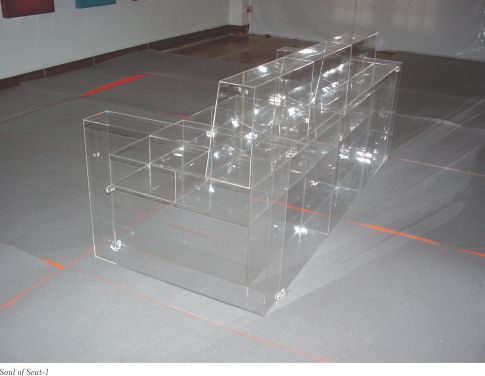
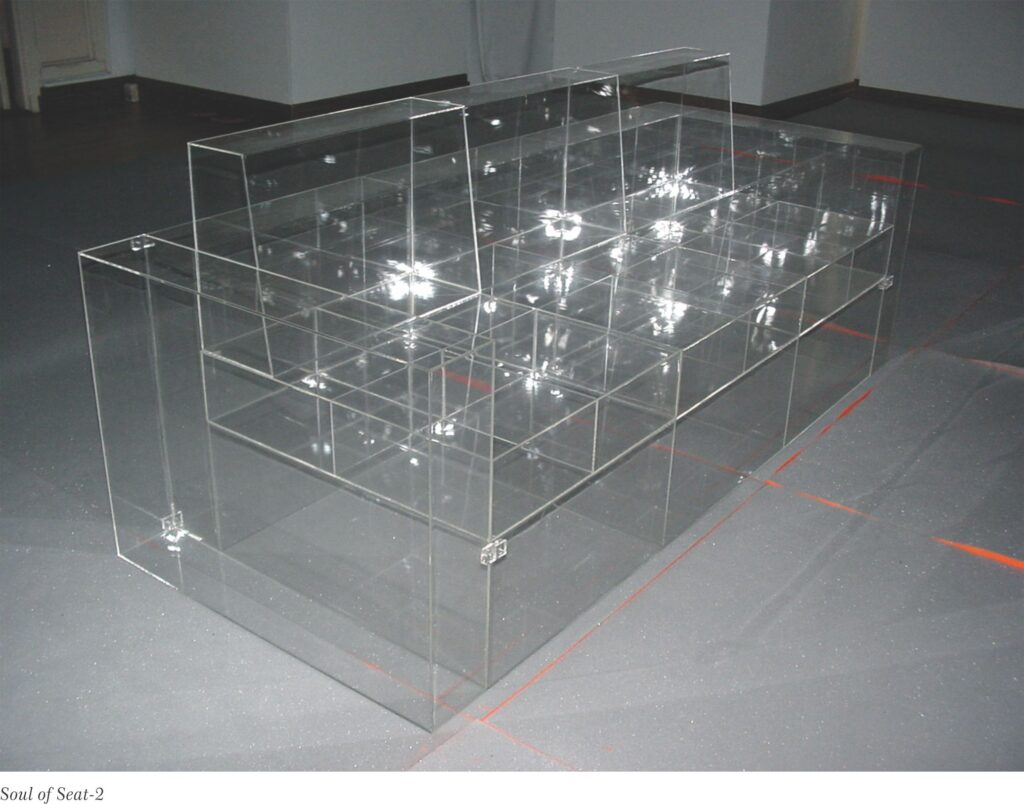
Rashid’s most recent work, ‘Soul of Seat’, (2002), was a functional installation for an exhibition entitled, Functional Beauty. Moving out of mere shapes, Rashid here transposes metaphysical issues into everyday life. An acrylic sofa, functional in its form, is thereby given spiritual lift. Structurally strong and visually deceptive, the sofa is not merely a sofa. It is the ultimate point of arrival if seen through the lenses of history. Time is no longer material or ritualistic; rather, it is the attendant waiting on the living.
Venka Purushothaman is Senior Lecturer of Arts Management at the School of Fine Art LASALLE-SIA College of the Arts, Singapore
The island republic of Singapore, located slightly off the north of equator in Southeast Asia, is home to about four million people. Almost all of them come from migrant families. As such, issues of national, personal, ethnic and social identity imprint themselves on their psyches. Displacement, migration, exile and diaspora define them. There is a…