
the nakshi kantha embroidered dreams
What do you do, O mother of the bride,
Sitting on your bed?
Your daughter’s groom approaches fast,
A flowered turban on his head.
O let him come, as fast as he will,
What have I to fear?
For his sake, at the threshold,
I have spread the marriage kantha, dear. – Bengali marriage song
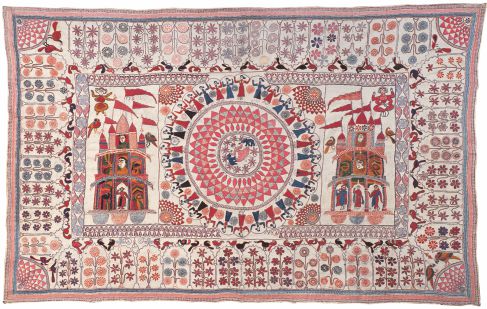
While quilting is common to many cultures, the nakshi kantha or embroidered quilt of Bangladesh is a unique form of folk art in which worn-out or discarded material is used to create a useful and often exquisitely embroidered article. Traditionally, discarded saris, dhotis, and lungis are used to layer the kantha, while thread drawn from the coloured borders of saris was used to hold the layers together. Quilted with simple lines of running stitches, the humble kantha is transformed into a nakshi kantha in the deft hands of a skilled housewife. The kantha maker could coax out a variety of textures with the aid of needle and thread, thus transmuting worn-out rags into pieces of art, where a wealth of motifs and sari border patterns juxtaposed scenes from legends and domestic or agricultural life. Often made for utilitarian purposes – to ward off the cool of monsoon or winter nights or to wrap up toilet articles – some of the finest nakshi kanthas were made for special reasons: to be given to daughters or, as the above example from the Bengali marriage song suggests, to welcome bridegrooms. These superb examples of Bengal women’s art testify to the aesthetic ability and acute perception of the kantha makers as they do to the patience with which they embroidered the dreams they had for themselves and for those they loved.
Early references to the kantha are not complimentary. More often than not, the kantha – derived from the Sanskrit kontha, rags – was associated with poverty. The legendary Raja Gopichandra, for example, is described as accepting a kantha on becoming an ascetic. But precisely when the simple, utilitarian kantha was transformed into the nakshi kantha has not been documented. This is largely because kanthas tend to disintegrate quickly under normal circumstances. The earliest surviving examples of quilts from Bengal are therefore not indigenous quilts but the sixteenth-century ‘Bengalla’ or ‘Sutgonge’ quilts, which were made for the Portuguese. Made in the Satgaon-Hooghly districts and exported to Europe, these quilts, worked in yellow tasar or muga silk on a ground of cotton or jute, show a distinct Portuguese influence in subject matter. These Indo-Portuguese quilts testify to the skill of the embroiderer of Bengal in the sixteenth century. It is possible that the heavy embroidery on these quilts influenced the closely embroidered nakshi kantha. Nevertheless, it may be safely assumed that the embroidery of Bengal was well established before the Portuguese commissioned these quilts.
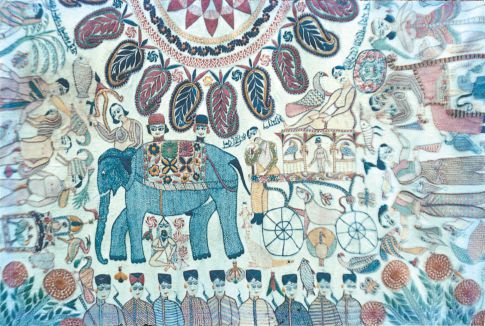
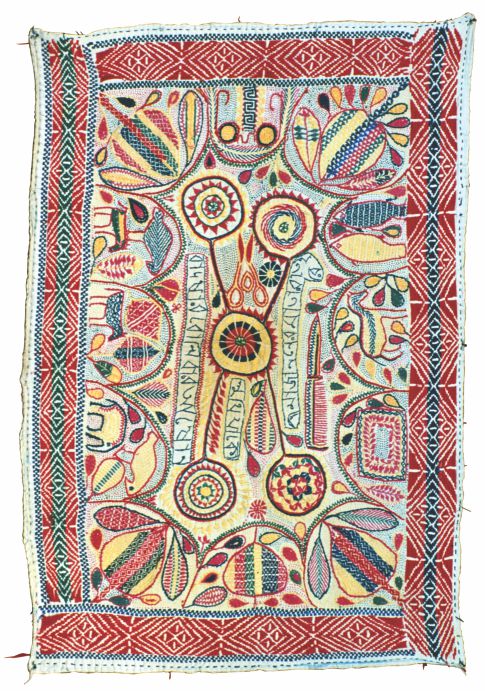
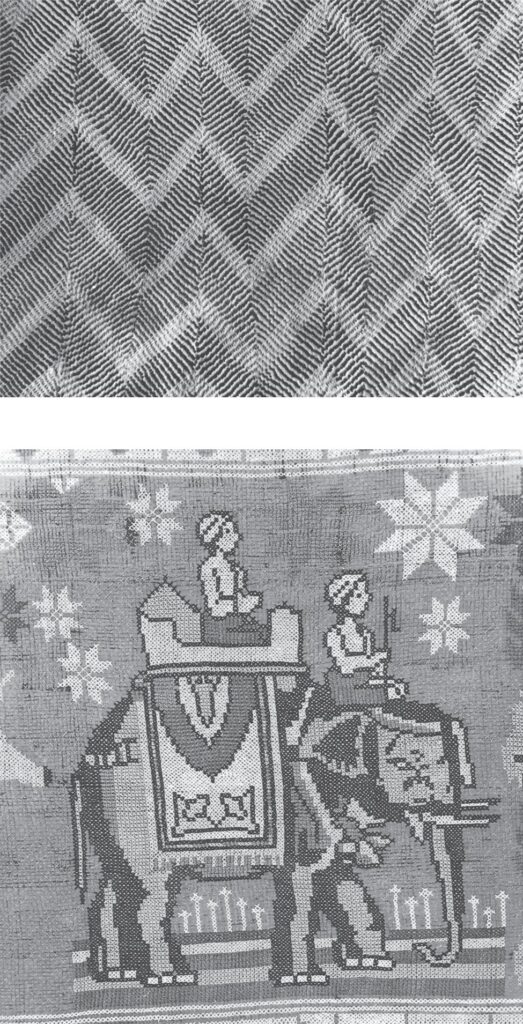
In addition to the Portuguese influence was the earlier influence of Islamic motifs derived from clothes or artifacts of Muslim travellers, especially in the Rajshahi area, on the lohori and lik kanthas and the sujni. The name of the lohori kantha derives from the Urdu word lehr, after the wave pattern popular in these kanthas, but other patterns such as the kautar khupi (literally, pigeon coop) or triangle are also common. The name of the red sujni appears to be a mutation of the Persian word sozni, sewn by a needle. The geometric and undulating floral and vine forms are also reminiscent of Persian art. However, the sujni was also influenced by the British, who commissioned white on white counterpanes, and it is not surprising that village women at Raja Rampur in the Chapai Nawabganj area refer to the sujni as belayeti sujni, English sujni. The back stitch or bakhya, which is used to embroider these quilts, is not an indigenous stitch and its foremost use is to sew garments. What is called the lik kantha also suggests a Muslim influence. The lik stitch, known in the West as the Holbein stitch – because of its appearance in Tudor portraits done by the artist Holbein – entered Europe from the Islamic world during the Crusades and was referred to as an ‘Islamic stitch’ at an exhibition organized by the Textile Museum, Washington D.C. in 1994. With the British came the cross stitch – which would be later replicated in the heavy cross stitch kanthas of Rajshahi.
While drawing upon these outside influences, the kantha makers of Bengal continued to make quilts for their own use with the simple running stitch. However, with their keen eyes and deft fingers, they also recorded the British presence in the region. Thus, even as the Bengali needlewoman recreated the traditional forms and patterns of the kantha she had seen her mother and grandmother make, or drew upon the rich indigenous culture of Bengal, she immortalized the sahib puffing on his hookah or the army of red-coated soldiers on the march. Not conscious of her ‘rural’ art, she embroidered the strange incongruities that resulted from the British conquest. With her adept needle she embroidered the carriage of the god or the palanquin that carried her daughter or granddaughter to her new home. She also embroidered images of dhoti-clad Bengali babus sporting European jackets and boots. A fine kantha from this period – the motifs embroidered in such tiny stitches that the colours are muted and almost impossible to capture on film – displays a train chugging through the countryside. In a kantha displayed at the Gurusaday Dutt Museum, Thakurpukur, Manada Sundari – one of the few kantha makers to inscribe her name on the kantha – has embroidered two rows of dapper English soldiers on a march. However, if the kantha is a witness to history, it is also the mute confidante of the kantha artist who embroiders into the kantha her hopes and fears, her joys and sorrows. The women who worked on kanthas usually did not write about their experiences, but the poet Jasimuddin has imaginatively portrayed how a village woman might embroider a kantha out of the strands of her own life. In Nakshi Kanthar Math – The Field of the Embroidered Quilt in E M Milford’s translation – Jasimuddin describes how Shaju, waiting for her husband, Rupa, who has had to flee the village after a quarrel, embroiders pictures in the kantha.
Spreading the embroidered quilt
She works the livelong night,
As if the quilt her poet were
Of her bereaved plight.
Many a joy and many a sorrow
Is written on its breast;
The story of Rupa’s life is there,
Line by line expressed.
Traditionally, kanthas were stitched during leisure hours, and elaborate kanthas could take years to complete. Jasimuddin indicates the time taken to complete a kantha by showing how Shaju begins to embroider her quilt while she is still unmarried and continues to work on it through the years.
She is a daughter beloved at home
When the embroidery begins;
Later a husband sits at her side,
Her red lips hum as she sings.
But if the quilt could tell of happy days, it could also record sad ones. After Rupa flees, Shaju’s mood changes. Her sorrow is recorded in the quilt as she embroiders the sorrowful scenes etched in her memory.
Stitch by stitch, she carefully draws
The last scene of pain,
The farewell of Rupa, slowly going,
Then turning a little again.
Turning again to the cottage home,
At the door his peasant wife
Standing dishevelled, gazing at him
Who is going to leave her for life.
Shaju foresees her own death and asks her mother to spread her kantha over her grave. When Rupa returns many days later he recognizes Shaju’s grave by the kantha on it. Wrapping himself in the kantha his wife had made, Rupa pines away and dies. His wife’s kantha becomes for Rupa the symbol of Shaju, the needlewoman becoming identified with the kantha she has made.
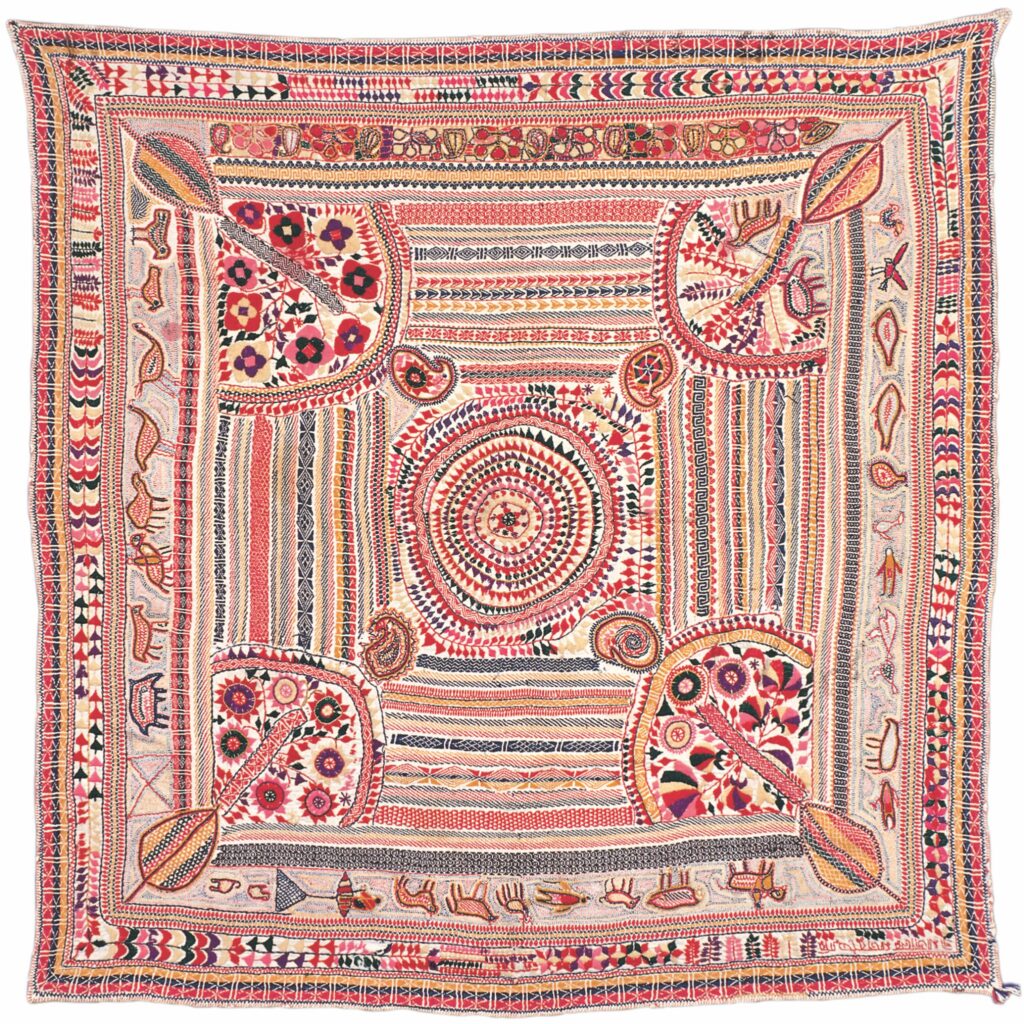
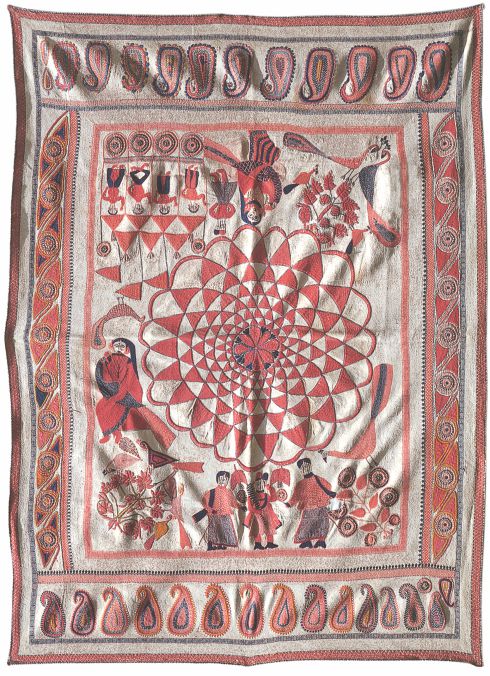
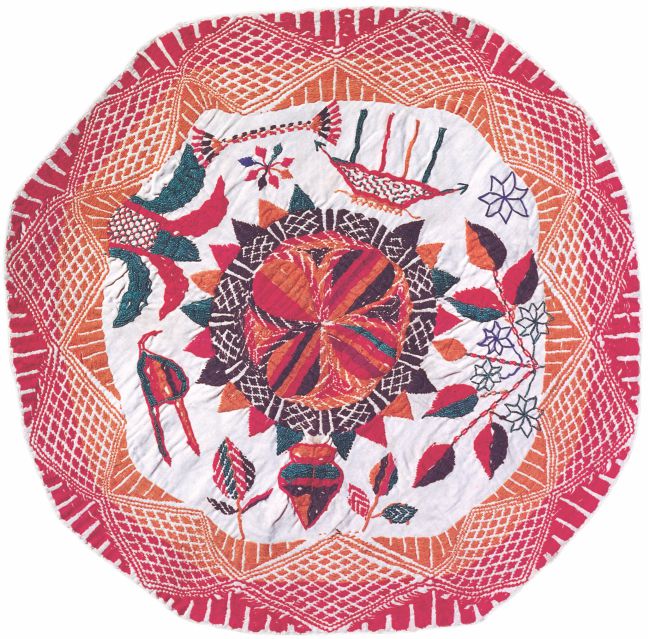
The kantha maker does not consider her work to be ‘art.’ Instead, stitching the kantha as a gift for a loved one, she embroiders into the kantha her blessings and good wishes. Thus in one kantha, the kantha maker blesses her son-in-law with the phrase ‘Sukhi thako’ (be happy). Many of the motifs suggest plenty and prosperity, while others embody prayers for safety. The kantha is, as has often been noted, closely allied in motif and spirit to the alpana. The Sejuti Brata Alpana, for example, depicts a central lotus drawn within a mandala or circle. Additional motifs include the sun, the moon, ornaments, a boat and a palanquin. Other alpanas depict animals, trees, footprints, as well as objects desired by the devotee for herself or for the person for whom she was performing the brata, or vow, and its attendant rituals. Alpanas accompanying bratas for the well-being of male members of the family include motifs of water pots and boats. Similar motifs in kanthas replicate these prayers for safety.
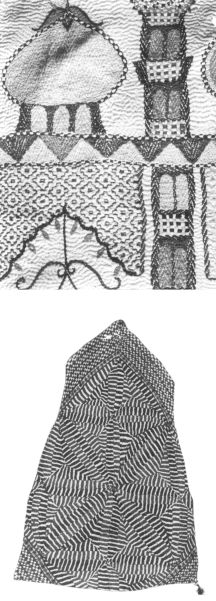
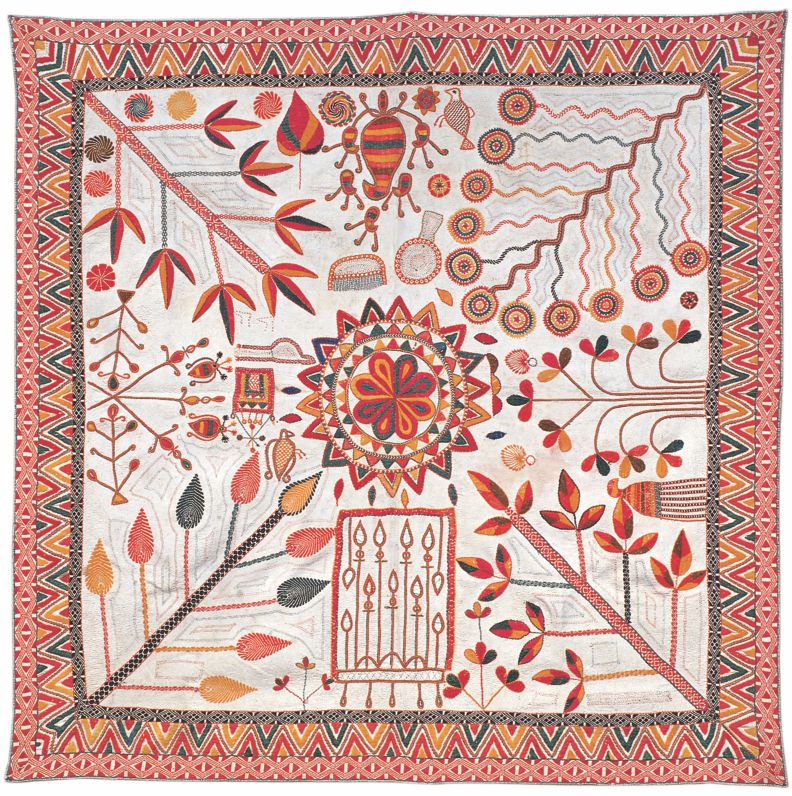
The kantha maker is usually content to recreate the familiar designs that she has seen embroidered in the kanthas made by the women in her own family or her adopted one. Despite its variety, therefore, each kantha tends to follow a similar basic pattern. In the centre of most kanthas is a lotus: an astadal padma or eight-petalled lotus, or a satadal padma or hundred-petalled lotus – around which are undulating vines or sari border patterns. Occasionally, the outermost border round the lotus is not circular but square. In the corners of this square are embroidered floral or kalka, paisley, motifs. The kantha is also edged with sari border patterns, ranging from simple ones to elaborate ones. From the four corners of the kantha, kalka or tree-of-life motifs point to the central motif or mandala. The empty spaces between the central motif and the corner motifs are filled with traditional motifs drawn from nature or the homestead as well as scenes from real life or legends. The areas left bare of motifs or scenes are worked with the kantha stitch in white thread to create undulating ripples.
What makes the kantha different from other forms of embroidered pictures is the ingenious use of stitch-craft. Using her needle to hold the layers of cloth together or to draw motifs and scenes, the kantha artist uses a variety of stitches to create rippling expanses in the white field of the kantha or coloured pointillist designs, ‘woven’ textures or ‘transparent’ effects. Thus, the running stitch is not just a stitch used simply to hold the several layers of the kantha together but lends itself to a number of variations. These different forms of the running stitch are accordingly denoted by names such as kantha phor or the kantha stitch, chatai or the mat stitch, kaitya or the bent stitch, the weave running stitch, the Jessore stitch, the lik stitch, etc. With these simple variations, the kantha maker, at her most creative moments, blends texture with motif in a manner unique to kantha art. Apart from these variations of the running stitch, other embroidery stitches too are used in kanthas. In addition to the back stitch and cross stitch, these are the Kashmiri stitch, stem, arrowhead, herringbone, satin stitch, and buttonhole stitch.
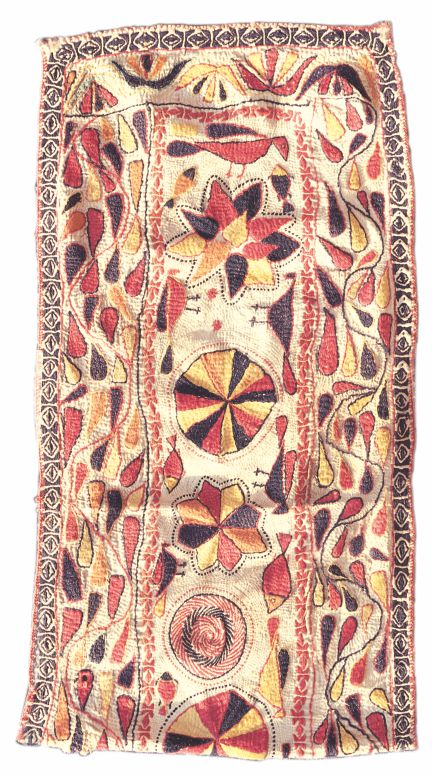
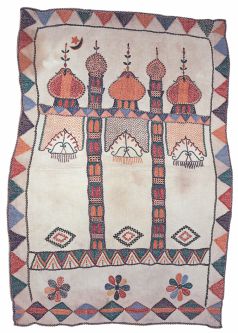
Traditionally, kanthas have a variety of uses, domestic, ritual, and ceremonial. Kanthas thus range from large lep and sujni kanthas, used as spreads and coverlets, to small bashon dhakar rumal, used to cover dishes, and arshilata, used to wrap toilet articles. Other kantha articles include jainamaz, Muslim prayer mats; gilaf, a small square kantha folded and stitched envelope fashion, to cover the Quran; ashon kanthas, used as spreads for pujas or for seating special guests or a bridegroom; palkir topor and khat kantha, used to spread on top or inside the palanquin; bayton, bostani, or gatri, a square kantha used as a wrapper for clothes and other valuables; balisher oarh, balish kantha, balisher chapa, or balisher oshar, a small square or rectangular kantha used as a pillow cover; dastarkhan, a long, narrow kantha used as a dining mat; chadua kantha, used over the grave of a saint; khicha, a small square kantha gathered in the centre to form compartments and used as a container for betel batua or as a purse.
The kantha revival followed the liberation of Bangladesh and was fostered by the interest in ethnic arts and crafts as well as the desire to create and express a unique Bangladeshi identity. In the search for traditional forms, older kanthas were cannibalized for new configurations and new ‘rural’ kanthas were designed. Apart from large kanthas made to fill large public spaces, the kantha revival also saw kanthas being made to meet contemporary needs: as bedcovers and quilt covers, wall-hangings, cushion covers, place mats, napkins, etc. Kantha embroidery also began to be used on saris, dresses, and kurtas.
In Brihat Banga (1935), Dinesh Chandra Sen noted that a composite kantha, even when designed by taking motifs and designs from fine old pieces, lacked the beauty of the old ones. This is a point that continues to be made today, especially with the production of kanthas as in a factory line, for commercial purposes. As handicraft shops mass-produce kanthas for sale, both aesthetic variety and emotional content are lost. The commercial kantha is often designed by men, usually trained artists, and lacks the spontaneity and variety of the older forms. Inspired by the idea that the kantha is a ‘rural’ craft, some artists embroider scenes from the countryside, where time seems to have stood still, while others design kanthas inspired by Jasimuddin’s poems, thereby returning the compliment the poet paid to the kantha.
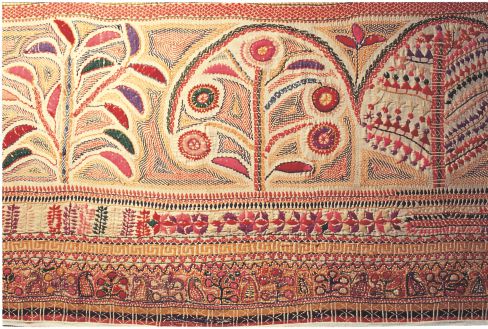
Of course, there have been significant changes in the form as well. The popularity of the wall-hanging, for example, has influenced the traditional configuration of the kantha, with the centre and four corners being replaced by a top and a bottom. Many kanthas also rely heavily on the bhorat or Kashmiri stitch, rather than the traditional running stitch, and resemble Chinese tapestry work rather than the traditional kantha. Because of their vivid colours and scenes, many of the finer examples of this new hybrid form tend to command astronomical prices compared to the more modest prices for the muted traditional kanthas. Nevertheless, an art that the folklorist Tofail Ahmed had mourned as dead in Amader Prachin Shilpa (1964) has been revived. Furthermore, the interest in the traditional kantha is inspiring not only artists and designers but also scholars and researchers to study old kanthas in museums at home and abroad as well as in private collections. While the early forms of this art are being explored for their wealth of motifs and ingenuity of stitchcraft, in the process more is being learned about the lives and mindset of the women who made these kanthas.
Nevertheless, contemporary kanthas cannot replicate the old ones. This is not only because the times have changed and our needs are different, but also because the contemporary kantha is a conscious attempt to replicate a traditional art. Traditional folk art allows for both repetition and change. It is this combination of repetition and change that marks the older kanthas, giving them a spontaneity that the newer ones lack. All the same, there is a value in these newer forms. Not only have they helped provide material for craft shops and boutiques, they have also called attention to the value of the unpaid work women did during their leisure hours. Though far removed from the older kanthas, these newer kantha items, with a price tag on what used to be unpaid, uncounted labour, honour the thrift and patience of the Bengali housewife who stitched her dreams into discarded, worn-out material, transforming it in the process into a priceless work of art.
Niaz Zaman is Professor of English at the University of Dhaka
What do you do, O mother of the bride, Sitting on your bed? Your daughter’s groom approaches fast, A flowered turban on his head. O let him come, as fast as he will, What have I to fear? For his sake, at the threshold, I have spread the marriage kantha, dear. – Bengali marriage song…