

from the ravi to lake ontario sheherezade alam continues her journey with clay
Sheherezade’s personal journey with clay began in the 1970s in Lahore when she became one of the first few graduates of The National College of Arts with a major in Ceramics. Her prolific career that stretches over three decades and two continents places her among the influential exponents of this art form in Pakistan
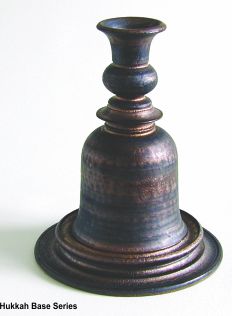
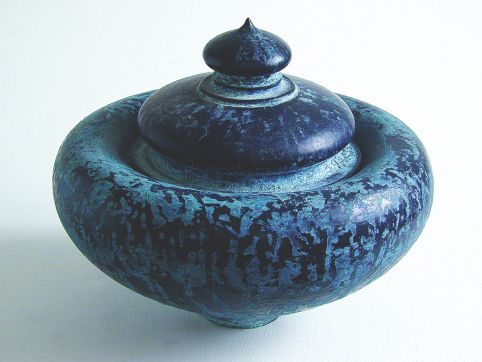
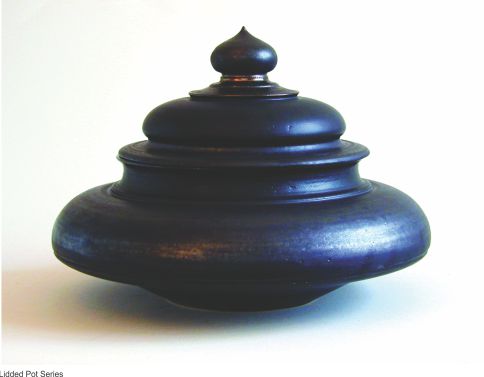
The pots that you see in Sheherezade Alam’s studio in Toronto in 2005 don’t have the familiar look of their material. They appear like chiselled stone rather than wheel-thrown clay. A primordial energy seems to emanate from the centered roundness of their womb. Here symmetry becomes a powerful mantra of the perfect balance.
Step closer and you find the forms vaguely familiar. The eye begins to pick out the parts of classical shapes that have been cleverly juxtaposed into a hybrid body. The degh (communal cooking pot) ‘lip’ and ‘shoulders’ synthesized with the wide belly of the matka (water pitcher) take on a new identity that can only be a ‘Sheherezade pot’, a modern studio potter’s homage to her 5000-year-old clay legacy.
Sheherezade’s personal journey with clay began in the 1970s in Lahore when she became one of the first few graduates of The National College of Arts with a major in Ceramics.
Her prolific career that stretches over three decades and two continents, places her among the influential exponents of this art form in Pakistan.
‘The difference between an old potter and a new potter is between the unconsciousness within a single culture and the individual consciousness of all cultures’ observed Bernard Leach, the father of Studio Pottery. He clearly refers to a master craftsman who with his inward vision of perfection spends a lifetime oblivious to outside influences. The goal is a quest for perfection within the tradition. Working within the confines of the pre-assigned role, they are relatively immune to the influences of global clay culture. The new or Studio Potter’s perspective is global and clay becomes a means of discovering the limits of personal creativity and is seen as an expression of identity.
It is not surprising that Sheherezade’s early influence came from Bernard Leach and his interpretation of the Japanese ceramic aesthetic. Which is to say she discovered the East via the eyes of the West and her own culture was explored as the result of awareness created by Leach’s revival of traditional pottery in Japan.
How could it be any other way? For two hundred years colonial powers dominated art education and carried out direct interventions to subvert the birth of an independent identity. The National College of Art (previously the Mayo School of Art), which she attended had been created by the British more than a hundred years ago. After Pakistan was founded it was restructured on a Western model, and thus it was not surprising that its ceramic curriculum was totally divorced from the indigenous history of clay craft production, which dates back to 3000 BC.
Sheherezade’s oeuvre in the decades that followed was to reflect her natural affinity to clay, and this was interwoven into her own search for spiritual and artistic identity.
Her first major solo in Karachi in the late 1970s was a generous acknowledgment of the debt owed to Leach as her pots predominantly emulated her mentor’s engagement with Japanese pottery. Dozens of pots paid tribute to Sung pottery in the large exhibition hall of the Arts Council in Karachi. One sure outcome of this ‘Sung worship’ was that it put Sheherezade in touch with her own minimalist sensibility. From the monochrome and unadorned surface of the pots of this show, Sheherezade’s experiments led to an ever- evolving vocabulary of forms glazed with a vast range of colours and textures. What remains constant throughout her oeuvre is the exploration of the vessel form. She has stretched its possibility from the functional to the purely decorative. Made sculptural with surface textures and altered form, the pots are carefully balanced between surface decoration and form. It’s the streamlined silhouette with its clean line that emerges as the primary concern in the work.
In Pakistan Sheherezade gave ‘the matti ka piyala’ or ‘brown pot’ a new identity. She searched for existing forms in the vessel tradition regardless of material. The vast vocabulary of utilitarian clay and metal vessels began to be referenced in her work. Sometimes the glaze recalled the patina of weathered brass and iron. In 1987, she accompanied her husband Zahoorul Akhlaq, the eminent Modernist painter of Pakistan, as Artist-in-Residence at The School of Sacred Music, Yale University. The challenge she set out for herself was to spotlight the Islamic ceramic legacy through glaze. For this she chose the turquoise glaze, which is the hallmark of Islamic ceramics regardless of geographical location. From Iznik to Mughal India, from Samarkhand to the Spain of the Moors, it was appropriated by Muslim potters for their pots, platters and tiles and given a dynamic creativity when introduced to local forms and patterns. Growing up with the traditional ceramics of Hala, Nusserpur and Multan around her, Sherezade was also exposed to Islamic ceramics during her extensive travels in South Asia and the ‘Near East’ and was struck by this common thread and inspired to explore it in her work.
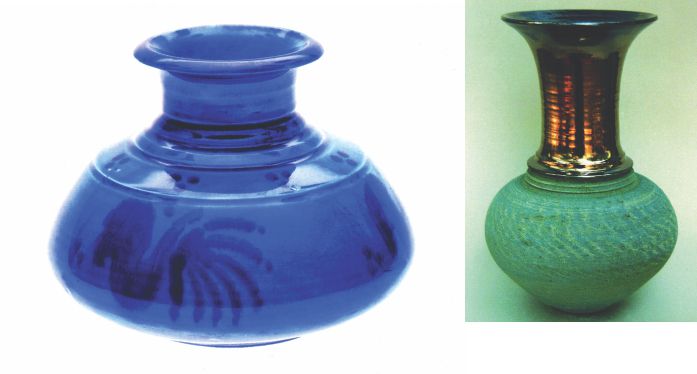
Soon the potter was to discover that the electric firing and clay would not yield the particular shade of turquoise she sought and it was only after extensive experiments that she could come close to it. This body of work was provocative in content and tranquil in appearance as dozens of tones of Turquoise were re-discovered, spotlighting a significant era of the world’s ceramics history. At various exhibitions of this work the potter displayed dozens of varied forms from her entire repertoire that were all held together with the turquoise glaze. Her contemporary interpretation shunned elaborate ornamentation and pattern as it sought to emphasize the lustrous clarity of turquoise.
Another glazing technique inspired by what was familiar in her environment was the treatment of metal cooking vessels that after a good exfoliating scrub with ash and sand are then lightly covered with a light coat of clay slip for even heating. This contrast of the shiny metallic surface of the ‘lip’ with the matt clay body led to a series of works done in a matt powdery gray-blue and tar-black or blue metallic glaze.
The form took precedence with the Dancing Pot. This was inspired by the performance of her friend, Nahid Siddiqi, the internationally renowned Kathak virtuoso. The whirling of the full long-skirted costume with its undulating rhythm caught the imagination of the potter and was manifested in the dancing bowls.
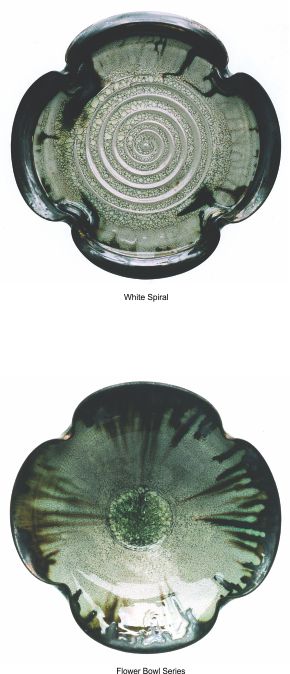
While ‘turning’ on the wheel the potter coaxed the walls to open up like a flower and take on an undulated lip that echoed the dancer’s costume. This shape was extensively used later and led to the Flower Series, which was based on a variation of this form. With the inner pool of the bowls emphasized though a dramatic core, Sheherezade created effects with crystalline layers and glaze trailing to echo the botanical specimens.
1993 was the year the potter and her family re-located to Canada. The foremost challenge Sheherezade remembers was presented by electric firing. Her entire colour palette that was developed around gas firing required a newlook. After a brief period in Montreal, they decided to settle in Toronto, where Sheherezade was able to reach out to the local ceramic community. Soon she was invited to exhibit in a single-person show at the prestigious Gardiner Ceramic Museum in 1996 and was regularly selected by the jury to participate in The Annual Toronto Outdoor Exhibition.
Asked if her work has been influenced by anything after her move to Toronto, Sheherezade replied that since by this time she had developed her own aesthetics, and since the work around her was so different from hers she found little inspiration from it. However, she learnt and grew with the highly technical glazing expertise available.
The greatest opportunity came when Sheherezade could find accommodation in Arcadia, an Artists Cooperative with its fully equipped ceramic studio. Not only could she work uninterrupted close to home but she could also take ceramic classes to generate an income. Her career also extended to teaching ceramics at school through the ‘artist in residence’ programme.
All this was sadly interrupted in 1999 when her husband and her elder daughter were murdered in Lahore. This tragedy changed Sheherezade’s life and work.
She had been firing her pots when she got the news and somehow as a reflex action she got them out of the kiln before she rushed to Lahore. It was to take her many years before she could get herself to go back to the studio.
In order to come to terms with her grief and consolidate her husband’s work Sheherezade formed Laal, an organization dedicated to the documentation and exhibition of his art. Laal also tried to keep alive the memory of her elder daughter, Jehan Ara, who was an outstanding young dancer. Over the years two major exhibitions were organized and a book was published to achieve these goals. The Thakti Show that was held in Pakistan was inspired by Zahoor’s use of the Takhti (wooden writing tablet) as a substrate. This national show brought together over 100 artists from all over Pakistan and several from Canada.
When Sheherezade returned to the wheel in her studio 2004, she found her work taking a different direction. Now she was drawn to a larger scale and this change pushed her previous skills to new limits. After years of throwing on the wheel, Sheherezade began to look at the Pakistani craft potters, method of combing techniques for composite building. Now she uses a roller to create big clay slabs that are pressed into a wide shallow mould to shape the base, which is attached to wheel – thrown parts. The result Sheherezade seeks is one of monumental sculptural presence. She wants her pots to embody strength and silence simultaneously.
The potter’s last exhibition ‘In Silence and Light’ in Toronto and ‘Lalli’ (illumination) in Lahore both allude to the deep link between spirituality and clay. The subtext of these shows remained strongly spiritual and can be traced to her early exposure to the spiritual roots of pottery.
A proud tall figure, Sufiji, the craft potter, drifted into her studio quite by chance in the 1980s in Lahore, and for years he helped her with the preparation of clay and throwing traditional pieces and simultaneously initiated her into the sufic tradition of the potters of South Asia. The Naqshbandi Sufis of Islam are closely aligned to the clay and textile crafts. They strongly believe that their creativity makes them a medium through which the divine spirit flows which makes their work akin to worship. A respect for the medium and a vigorous work ethic is integral to their life. Sheherezade remembers how Sufiji began his work with a morning ritual of lighting an oil lamp. This was the beginning of her own exploration of oil lamps in her oeuvre.
Kulalnama, or the ‘Craft Potters Prayer Book,’ reinforces the strong link between prayer and pottery. This book is probably modelled on the pre-Islamic practice when each craft had its own patron deity and prayers addressed to the deity safeguarded their work from the vagaries of nature. Today the Kulalnama invokes the name of God through verses from the Quran.
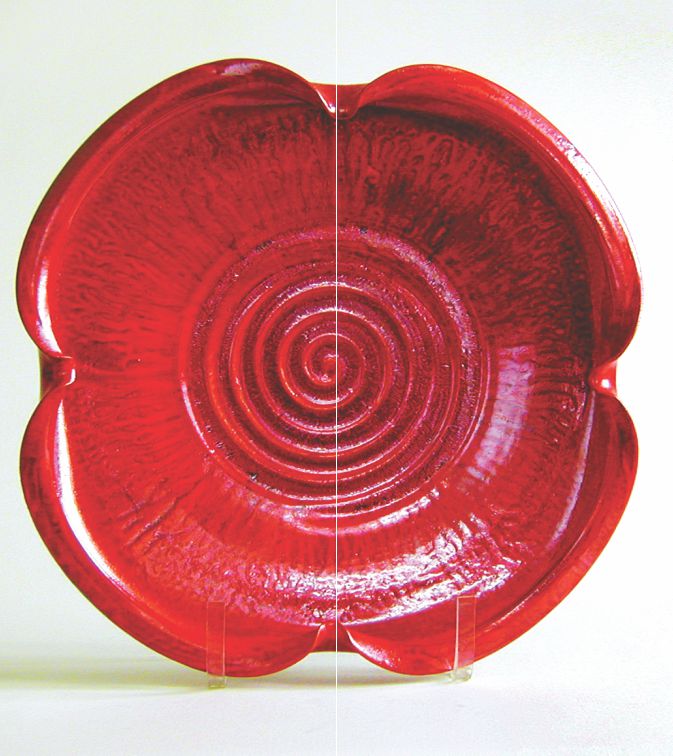
The ‘In Silence and Light’ show was conceived on the day of her late daughter Jehan Ara’s birthday. While she felt the acute loss of her firstborn, this day also coincided with the dates of the Beslan Tragedy in Russia. After many sad weeks Sheherezade once again turned to her pots for strength and decided to share her pots with the children of her neighbourhood school. Sheherezade collected some 100 biscuit fired pots in her studio and glazed them in red. The colour red for her has always been a symbol of celebration, the cleansing flame and ray of hope all rolled into one.
The exhibition was held on Remembrance Day, the day that marks the end of the First World War in Canada. Her project included ‘art offerings’ on cards created by students and 100 red pots of Sheherezade that were lit with small candles at the ceremony that brought the school together in ‘a moment of remembrance’.
After ‘Remembrance Day’, the pots were shifted to the Arcadia Gallery where visitors were invited to join artists in meditation for a week.
When the same idea crossed two continents to Lahore she lit candles in the red pots in her apartment, the site of the tragedies. This time the show, Lalli or Illumination of Sheherezade’s, was not only an offering of her creativity but vital to the process of healing– her work as a mother and wife had finally merged with her work as a potter.
Niilofur Farrukh is the author of The Pioneering Perspectives, Biographies of three Women Artists of Pakistan, Meher Afroz, Nahid and Sheherezade Alam, Ferozsons (Pvt) Ltd., Pakistan, 1998
Sheherezade’s personal journey with clay began in the 1970s in Lahore when she became one of the first few graduates of The National College of Arts with a major in Ceramics. Her prolific career that stretches over three decades and two continents places her among the influential exponents of this art form in Pakistan The…