
rwitik ghatak and bengali identity
Throughout his life, Rwitik Ghatak was haunted by the specter of Partition, a trauma that found creative expression in many of his films. A careful examination of Rwitik’s cinematic oeuvre reveals a strong underlying influence of Carl Jung’s theories, through which Rwitik projected his idealized image of an eternal and undivided Bengal.
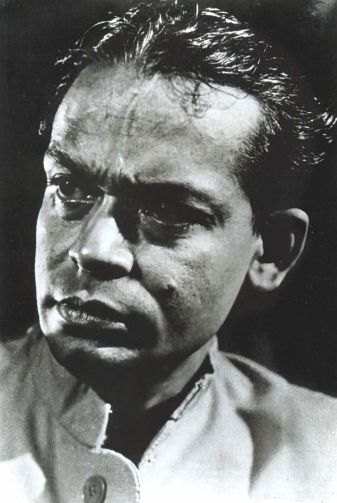
1976, after the death of Rwitik Ghatak, the federation of film societies of India arranged a condolence meeting for him. There Satyajit Ray said without any hesitation, “Rwitik by heart and soul was a Bengali director and an artist. He was a true Bengali, much more than me. To me, that was his greatest identity.” It is true that, among all the praise worthy directors of Satyajit’s generation, Rwitik was most vocal about Bengali identity. This was because after the partition of Bengal, Rwitik had a severe identity crisis. His sense of being a Bengali was threatened, reduced & divided from various angles. major part of Rwitik’s youth was spent in Pabna, Mymensingh & Rajshahi. It was his most formative period, and the sensitivity he developed during this time became the driving force for the rest of his life.
After the partition of 1947, Rwitik became a permanent resident of West Bengal and his childhood world was left behind in the former East Pakistan.
“This is my biggest problem. I was constricted within a boundary even before I started, as I can
never find that kind of landscape here. Those facial features, that certain style of speaking cannot be recreated here. All these can somehow be showcased in front of the world but film cannot lie. Mere words cannot solve anything. The thing that was meant to be portrayed will be lost.”
Had he been a writer or a painter, he could have captured his left-behind world from the pages of his memory. But film is very much a photographic imagedependant media. The thoughts and imagery that had been gathered in his mind from childhood could not be captured in celluloid. The creator is successful when he can identify himself with his creation. The inability to express what he felt created a bizarre identity crisis in Rwitik. People usually search for panacea when they suffer from this kind of mental trauma, so that the pain can be relieved even to a minute degree. Rwitik found his panacea in the analytical psychology of a Swiss psychiatrist, Karl Gustav Jung.
According to Jung, a human mind is divided into 3 levels – consciousness, the personal unconscious and the collective unconscious. The most ancient and fundamental level of the human mind is the collective unconscious and this is also its prime mover. The collective unconscious is comprised of certain archetypes or basic propensities, which have been developed over generations of common human experience and transcend barriers of culture, language, or ethnicity.
It is a commonly held notion that our sense of personality and identity is created through experiences gathered during conflicts with external reality. But Jung takes a totally opposite view. According to him, all experiences and tendencies are determined by the collective unconscious and not external reality. A child is born with a complete blueprint of its mental makeup and personality in its collective unconscious.
These innate tendencies are brought out through the course of experience. In other words, identity is not created in a person, it is awakened. Rwitik unquestioningly adhered to Jung’s theory. Rwitik found solace in the thought that no matter how many times Bengal might be divided, in terms of culture and identity Bengal remained united.
If we judge Rwitik’s cinema characters on the basis of this theoretical background, it becomes easy to comprehend them. There was no reflection of Jung’s theories in Rwitik’s first film Nagorik (The Citizen), released in 1952. Probably, at that time, he was not aware of Jung. The first film that showed the influence of Jung was Ajantrik (Non-Mechanical), released in 1958. The film’s main character, Bimal, is a driverfor-hire who has an old Chevrolet car named “Jogoddol”. Bimal does not have anyone in this world other than Jogoddol. Jogoddol is simultaneously his mother, lover and companion. To Bimal, Joggodol seemed to possess a soul. This is Rwitik’s interpretation of an archetypal human tendency to anthropomorphize objects. As they live, also they die.
Even Bimal in the end has to accept Joggodol’s death. The car is ripped apart and sold for scrap. At the end of the movie, we see the horn of the car in the hands of a child. This is the rule of life: one generation ends with the beginning of another.
Rather than viewing Bimal as merely an exceptional individual, Ritwik generalizes Bimal as a representative of the working class people of India. Bimal’s attachment to his car is an expression of an ancient Indian tradition of attributing life to inanimate objects.
According to Rwitik, in a third world country this attitude is beneficial for industrialization. In developed and developing economies, after a product receives its finishing touch through the hardship of numerous people, the owner takes it all. Thus workers become alienated from the product of their own labor. The service sector shows the same tendency as manufacturing. Bankers, schoolteachers, or drivers like Bimal cannot understand their role in the development of the national economy. They cannot identify with the fact that their own creation changes hands. Although Rwitik claims that tribal people have escaped this sense of alienation, in reality, they have suffered from the same sense of alienation and identity crisis with the advent of industrialization.
Arguably, this identity crisis cannot be overcome by some archetypal magic nurtured in the subconscious mind. The only way to escape from this is classconsciousness, through which people can feel that wealth, capital or machines are the collective outcome of the mental and physical labor of numerous people.
It is not the collective unconscious, but collective labor, that can bring about a sense of solidarity with our creation and help us find our own identity.
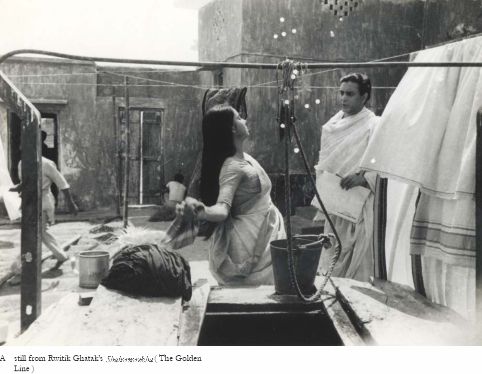
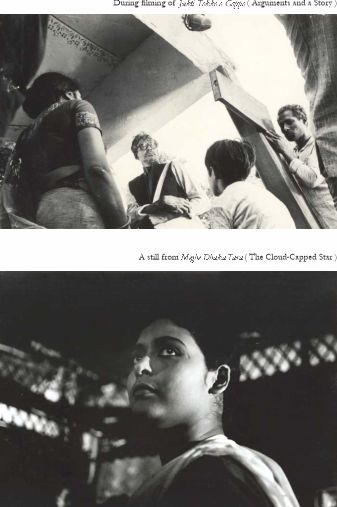
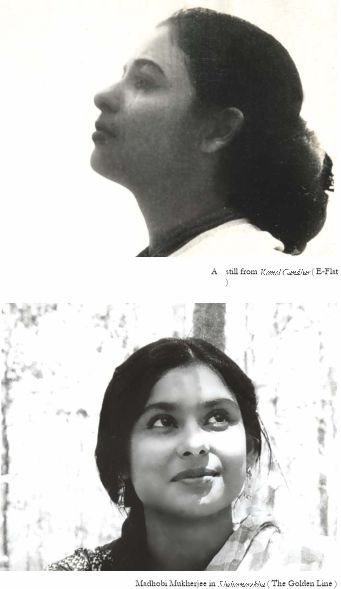
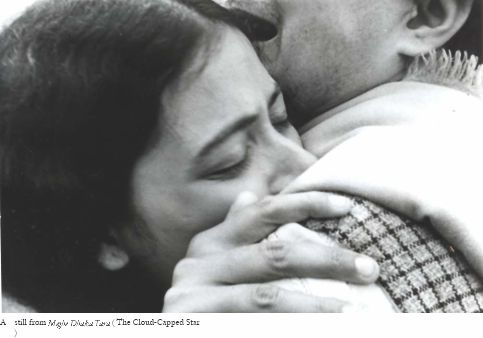
During the period 1960-65, Rwitik made three more films: Meghe Dhaka Tara (The Cloud-Capped Star), Komol Gandhar (E-Flat) and Shubornorekha (The Golden Line). Here he added two more elements in parallel to Jung’s theory: Hinduism and the refugee problem. Nita of Meghe Dhaka Tara is the modern representation of Durga. She is the only earning member of an extended refugee family. She dedicates her entire life for her family like her all-enduring mother. Anashua of Komol Gandhar is the symbol of uprooted Bengal. As a theatre artist she portrays the role of Shokuntala, a woman who leaves for her husband’s house– a reference to the pain of millions of refugees.
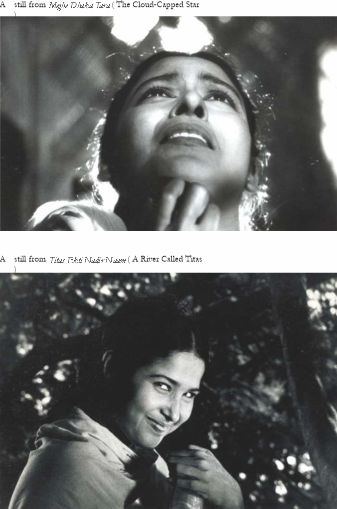
By this design, Ritwik’s characters have risen from the ancient archetypal depths of our collective unconscious. Their identities have been determined on the basis of Hinduism. They are actually mere vessels of ideas, and the conflicts between them are conflicts between ideas. Rwitik himself declared these three films as a trilogy. “I could never accept the partition of Bengal. I still cannot. And I tried to convey these feelings in those three films. It became a trilogy even though it was not intended to be.” In this sense these films were failures. They were produced from the inability to create the films that he truly wanted to make. To overcome his own identity crisis, he created such characters whose identities are indivisible, ineffaceable and unpartitioned from a mythical age.
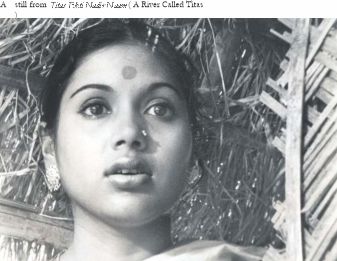
Rwitik came to Bangladesh after its Independence in 1971 to make a film. At last he found an opportunity to return to the fairy tale land of his birth. His film was to be based on the 1945 novel ‘Titas Ekti Nodir Nam’, written by Aditya Mollobormon, who was from the fishermen caste and wrote from his own experience. Rwitik chose this novel as a base for the reconstruction of his lost dream world. “In my view this novel is like an epic,” he said. “I tried for the first time to capture this style in a film.” Titas Ekti Nadir Naam is Rwitik’s most linear and narrative film.
In the course of making ‘Titas, Rwitik realized that whatever he had thought about East Bengal till then was only a nostalgic fantasy. “I never knew that my idea of Bangladesh, consisting of the two Bengals, was 30 years out of date. My teenage years and youth were spent in East Bengal. That memory, that nostalgia drew me like a madman towards Titas to make a film. The novel takes place 40 to 50 years ago…So Titas is a kind of tribute to the memories I left behind… It seemed as if I was walking through the path of that life, in the middle of that life … as if the clock had stopped ticking during this time. Titas started with this child like attitude, this foolishness.” “While I was making the film, I realized that nothing of the past is left, it cannot be. Everything has been lost with time; history is very cruel. The feeling that what once was will never return is a tragedy for me. But there is no point of being sad, death brings sorrow, but ultimately it is inevitable.” This confusion became an extreme irony in his creative life. He had always regretted his inability to make a film in his own land. But when he came to Bangladesh, he saw that the land of his memories was there no more. Why did he ever make that mistake?
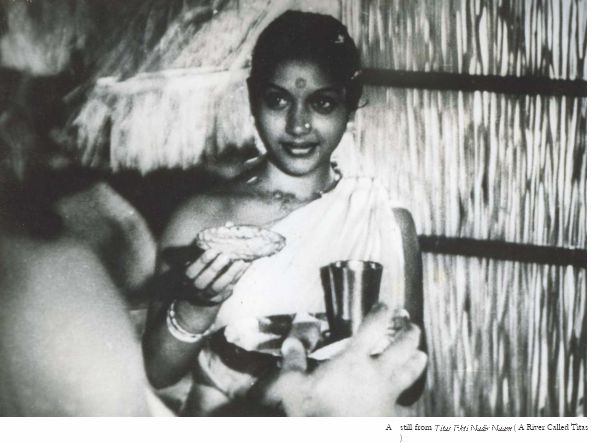
The collective unconscious mind is pre-determined and static, and man characteristically resists any change. Rwitik assumed that the east Bengal of his childhood was still there in Bangladesh. The shock of his return made him realize that the creation of a fairy tale epic in today’s age is impossible. As a result, when he made his next film in Calcutta, he declared without any hesitation, “The name of this film is ‘Jukti Tokko o Goppo’ (Arguments and a Story). You basically want a story, so I am giving you one. This is actually an argument. It is a completely political film.” Among the eight films directed by Rwitik, the storyline of Jukti Tokko o Goppo (1974) is the weakest. It is staccato in style, and is the most non-linear in structure. This is the first time that Rwitk moved away from his selfdeclared ‘epic’ format. This shift is also a reflection of his acute identity crisis.
As a sensitive person, Rwitik could not accept the partition of Bengal in 1947. It is easier for fundamentalism to rear its ugly head in India, Pakistan and Bangladesh due to the history of partition. Thus the slogan of cultural unity of the two Bengals is as important today as it was back then. In today’s circumstances, greater exchange of thoughts and ideas are necessary for the development of both WestBengal and Bangladesh. But where Rwitik’s treatment of identity is concerned, the question is not one of relevance but of form. To convey his concept of
unity, Ritwik used an abundance of Hindu symbols and icons in every layer of his films. This is because he basically considered that Bengali Identity had emerged from an archetypal layer of Hindu mythology present in the collective unconscious. Though not fundamentalism in today’s sense, this interpretation reflected a kind of Hindu chauvinism. A huge portion of Bangladesh’s and Pakistan’s populations are Muslims. In the same way that Hindus are indifferent about the intricacies of Islam, Muslims may also be reluctant to connect deeply with Hinduism. It is very
difficult to capture the essence of Rwitik’s films without a certain cerebral identification with Hinduism. So the actual question is, how acceptable is the slogan of cultural unity as presented by Rwitik, standing on the ground of sublime Hindu Chauvinism, to the Muslim Bengalis of today and tomorrow? There is no point to his approach if it does not stir the Hindu Bengali and the Muslim Bengali in the same manner.
The relationship between Hindus and Muslims changed for the worse even before Partition. The reason for this is economics. The Jamindars (landlords) of undivided Bengal were predominantly Hindus.
Their subjects were generally Muslims and low caste Hindus. The economic and social repression meted out to them by the Jamindars has become a legend.
There is a hint of this in the novels of Aditya Mallobormon. According to his writing, the life of the Fishermen caste revolved around the Titas river. Titas dried up slowly due to nature’s whims, exposing a bare sandy land. The fishermen and the farmers fought new land, but in vain. The Jamindar’s hoodlums took possession of it. But Rwitik’s Titas is quite different.
In the film we see that while the fighting continued between the farmers and the fishermen, the main protagonist of the story, ‘Bashanti’, rises above all these economic conflicts. Later a child is seen running through the fields, blowing a horn in his hand. Thus Rwitik didn’t portray clearly who took possession of those lands. In Ritwik’s analysis, the archetype of motherhood still exists at large no matter how much a region changes from riverine civilization to farm
based civilization. To establish this vague theory, the cruel relationship between the Jaminders and their subjects is tactfully avoided. The high caste Hindu Jaminders brought disintegration and poverty to every house of East-Bengal and the land of Titas. This process eventually resulted in the partition of the country. Even Aditya Mollobormon had made this connection way back in 1947. Rwitik, with the advantage of hindsight, could have more easily understood this. He could have been a step ahead of the writer, but instead he fell two steps back. In reality, Partition is a matter of resentful acceptance for the Bengali Hindus and a sigh of relief for the Bengali Muslim. For Bengali Muslims, the search for identity began with the establishment of East Pakistan.
Were there any negative feelings for Islam in Rwitik? The one word answer to this question is ‘No’.
Rather, there was a kind of indifference in him about Islam. That’s why he tried to find the expression of unity of the two Bengals through Hinduism, when he couldn’t find anything in Islam. He wanted to get to the core of Hindu Bengalis. Muslim Bengalis always remained outside his boundaries. How could he make this mistake? Even here, his thoughts were distorted by the influence of Jung. It can be observed that Jung’s search for archetypes is more at ease with Hinduism, Buddhism and pre-Christian Paganism. But he had many conflicts, doubts and questions regarding Christianity. It is a matter of extreme astonishment lh that if we go through the pages of the 17 volume “Collected Chorus” of Jung, we can only find a few scattered comments and criticism on Islam and Judaism. Jung’s logic is that the establishment of Christianity and Islam in the history of civilization occurs at a much later date. The arrival of Jesus occurred at the dawn of the first millennium.
Compared to that, Islam is almost new. It started its journey in 700 AD. Thus these religions related ideas that had been galvanized in people’s minds relatively recently. The archetype is formulated from the most primitive religious beliefs and the most ancient regions of the mind. As for Judaism, although it is an older religion, originating somewhere around 200 BC, because the Jews are scattered in many countries, they lack strong cultural roots. Thus according to Jung, they have become detached from the archetypal wellspring of the mind. Jung’s analysis led him to this one-sided view, because of the modern-ness of Christianity and Islam and the rootless-ness of Judaism. But there is also a more fundamental basis of Jung’s outlook. The frameworks of Paganism, Hinduism and Buddhism are somewhere connected to the Aryan mentality. On the other hand Judaism, Christianity and Islam have semetic origins. Jung tried to reinforce his belief in ancient Aryan glory through his sychological theories. To explain why the Nazis were so virulently opposed to other religions and opinions and why millions of Germens followed Hitler without any hesitation, Jung said that Catholicism and Judaism had too long suppressed the ancient Aryan identity. In his view, Nazism was a turbulent reaction against this suppression, which was as inevitable as it was undesirable.
Rwitik never said anything directly about Jung’s theory of eternal identity, which is actually a camouflaged face of racial identity, but he depended on this complicated theory to resolve his own identity crisis.
He made six films based on Jung’s psychological theories, where many different incidents and characters are represented. Jung had divided humans in two different groups as defined by character: extroverts and introverts. The people who are engaged with the outside world are extroverts, and the people who are preoccupied with their inner being are introverts. If
we analyze the characters of Rwitik’s films, then we can see that they generally fall under these two categories. The introvert characters have to suffer in many different ways – no one comprehends the sacrifices made by Meghe Dhaka Tara’s Nita, Shubornorekha’s Sita was trapped in a comer till her death, Titas’ Ononto fled from Bashanti and Nochiketa cannot tolerate Bongobala. The eternal archetypal wisdom has been captured in the characters of Bimal, Nita, Sita, Bashanti or Bongobala. But why are they always misunderstood? According to Jung, the major crisis of modern man is that he has been detached from the nemesis of his mind’s archetypal layer. In Shubornorekha a news reporter says, “Who is not a refugee?” Today man seems to have lost all his ethics. As a result, his own existence is meaningless to him. In the past, people could easily identify with myths and epic characters, a capacity which the modern age destroyed.
Influenced by Jung’s philosophy, Rwitik took it for granted that identity is actually eternal. This was the source of his internal dilemma. If man changes with time then his sense of identity must also change with time, it is never static. Identity must be an amalgamation of past traditions and new experiences. Otherwise, human civilization could not progress from one generation to the next. In the case of Bengali identity, it has continued to evolve through the ages due to various influences: Buddhism, Hinduism, the arrival of Islam and ultimately the British. We can even observe a significant difference between the self-identity of the Bengalis before and after Rabindranath. The thirst for self-identification amongst Bengali Muslims was not satisfied with the establishment of East Pakistan. It eventually had to find resolution in the language movement. After the birth of Bangladesh in 1971, the search for Bengali Muslim identity gained a new dimension. With the division of Bengal, the identity of the Bengalis has also diverged. Bangladeshis and Bengalis of West Bengal have two different identities because they have to face different realities; on the one hand as citizens of a sovereign country, Bangladesh, and on the other as a cultural/linguistic sub-group within the larger national entity of India. But there still remain many common factors in the cultural heritage of the two Bengals, especially when we talk, laugh and cry in the same language. During the movement against the first Bengal partition in 1905, Rabindranath realized this truth, and the songs that he wrote at that time expressed the emotion of the cultural unity of the two Bengals with ease. Today the situation of the Indian subcontinent and Bangladesh is gradually becoming more complex, due to the influence of the fundamentalists and imperialists. If the two Bengalis can come together with the help of a common language and cultural heritage, then it will be easier to resist imperialism and denounce the influence of fundamentalism. In the case of Rabindranath, he has been and continues to be a unifying factor, by tapping into the common legacy of both Bengals. In this respect Rwitik, whose sense of identity was wrought with division, could not succeed.
Throughout his life, Rwitik Ghatak was haunted by the specter of Partition, a trauma that found creative expression in many of his films. A careful examination of Rwitik’s cinematic oeuvre reveals a strong underlying influence of Carl Jung’s theories, through which Rwitik projected his idealized image of an eternal and undivided Bengal. 1976, after the…