
a mother river recovered qian’an sanlihe greenway
qian’an city, hebei province, china, 2010
The Qian’an Sanlihe Greenway has undergone a transformation from its former existence as a garbage dump and sewage drainage. It exemplifies how a neglected landscape can be recovered as a green infrastructure and everyday landscape with restored ecosystem providing multiple services. The combined pedestrian and cycle paths for both commuting and recreational use have been integrated artistically, revitalizing social identity by reflecting local traditions. Through the generation of ecological and aesthetic benefits, the project catalyzes sustainable urban development in the region.
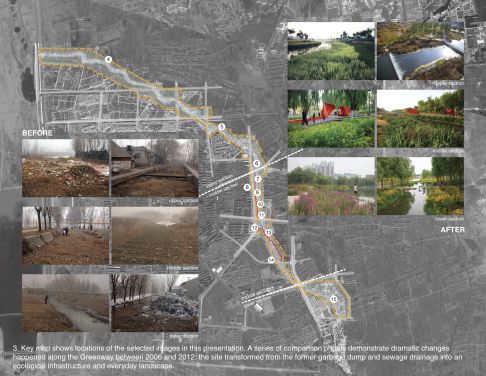
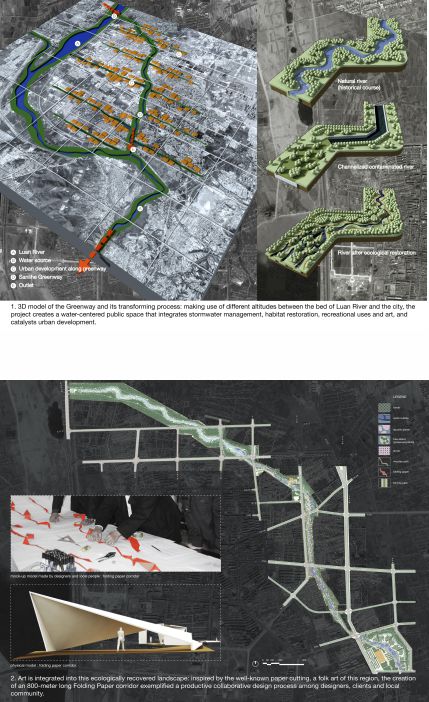
The greenway stretches 13.4 km in length and varies from 100-300m in width across the city of Qian’an. It covers 135 hectares and benefits a population of approximately 700,000. Qian’an City is located at the south foot of Yanshan Mountain, at the bank of Luan River, in the northeast of Hebei Province. Although the main city lies near the Luan River to the west, one cannot see the water since the topography of Qian’an is situated below the riverbed with its high embankment blocking the river view. The river is notorious for its unpredictable flooding, and has thus been kept outside of the city for decades through this high embankment. Meanwhile, as the life source of Qian’an, Sanlihe River has shouldered the long history of the city and carried the collective memory of its inhabitants.
Since the 1970s, the river has been badly polluted by sewage and waste that has resulted from the region’s continuous industrial development and urban population growth. As a consequence, with the depletion of regional water sources, the Sanlihe River became subsequently dried up and its channel blocked by solid waste.


The design strategies are comprehensive and have been developed across scales, and includes: cleaning the site, especially waste water from the urban storm water runoff; creating a scenic water byway; producing a resilient green river strategy; creating pedestrian and cycling paths; integrating of art and conceiving the greenway as a catalyst for urban development. It presents a strategy that suggests that landscape can guide urbanism.
qian’an city, hebei province, china, 2010 The Qian’an Sanlihe Greenway has undergone a transformation from its former existence as a garbage dump and sewage drainage. It exemplifies how a neglected landscape can be recovered as a green infrastructure and everyday landscape with restored ecosystem providing multiple services. The combined pedestrian and cycle paths for both…