

picture and performance
At different points in the history of the subcontinent, popular culture has shown sensitivity to the constantly energized political, cultural, religious and economic spheres that provide the context and rational for its production. The creative inspiration for printed art, however, is not always directly the people but often parallel cultural strands–such as the literary, visual and performing arts that are themselves emanations of the public imagination
The source base for what are now called ‘popular’ printed images of India has always been a vibrant public that is engaged in the simultaneous generation and consumption of cultural elements. At different points in the history of the subcontinent, popular culture has shown sensitivity to the constantly energized political, cultural, religious and economic spheres that provide the context and rational for its production. The creative inspiration for printed art, however, is not always directly the people but often parallel cultural strands–such as the literary, visual and performing arts that are themselves emanations of the public imagination. It is with such a perspective that I examine here the impact of theatre on the popular paper-based imagery (specifically prints and popular paintings) in 19th century India, and the result of the interaction and interdependence between two art practices that had contributed mutually to their circulation and consumption.
The nexus between theatre and the painted/printed image can be seen in three or four sub-categories—the company school paintings which appeared prior to the indigenous popular prints, the posters directly advertising prevalent theatre genres, prints that illustrated the same narrative as the theatre with or without any direct reference to that sharing, and the popular prints that without explicitly acknowledging it were influenced by stagecraft and the visual impact of theatre. These categories are not mutually exclusive of each other, but appear as several different responses to the performance traditions in 19th century India. With theatre, the paper-based image shared a visual and an ideological language—buttressing theatre’s intention to comment on, subvert, mobilize and entertain the public of that period. Whether there was affirmation or disagreement between theatre and picture or whether the two sought to tell diverging stories needs to be examined.
the company school
By the middle of the 18th century, Company art had virtually replaced the royal ateliers under Mughal patronage. The diminishing political power of the Mughals was accompanied by a decline of court sponsorship and painters were gradually seeking patronage at regional courts and on the open market that had emerged under the Raj. In response to the tastes of the new patrons, the Mughal idiom began to be altered and a new style and subject were adopted to suit the British patrons: ‘Now artists began to change their medium and colour range. They noticed that the British favoured water colour in somewhat sombre shades…They also began to change their subject matter, for they realised that it was largely festival scenes that attracted the British.’ (Mildred, Archer. Indian Popular Painting, London, UBS, 1978)

Two categories of artists, the indigenous ones displaced from the courts and the British travelling artists, together formed the Company School, their subjects being the spectacular and exotic elements of the Orient. Among portraits, court scenes, landscapes and botanical studies of exotic plants and animals, the vernacular performance traditions such as the charak puja or ‘hook swinging festival’ , nautches and semi-performative prayer rituals of regional origin quickly captured the imagination of the Company painters and were translated onto works on paper. Hence we have a portrayal of the charak puja by an artist of the Murshidabad school, dating to 1798 – 1804 and works by the reputed travelling artist Solvyns who gives written and pictorial accounts of the same event. These events for the European viewer heightened their sense of being on what Jeremy Black in The Grand Tour, Rocking the Cradle of Civilization calls the cusp of xenophobia and cosmopolitanism. Exotic and thrilling ‘spectacles’ such as the charak puja invoked in the white man simultaneously a fear of the foreign (as a threat to his cultural integrity) as well as a desire to partake of this unconventional, new world. The descriptions of the popular performative traditions (such as the churak puja and durga puja) are graphically narrated in Fanny Parks’ ‘The Wandering Pilgrim'(1850), published later as Thugs, Begums and the Englishman.
The painted version shows the event against a white background, reflective of how it was abstracted from the wider cultural and religious fabric of Indian life and regarded as an isolated item of fascination by the British. Graphic details of costume and paraphernalia feed the curiosity of the outsider who is always excluded from the frame of the painting, clearly separating the object being viewed from the viewing subject.
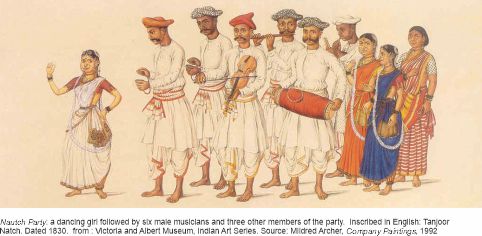
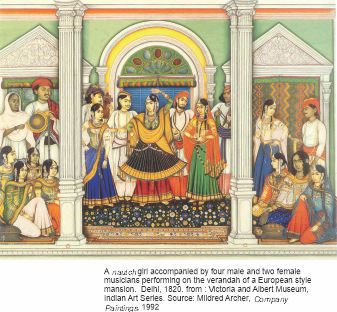
In a period prior to the institutionalisation of the theatre, such images seek to give public/ritual performances the status of theatrical performances. The manner in which Johan Zoffany (1733—1810) portrays cockfights elucidates this intention that arises out of the visual training and expectation of the British onlooker located in the east, who converts the daily into the theatrical and spectacular. The sheer uncoventionality of Oriental ways for the British heightens their reaction to it and this is reflected in their art and writing of this period. At another level there was the elite circuit comprising the ‘white Mughals’ among whom flourished a hybrid cultural tradition in which the British had less qualms regarding their own participation. This was a heterogenous tradition of nautches and theatrical performances that existed within the palaces and bungalows of the ‘nawabs’ who patronised a mix of the popular street culture and the courtly culture of the Mughals. Accounts of such occasions are present in the letters of Fanny Parks as well as the socially more elevated Eden sisters (Emily and Fanny Eden who wrote ‘Up the Country’ -1866 and ‘Tigers, Durbars and Kings’ 1837-38 respectively). Company School paintings of such performances embody the interest of the British viewer in the emergent aristocratic culture of the Indians and pay special attention to the nautch girls who portrayed a new phenomenon of the appearance of Indian women at court. Details of costume, jewellery and musical instruments are elaborately painted, with the performance and not the patron occupying the centre of the image.

The circulation of Company School paintings was much wider than the traditions of performance that they portrayed. As such, British audiences in England received visual education on indigenous performances and their conception of the Orient was conditioned by these secondary sources. The colonial artist’s preoccupation with making the work ‘picturesque’ and appealing to the European sensibilities, also to make it a graphic capture of an exotic spectacle, with his focus on objectifying the Orient as a specimen of interest and examination—caught as it were in pursuing barbaric acts of performance—provided a transformative quality to the reality of the East for those who were to view it from a distance.
***
The pictorial record of colonial India’s theatre practices was by no means one-sided and the public popularity of both rural and urban peformances found illustrated expression at the indigenous level too. Oil paintings, wood cuts, lithographs, oleographs and penny presses produced works inspired by the theatre to complement and advertise it in the form of posters and newspaper spaces. The theatrical mode influenced both sacred and secular imagery in the ‘popular’ art of India which aside from advertisements for the theatre appeared on advertisements for colonial and Indian products of consumption (cigarettes, matches, gripe water, food grains etc), calendars, post cards, billboards and as individual images for reverence (photos of the gods).
the woodcut prints
The woodcut block prints of Battala (located in the then ‘black’ part of town) in Calcutta were the first to arrive on the scene. These prints accompanied translations of Christian texts, local literature, folklore, popular romances and illustrated almanacs. They also appeared as the first advertisements for the performances of native theatre troupes. Their popularity was enhanced by the commercial and political function of Calcutta—which was both a major port for trade and the heavily populated capital city of the Raj till 1911.

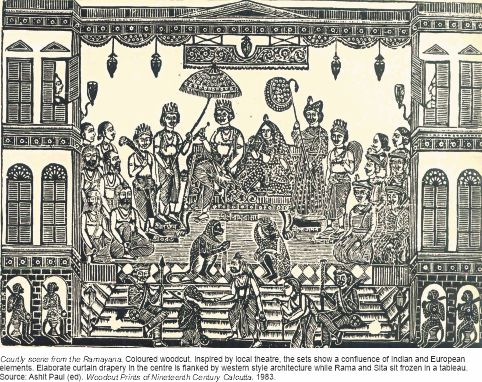
The appeal of the images of the ‘penny press’ lay in the manner in which it combined elements of Western and traditional pictorial practices. Neumayer and Schelberger mention how pictures of gods and goddesses would be clothed in traditional iconography with peripheral modern influences in the form of European classical architecture, European interiors with ornate glass chandeliers and some figures in foreign attire ( Christopher Pinney, Photos of the Gods, New York, Oxford University Press, 2004 ). The subjects are placed here as if in the newly introduced proscenium stage of the nineteenth century with heavy cord-held curtains on either side. On the other hand, the dramatic quality of the Battala prints draws from the theatrical genre of theatre that was extremely popular in this region. Under the patronage of the Bengali babus who sought markers of cultural refinement through the patronage of kabigan, bai nautch, jatras and swang performances, this regional genre of entertainment grew in popularity and competed against the theatre of the ‘White’ part of town. As elements from the colonial settlement filtered into the Battala traditions of performance, the woodcut prints too stand as testimonials for Western sets, costumes and paraphernalia. In an article on the Battala tradition Pinney states that the Europeanism of the woodcuts came from ‘their urge to mock, albeit cautiously, the pressures the artists felt, coming into the hybrid culture of the babus from the more wholesome rural environment where they still had their roots’. Hence the feelings of subversion, satire, comment and competition against a society both their own as well as foreign to them was reflected in the theatre and theatre-based woodcuts of early and mid-nineteenth century Calcutta.
The Tarakeshwar murder case of 1873 is an example of a dramatic incident that was simultaneously converted into a theatrical and visual narrative. Indeed, the Calcutta woodcut prints appear as specific tableaux from the stage adaptation of this true story with the figures in dramatical postures and with curtains framing them. Neumayer and Schelberger specify that this connection between the printed image and the theatrical visuals was a response to European developments where the palpability of the narrative expression could be found in the prints labelled ‘Theatrical Picture Galleries’. Specifically, the Bengal Press was set up by Harachandra Roy in 1816, the Chandimangal Press came by 1817, and the gradual growth of the genre saw up to 46 presses in the Battala region by 1857.
Kalighat painting followed next, sharing both form and content with the prevalent theatrical traditions. They competed with the woodblock prints for an audience but were in time replaced by the lithographs which due to their multiplicity and cheaper rates were better received on the market. There is special reference here to the popular play called Vidya Sundar which was the subject of several Kalighat paintings before it became illegal to read or perform it under the conservative laws of the Raj. Actresses such as the lead woman in this play, courtesans and singers or the ‘public woman’ known for her talents as a performer were portrayed in Kalighat paintings in closeup, posed theatrically, with a suggestion of stage backdrops. Stylistically, however, Kalighat imagery was replicated in the lithographs before academic realism captured public attention.
the lithographs
The eastern region saw the introduction of the lithographic press in the late nineteenth century—a phenomenon that replaced the retrospectively simplistic woodcuts and sketches with more sophisticated imagery in polychrome and with perspectival depth. The circulation of the lithographs produced at the Calcutta Art Studio (est. 1878) and the Chor Bagan Art Studio (1880s) was initially limited, since mass production was only possible after 1894 when Ravi Varma brought the steam-driven high-speed press to India for this purpose. As such, the thriving performance culture at Battala presented a contrast to the elitist theatre of Calcutta city, and hand in hand with this disparity was the difference between the types of printed imagery being produced. The penny presses of Battala produced images with a greater regional flavour than the sophisticated and Europeanized lithographs that were filtering in to accompany the English and English influenced theatre. This is a point of difference that arises between the printed images of eastern and western India, for the realism in the images of Ravi Varma is an idealised, academic realism while in Calcutta, the deities from mythological plays were made real in a more caricaturized sense. Pinney speaks of how in the east, the three dimensionality of images was never completely evolved and they remained ‘caught in a liminal state between the hieratic and the perspectivalized’ (Jyotindra Jain, Indian Popular Culture, The Conquest of the World as Picture, National Gallery of Modern Art and Apeejay Press, 2004). This deviation from realism in eastern Indian lithographs is attributed to the artist’s obligation to make the divine appear spectacular and mythical. It is here that we see the rare departure between eastern Indian theatre and the printed image as they imbibed realism to different degrees.
In their skewed attempt to capture realism, however, the theatrical themes continued to feature in prints. Pinney gives the example of Calcutta Art Studio’s popular Nala Damayanti which had immediately predated the Star Theatre’s production of Girish Chandra’s play of the same title on 15 December, 1883. Ravana Badh by Girish Chandra was staged in 1881 at the National Theatre and then later in 1883 at the Star Theatre and as a result of the success of this production (and Chandra’s own performance as Rama) the Chor Bagan Art Studio produced chromolothigraphs of various tabeauesque scenes from the narrative—such as Rama’s departure for the forest, Sita’s request to Rama for the golden deer, the exile of Sita etc. The best example of the efficaciousness of mythology-based theatre and print during this time is seen in an account of Ramakrishna Paramhansa’s reaction to the performance of Girish Chandra’s Chaitanya Leela and subsequently his excitement at perceiving popular printed imagery of the Hindu patheon. Ramakrishna is believed to have gone into samadhi while viewing this play like he did before the image of Kali at the Dakshineshvara temple. Subsequently, at the house of an aristocrat by the name of Nanda Bose, Ramakrishna had the chance to view and be delighted by lithographs of Rama, Vishnu, Hanuman, Krishna and other deities, and the similarity in his reverential reaction to theatre and (more subtly) to the prints establishes how both were perceived through a unanimity of vision.
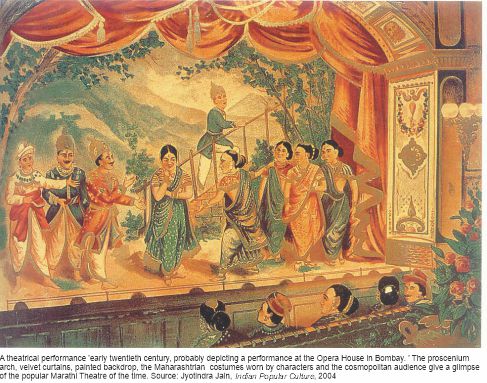
The introduction of realism in the theatre and in printed images took place simultaneously during the nineteenth century in western India. The Parsi theatre of Bombay had introduced an eclectic combination of European realism, Victorian melodrama, romances of the Arabian world and the performative traditions of contemporary courtesans. Elaborate sets imitating counterparts in Western productions came into existence and the parallel print medium, keeping track of these developments, gave birth to what Pinney has called the ‘xeno real’ mythological imagery. A shared visual language surfaced between print and theatre like never before as western influences were absorbed by both to produce identical imagery. Painterly elements like the vanishing point characterised theatre sets with the privileged viewers being seated along the central locus. Technically complex sets were designed by the likes of Rakhaldas Banerjee who was known for his contribution to Indian archaeology, and trap doors, revolving mirrors and layered sets became popular. In the style of acting, there was a new exaggeration of emotion and the celebration of melodrama which was loyally reproduced in the popular prints that, for the first time, were accurate in perspective.
The earliest oil painting practice in India borrowed directly from the theatre to produce tactile and sensuous images that appealed to a common audience. The medium of oil with its luminosity and versatility along with the format of academic realism borrowed from the West by the pioneers of oil painting in India—such as Raja Ravi Varma–cohered well with the ongoing technical improvisations of theatre. The proscenium stage brought to India in 1776 was highly effective in reorienting the theatre audiences to the actors in performance, with a new dynamics of proximity between them. Elaborate stage sets and backdrops and electrically controlled lighting on stage increased realism in drama and borrowing from this, the early oil paintings became rich and full in their depictions. Anuradha Kapur mentions how oil as a medium enabled the representation of darkness, shadow and depth, which along with the framing device provided by the easel, helped bring in perspective. The paraphernalia of props, curtains, furniture, jewellery and costumes in Varma’s works were borrowed from the theatre and collectively aided the creation of a ‘tangible past’.
Through the late nineteenth and early twentieth centuries, the lithographs and oleographs from the printing presses of Chitrashala at Mumbai, Pune etc turned out reproductions of the oil paintings of Ravi Varma and others, thus enabling audiences to enjoy theatrical visions in a pictorial format. Ravi Varma’s oleograph of Nala Damayanti, for example, demonstrates the impact of the proscenium stage through the heightened expression of passion and dramatic action animating the figures. ‘The gazes are absorbed within the picture, evoking the fiction of an absent audience’ and the figures are involved in private dialogue. The background of such paintings is set-like, with hybrid architecture, velvet curtains, carpets and vibrant costumes that are ornate and theatrical. Another oleograph–Rampanchayatam directly points to the tableauesque format of performances such as the Ramlila. One can interpret an entire scene as it appeared on stage from such an image—for performance itself was like movement from one frozen scene to another—tableau to tableau. The accurate reconstruction of nineteenth century theatre through contemporary prints is hence not an impossibility.

The simultaneous consumption of images in print and performances increased the market for both, as people began to identify their gods on paper and in action on stage. This dual affirmation of the sacred fabric of India was accompanied by the growing nationalist concerns of both artists and theatre personnel, and politico-historical themes appealed to a receptive audience. The melodrama of mythical and romantic themes transferred to politically-oriented plays, and productions such as Kichaka Vadh communicated a political message garbed in the name of mythology. Entering the early 20th century, this play ran successfully from 1907 to 1910 when it was banned, but the chromolithographs from Ravi Varma’s press continued to circulate for several years to come, keeping the memory and the message of the original performance alive. Khadilkar’s play titled Bhaubandaki was a similar political allegory making reference to Balgangadhar Tilak’s incarceration in Mandalay. The judge in the play was dressed in Tilak’s distinctive garb and the audience immediately made the connection, partly, no doubt, because of their familiarity with the already popular lithographic print (based on a Ravi Varma oil) of the leader that was in circulation.
It can be said that both mainstream theatre and much of painting and print-making in the nineteenth century along with the wider political movement was emulating British models in these areas in order to compete with the Raj itself. In theatre there was a constant negotiation to integrate the regional into the westernized mainstream, while in the printed images, a western language of academic realism and a western technique of litho and oleographic printing was used to imbue secular and sacred imagery with new efficaciousness.
Together, theatre and the press also suffered at the hands of British censorship acts. The Society for Suppression of Obscenity in India levied a license for the press or Press Censorhip in 1835. 1858 saw the Gagging Act and 1878 the Vernacular Press Act. Restrainting oneself, negotiations with authority, and subversion of that authority took place at both the level of print-making and at the level of theatre productions. Hence the inter-ocularity of theatre and the printed image can be traced across the cultural history of the nineteenth century to reveal overlaps, borrowings, and a simultaneous evolution.
Suryanandini Sinha is an MA student at the School of Arts and Aesthetics, Jawaharlal Nehru University, New Delhi. Her area of interest lies in Visual Culture studies
At different points in the history of the subcontinent, popular culture has shown sensitivity to the constantly energized political, cultural, religious and economic spheres that provide the context and rational for its production. The creative inspiration for printed art, however, is not always directly the people but often parallel cultural strands–such as the literary, visual…