

life and people of bengal
Bengal in the late eighteenth century was an unlikely destination for a young Flemish marine painter born to a prominent merchant family of Antwerp. But political unrest in Europe and the lure of fame and fortune led Francois Balthazar Solvyns (1760-1824) to arrive in Bengal in 1790. For the next thirteen years (from 1791 to 1803) Calcutta was his home and here he came up with unrivalled visual accounts of life and people of Bengal in the late eighteenth century. Though neglected and ‘rarely seen’, Solvyns’ engravings and his descriptive texts are now being recognized as the ‘first ethnographic survey of India, more precisely of Bengal.’

In his early years in Calcutta, Solvyns saw neither fame nor fortune. These were days of hardship and financial difficulties for him. He earned his living providing decoration for official celebrations of East India Company and offering instructions in oils, water colors and chalk. In addition, he decorated luxury coaches and palanquins for a well-known London coach maker who had an outlet in Calcutta. One of his decorated coaches was purchased by the exiled son of Tipu Sultan and another one was for the use of the Governor General. This however, didn’t bring any sense of achievement to Solvyns, who at the age of twelve had already received a reward for his drawings from the Academy of Antwerp. Fate eventually decided against him wasting his energy at the bidding of a coach maker.
In 1794, with the encouragement of Sir William Jones, founder of the Asiatic Society, Solvyns embarked upon his project to prepare ‘ 250 Colored etchings descriptive of the manner, customs, character, dress, religious customs of the Hindoos’ His depiction of the life of the native quarter of Calcutta, or Black Town as it was then called, was carried out with zeal of an ethnographer who drew his subjects from life, placing them in time and space, and putting more emphasis on accuracy than aesthetics. The collection, divided into twelve parts, was published in Calcutta in 1976 and in 1799. The first section with 66 prints depicted ‘the Hindu castes with their professions ‘ The subsequent sections portrayed costumes, means of transportation( carts, palanquins and boats), modes of smoking, servants, fakirs, musical instruments, festivals and the flora and fauna of Bengal. Solvyns employed local artists to apply watercolor to his prints. For his Calcutta edition Solvyns published a descriptive text in a small catalogue with brief entries. The etchings established him as a painter but proved a financial failure. In 1803, Solvyns left India for France and redid the etchings for a lavish edition of 228 plates, Les Hindous, published in Paris between 1808 and 1812 in four volumes. Each engraving of this edition was accompanied by a detailed descriptive text, in both French and English. In 1814, Solvyns returned to his native Antwerp where he was appointed Captain of the Port in recognition of his talent as an artist. He died in 1824.

The most interesting of Solvyns’ etchings are those that portray the various makes of boats and vessels (thirty) , the different types of palkis and dolis ( eight) and the musical instruments (36) in use in Bengal at that period. In her famous journal (1850) Fanny Parks, herself an artist, and a great admirer of riverine Bengal and its country crafts, declared the native boats to be most picturesque of all . ‘I am quite charmed with the boats. ‘ she wrote ‘ Oh that I were a painter , who could do justice to the scenery! My pinnace, a beautiful vessel, must add beauty to the river, especially when under sail. ‘ Fanny Parks was possibly not aware that Solvyns had already portrayed and published practically all the native vessels still in use in the rivers of Bengal and on its coast. There were other artists like Mundy and Heber who had sketched as well as described the river crafts, especially budjerows and pinnaces, the most common boats on the rivers of Bengal. But Solvyns’ works proved in advance of his time and still remain one of the most comprehensive surveys of the great variety of Bengal boats. It’s a pity that his etchings were till recently little known to the majority of modern researchers working on boats and ships of Nineteenth Century Bengal. Solvyns’ vivid depiction of Suttee (four) was done in both its forms, widow burning and the less common practice of burying alive with the husband’s corpse. Solvyns provides a rare description and perhaps the only visual depiction of this rite as practiced by the Jugi community a caste of weavers in Bengal who bury their dead. It may be mentioned that the widows of Jugi community in Bengal were sometimes buried alive with their deceased husbands. His works on Suttee was favored by missionaries and native reformers in their campaign against Suttee. Solvyns was deeply sympathetic to the plight of the Hindu widows.
It is interesting to note that Solvyns used neither ‘Suttee’ nor sati as terms in his descriptions. He used the Sanskrit term Sahagamana, pronounced in the Bengali manner as Shoho Gomon, meaning ‘going together.’ The practice by which the wife joins her husband in the flames is termed ‘Sahamarana ‘dying together’ also known as Sahagamana- Solvyns’ ShohoGomon- meaning ‘going together’ ( Robert.L.Hardgrave Jr)
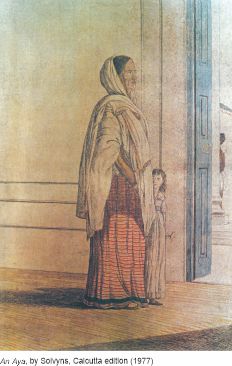
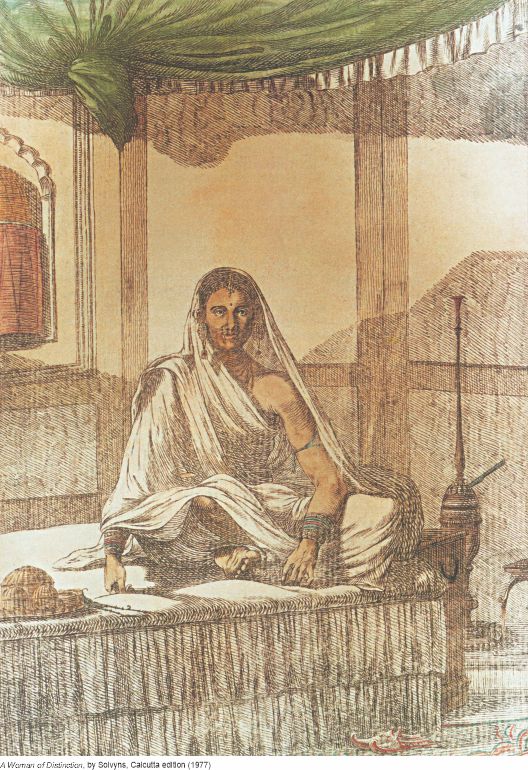
Comparatively a few women are found in the Solvyns etchings. As an explanation Solvyns argued that Hindu women being shut up in their separate apartments are seen only by their nearest relations and when appearing in public they always put a veil upon their face. He, however, was quick to add that this restriction does not extend to the women of lower classes who appear in public without reserve. Solvyns had only a few engravings of the Muslims whom he generally saw as the conquerors of India.
As regards the credibility of his engravings, Solvyns assured his readers that the drawings from which the engravings were made were taken by himself and upon the spot. His prints purposefully avoided all sorts of ornaments or embellishment, these being merely representation of subjects as they appeared before his eyes. ‘Instead of trusting to the words of others or remaining satisfied with the knowledge contained in preceding authors,’ continued Solvyns, ‘…… I have spared neither time, nor pains, nor expense to see and examine with my own eyes and to delineate every object with minute accuracy……..’ He forwarded equally forceful argument with regard to the validity of his descriptive texts by declaring that he relied for his description on what he could verify.


Solvyns’ Calcutta edition was praised for its faithful delineation but it did not suit either British or French tastes. He didn’t follow the existing style of the picturesque in soft coloring and persistently refused to romanticize his subjects. The forms and settings of his etchings were criticized for being monotonous and the colors dull and uninviting. Some of his texts might have impinged on European sensitivities. The description of the cockroach’s smell and its habit of eating through mattresses and biting people while they slept might have upset the Memsahibs. His Paris edition however, received more favorable response as Solvyns was credited with having great precision and the courage to discard all artificial charm to austere truth. But again Solvyns was unlucky. The unrest of the Napoleonic wars in Europe and the sheer cost of the publication of these sumptuous volumes brought him close to financial ruin.
Recognizing the compelling nature of Solvyns’ etchings and its commercial potential, the London publisher Edward Orme conceived the idea of repackaging Solvyns’ engravings with a romantic tinge to make them more viewer friendly. In 1807, he brought out Costumes of Hindoostan –now known as a ‘ pirated edition’–with sixty prints ‘after Solvyns’ that were redrawn and colored in soft and pleasant hues. Orme excluded much of Solvyns’ background details and used roulette work and watercolor. The enterprising publisher dedicated this edition to the Chairman of the East India Company. The volume was highly successful but “Solvyns derived no benefit and suffered as he later wrote, ‘abuse made of his name and of his works’ ” (Robert L Hardgrave Jr.)

An artist of unflinching integrity, Solvyns was a man ahead of his time. His drab and melancholy figures convey more realistically the true image of the sadness and poverty of ordinary people of 18th Century Bengal. He had erred on occasions in depicting the social life of the Hindus and Muslims correctly but this doesn’t diminish the value of his etchings as social documents. From the social and historical perspective it can be said that he saw ‘art as information’. Historians and anthropologists, after their initial neglect, are increasingly drawing on the works of this unsuccessful and almost forgotten artist for a better understanding of the society of Bengal that existed two hundred years ago.
Acknowledgments: Mahmudul Haque, DG National Museum of Bangladesh Dhaka for reproduction of engravings from the Costumes of Hindoostan, Robert Orme edition, London.Dr.Robert L Hardgrave Jr, The University of Texas Austin, USA.Reproductions of Solvyn’s etchings from Nari, published by Lubicr Study group, Calcutta, 1990.
Mohboob Alam is a former ambassador of Bangladesh
Bengal in the late eighteenth century was an unlikely destination for a young Flemish marine painter born to a prominent merchant family of Antwerp. But political unrest in Europe and the lure of fame and fortune led Francois Balthazar Solvyns (1760-1824) to arrive in Bengal in 1790. For the next thirteen years (from 1791 to…