

performing fascism, resisting fascism
Theatre is a public art, and must, though it often does not, concern itself with public issues. For the last decade and a half or more, a very ferocious Hindu fascism has been ascendant in Indian politics. Its rise seemed inevitable till the Indian electorate executed a democratic coup by ousting the right-wing Bharatiya Janata Party (BJP)-led alliance from office in the elections of summer 2004. Yet, while the BJP has lost the elections, the larger tendency of Hindu fascism is far from dead, and the Rashtriya Swayamsevak Sangh (RSS), the BJP’s parent body, and its numerous fronts are active as ever
What is heartening though is that Indian theatre has responded to the onslaughts of the Hindu Right, even if in a small measure. This article looks at four plays of recent times shaped by Gujarat 2002, and the hypocrisy of the flag-bearers of Hindutva.
Gujarat 2002 was India’s first televised pogrom. While earlier communal flare-ups were written about, still-photographed, and so on, none of them came quite like this into our drawing rooms, every evening, with the television news. The fact that Gujarat burnt for over a hundred days meant that those images stayed with us much longer. It also meant that television crews and independent filmmakers got the opportunity to shoot over a much longer duration, generating several hours of damning footage of Hindutva in action. It is no coincidence, therefore, that a relatively large number of documentary films have been made on the pogrom.
But filmmakers are not the only ones to have responded to Gujarat 2002. Some of the finest Hindi political poetry of the last several years has been written in response to Gujarat. Mangalesh Dabral’s Gujarat ke ek mritak ka bayaan (Testimony of a Gujarat corpse), Vimal Kumar’s Ek jalte huve shahar ki yatra (Tour of a burning city) and Vishnu Nagar’s Becharon ka Hindu rashtra (The Hindu nation of the poor blighters) are some of the most outstanding of the more than 100 poems on Gujarat that I have read. And I am sure there are poems in other languages as well.
Theatre, being a collective and more expensive art, takes a little longer to respond. (I am not talking here of street theatre, which has of course responded to Gujarat 2002 with a large number of plays, some of which, like Jana Natya Manch’s Yeh Dil Mange More, Guruji were on the streets long before the fires had started dying out.) A remarkable theatrical response to Gujarat evolved in Kolkata. Here, Suman Mukhopadhyay led a bunch of theatre groups in evolving a collective statement on Gujarat 2002. Unlike most statements, however, this was not read out or published, it was performed.
Mukhopadhyay belongs to the theatre group Chetana, of which his father, Arun Mukherji, is a founder. Mukhopadhyay has earned critical acclaim for several of his productions. I have seen only one of those, Teesta Parer Brittanto. Based on a novel by Debesh Roy, this play, set in north Bengal, takes a critical look at the land reforms undertaken in the state. While the political content of the play came in for some criticism, there is no doubt that the play itself is the work of a wonderfully talented and politically alive director. He received the Best Director award from the West Bengal Natya Academy for the play.
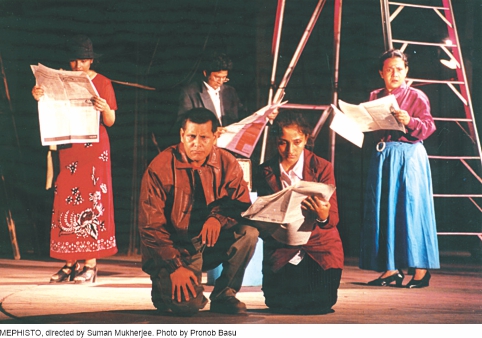
When Gujarat started burning, Mukhopadhyay convened a meeting of several theatre groups and outlined a proposal: a collective production of Mephisto to be directed by himself, drawing actors and backstage workers from all the groups. The assembled groups responded enthusiastically and, after intensive rehearsals spanning barely a fortnight, the play was up.
Mephisto would be familiar to audiences in Istvan Szabo’s film version of 1981. The film is based on a 1936 novel by Klaus Mann, son of the more famous Thomas Mann. The novel itself was a thinly veiled fictional account of the life of Klaus’ brother-in-law. The novel was also turned into a play by Ariane Mnouchkine in 1979. Mukhopadhyay has translated the play into Bangla, but also interpolated characters and situations from the film into his production.
The story of Mephisto revolves around the life of Hendrik Höfgen, a German actor. When the play opens, we see him in Hamburg in the 1920s, member of a small left-wing theatre collective. But he nurses ambitions of becoming Germany’s greatest actor. To do that, he abandons his wife, uses his sexual charm to climb the social ladder, shifts to Berlin, and eventually heads Germany’s most prestigious repertory. In the meanwhile, Hitler has come to power. Höfgen becomes a particular favourite of Hitler’s Prime Minister who turns him into a hero of the Nazis — an example of the perfection of the Aryan race and its superiority over everyone else. At the pinnacle of his creative (and political) powers, Höfgen plays the role of Mephistopheles in Goethe’s classic Faust. Like Faust, Höfgen has also made a pact with the devil — a role he plays to perfection and great critical and popular acclaim. But what is Höfgen? Is he, like Mephistopheles, an agent of the devil, seducing the German public for the Nazis, or is he, like Faust, a willing victim? Life and fiction blur uneasily for Höfgen as he is taken, in the final scene, to the stadium where the Prime Minister promises him the biggest stage he has ever played on, and Höfgen, under the glare of spotlights in a vast, empty, dark space, pleads, ‘I am merely an actor . . . merely an actor’.
In that final moment, we see Höfgen as a puny human being, unable to face up to the enormity of his own role as accomplice in a gigantic crime against humankind.
The play has been visualized brilliantly by Mukhopadhyay. He has used the peculiarities of the Fine Arts Academy auditorium in Kolkata to superb theatrical effect. He strips away the backdrop to reveal the backstage; he raises the wings to reveal the entire wing-space; he even puts lights in the lightbooth and uses that dramatically as part of the set. At one go, then, the playing area is more than doubled, which gives the space tremendous depth as well as height. The dilapidated state of the backstage is revealed to us, becoming a fitting backdrop to the moral decay of the central character. Near the centre, slightly to the left, is a huge ladder that seems to disappear into the dark depths of the roof. The graphic externalization of Höfgen’s blind ambition, the ladder is used in the final stadium scene to light him dramatically, as if dangling in midair, on the edge of history’s precipice, much like the wire frame of a falling human figure hangs from the ceiling throughout the play. The other element of the set that Mukhopadhyay uses is a human-length mirror, for Höfgen to preen at. The mirror reminds us that narcissism and Nazism share more than merely aural closeness.
Gautam Haldar, from the group Nandikar, plays Höfgen. Those who have seen Haldar’s work in the past may complain that he does as Höfgen what he has done all his life. Yet, there is something to be said for the hyperenergetic performance by Haldar. He plays it like a man possessed; he looks arrogant and brash, and completely self-centred. I will not say that he imitates the Hindi film actor Shah Rukh Khan, for that is not true; yet, in his portrayal of Höfgen, he gestures towards the superstar. If this is indeed intentional, then Haldar has pulled off a remarkable achievement as an actor, pointing us towards the dangers contained in the sort of mass adulation commanded by filmstars and others. Mukhopadhyay extracts fine performances from other members of his large cast as well. Bimal Chakraborty as the Communist actor Otto, Sujan Mukherjee as the Nazi actor Miklas, Suranjana Dasgupta as Höfgen’s black mistress Julietta, who he dumps as he moves from Hamburg to Berlin, and Supriyo Dutta, a veteran Chetana actor, as the Prime Minister all stand out.
Mukhopadhyay mixes styles, sometimes using a docu-drama kind of narrative, sometimes agit-prop, shifting easily from naturalism to stylization and exaggeration. Some of the tricks he uses are disarmingly simple. To show Höfgen’s rise as an actor, Mukhopadhyay makes a number of actors walk rapidly across the stage one after the other, carrying placards, each one of which has the same picture of Höfgen, progressively xeroxed/enlarged — within seconds, we traverse years and see Höfgen become a superstar.
Mukhopadhyay is a director with an extraordinary visual imagination; he is very highly skilled in his use of lights and sets and other elements of theatre, but he is also scrupulous in subordinating form to content. Or, to put it more accurately, he ensures that content is expressed in the richest possible form, with neither dominating the other. This is a rare gift, and indicates a sharp critical intelligence. Mephisto is a tour de force and it would be a great pity if the play is confined to Kolkata. Given the fact that the production is a collective statement by the theatre community of Kolkata against the horrors of Gujarat, one hopes that the play will find more financial support than it has done hitherto, allowing the cast to travel to other parts of the country to perform what is surely one of the most remarkable productions in recent years.
II
From the capital New Delhi came another production which comments on Gujarat. This is The Antigone Project, directed by Anuradha Kapur. The story itself is of course well-known, since the original Greek myth has been adapted repeatedly by modern writers, including Jean Anouilh and Bertolt Brecht. In fact, Kapur’s production is a further adaptation of Brecht’s. It is no coincidence, of course, that both Mukhopadhyay and Kapur have turned to Nazi Germany when grappling with Gujarat 2002.
Antigone is Oedipus’ daughter, who has lost her brothers in Creon’s war. The corpse of one of the two brothers, Polinikes, is left to rot on the battlefield by Creon, since he fled the fighting. Creon wants to make an example of Polinikes, to show what fate awaits a traitor. Antigone disobeys her uncle’s orders and gives her brother the burial he deserves. Captured by soldiers, Antigone is brought before Creon, who threatens her, and when she refuses to obey him, sentences her to death. As she prepares to die, Antigone warns the citizens of Thebes of their impending destruction if they allow Creon’s pillage and murders and hate to continue.

This ancient tale is invested with a tremendous contemporaneity by Kapur, who teams up with filmmaker Ein Lall to interpolate into the text images of Gujarat 2002. As the play opens, we see a sand mound on the stage, while on the projection screens in the background the camera moves slowly over the dead body of a male. As the play progresses, at strategic moments we are shown burnt out holes that were houses, refugee camps, children and women and men ravaged by the violence. We listen to their testimonies, to their cries of anguish, and suddenly very little separates Thebes from Ahmedabad. Kapur also uses paintings by the Gujarati artist Gulammohammad Sheikh. One of these paintings, of a blue mosque, is particularly haunting. Seema Biswas, as Antigone, delivers a gut-wrenching performance that proves that years of acting in the commercial film industry (her best known role being the title role in Shekhar Kapur’s Bandit Queen) has not blunted the power of this accomplished performer. Harish Khanna plays Creon as a Nazi skinhead in a chilling performance.
What brings potency to the play, however, is the video work of Ein Lall who eschews sensationalism and selects footage (shot in Gujarat by Gauhar Raza) that heightens the poignancy of the play. Rajesh Tailang’s Hindi translation is the other notable feature of the play. Tailang incorporates into his text all the phraseology used by the Hindutva forces in the context of Gujarat (gaurav yatra, rajdharm, abhaydaan, and so on), so that the text becomes contemporary. Surely, this is a translation that would have pleased Brecht himself, since the German did the same with the Greek myth.
Kapur has always done difficult plays; sometimes a trifle too difficult. Her productions are visually rich, sometimes spectacular. In the past, on some occasions, I have felt that her visual richness tends to obfuscate her politics. In Antigone, though, there is no doubt: politics is in command. I have heard some people complain about this production that Kapur has needlessly politicized an ancient myth. This, quite frankly, amazes me. Through the history of modern theatre, writers and directors have turned to ancient myths to tell contemporary tales. In Europe and elsewhere, Shakespeare has also been done politically. In India, especially during the Freedom Struggle, playwrights used mythological settings to give an anticolonial message. Moreover, Antigone itself has been used by Anhouih and Brecht to comment on the rise of fascism. It is stupid to complain that Kapur has done likewise. In fact, Kapur’s production is part of a long and rich tradition of ancient stories being used to comment on contemporary times. To her credit, she does it with technological finesse and great power.
III
From the belly of the beast, so to speak, comes a heartwarming play. Dost, Chokkas Ahin Nagar Vastun Hatun (Surely, Friend, There Was a City Here), produced by the Ahmedabad-based Fade In Theatre, comments on Gujarat 2002.
The city of Ahmedabad is bisected by the river Sabarmati. On one side of the river is the historic old city with its bustling lanes and beautiful architecture (which is being pulled down to make way for ugly modern structures). On the other side is the new city, more prosperous, relatively clean, ‘modern’. Several bridges connect the two parts of the city. The playwright-director of Dost, Chokkas, Saumya Joshi, has turned one of these bridges, the Nehru Bridge, into a character. The action of the play is set in the year 4002, two thousand years after the pogrom. Two archeologists, Anant and Samprat, are excavating the remains of a city. As they begin digging, they suspect that the city has not been destroyed by natural causes. As they meet Nehru Bridge, their suspicion is confirmed.
What is most striking about the play is the youth of the actors. Joshi handles a large cast, all of them in their twenties or younger. The actors bring a lot of zest and verve into their performances. It could be argued that the play is a little simplistic, especially since it implies that the pogrom was a response to the fear of revolution. The significance of the play, however, lies elsewhere. It lies in the fact that it comes as a message of hope, a voice of reason, a ray of light from a city fast embracing darkness.
The Bridge tells them the sad tale of the city. He takes them into the industrial areas of the city, with its textile industry. They see the workers as they go about their daily business. But the textile industry is in crisis, and mill after mill starts closing down, destroying the workers’ employment as well. The workers somehow survive, making ends meet as best they can by taking on whatever employment comes their way. What destroys the city—and the poor in particular—is the wave of communal hatred and violence that follows. Anant and Samprat watch horrified as violence engulfs the city, and they realise that the only way they can save their own civilization is by not allowing the forces of hatred to gain ascendancy in their own times.
IV
As the curtain goes up at the beginning of Usha Ganguly’s new production Kashinama, based on a short story by Kashinath Singh, we see a large number of actors, dressed in saffron, with the actor in the centre holding a large lamp. In the glow of the fire, the saffron dhotis and saris of the actors look even more blazing. The song they sing invokes the river Ganga. As they sing on, we are introduced to the various ghats of the holy city of Benaras. We stop, in the end, at the famous Assi Ghat, where the action of the play will take place.
The protagonist of the play is Pandit Dharmanath Shastri, a brahman who sets up shop every day on the Assi Ghat, waiting for customers who would buy the spiritual—or should one say simply ritual—wares he has to offer. Business is down, but the obstinate pandit will not cater to the demands of the market. He will not, for instance, teach Sanskrit to foreigners or let out his house to them. The Pandayin (his wife) has to somehow make ends meet. Ganguly weaves a lovely sequence from another of Kashinath Singh’s stories centred around the pumpkin—the only vegetable the pandit can afford—into the play. So while many others are busy catering to foreigners and earning well, poor Dharmanath Shastri remains just that—poor. Till, that is, a French spiritual tourist enters his life. Madeline is young, beautiful, white, and has money. Dharmanath Shastri has an eye for women, as his wife knows. The broker who introduces Madeline to Dharmanath Shastri is aware of the pandit’s financial situation. Step by step, he convinces Dharmanath to first teach the girl Sanskrit, then to let out a room in his house to her, then to let her eat with them, then to give her the ground floor room which has the best view of the river. The pandit, allured by both the money and the nubile white woman, gives in step by step.

The wife, well aware of her husband’s roving eye, is a little harder to bend. But the broker brings her a gift from Madeline, a beautiful new sari, and the Pandayin yields. In a dream sequence, superbly lit by Tapas Sen, the veteran light designer, we see the Pandayin draping herself in her new sari and planning what she will do with all the money she will get. And the money itself is more than good. The broker explains that foreigners pay on a daily basis, and if they rent a place for a few months, the family stands to gain several thousand rupees.
There is one problem, though. Madeline has to stay in the room on the ground floor. But she also needs an attached toilet. The room next to the one she is going to get is the devalaya (a small temple inside the house), which, the broker insists, has to be converted into a shauchalaya (toilet). The family is in a quandary, but Dharmanand absolutely refuses to convert the temple into a toilet, money be damned.
Till the gods come to his rescue. As he sleeps, he is visited by Lord Shiva in his dream. (This is another scene expertly lit by Tapas Sen.) Lord Shiva admonishes him for keeping him cooped up in a tiny room on the ground floor. I am a creature of the mighty Himalayas, the god tells the pandit. I need open space, the wind blowing through my locks, I need to see the wide expanse of the open skies. How dare you imprison me in that tiny dark room?
That’s it: the god has spoken. To build a new temple on the roof (for which Madeline has kindly consented to pay) is then a divine order, which cannot be disobeyed. The temple of the ground floor will be converted into a toilet. But as the workers are transporting the idol from the ground floor to the first, it breaks. Now, to avoid installing a broken idol, the pandit decides to immerse (visarjan) the idol in the river. This is opposed by another pandit, who says that a Shiva idol is never immersed in water, and that Dharmanand is doing wrong. Riding roughshod over such objections, Dharmanand eventually does immerse the idol.
The Hindi writer Kashinath Singh is a resident of Benaras, whose stories have brought alive the ghats and bye lanes of the city as few other works have. Singh has an eye for detail that is unmatched; his knowledge of the city is very intimate, and his humour is biting. Usha Ganguly, in her production, does full justice to all this. She creates the ghats of Benaras with deft touches and artistry. She handles the crowd scenes with élan, and the busy ghats never seem too cluttered for dramatic action. Her handling of the domestic scenes in Dharmanand’s house is also expert. She brings out the pathos of the pandit’s domestic situation with humour as well as poignancy.
Though Ganguly ends the play on a note of melodrama—the child asking his mother, ‘Where is god going?’—the play is a delightful satire on the effects of globalization and the market economy on the spiritual economy of Benaras. What it also brings out admirably is the fact that pandits will go to any extent to justify an action that brings them profit. While a number of other plays have dealt with communalism and the politics of hatred, the strength of Ganguly’s play lies in the fact that it takes on the question of religion and spirituality head on, and shows pandits to be what they often are: immoral, calculating, greedy men, prepared to bend and bow if a few pieces of silver are thrown their way.
Sudhanva Deshpande is an actor and director with the New Delhi-based group Jana Natya Manch, best known for its street theatre. He works as editor in LeftWord Books
Theatre is a public art, and must, though it often does not, concern itself with public issues. For the last decade and a half or more, a very ferocious Hindu fascism has been ascendant in Indian politics. Its rise seemed inevitable till the Indian electorate executed a democratic coup by ousting the right-wing Bharatiya Janata…