
goddesses of the kathmandu valley
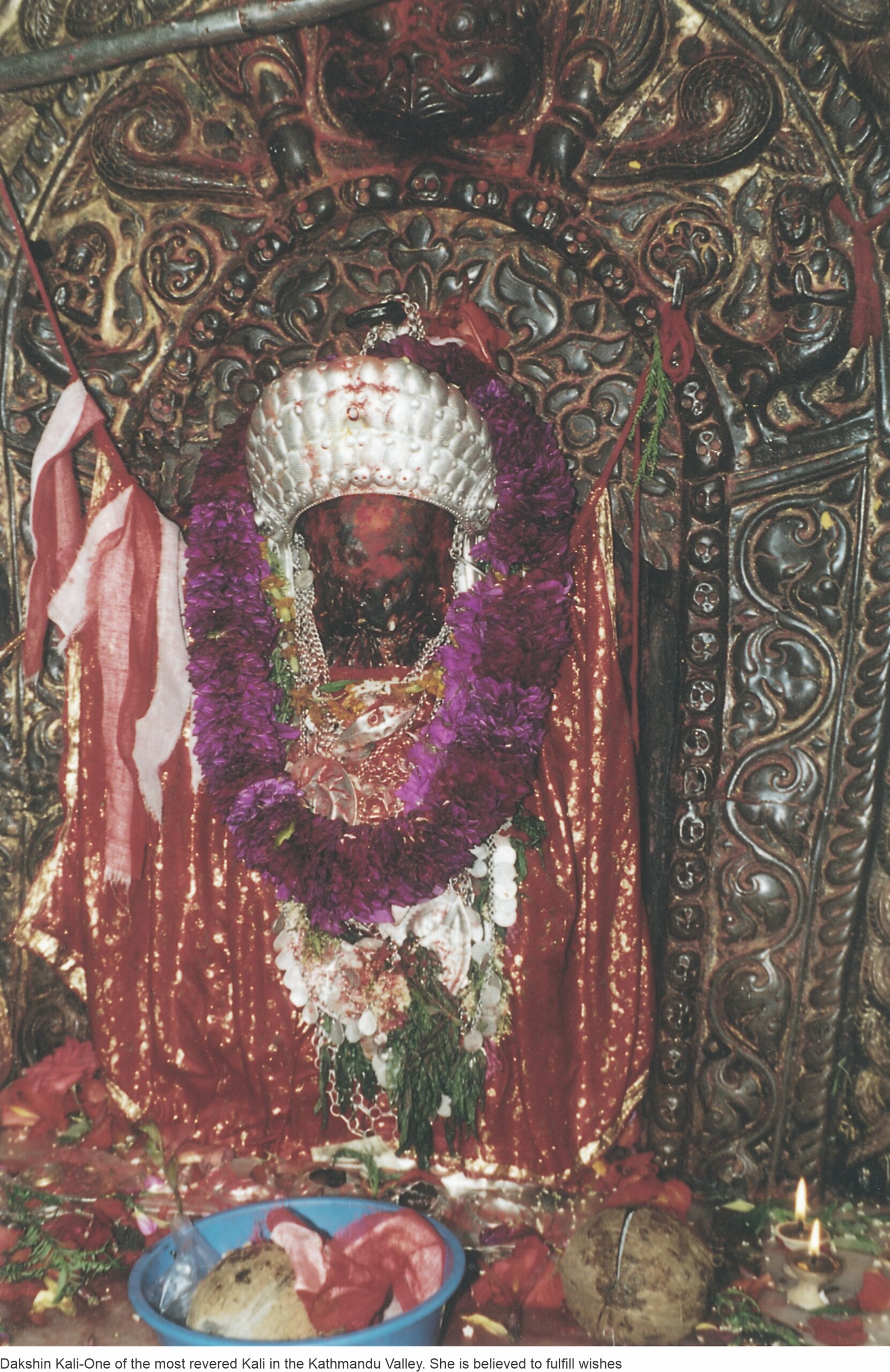
The manifestations of Devi as Durga, Kali, Chandi, Bhavani, Bhagwati, Bhairavi etc. are found in various art forms in the Kathmandu valley. One can trace the worship of the goddesses in household rituals, community festivals, performances and shrines sacred to both the Hindu and Buddhist communities of the valley. The Buddhists of the Vajrayana tradition have their own goddesses who may be identified with Durga and Kali
There is a popular ritual called the Devi dance, which is performed in Sankhu, a town northeast of Kathmandu. In Devi Pyakham, the dancers perform the triumph of the goddess over the demon. The term Pyakham in the Newari language means dance and drama. The dance is performed any time between the Indra Jatra festival and Durga Puja. The chief deity of Sankhu is Vajrayogini, a local manifestation of Kali. The festival is also a tribute to Nasadyo who is the deity of dance and music. Nasadyo can be understood as an agent to pass on divine power to human beings. Pyakham thus is comprehending the divinities: the dance works as a medium to assimilate the pervasive energies of the divinities. The performance is therefore the sacred method of evoking the supernatural through art.
Three masked people representing Devi, Chandi and Bhairava dance to the accompaniment of a Malashri song in praise of Kali. A significant feature of the Devi dance is that the demon (asura) is not visible and hence is not shown being slain by the goddess.
Samyaka Mahadan is an elaborate ritual performed on the hills of Swambhu in Kathmandu that reveals a fusion of Hindu and Buddhist elements. The ritual is understood as the samyak or perfect gift to the monks and gods. The time of the ritual is mid-January or the Magha Sankranti of the Hindu calendar. The following day’s celebration is called the Misa Samyak, the Samyak of woman. Misa Samyak is attended by Hariti Ajima, another local manifestation of Kali.
Goddesses like Vajrayogini in Sankhu’s Devi Pyakham festival or Hariti Ajima during the Samyak Mahadan ritual are the most popular manifestations of Devi. Devi is the most widely used term for the goddess in the Hindu pantheon. The Devi archetype is found in fertility goddesses, and the earth or mother goddess, and it has its roots in the Indus valley culture. Devis are numerous and are understood as the images of the feminine force or Shakti, especially in the Shakta cult. Shakti in Hindu tradition is conceptually understood as the power that permeates all creation. Shakti in personified form is the divine consort of the god Shiva. Devis are worshipped in a wide range of images and symbols, from the mother goddess to erotic femininity. The feminine force in the Shakti cult is associated with a terrible deity annihilating evil to preserve the universe. In the Tantric or Shakta doctrines, the feminine power is supreme in the entire cosmos and the male divinities are secondary to the female ones. She is the feminine energy underlying the creation of the cosmos and hence the underlying condition of all being. In the Tantric tradition, Shaivas worship the phallus or lingam of Shiva, and Shaktas worship the feminine force symbolized by Yoni. The cult elevates Shakti to the position of the primal mother, the ultimate cosmic force working behind mundane realities.
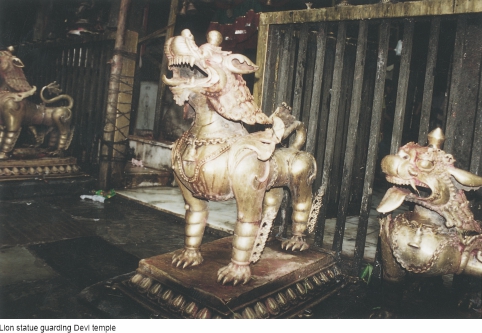
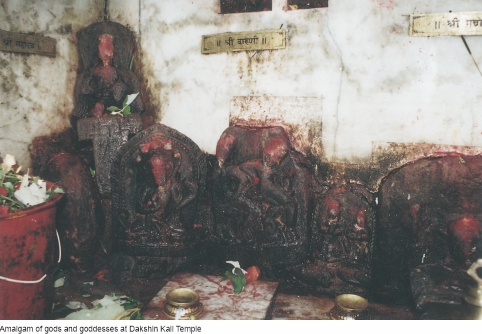
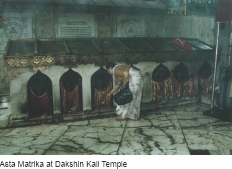
The most acknowledged form of Shakti is Durga, and the other names associated with Devi are Sati, Parvati, Uma, Annapurna, Gauri, Vindyabasini, all of whom are identified with motherly images. Kali and Chandi are the deities of power and aggression. Furthermore, there are the forms of Devi who come under the group of Mahavidyas, the deities of supreme knowledge. If Durga is manifested as the matrkas who represent earthly human traits like lust and jealousy, then these goddesses represent ten forms of supreme knowledge, and hence are called Dasa-Mahavidyas. There are icons of the Matrkas in the temple of Dakshin Kali, northeast of Kathmandu. They are generally endowed with wild and dangerous human traits. Myths narrate that when Durga was fighting with the demons Sumbha and Nisumbha, the gods created female forces to help the divine warrior. These goddesses are Brahmani , Mahesvari, Yogesvari, Kaumari, Vaishnavi, Varahi, Narasimhi, Indrani, and Chamunda, and are associated with vices: Yogesvari with lust, Mahesvari with anger, Vaishnavi with greed, Kaumari with attachment, Brahmani with pride, Aindri with jealousy, Chamunda with depravity, and Varahi with envy. The formation of such mundane deities probably reveals the fact that the woman warrior needed baser human traits to overpower the powerful beast. The idea behind such manifestations may be that Devi, possessing the mother image, could not defeat her enemies, and hence needed those traits that the demons themselves possessed, so as to face them on equal terms.
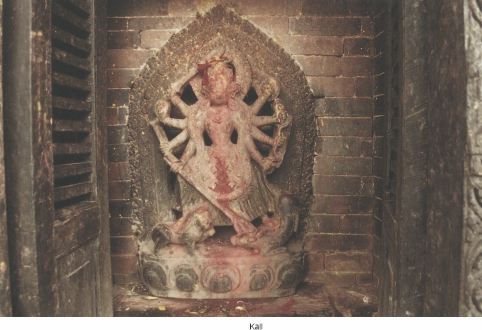
Kali with her various forms is the fiercest aspect of Devi. Myths tell us that the demonic forces had been dominating and oppressing the world for a long time. The gods were tired of their increasing power. The defeated and humiliated gods finally went to the daughter of the Himalayas to seek protection. Durga agreed to help them. She then obtained radiant flames from the gods and set forth for the battle against Mahisa, the king of the demons. She fought for days and to destroy that most disdainful and vicious monster, a dark deity sprang from her brow.
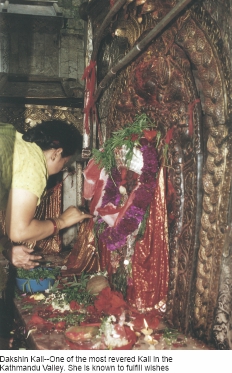
A simpler reading of the story may be that when Ambika or Durga became dreadful in anger and exhaustion, she turned black as ebony. One metaphoric reading is that Kali evolved from her frowning forehead. She was armed with a sword and a noose and was wrapped in a tiger skin, and shown holding a skull-bowl, and wearing skull-garlands. She looked starved and thus open-mouthed, with a lolling tongue, as she went looking for the demons. In the fierce fighting that followed, Durga assumed the form of a wild warrior, devouring every demon on her path. She fought another devil called Raktavira. She had to drink every drop of blood that fell on the ground from the demon’s body because every drop created innumerable devils like him. Blood dripped from her mouth and the tongue came out to consume the demons. Taking different forms, and as if playing with the army of the demon as a demon herself, she finally overpowered them. She is Kali.
Along with the epithet, ‘Like the great goddess, or Mahadevi,’ she is referred to as Mahasuri, the great demoness. This double identity of the goddess itself ruptures the hierarchy of gods and demons. Divinities are not always conceived as entirely value-loaded entities, probably because Hindu religiosity sometimes identifies them with human traits and consequently with human weaknesses too. Divinities therefore are not merely transcendental entities who are remote, all powerful, and sacred; rather, they also have anthropomorphic characteristics, making them nearer and dearer to the humans. Such immanent deities are pervasive in the arts and religions of the valley.
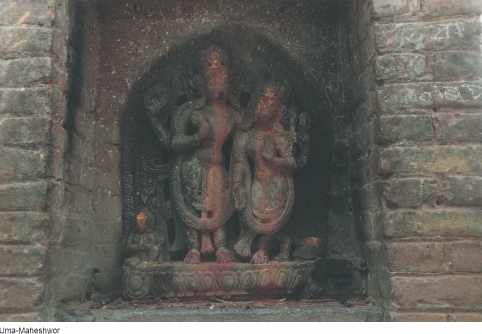
The opposition between good and bad is best understood in the narratives and arts associated with the names of the goddesses Durga, Kali, Chandi, Bhairavi, and Bhavani. In artistic manifestations they appear both graceful and terrible. The common belief is that Devi worship has to follow strict ritualistic codes under Brahminic supervision. But there are subaltern images too. Unlike Durga, Kali is more commonly worshipped by the subaltern classes in Nepal who offer her eggs and chickens.
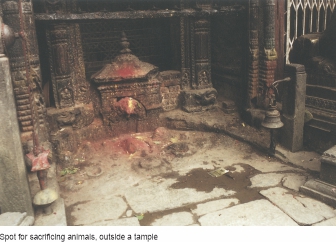
Kali represents both death and time. She is known as Kamakshi, Chandika, Bhavani and Bhairavi, (Jagatdhatri in Bengal and Sherawali in North India). Both Bhairavi and Kali are associated with Kalaratri and Ghoratara (the black night and the extremely terrible one respectively). The devotees offer her the blood and flesh of animals. People believe that the offerings do not represent the evils that Kali killed, but the offerings become sacred objects when sacrificed at the altar of the temple.
She is associated with her trance-dance also, which again is a common folk image of the uninhibited expression of emotions and feelings. After one of her victories, in a fit of joy she began dancing. The dance was so intense and fearful that Shiva had to lie on her path. She came out of the trance when she stepped over the body of her husband.
The myths locate Kali with cremation grounds because of her frequent experiences with flesh and blood. This association with Kali is popular in the Tantra cult. Tantra, the esoteric form of Shaktisim, seeks to find salvation through the means of Panchtatwas or Panchamakaras. These five means of worship are Mudra (sexual posture), Mada (liquor), Mamsa (flesh), Matsya (fish), and Maithuna (sexual intercourse).
Furthermore, Kali is more popular among tribal people, villagers, and the marginalized castes of the Hindus. She can be associated with subaltern characteristics for many such reasons: as a revengeful mortal she causes suffering and disease when enraged, she can blame or curse in the forms of birds and reptiles, or she utters threats if she is not revered properly by the devotees. Common people take her as an immanent deity, as opposed to transcendental ones like Brahman and Vishnu. Her male consort Shiva too is endowed with such subaltern, immanent qualities. Like an ordinary human being she can be pleased with modest food.
Dakini is the other fierce form in the Durga group. Dakini belongs to the group of demon goddesses. Dakinis can fly and cause havoc. There are seven and sometimes nine paths for salvation mentioned in the Tantra. These paths are to acquire worldly and transcendental perfection. Those who have attained perfection are called siddhis. These siddhis are personified as goddesses. These goddesses are also associated with the chakras (or spiritual centres) mentioned in Kundalini yoga. Kundalini is a Tantric yogic method to arouse the female power within the body. The Kundalini sleeps like a snake in the lowest chakra in the body, and by yogic meditation can be made to rise and finally meets Shiva in the topmost chakra called Sahasrara. There are seven chakras. Muladharachakra is the lowest spiritual centre and Dakini is associated with it. Dakini is the feminine force in a trance-sleep in three and a half coils. She also represents the sense of smell.
In art works, Dakini is seen standing to the right of the goddess Chinnamasta and drinking blood from the headless body of the goddess. Varnini stands on the right drinking the blood from the decapitated head. They both are sometimes called Jaya and Vijaya. The goddess had severed her head to satisfy the hunger of her associates.
Hariti and Sitala belong to the group representing chaos, destruction, disorder, and disease. She is popular and feared more among the rural folk of Nepal and India. Sitala is particularly the goddess of pustuler diseases like small pox. She is known as Hariti Ajima in Kathmandu Buddhist tradition. She cripples, disfigures, and even kills when she is angry. Her demon consort is Jara (fever) who enflames the body and causes delusion in the victim. The goddess is called Sitalamata (mata meaning mother). Such goddesses of disease are presented in dual roles: they protect people from diseases and are identified with diseases. There are tales about Haritimata stealing children and feeding on them, but Gautama Buddha transformed her into a benign deity. Hariti is incarnated as a Dyo maiju, a native female healer like male Viadyas (physicians).
Such supernatural images probably were embodied manifestations of the sublime and the terrible forms of nature. Primeval cultures with their mythopoetic sensibilities gave human forms to such benevolent and terrible aspects of nature. Forming gods and goddesses can thus be naming the myriad natural forms.
Hariti and Sitala types of deities are social explanations of sufferings eternally around us and teach one to fear and respect such adversities. They are the metaphors of varied natural forces like wind and rain, fire and sun, disease and health. The early humans probably transformed these forces of nature into concrete forms by naming and narrating them and identifying them with their lives. What is significant about Kathmandu culture is that such identifications are part of the daily lives of the people, irrespective of rational attempts to interpret such cultural traits.
The identifications range from conceiving them as warriors like Kali to Luti Ajima who cures dysentery. She in this form is represented as a poor widow. The festival of this local deity is held in late November or early December. Kankeswari Kali, Tankeswari, Nar Devi, Mhaipi Ajima, Maitidevi, Bachala Maju, Swetkali are the other local forms of Kali who are identified with varied human experiences. Dhusi Ajima is another form of Draupadi, the wife of the Pandava princes in the epic Mahabharata. She cures backaches and is seen as a stooping figure.
Goddesses are not merely about the power of the body and weapons that destroy the demons, or the rage and blessings of the local deities on the common folks, but they also are about the sheer power of wisdom and knowledge that looks for order and stability in the world. Evil itself is not devoid of knowledge. The demons are intelligent creatures and sometimes surpass the gods of heaven in wit and conceit. The battle between the goddesses and the demons is a war of intelligence. The humble gods of heaven under the king Indra are sidelined in such confrontations. The war between good and evil can be the war between wisdom represented by feminine force and the unbending intelligence represented by the demons. Embodying knowledge and wisdom, there are goddesses conceived as Dasa-mahavidyas (dasa meaning ten), for whom many shrines are erected.
Mahavidyas are ten objects of transcendental knowledge. Kali is the force of time, while the force of recreation is Tara. The desire and power of perfection is Tripurasundari. Bhuvanesvari is the substantial forces of the universe and thus is the underlying condition of all existence. The infinite ontological condition and force of destruction is Bhairavi. Chhinamasta emits the life force and also brings about the collapse of existence. Dhumbavati is the power of darkness, inactivity, and unsatisfied desire. The destroyer of evil is Bagalamukhi. Matangi possesses the power of domination and so she dispels evil. Kamala reconstructs unity.
Kali is considered the primordial Mahavidya and the other Mahavidyas are said to have originated from her. The cult of Mahavidyas arose during the sixth century A.D. in India when she achieved popularity in Hindu Tantric traditions. She is death, destruction and creator of the world and thus she is understood as the ultimate truth. These two extreme binary truths, destruction and creation, are the ultimate realization of the human consciousness. She also symbolizes female independence. She represents freedom from patriarchal essentialism for she is not depicted as a consort of Shiva in this form of knowledge. She ruptures the patriarchal stereotype in the myths: she stands on Shiva, and she takes the upper position in sexual union. She roams naked and wears unconventional dresses. Her disheveled hair and her exotic habits defy social order. She generally looks ugly, hag-like, skeletal, thin, tired, disorganized, but is sometimes extremely beautiful, thus defying any specific norm. She has devotees like the saint Ramakrishna of Bengal, but robbers and criminals too worship her as their protector.
Tara is close to Kali in attributes. She is the most popular deity worshipped in the valley. She belongs to the Buddhist pantheon also, where she is depicted as a gentle benevolent deity. In the Hindu pantheon she is a fierce and enraged figure like Kali. In both the traditions, Tara and Kali are compassionate too. Tara’s compassionate nature comes from her association with Avalokiteswara, the Buddhist deity popular in Nepal. She is made from the tears of the deity. The Tibetan king Songsten Gampo of the seventh century A.D. is associated with Tara. As the legends go, his Nepali wife, Princess Bhrikuti, is the incarnation of the Green Tara and the Tibetan wife is called the White Tara.
Tara holds a very important place in Tibetan Tantric cults. Two places are frequently mentioned in relation to Tara as a Hindu deity: Kamakhya in Assam and Tarapith in Bengal. In her most representative images, she is shown with a large belly and big breasts, symbolizing her creative potential.
Among the deities of knowledge in the Vajrayana or Nepali Buddhist pantheon, the Tara group of goddesses represents the essence of wisdom. Though she has many forms in the Tibeto-Nepali Buddhist tradition, the best known forms are as the consorts of the five Dhayani Buddhas or Tathagatas.
The Kathmandu valley is ritualistically considered as a place charged with a special power. There are temples of the goddesses in almost every locality. The valley is supposed to be protected by multiple goddesses. The protector deities of the valley are known as Varahis, the boar-faced deities, and they reside on the four sides of the valley. Then there are the goddesses of the Mandala, the diagram used for worship in the Buddhist tradition. Kathmandu is artistically visualized as the Mandala. There are animal faced goddesses protecting the four gates, and bird-faced goddesses who stand at the four corners of the Mandala diagram.
Arun Gupto teaches English at Tribhuban University, Kathmandu
The manifestations of Devi as Durga, Kali, Chandi, Bhavani, Bhagwati, Bhairavi etc. are found in various art forms in the Kathmandu valley. One can trace the worship of the goddesses in household rituals, community festivals, performances and shrines sacred to both the Hindu and Buddhist communities of the valley. The Buddhists of the Vajrayana tradition…