
four painters and their work mainstreaming women’s art
Women came to the art scene in Bangladesh quite late. Although the Art Institute at Dhaka opened its doors to both men and women more than fifty years ago—and the art schools/departments, in existence for the last three decades, have done the same— adverse social attitudes prevented women from entering these in large numbers. It was not until the 1970s that a significant number of women took up the study of art
In discussions about women’s art, even in the west where participation of women in contemporary art scene has been quite substantial, it has almost become commonplace to talk about ‘border crossings’, or how women depict ‘a world of their own’, or how they adjust the conflicting demands of ‘home and the world’. Exhibitions of women’s art under these and similar titles have been mounted in many parts of the world, suggesting the persistence of an attitude that sees women’s work in terms of the feminine, the domestic or homely, and even the exotic. Even at its best, women’s art is supposed to measure itself against standards set by men. One remembers the remark by Hans Hoffmann, artist and teacher of abstract modernism, on the work of his student Lee Krasner, ‘This is so good, you would not know it was painted by a woman’. Hoffmann made that comment in 1937.
Things have certainly improved since then, as one can see from exhibition titles like ‘Women of Spirit, Colour and Soul’, or ‘A Point to Prove’. Here, women are no longer subalterns but appear to be leading the way towards an independent status. Still, recognition is slow to come, and when it does, it is usually conditional to a woman’s crossing the ‘male threshold’. That threshold is both quantitative and critical. A woman’s work has to come up to masculine considerations of energy, power, spirit; there has to be that mass and volume that depict a masculine project. In societies where patriarchal attitudes predominate (that, practically, should be most societies), and women constantly find themselves under the male gaze, it is understood that ‘the world of their own’ would be a self-inclusive one which—no matter what its terms of engagement are or the possibilities of liberation, power and authority they suggest—will be eventually subsumed under the male world. A sociological-anthropological study of the evolution of these attitudes/notions, even in aesthetics and art, should be a tempting proposition, but out of the question here, considering the constraints of space. But one should keep in mind that the male dependence on the ‘virtues of binaries’—us-they, masculine-feminine, home-world, and a hundred others which privilege the male—will be difficult to dispense with anytime soon. Even the title of this article uses ‘women’s art’ in place of, simply, art. Tacit in the use of such descriptive terms is the recognition that art is a male bastion where women are occasional travellers. One never sees terms like ‘male art’ or ‘men’s art’ in describing, well, men’s art. No book with a title Men’s Art in the 20th Century has ever hit a bookstore.
Despite hardened, hidden or politically correct attitudes towards women in the arts, women’s art is entering the mainstream—or the mainstream is no longer being able to ignore it. It is happening in the west, in Japan, India or Bangladesh. It is happening not because women’s art is exploiting the notions of ‘difference’ (implied in the male-female, us-they binaries) to its advantage and becoming more acceptable in mainstream terms, or is eroding the hyphenated space within those binaries to slowly encroach upon the male privilege. It is because women’s art is increasingly taking up issues/ideas that preoccupy people, is breaking new grounds in technique and style, and is turning ingrained ideas of tradition (both in life and art) on their heads. Women are doing what artists are expected to do, or are seen doing everywhere. While mainstream still remains a term of privilege and is heavily a male field of engagement, it is not exclusively, or automatically so any more, particularly where both men and women have to work their way into the mainstream from ‘fringes’ and ‘peripheries’.
So what does it take to get into the mainstream of art in a country like Bangladesh? An institutional position? Membership in a strong and influential group? Solid work that stands on its own and demands to be counted? The last, more than anything else. More and more women are doing solid work that responds to the world and experience of not just the artist but of the viewers too. Their work is both about private and public spaces, about time, history and contemporaneity; about alienation, pain or the joy of life. And there is more—many women artists are revisiting and reworking traditions and making representations of gender, race and ethnicity that both raise theoretical concerns of feminism, and the more universal questions of bias, exploitation and subjuga tion. While mainstreaming would usually imply an adherence to the more practiced of trends and styles, women artists are not limiting themselves to these only. As their area of discourse expands, many artists are taking increasing interest in social issues. They are also exploiting the many contemporary styles—from postmodern to installation—that mainstream art is not always comfortable with.
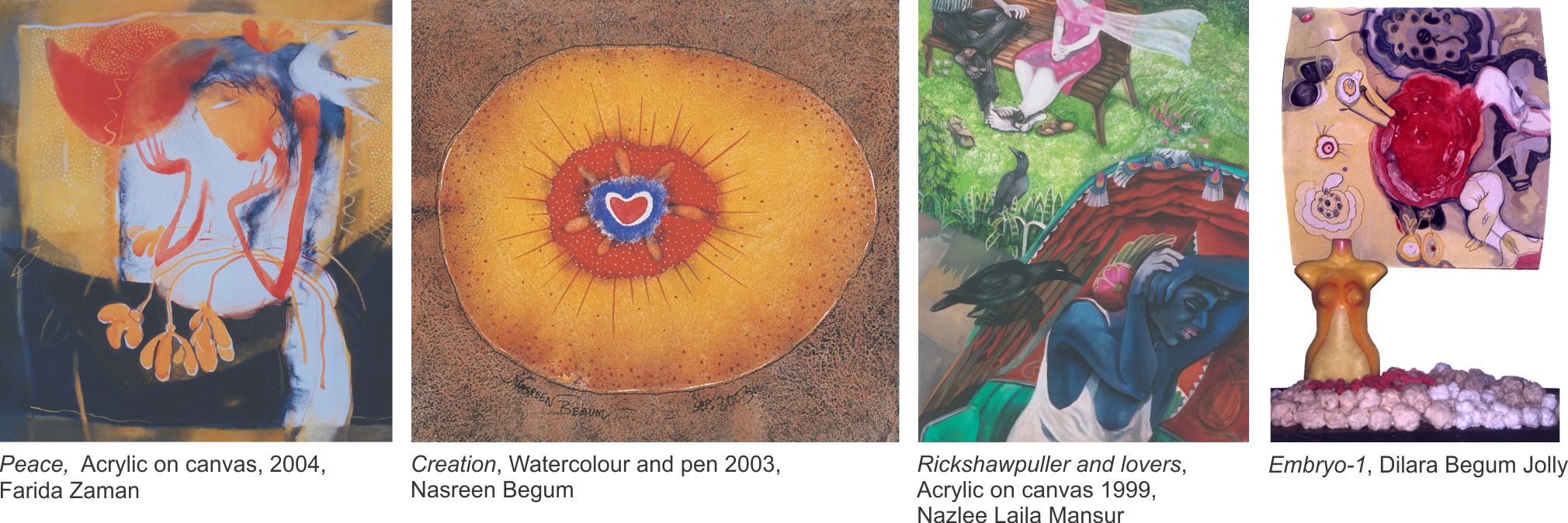
Women came to the art scene in Bangladesh quite late. Although the Art Institute at Dhaka opened its doors to both men and women more than fifty years ago, and the art schools/departments, in existence for the last three decades, have done the same, social attitudes prevented women from entering these in large numbers. It was not until the 1970s that a significant number of women took up the study of art. Today, nearly one in every three art students is a woman. They are active in every medium, mounting exhibitions and, yes, selling their work. Over the years, Dhaka has become the focal point of art activities in Bangladesh, since it has more galleries, a wider audience, and a bigger market, but there are other centres too. Of these Chittagong, with a university department of art, an art college, and a fast-growing metropolitan culture, is becoming an important second centre. When one talks about art—not necessarily women’s art—in Bangladesh, the name of Chittagong comes up for its energetic and highly motivated artists: Mansur ul Karim, Alok Roy, Nazlee Laila Mansur, Dhali Al Mamoon, Dilara Begum Jolly, Niloofar Chaman. There are of course more, but to see how women’s art is claiming its place in the mainstream, Nazlee and Jolly make a good study along with their counterparts in Dhaka, who in this article will be limited to a pair of artists: Farida Zaman and Nasreen Begum.
Together, the four artists fulfil something of a vanguard role in mainstreaming women’s work on its own merits—on the strength of its artistic range and vision, and its powerful portrayal of the contemporary ethos. But one has also to give the mainstream the credit it deserves: ever since Novera Ahmed burst into the scene in the 1950s with her Henry Mooresque sculptures, the best work of women have always been valued first as art, and subsequently as work of women. The four artists have been able, to a large extent, to discourage that ‘subsequent consideration’. This is all the more remarkable considering how women working in other fields of art— cinema, for example, and certainly in literature—still have to struggle for gender-free recognition. Women writers are still described as lekhika.
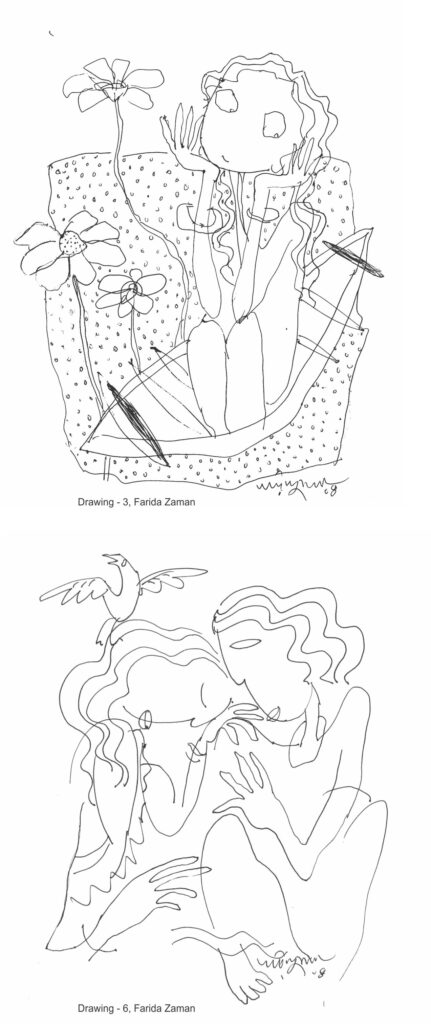
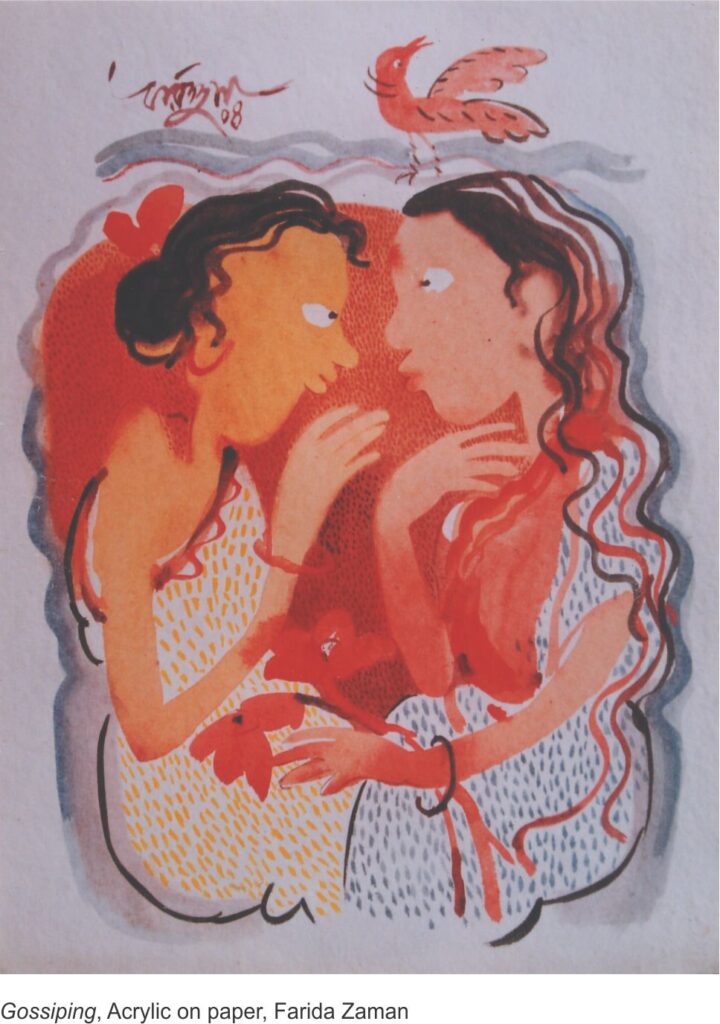
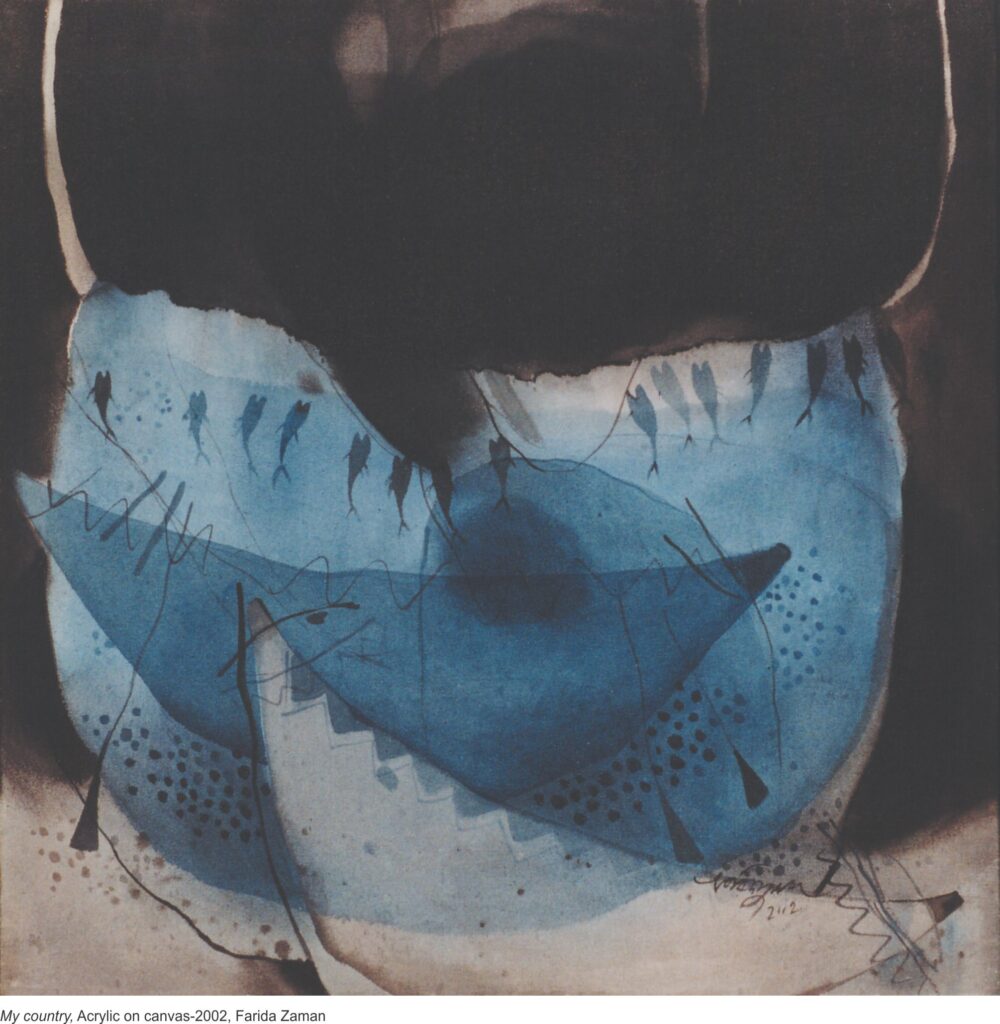
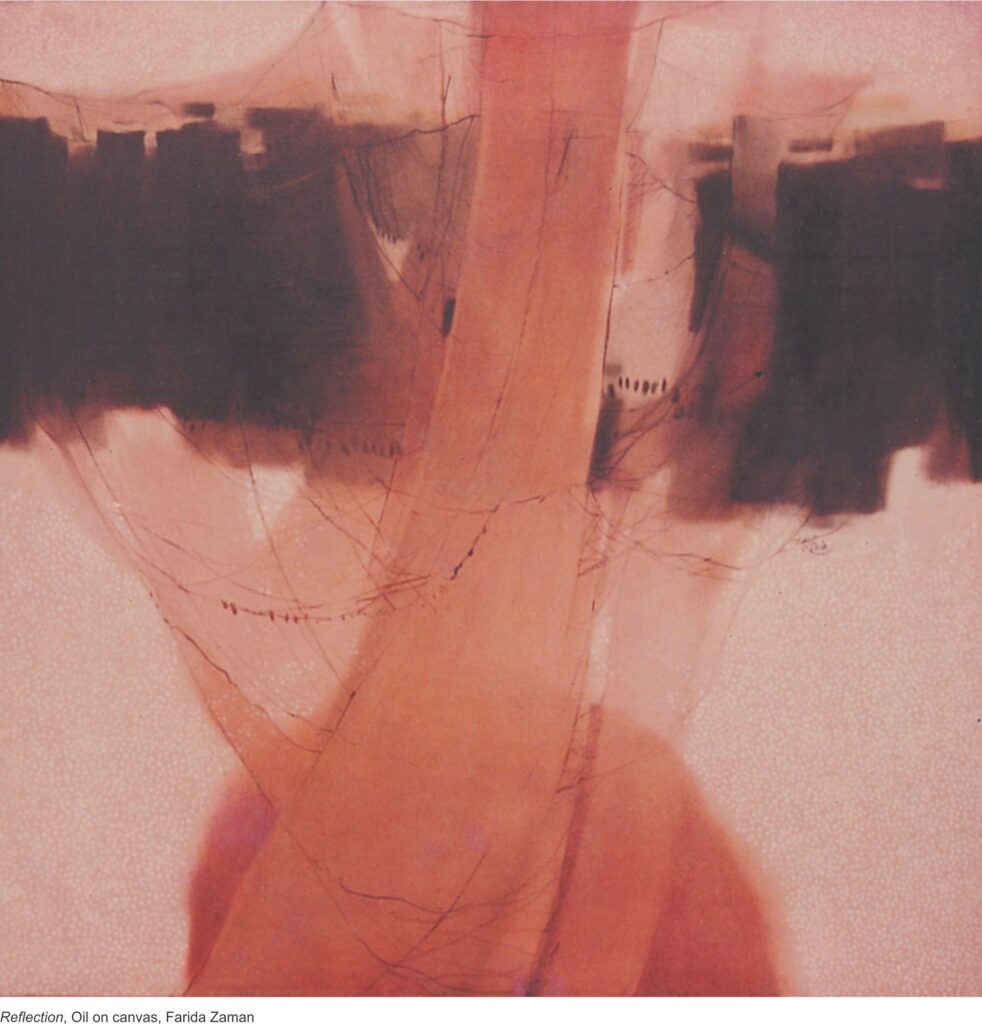
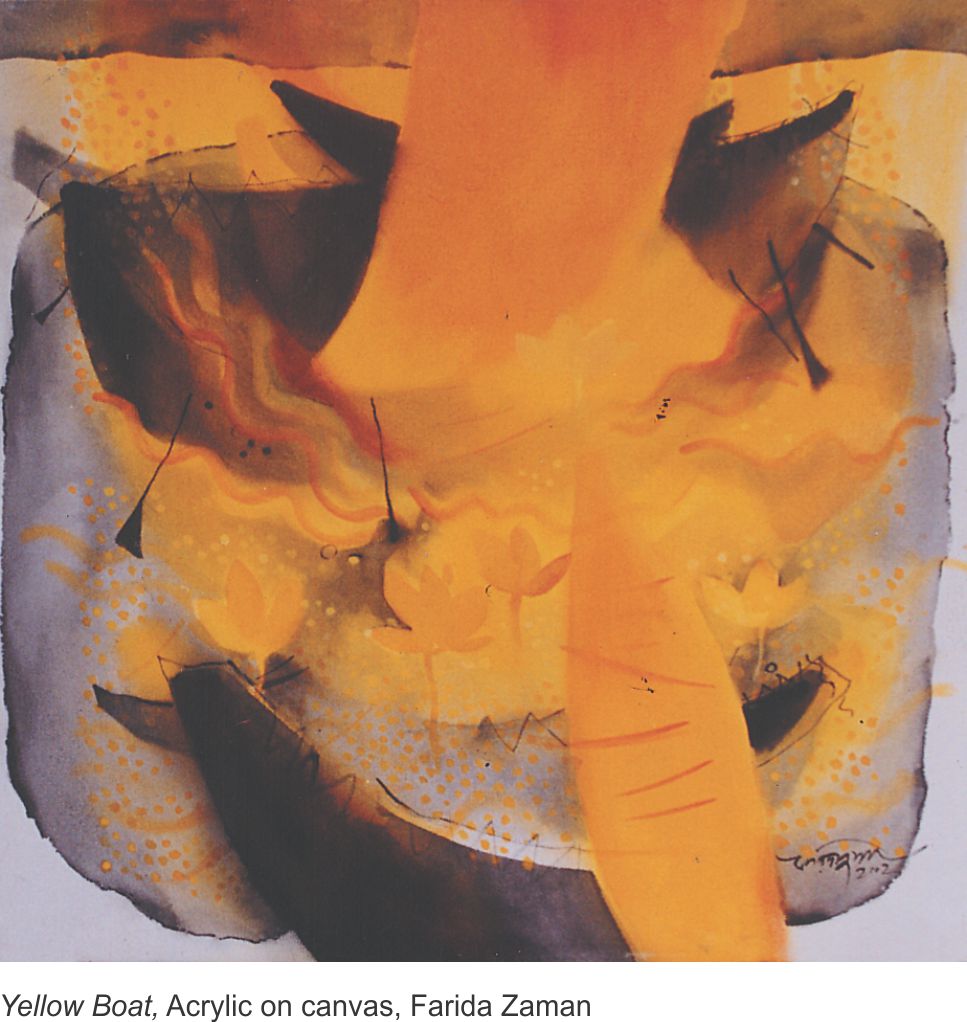
The first impression one receives of Farida Zaman’s paintings, for example, is one of intense involvement with life—with the life of the rivers she depicts, life on and around them, life of the community. Her initial themes were those that expressed man’s elemental, but often complex, involvement with nature—where nature is the provider, but sometimes a punisher, particularly when man exceeds the limits of his needs, and begins to chop at the hand that feeds him. In environmental terms, that amounts to the despoiling of nature, and the resultant upheavals. In many of her paintings with a central symbol of the fishing net, not only the fish appear to be in danger, but the water bodies too. While the fish—which can be seen as marginalized humanity pursued by forces of repression—try to swim free, the shrinking water body, painted in stark brown and gray, poses an equal threat. In other pictures, a romantic evocation of rivers, with their swirling water, sparkling light points in vibrant orange and yellow, is ironized by the dark fishing nets, sometimes only suggestively presented. One then reads in this contrast an element of uncertainty and unease. Farida’s romantic mood lasts as long as her imagination briskly gathers together the colours and tones, shapes, forms and textures of the world of nature, but as soon as reality intrudes (fishing net, the cat, considerations of livelihood) it dissolves, leaving the viewer to contemplate the colour contrasts, the strong use of line that seems to limit the freedom of space and the presence of human figures on the canvas.
In the beginning, Farida seemed to alternate between two worlds— the world of imagination and the world of lived reality. She was born in Chandpur in 1953, where the mighty river Meghna dictates the terms of daily life along her banks. She observed closely the life of the fishing community, its grim struggle, and the periodic displacement of people due to erosion of river banks. But her childhood spent in Chandraghona in Chittagong amidst an idyllic landscape and rolling hills has left its mark on her imagination in terms of recurrent warm colours and images of quiet and peace. She turns to them in moments of despair or agitation, but knows her stay there has to be shortlived. In some of her recent work, memory and reality blend, creating haunting images of desire and despair. The sampan, the canoe-like country boat local to Chittagong, has merged with the more robust forms of fishermen’s boats plying the strong waters of the Meghna, taking broken, geometric or suggestive shapes. This latter preoccupation—the boat—comes in the wake of another recent preoccu pation: the life of a girl from the fishing community, Sufia. While Sufia’s life is claimed by the community, in the sense she is bound by its restrictive space along with its poverty and ill-health, she is something of a child of nature. With her powerful eyes, and the hint of a smile playing on her face, she looks destined to win over adversities. In these paintings, Farida experiments with folk forms. Their strong fluid lines, stylized figures and contrasted use of colour are now used to evoke very contemporary moods and concerns.
Farida admits that she likes to paint her country and its traditional ways of life, but also casts her eyes on the future, hoping for a regeneration of the human spirit. Indeed, the sunbursts in her recent paintings are indications of that hope. She has an intuitive feel for colour and form. From brown or sepia (memory) to green, moss and yellow (desire), to red and orange (reality, uncertainty), her palette is well defined yet not restricted to these colours only. Her forms have also evolved through the years. From semi-abstract to half-figurative to suggestive, the forms appear energized and loaded with meaning and associations. These are often complemented by a carefully worked area full of colourful dots. Although she works mostly in acrylic, she has used oil in her earlier works but diluted it with thinners for a wash effect. The thinness of application has been particularly suited to her aquatic involvement.
Farida went to Shantiniketan, India, to do her doctoral dissertation on the influence of folk forms on modern Bangladeshi art under the supervision of celebrated painter K.G. Subramanyan. Subramanyan instilled in her the need to observe and think. Her work certainly has a rich visual quality, but it also engages us in a critical examination of the world around us.
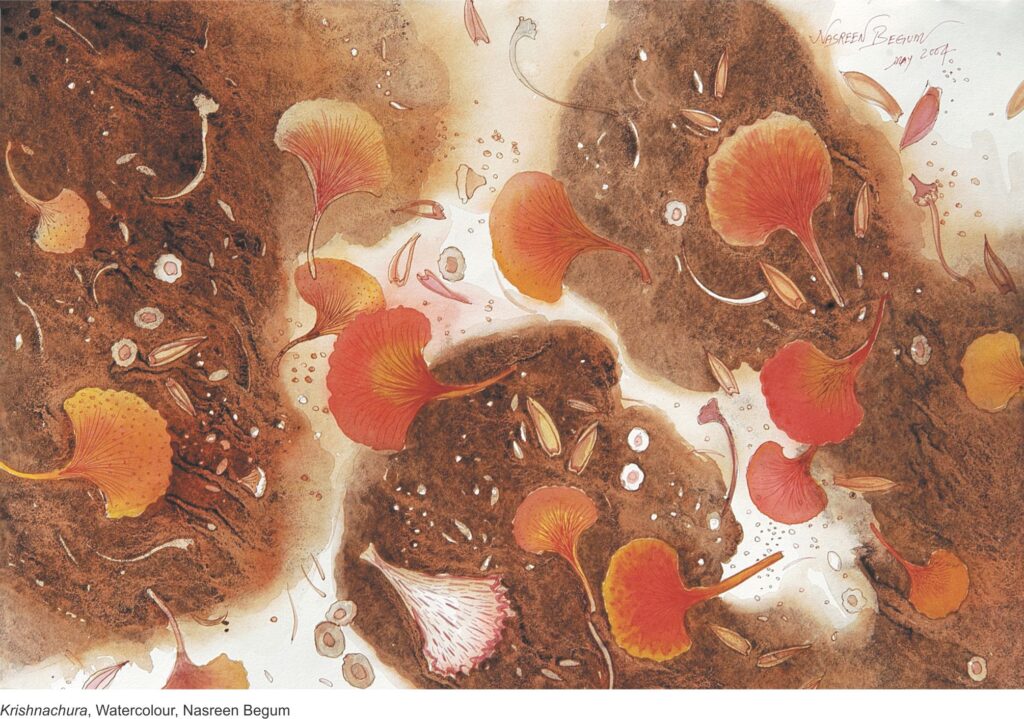
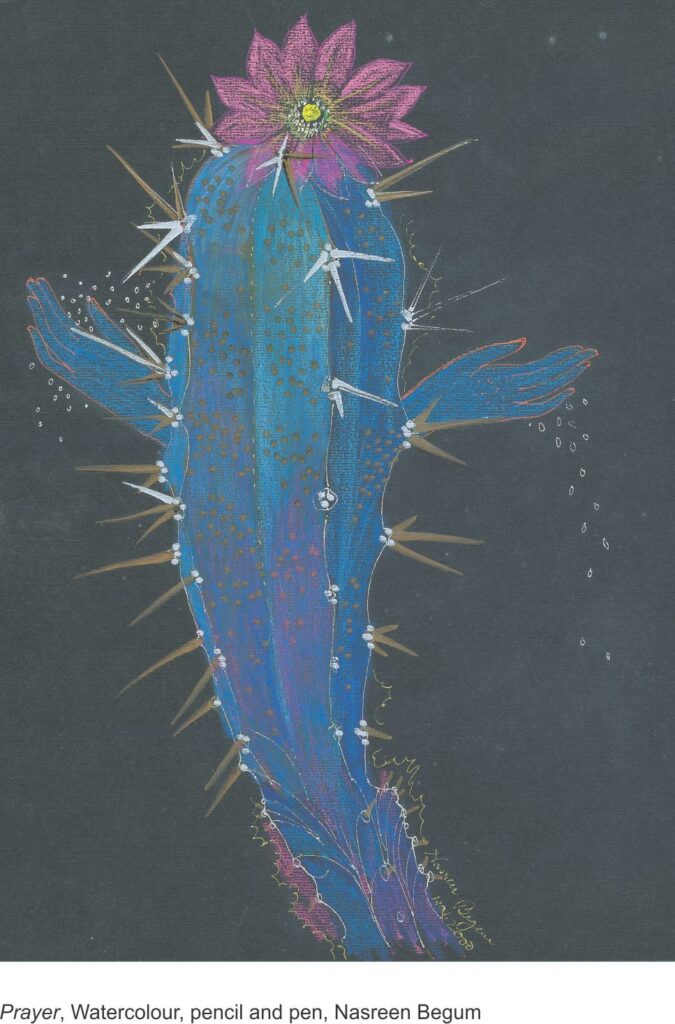
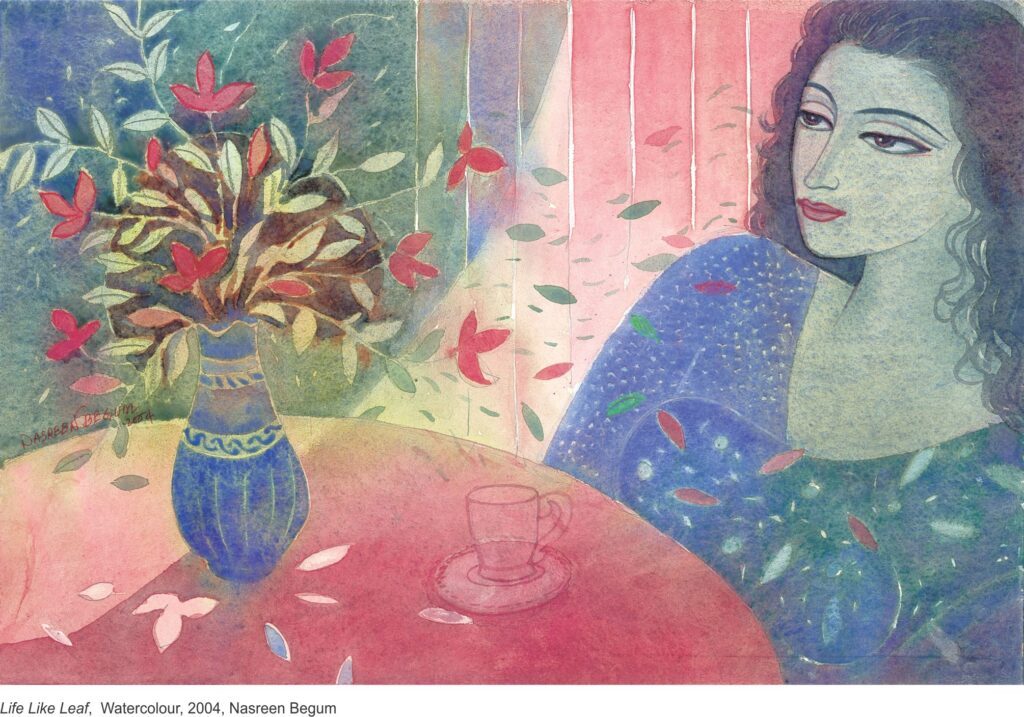
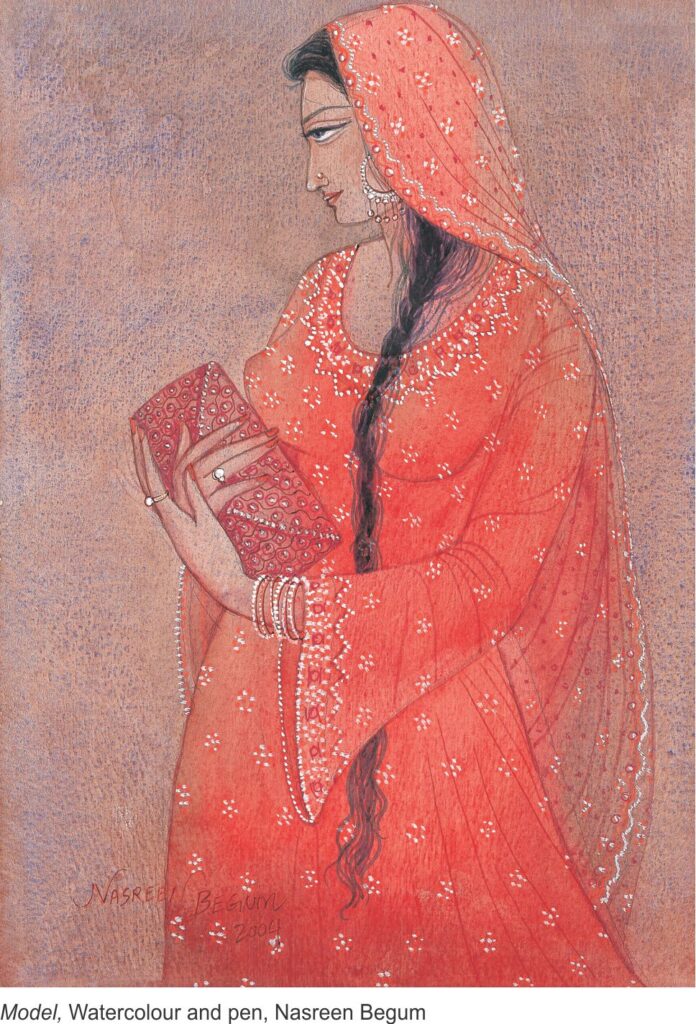
Nasreen Begum, three years Farida’s junior, and a colleague at the Institute of Fine Art where both teach, began as an avid student of oriental art—a genre that owes its revival in the first few decades of the 20th century to Abanindranath Tagore and the Neo-Bengal School that grew under his influence. The School drew its influence from the Moghul and Rajput miniature paintings, and from mythological and historical narratives of ancient India. The kind of painting it promoted had highly stylized figures drawn in flat body tones, and landscape or interior details painted in earth colours, with a flattened perspective and an evocative mood. Nasreen’s early works were fairly routine pieces that nevertheless showed an intelligent use of watercolour and a restrained sensu ality in the drawing of the figures. Soon she began to chart her distance from the predominant style of oriental art while retaining its preference for the local, the timeless and the elemental. Her figures began to assume a life of their own, her use of wash technique in the manner of A.R. Chughtai—a forceful practitioner of the Bengal School — began to draw on lived experience rather than moments frozen in time, as is usual in oriental art. In Nasreen’s own words, she began to take off from the point the Neo-Bengal School had left off. Her colours became spontaneous and sensuous, her forms and figures fluid and free-floating. She kept a close eye on nature, and observed its seasonal changes. Her paintings incorporated these changes in terms of rich colours and arrangement of pictorial details. She also took up oil and acrylic as her media, but found acrylic more suited to her style because of its nearness to watercolour in terms of pliability and transparency.
Over the years, Nasreen’s gaze has moved from the exterior world of nature to the interior world of men and women as she has begun to explore the depths of dence she has gained from a controlled use of her materials, it will be interesting to see how she now uses it to chart new areas.
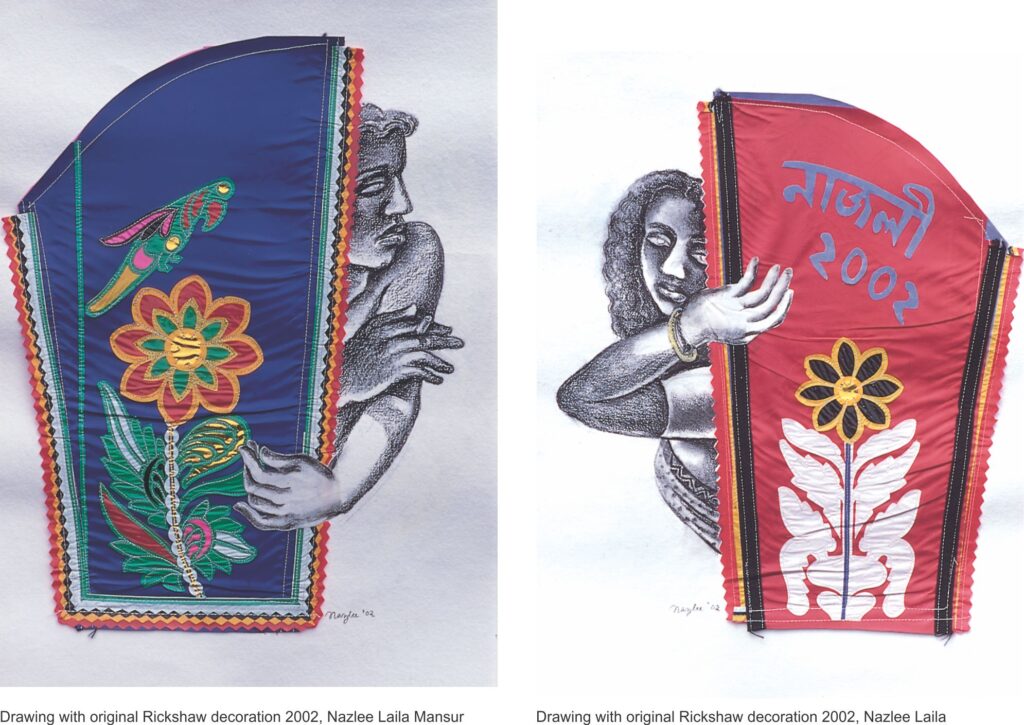
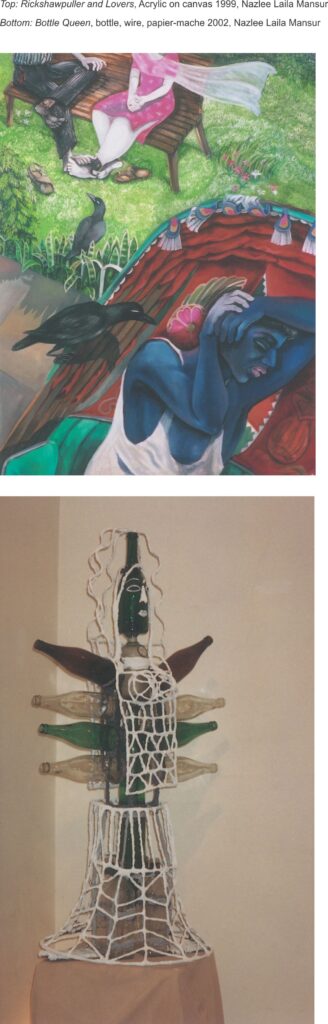
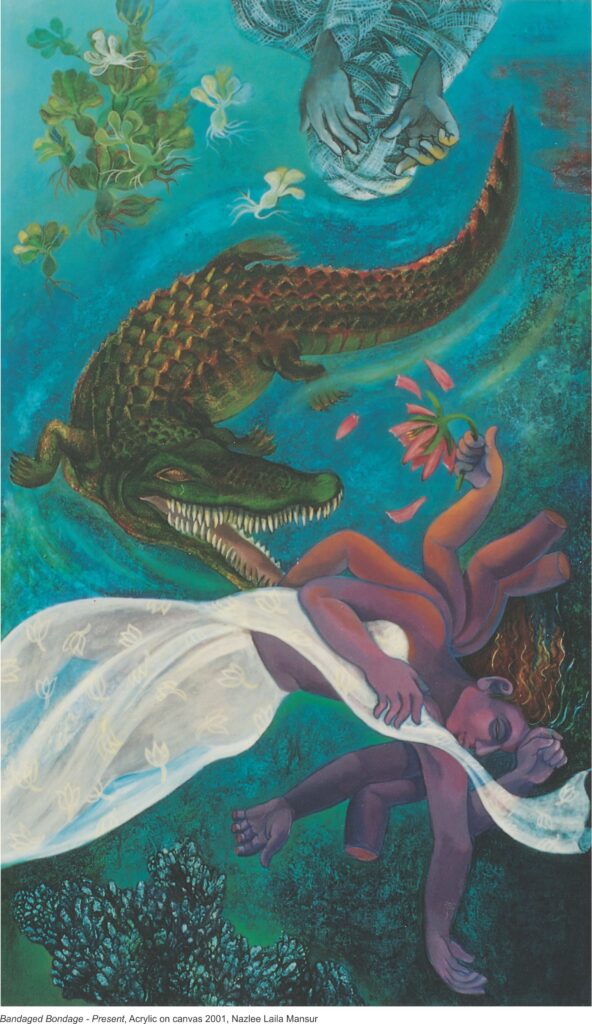
Like Nasreen Begum, Nazlee Laila Mansur (born in 1952) also found in oriental art a source of inspiration early on in her career. After taking a Masters degree from the Department of Fine Arts, Chittagong University, she settled down in Chittagong, and took up teaching at the Chittagong Art College. The subject she taught, and has been teaching, is oriental art, which is marked with an old world ambience, an overt dependence on stylization—which, in lesser hands, degenerates into mannerism—and a preference for earth tones and colours. What interested Nazlee, however, was its clear and powerful imagery, its sharp picturization of figure—mostly portraits of women set amidst floral designs and landscape features. She found in oriental art’s penchant for stylization, its colour scheme, its collapsing of perspectives, and its narrative content, a route to an alternative language she had been searching for.
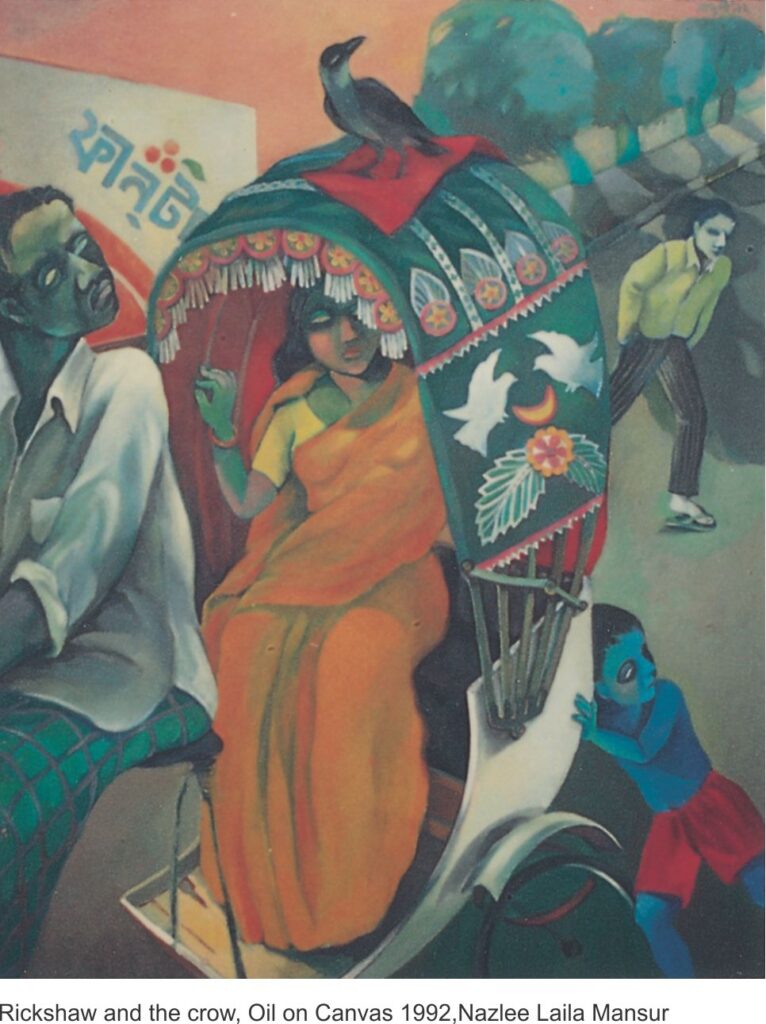
The heavily western diction of the language of contemporary art and its avoidance of narrative left little space for an artist’s social concerns or her personal/communal memory or her nostalgia for a lost land or time to take shape. Nazlee found both the academic style and the abstracted styles of many contemporary artists restrictive, while the purely figurative seemed, in many places, superficial and devoid of significance. She was looking for dynamism, depth and meaning, and she found these in a reworking of her pictorial language in terms of both aesthetic and social needs of communication, story-telling (putting a point across) and linking up with tradition (Moghul miniatures to rickshaw paintings). Indeed, later in her career, Nazlee took up many elements from rickshaw painting—a form of transport painting unique to Dhaka whose artists rely on strong colours and sharp contours to paint landscapes and cityscapes on rectangular tin plates at the back of the three-wheelers. What attracted Nazlee was its joyful disregard of the grammar of colour and boldness in putting, say, an orange line across a green field of colour. Nazlee’s own latter paintings are memorable for their evocation of a mood through colour and her seemingly absurd arrangement of objects in the visual field.
Nazlee herself began with landscapes though, painting lakes and trees and wide open spaces, which had a romantic, dreamlike quality, ably captured by her use of green, yellow and watery blue. She also did some figurative work, where evocation of a mood and the truth of experience rather than naturalistic details were important. Then, beginning in the 1980s, as the time became more uncertain and restless because of the rise to power of a military dictator who was not tolerant of creative freedom, Nazlee began to look for ways to incorporate the incongruities of her time on her canvas. Like most citizens of her country, Nazlee was amused and disgusted by political wheeling dealing and double talk. She was distressed also by the sharp social disparities and by the restrictive space that limits a woman’s ability to negotiate her day to day life. She was also aware of the coexistence of so many contradictory notions and ideas in her own personal surroundings. Her canvas began to reflect disoriented urban sensibilities and pictures of disquiet, or simply lethargy and boredom. Her figures became prominent and stylized, their postures often angular, their eyes reflecting emptiness and non-meaning.
The influence of oriental art in Nazlee’s work now appears in a new mode; or, to put it in another way, Nazlee’s pictorial language has come full circle, in which elements of an earlier style find their relevance in a modern context. Although her canvas from the mid-1980s has no scope for romanticism or idyllic image-making, she retains her colour scheme in presenting urban disorder and the uncertain journey of her time. This is an ironic comment on the gradu ally diminishing space in life. Whatever space is left for urban couples to play in—from city parks to bedrooms—is cluttered by unmoving objects and images of fixity. Nazlee’s canvas is strangely unmoving, even rickshaws appear to float more like shadows than objects with substance. Their passengers appear forlorn, as if they have risen from the underworld. Nazlee’s colour was once drawn from rickshaw paintings, which celebrate life and experience, but in her recent paintings the rickshaw is a reminder of lack of life and movement. Nazlee’s paintings, mostly done in acrylic now, with their self-reflexive, ironic/satiric quality, their blending of high and low art, their self-delusory evocation of a time marked by an absence of centre, appear to have a postmodern ethos. This impression has been heightened by her most recent work, such as the ones shown in the 10th Asian Art Biennale in Dhaka, where her paintings could also double as upholstery and sofa covers. While her work thus narrows down the gap between utility and art, it also makes a wry comment on the dysfunctional nature of art and aesthetics in our time.
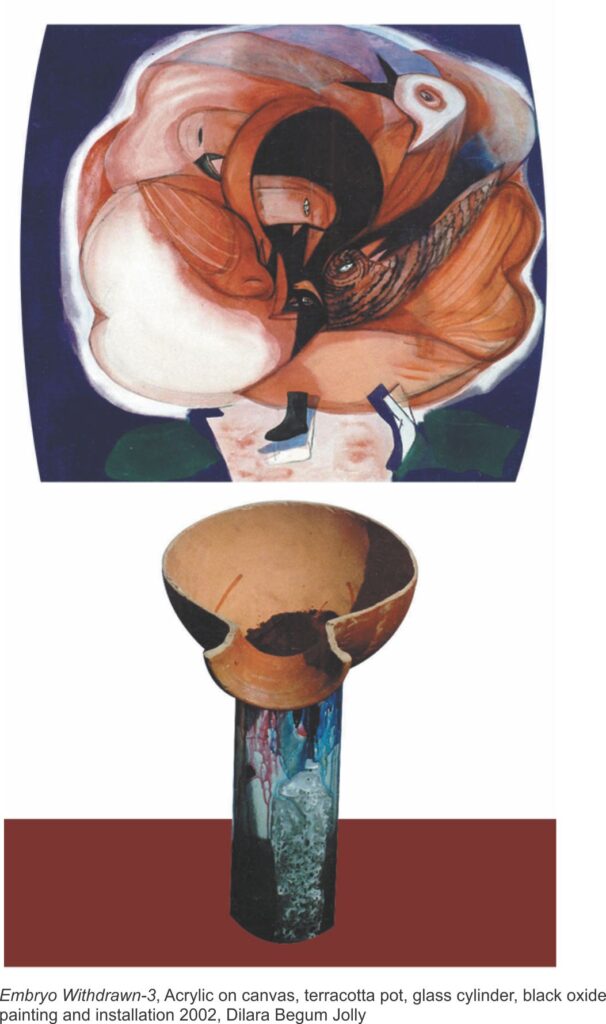
Dilara Begum Jolly, although the youngest among the four (she was born in 1960) deals more centrally with women and women’s issues, giving them a whole range of treatment—from biological to sociological. Her work is known for its strong social content, which, without evoking political overtones, centralizes the problems of our time. These range from spiraling violence to erosion of values which victimize women more than any other group. As an undergraduate student of art, when she had started going out on her own, Jolly felt the vulnerability of a woman in a male-dominated society. She found it difficult to balance the opposing pulls of home and the outside world, but found in art a secure space, a sanctuary. In her initial work, the reality of shrinking space for women gave her canvas a claustrophobic feel, but her overall treatment remained generalized and impressionistic. She wanted to be more specific, more focused. The break she was looking for was not provided by a painter, though, but a novelist, Syed Waliullah, whose Lal Saloo, a scathing satire on social institutions and religious pretensions she read with avid interest. Through the symbolism of the red cotton cloth, which is used to mark out religious shrines, Waliullah makes a sharp comment on the clever exploitation of people’s religious sentiments in rural areas by opportunists. Jolly executed a series of paintings based on Lal Saloo, and later another series on yet another novel by Waliullah—Chander Omabashya (The Moon’s Darkest Night). Her treatment began to assume a boldness as her content became more well defined and her style more sure.
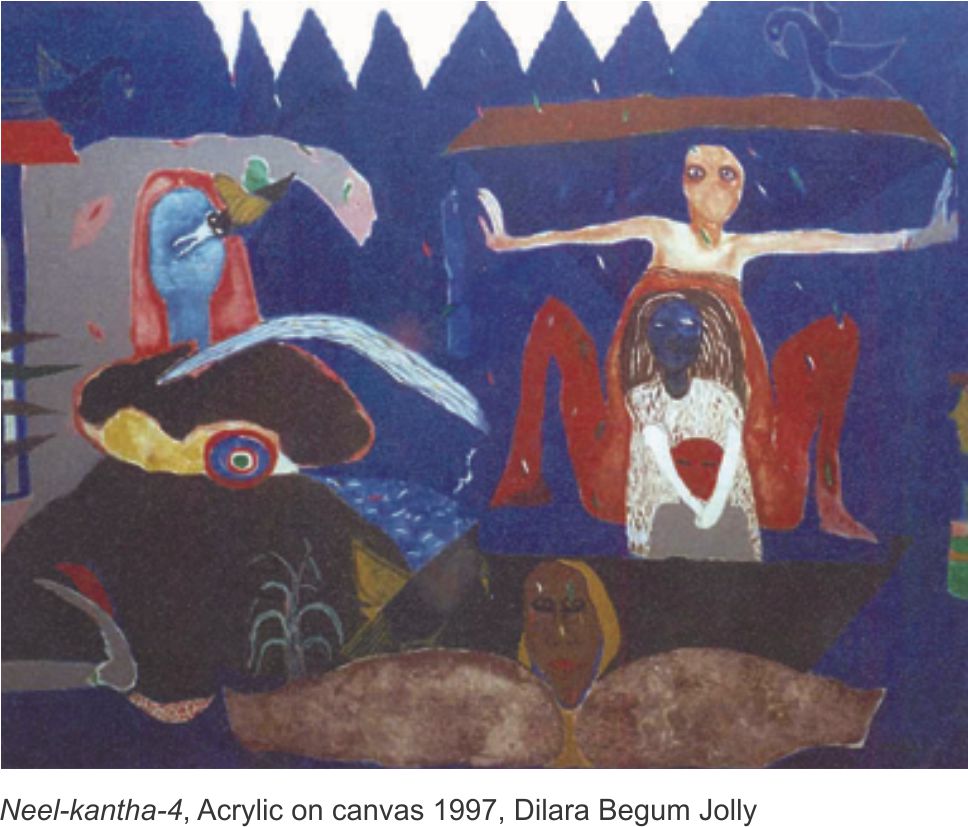
As her concerns grew, Jolly felt that a single canvas was inadequate to harness all her ideas, all her angles of vision and her narrative contents. She began to do a series of paintings instead of one or two, and thus developed such intensely explorative work as the Nilkantha series, where women as nilkanthas or poison drinkers suffer to keep the society healthy; or Dibaratrir Kabya (Poetry of Day and Night), where nature comes alive through human interaction. Nature, incidentally, is one of Jolly’s recurrent themes. It was there in the beginning of her career when she drew birds and butterflies, aquatic plants and wild flowers. But her more recent work shows nature becoming more distant and inscrutable. Nature’s world is changing because man is also changing. From an intimacy with nature, man has shifted into a relationship that shows strain and unease. When Jolly went to Shantiniketan to do her Masters, she studied etching. Her etchings were distinguished by lightness and naturalistic nuances. When she returned home, nature remained an important concern. However, in course of time, nature began to recede from her canvas as she was sucked by eddies of violence and anarchy around her. Her work began to focus more on social issues like marginalization of women. Her style also reflected the change. Forms became broken, jarringly outlined or clustered in dark piles here and there, while an incisive irony, satire, or ridicule set the dominant note.
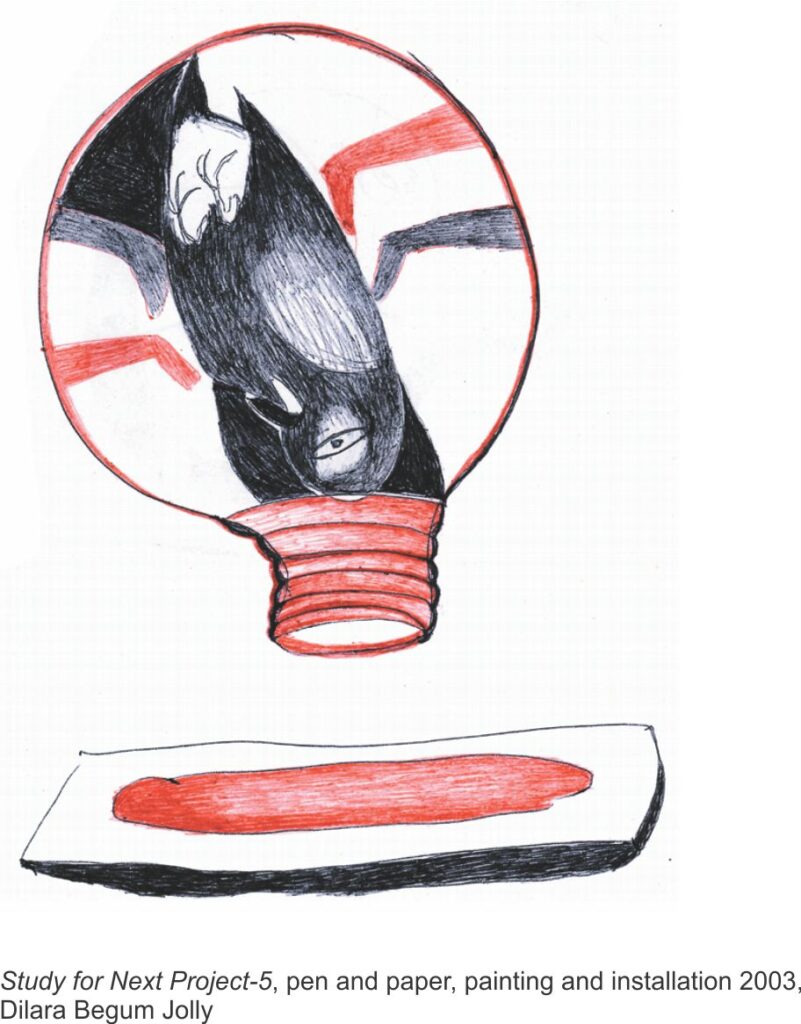
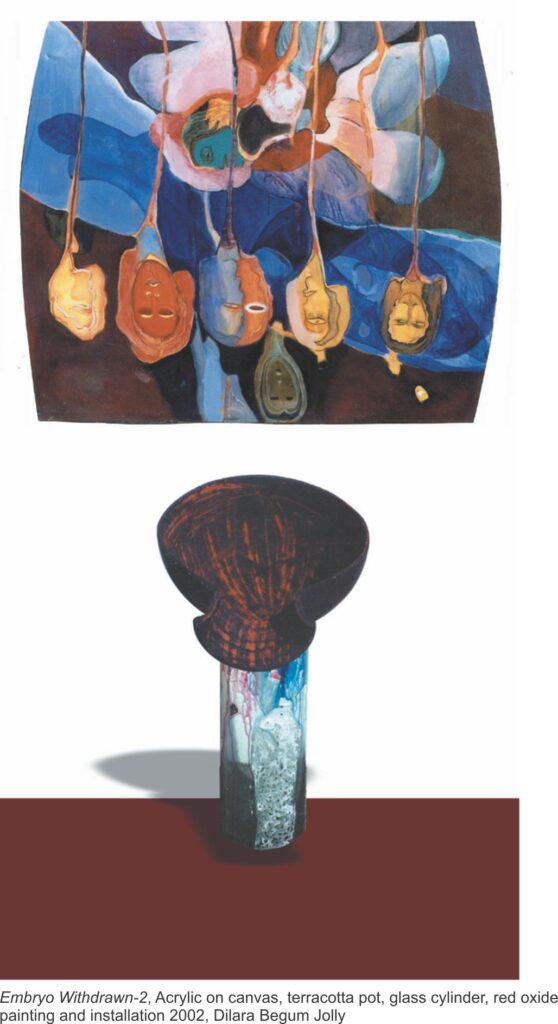
In her more recent work, Jolly explores the biological aspects of a woman’s life as part of her continuing narrative of struggle and emancipation. As times become more violent, Jolly wonders how a child may grow to live a normal life. A mother’s reaction should be, she thinks, to take back a vulnerable child to her womb if she could. The womb—the uterus—has thus begun to assume a central symbolic role in her work. The uterus, a friend told her a couple of years ago, looks like an inverted pear-shaped pitcher (commonly used in Bangladeshi households). That was a new way of looking at the organ: Does it retain life (the upright pitcher) or give it away (the inverted pitcher)? Jolly began a series on the whole question of a mother’s dual role: a lifegiver and the most primal protector. Another friend making a film on why some women do not want to have children triggered a search for the embryonic cycle. The result was yet another series where Jolly combined painting with installation art.
But despite such a glorious role as a mother, Jolly asks, what position does a woman have, socially? In answer, she turns to figures of mannequins which she installs at the base of her paintings. They are self-explanatory. Deep down, however, Jolly refuses to accept such roles. She knows, with the faith of the children she teaches in a school, that at the end of a turbulent time peace will return.
Syed Manzoorul Islam is a member of Jamini editorial board
Women came to the art scene in Bangladesh quite late. Although the Art Institute at Dhaka opened its doors to both men and women more than fifty years ago—and the art schools/departments, in existence for the last three decades, have done the same— adverse social attitudes prevented women from entering these in large numbers. It…