

as seen by an european artist life and society in early nineteenth century bengal
The first quarter of the nineteenth century saw British authority deeply and extensively entrenched in India. Interest about the newly colonized land and its people went on increasing in the west. A large number of visiting artists from Britain and Europe took up their residence in Bengal and some of these artists interested themselves, not so much in depicting portraits and landscapes, but in the portrayal of the life as lived by the people. We owe to them a large number of invaluable visual studies of contemporary life and scenes in Bengal
Madame S.C. Belnos, possibly French, spent the large part of her life in Bengal and called herself ‘a native of the country’ and was a talented artist. She chose to depict the social life and manners of the late eighteenth and early part of the nineteenth century Bengal in her celebrated lithographic album Twenty-Four Plates Illustrative of Hindoo and European Manners in Bengal / Drawn on the stone by A Colin from sketches by Mme S.C. Belnos 1832. Each plate displaying her remarkable talent for details was accompanied by a descriptive text both in English and French. These descriptive notes are equally interesting and illustrative of the sights, sounds and lively atmosphere of her time almost 175 years ago.
Raja Ram Mohun Roy received a copy of the album while he was in Britain in 1832 and wrote a highly complimentary letter to Madame Belnos praising both the drawings and descriptive notes. Ram Mohun found these as true representation of nature ‘so much so, that they have’, in his words, ‘served to bring to my recollection the real scenes alluded to of that unhappy country. ‘
In the absence of details of her life, only a hypothetical sketch of her career can be constructed. Eminent historian Dinesh Chandra Sen thought she was a Bengali. What the historian meant to convey was that she was born in Bengal. Sukumar Sen presumed her to be a person of Portuguese extraction though he didn’t substantiate his premise with any further reasoning. All that we can say with certainty is that her mother tongue was French and her association with Bengal dates back to her days of childhood, long before she was married to J.J Belnos, a French miniature artist who was known to have spent many years in India, in particular in Bengal, arriving in the country from France in 1806. The miniature artist after initial failure found remarkable success in the field of lithography. Fortune also smiled on his wife and soon Madame Belnos established her claim to fame with the publication of her celebrated album in 1832. Shortly afterwards, Madame Belnos accompanied her husband to a visit to France and the couple were back in India in 1839. Mr. J.J Belnos died in Batavia in February 1847 and the widow came back to the Bengal with which she had long and intimate association since her early childhood. She also returned to her former pursuits of a painter in watercolors, chalks and crayons as The Harkara mentioned. Four years later, her second album The Sandhya was published from Allahadabad. Subsequent to this period there appear to be a lack of definite information about her. The year in which she died is not known.
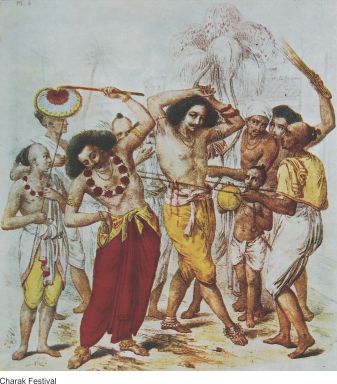
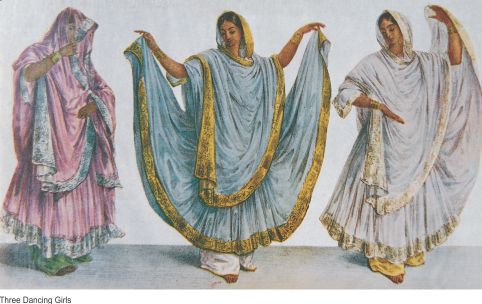
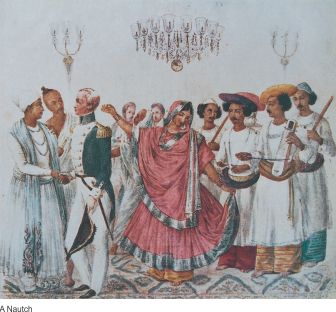
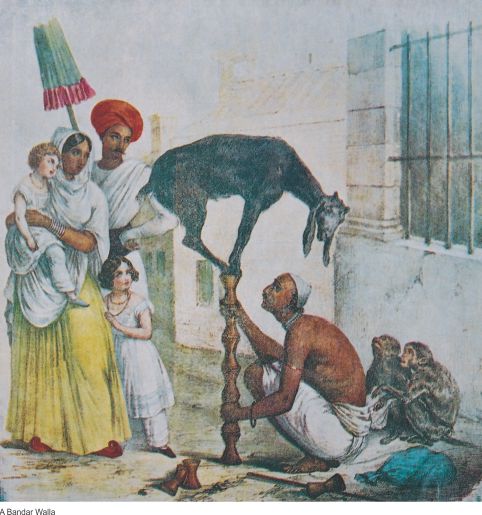
The social gatherings, costumes, festivals and religious practices were faithfully captured in her twenty-four lithographic plates. Her range was astonishingly wide, encompassing events such as sacrifice of animals to the deity, festivals of Holi and Charak, convivial gatherings like ‘nautch’ attended by European male and female guests and the practices of ordinary life. Varying professions from those of the bandarwallahs, the peddler, the mendicant, and the civilian to the profession of village ‘Gooroo’ and intimate scenes of common household life in Bengal were objects of interest for her. She didn’t provide glimpses of elite life in Bengal except on one or two occasions. The omission has been termed as deliberate because the artist was more interested in the life as lived by the musses. To her, the day-to-day lives of simple folk appeared to be more colorful and vivid, reflecting their joy, happiness, and sorrow, and their faiths and rituals.
Belnos captured vividly an interesting aspect of Bengal society in the late and early part of the nineteenth century when the European civil and military officials used to participate as invited guests in the celebrations of the natives where the former were entertained lavishly by performance of nautch-girls, singers, jugglers, and sumptuous dinners and excellent fireworks. The contemporary journals, news reports, and memoirs by visiting European travelers left behind vivid accounts of these convivial gatherings. ( This practice, however, was discontinued in 1840 by an order from the government.) Fanny Parks, herself a witness to such celebrations in the palace of Raja Ram Mohun Roy in May 1823, left a detailed record of the event in her famous journal Wonderings of a Pilgrim in Search of Picturesque.(1850) In absence of photographs and camera, still things of the future, Belnos’ portrayals of the celebrations are the sole visual records of the exchanges that took place between the locals and the Europeans on a social platform. Belnos’ nautch girls and the singer appeared to be far from being indecent, provocative and sensual as some of the visiting foreigners, suggested while narrating their experience in witnessing such events. But the majority of the European guests found them modest and dignified and not at all lacking in poise, decency and decorum. The authenticity of the modest appearance of Belnos’ three dancing girls and the lone singer seemed to have received supportive evidence from Mrs. Hebber, wife of Bishop Hebber, who herself was present in one of these performances and wrote in 1828, ‘I never saw public dancing in England, so free from everything approaching to indecency’. She further wrote that the costumes of the nautch girls appeared to be very decent because only the face, hand and feet of the dancer were visible. Fanny Parks’ description of the nautch girls in her famous journal fully confirmed the pictorial details of Belnos’ dancing girls. Fanny Parks wrote that the nautch girls ‘wear dress of fine white or coloured muslin , trimmed with deep borders of gold and silver, full satin trousers covered the feet ; the duppata, or the large veil, highly embroidered, is worn over the head, and various ornaments of native jewelry adorn the person …..Several men attended the women, playing on divers curiously shaped native instruments.’ One wonders if on seeing the album in England Raja Ram Mohun Roy remembered his own celebrations and the dances in his Calcutta palace as mentioned by Fanny Parks in her journal.

In her preface of the album, Belnos threw interesting lights on how she became acquainted with the customs and rituals of the land. ‘From earliest childhood,’ she wrote, she ‘was curious and interested in being a spectator of every object and event characteristic of native opinions and manners in Bengal’. Speaking about her early stages of development as an artist, Madame Belnos informs us that as a young child one of her great source of amusements, after witnessing an interesting event’ were to trace upon the wall of the garden a representation of what she had seen while its impression was still vivid in the mind. ‘Thus, so intimately acquainted had I become with the style and character of native manners’ wrote Belnos. She further disclosed, ‘every plate is executed from sketches after nature which I made chiefly during my pedestrian excursions in the interior of the country’. As she was not married to a civil or military officer, she was comparatively free from restrictions on her movements, thereby enjoying better access to the households of the native quarters. Her unconventional attitude and her gender might have helped her in gaining access to the female quarters of both rural and urban Bengal. This is amply proved by her realistic portrayal of the ‘Village Gossip’ and the ‘Interior of a Native Hut’ that skillfully captured the minute details of life around the village women and the domestic bliss of a common Bengali family.
Art critics pointed out that some of the figures she drew appeared to be more North Indian than Bengali. And the mellow charm and nuances characteristic of Bengali women seemed to be also missing in some of her Bengali subjects. Critics trying to explain this lacuna argue that Belnos treated Bengal on a larger canvas consistent with the areas which in administrative records of those days were known as the Bengal Presidency. It could be mentioned here that Bengal in 1832 was administratively a much larger unit.

Belnos depicted her characters with sympathy and understanding—there being no trace of cultural or intellectual presumptions on her part. The female characters attracted her sympathy in abundance. The portrayal of female singers, dancers, village women, and the crying mother over her dead child testifies to her sensitive mind and an attitude devoid of any prejudice or racial discrimination. She might have on occasions erred in depicting correctly some of the social and religious traits of Hindu and Muslims but this does not diminish the merit of her work as a first-hand source material for social and anthropological study of a society more than 175 yearsold now. It can rightfully rank as a document of social history and it is in this that the value of her works lies.
Acknowledgement
Reproductions of the lithographs from Madame Belnos’ ‘Twenty Four Plates Illustrative of Hindoo and European Manners in Bengal’, London 1832. 1979 edition.
Mohboob Alam is a former ambassador and secretary to the government of Bangladesh. Courtesy Mahmoodul Haq . D.G. Bangladesh National Museum, Dhaka, Bangladesh
The first quarter of the nineteenth century saw British authority deeply and extensively entrenched in India. Interest about the newly colonized land and its people went on increasing in the west. A large number of visiting artists from Britain and Europe took up their residence in Bengal and some of these artists interested themselves, not…