

joseph beuys at tate modern
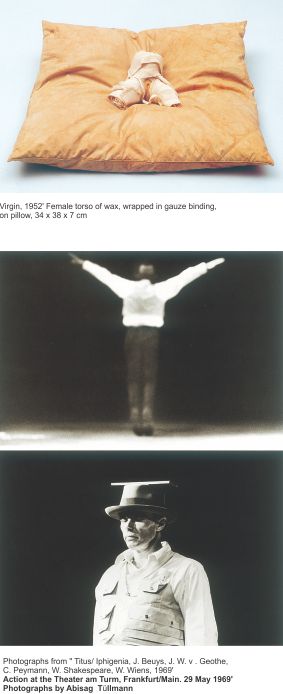
As a member of the avant-garde Fluxus movement, Joseph Beuys was interested in the way meaning is produced in society. Central to Fluxus is the idea that art is a part of nature and should therefore be founded on the universal processes of flux and change. In the process, the public ‘concerts’ of the Fluxus group blurred the boundaries between literature, music, visual art and everyday life. Beuys thus indulged in an unconventional style that has been known as ‘performance.’ He undertook schizophrenic walks, looked for materials and installed them in an environment that would give thematic congruity. No wonder Joseph Beuys is considered a shaman as well as a showman

Last December Gordon’s, the sponsor of the Turner Prize, conducted a survey among 500 artists, curators, critics and art dealers. The result was astonishing to say the least. Michael Duchamp’s Fountain (1917) was named the most influential piece of modern art. The porcelain urinal carrying a fake signature “R. Mutt” robbed great names like Picasso and Matisse of their bourne supremacy. In the same survey, the German artist Joseph Beuys (1921-1986) was placed at number six for his work I Like America and America Likes Me (1974). While Duchamp’s ready-made Fountain ‘scandalised’ the art world by submitting an upturned retinal as an exhibition display with an aim to contravene the modernist craving for symmetry and intelligibility, Beuys had a much serious notion for his art. He used performative actions to free art from a museum object and to turn it into a springboard for social change. Beuys probably had the Dadaist anti-art stance in mind when he retorted, ‘Art that cannot shape society and therefore also cannot penetrate the hard questions of society, [and] in the end influence the question of capital, is no art.’ Although Duchamp and Beuys pursued different paths of art, their contribution to the paradigmatic shift in contemporary art is lately being investigated with renewed interest.
Beuys became both famous and controversial in the 1960s. His relevance, however, is beginning to show up more and more not only in art but also in literature, film, media and theoretical discourses. Almost twenty years after his death, Tate Modern held the first major survey exhibition of Joseph Beuys in the UK from February 4 to May 2, 2005. This exhibition is not only a tribute to one of the most radical artists of our time but also a testimony to the evolution of the museum as an institution.
As a member of the avant-garde Fluxus movement, Joseph Beuys was interested in the fluidity of meaning than how meaning is produced in society. Central to Fluxus is the idea that art is a part of nature and should therefore be founded on the universal processes of flux and change. In the process, the public ‘concerts’ of the Fluxus group blurred the boundaries between literature, music, visual art and everyday life. Beuys thus indulged in an unconventional style that has been known as ‘performance’. He undertook schizophrenic walks, looked for materials and installed them in an environment that would give thematic congruity. No wonder Joseph Beuys is considered a shaman as well as a showman. He is an urban shaman who longs for social healing in the manner of a traditional medicine man. He is a showman because he participates in life to explore the meaning of art, but entertains us in the process. His choice of materials (felt, fat, copper and honey, for example) is eclectic. But a closer look shows that these heat-conducive materials are suggestive of energy that art can contain and circulate. And he presents them in such a way that they become an expansion of his own self, his own myth-making project.
During the Second World War Beuys worked as a radio operator and combat pilot for the German Air Force. He was wounded several times during the war. In one close combat he received bullet injuries in the head. To repair his fractured skull, silver plates had to be inserted. Ever since, Beuys had to wear a felt hat to save his brain from being over-heated. He turned this hat into a signature item of his dress code and made it relevant to his art. In all his performances he wore a felt hat and a felt suit. For a man whose art is highly synechdochic, the felt dress is his way of insulating himself from his Nazi memory. Throughout his life, he resorted to art to come to terms with his part in the war, a role that earned him notoriety and attracted hostile criticism. For some, his shamanism is just a sham to hide his Nazi past. For others, he is the face of post-war Germany that is agreeable and reconciliatory.

The official booklet for the Tate exhibition seemed to underplay Beuys’s Nazi past. His short bio reads: ‘Born into a Catholic family in the north-western Germany, the young Beuys pursued dual interests in the natural sciences and art. In 1940 he joined the air force as a combat pilot and radio operator. The process of coming to terms with his involvement in the war is a constant subtext in much of his work.’ The exhibition focused on three broad themes of Beuys’s works: actions, vitrines and environments. As a whole, these works reflect Beuys’s obsession with his radical politics, especially his involvement in grassroots direct democracy, his teaching strategy that was instrumental behind the Free International University network, and his involvement with the Green Party.
The first room of the exhibition housed Beuys’s anti-minimalist work Fonds VII/2 (1967/84). Eight towers of felt covered with copper sheets created an architectural Manhattan. The dull and drab looking organic felt towers of varying heights under the weight of shiny metallic copper sheet are imposing, but their meaning becomes obvious when we refer to Beuys who termed this work ‘a battery.’ It becomes elementary science; felt stores energy and warmth while copper acts as the conductor that transmits energy. Suddenly we find ourselves in a strange network of powerful energy that is both science and magic. The title ‘Fond’ is the base-form of foundation, and points to the most basic encounter with materials.
The second installation is no less imposing. I Want to See My Mountains (1950/71) is a room-sized installation replete with personal items from Beuys’s studio in Cleves. At the centre of the room, a ceiling lamp droops low only to create a mountainous light. The wooden wardrobe with an oval mirror is inscribed with ‘Vadrec(t)’, a Celtic word meaning glacier. The packing case in one corner is marked as ‘Felsen’ or cliff, and the bed is ‘Walun’—the valley. And on the butt of the rifle that is hung on the wall is written, as if to taunt the abstract movement in art, ‘Denken’ or ‘thinking.’ The landscape that once impressed Beuys in Switzerland is thus transported into the mindscape of his audience with simple chalk marks on the items. Beuys once said, ‘when I make an environment called I Want to See My Mountains I mean an inner archetype of the idea of the mountain: the mountain of the self.
Tram Stop (1976) installed in the third room also echoed Beuys’s childhood days in Cleves. While waiting for his bus, Beuys used to sit on a seventeenth-century old canon whose mouth was designed as a fearsome dragon. Beuys chose a discarded canon from the war and gave it a screaming head. The canon lies on the floor in the midst of scattered weapons and war memorabilia. In an earlier version, Beuys made a cherub for the canon-head to suggest peace. The work on display, however, had anguish written all over it.
The fourth room displayed some of the blackboards used by Beuys in his 1972 lectures given at Tate. Teaching has been quite crucial in the artistic development of Beuys. He was a professor at the Dusseldorf Academy of Art when he ran into trouble with the authorities for his free admission policy. He was ultimately dismissed from his post in 1972. At the centre of the room, two TV stands were constantly screening Beuys’s most celebrated Action, I Like America and America Likes Me. In 1974, as a protest against America’s military action in Vietnam and as a challenge to the hegemony of American Art, Beuys flew to New York. He was wrapped in a felt blanket and then carried to the gallery in an ambulance. There he entered a room inhabited by a Coyote, the prairie dog famous for its place in different Native-American origin stories. With his props of walking stick and gloves, he spent three days with the Coyote. Each day he gave the Coyote fifty copies of the Wall Street Journal. The Coyote responded by urinating on them or tearing them into pieces. The Coyote’s behaviour shifted from being cautious to hostile, but Beuys withstood it all, always having his eyes fixed on the animal. He held his felt blanket and the crooked stick and his look changed from that of a shepherd to a Native American tepee. At the end of his Action, he was driven back to the airport in the same ambulance; he had completed his insulated tour of America without touching its soil!
On a personal note, let me point out that I was really surprised by the amount of curiosity generated by the short film of Beuys’s action. The room was packed. The only sound came from the surround system. It appeared that the audience was part of some sort of a ritual headed by the arch shaman who was transporting the masses to a pre-Capitalist pristine thoughtscape. It is a strange thought to have for one sitting in the monumental Tate building on the south bank of Thames.
Room 5 once again consisted of an arrangement of copper and felt, but this time the agenda was one of teaching democracy. A heap of felt located in the corner of the room was neighboured by a host of copper and iron sticks to represent the importance of exchanging ideas in a healthy democracy. These installations were titled as Hearth I and Hearth II. The blackboard in the room contained the map of Ireland to localise his action.
The Pack (1969) in Room 6 carried on with the dynamics of energy radiating from personal memory. At the age of 22, Joseph Beuys reportedly survived a plane crash in Crimea. The nomadic Tartars saved him and gave him fat to eat and felt to cover himself. The truth behind the story remained shady, but it had a lasting impact on all Beuys’s works. In the work pack of twenty-four sledges powered by fat comes out of an old Volkswagen minibus. The stranded old German automobile is contrasted with the sledges equipped with emergency torches and blankets. The sledge-dogs are missing, but not their primitive energy. Beuys observed, ‘This is an emergency object: an invasion by the pack. In a state of emergency the Volkswagen bus is of limited usefulness, and more direct and primitive means must be taken to ensure survival.’ Like his other works, this conceptual installation has a personal significance. It seems that behind the aesthetics of sense, movement and form there is a plea for purgation from wartime guilt. After all, it is the nomadic tribe that saved his life and gave him vitality when he freed himself from the old German machinery.
Beuys is probably the first German artist to openly talk about the holocaust. Again and again, he refers to the theme of death and mourning, which he simply termed ‘the wound’. The next installation, Show Your Wound, employed two mortuary tables, two agricul tural implants and, of course, two containers filled with fat. The paired objects in a way symbolised the unresolved conflict. It’s simple yet epic in its own dirge.
The personal wound has a different meaning in the next installation, The End of the Twentieth Century (1983-85). Beuys arranged a number of basalt blocks like ruins of ancient civilisation. Each block of these volcanic rocks contains a ‘wound,’ a conical hole bored by Beuys, which he ‘treated’ with an ointment of clay and felt before reinserting the plug of stone. The choice of material is once again suggestive. The basalt, for example, is significant because it was ‘once pressed out of the interior of the earth.’ This work was part of Beuys’s greening project. In 1982 he began to plant 7000 oaks in Kassel, Germany. It took him five years to finish this plantation. Each treated basalt rock was then planted next to an oak tree.
Through art, Beuys thus encouraged nature to regenerate itself. His shamanic vocation becomes obvious in his mediation of his objects. Healing with likeness is an idea that can be found in Frazer’s Golden Bough. While explaining ‘sympathetic magic,’ Frazer uses the law of similarity, which states that like produces like or an effect that resembles the cause. This Latin idea of similia similibus curantur, literally meaning, ‘like cure like’ is also practised in homeopathy. Beuys’s action of social healing thus becomes a ritualised performance to renew and regenerate Germany, and, by extension, the world from the ills of the War.


The last two rooms held some found objects, props and small sculptures that Beuys used in many of his performances. Each case contains a mini-environment created through the objects that he collected during these performances. One memorable action was to sweep up all the litters following a May Day march in the Karl Marx-Platz in Berlin. It does not take a genius to understand Beuys’s dissatisfaction with Marxist dogma. His rejection of capitalism we have noted already. In a simple back-to-the-basic way, Beuys reminds us of finding energy within our own selves and plugging that energy with the energy outside. This he calls social sculpture. Only through connecting with such an energy-base one can be alive and become an artist, hence, the Beuysian slogan, ‘everyone is an artist.’
In an age, when creativity is held with suspicion, Beuys gives new meaning to creativity. He uses old sacred texts and creatively arranges them so that new meanings are produced. He never gives fixity to his work as the materials used in his works decay and rot to suggest new chemical bonding and new relationship between matter. Such is life. At Tate, we get to see Beuys’s works in which a complex sequence of association of materials is used to produce the relationships between body movement, senses and form in a continuous state of change. One day, one must hope, these changes will breed changes — in art and in life.
The writer teaches English at Jahanagirnagar University. He is presently pursuing a doctoral degree at Birkbeck College, University of London
As a member of the avant-garde Fluxus movement, Joseph Beuys was interested in the way meaning is produced in society. Central to Fluxus is the idea that art is a part of nature and should therefore be founded on the universal processes of flux and change. In the process, the public ‘concerts’ of the Fluxus…