
shambhu acharya keeping the patua tradition alive
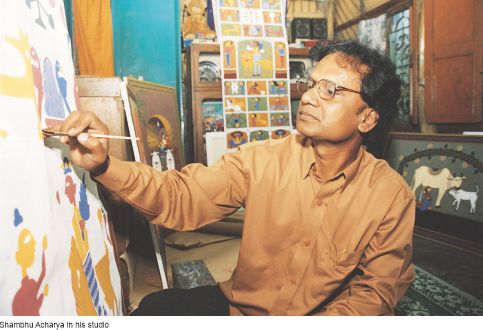
Patuas are hereditary painters—the skills and dedication are handed down from one generation to the other. In Bangladesh many such families once existed, but now there are only to a few. Shambhu Acharya, a 10th generation patua, is one of the last, perhaps the last patua at the end of a long line of illustrious patuas of Bikrampur

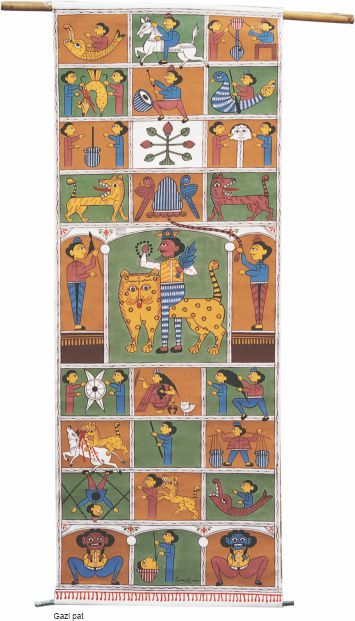
Patachitra has been one of the earliest forms of popular art in Bangladesh. Deriving from the Sanskrit work patta meaning cloth, patachitra is essentially painting done on a piece of cloth, either rectangular or oblong and mounted on a bamboo or wooden frame, or on a long strip that can be unfolded frame by frame for display. In earlier times—from the 12th century to the end of the 19th—this latter form was more extensively used by the patuas—pata artists—as the scrolls offered ample opportunity to paint narrative stories based on religious and moral themes for the edification and entertainment of the village folk. As the patua unfurled the frames depicting scenes that told a story from the Ramayana or Mahabharata, or the exploits of Gazi Pir, a mythic muslim warrior-saint who defeated a Hindu King with the help of goddess Ganga and Khwaja Khijir—whom Muslims venerate as the protector of the waterbodies—or the story of a soul’s progress through the afterworld after Jam or Yama, the Hindu deity of death, had taken its charge, he usually sang songs he had composed himself. The patas or pats in common parlance thus came to be known as Mahabharata pat, Ramayana pat, Jam pat, Chaitanya pat, Gazi pat and the like, depending on the subject they treated. Much later, pats began to accommodate secular themes reflecting the popular appeal of the pat tradition, and the versatile use they could be put to. As the twentieth century progressed and films became a popular means of entertainment, cinema pats evolved to cater to the craze for filmstars’ portraits and particular scenes from hit films—usually romantic. During British rule in India, white planters or officials had their portraits done by patuas, and these became known as shaheb pats.
But generally, four types of pats were found in Bengal (comprising today’s Bangladesh and West Bengal) depending on their content—(a) pats based on the Hindu Puranic sources, such as the Ramayana, exploits of Lord Krishna, etc; (b) Jam pat; (c) Gazi pat and (d) Chakkhudan (bestowing eyes) pat. Of these, the pats based on Puranic and Hindu mythic tales enjoyed more widespread popularity as they fulfilled the four-fold objectives of pat art—knowledge, education, virtue and entertainment. Indeed, the tradition of these pats appears to be much older—dating back to the end of the 8th century, by some accounts, when Buddhist pats depicting the life and times of Gautam Buddha and various jataka stories began to be circulated and patuas sang songs and gave an oral narration to supplement the images and messages painted on the scroll. Gazi pats were popular with both Hindu and Muslim clientele because of the essentially syncretic nature of the tale. As Gazi rode a tiger through thick forests teeming with tigers, he wielded a stick that subdued an opposing army. The supernatural powers of Gazi were narrated frame after frame as he defeated monsters and demons, even Jam himself. The Jam pats were particularly welcome in households where there had been recent bereavements, and people expected the souls to have a pleasant journey all the way to heaven. Chakkhudan or eye-bestowal pats were also something such households liked to buy. The patua would paint figures resembling the dead, but without the eyes, and sang a song to the effect that without the eyes, the dead could not find their way through the tricky regions of the afterworld. The households paid the patua to put the eyes, and he obliged, much to the delight of the people who gathered to see the spectacle.
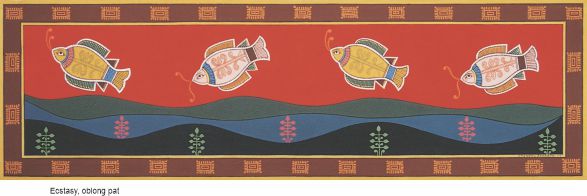
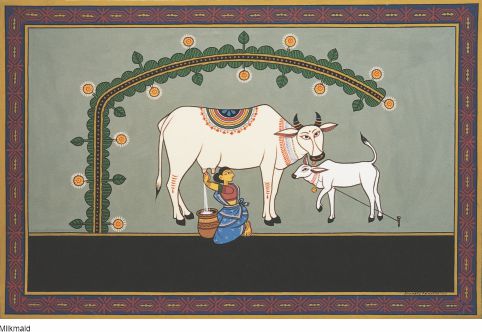
In addition to the chauka (rectangular / oblong) pats, and jarano (scroll) pats, there were also aré-latai scrolls or oblong scrolls that had six to eight frames. The cloth was simple cotton, sometimes a gamchha that was common in every household. Brick or chalk powder mixed with a sticky substance such as tamarind seed paste applied to the cloth usually made the canvas, while the colour was made from vegetable dye, lamp soot, burnt rice, vermilion powder or puree bought from the market. The patuas took meticulous care in painting a scroll, often taking weeks. Many made their own brushes. But whatever colours they made or procured, the forms showed a great deal of similarity and simplicity, as they maintained a steadfast allegiance to traditional, schematic style. Figures had a set pattern, and profiles were preferred, with large eyes and rounded limbs. The stylized, elaborately worked figures were meticulously contoured and placed against decorated flat backgrounds. The borders of the paintings, and sometimes the frames within a painting had floral or alpana designs which highlighted an aesthetic mood.
Although the pat tradition dates back to the 8th / 9th century, the earliest samples preserved in the Ashutosh Museum in Calcutta (a Gazi pat) are just over a hundred years old. One reason is that the material used (both cloth, paper, and the colours / dyes) cannot survive the effect of humid and wet weather for very long. But then, most village houses in Bangladesh do not survive even that long.
Over the years, as urbanization and western education spread, patachitra lost its ground to cheaper forms of image making (poster art, for example), and came to be regarded as ‘low’ or even ‘inferior’ art. It is only recently that interest in this popular art form has revived. Even then, there are not many practitioners of this art. Patuas are hereditary painters—the skills and dedication are handed down from one generation to the other. In Bangladesh many such families once existed, but now there are only to a few. Shambhu Acharya, a 10th generation patua, is one of the last, perhaps the last patua at the end of a long line of illustrious patuas of Bikrampur.
How old is the tradition of patachitra in your family?
The history of the Acharyas is more than 400 years old, but the first few generations used the title Lagnacharya—they were astrologers in addition to being idol makers, and analyzed lagnas—auspicious moments—in making zodiacal charts for those who wanted them. As clay idols were not affordable to every devotee, the Lagnacharyas were requested to paint the images of deities on paper. Cloth was then used for durability. This was the beginning of the pat tradition. The first Lagnacharya to paint patachitra was Ramlochan. He was followed by an illustrious line of patuas—Ramsunder, Ramgopal, then my grandfather Pran Krishna. Along the way they dropped Lagna from the family name as they no longer practiced astrology. All these generations of Lagnacharyas and Acharyas have lived and worked from the same household in Kalindipara in Bikrampur in Munshiganj district. My father, Sudhir Acharya was a versatile artist whose influence on me has been very profound. But he, like his father, stuck to traditional motifs and style, although each of them tried to give their work a distinct look that would mark them out.
How many different types of pats did your forefathers paint?
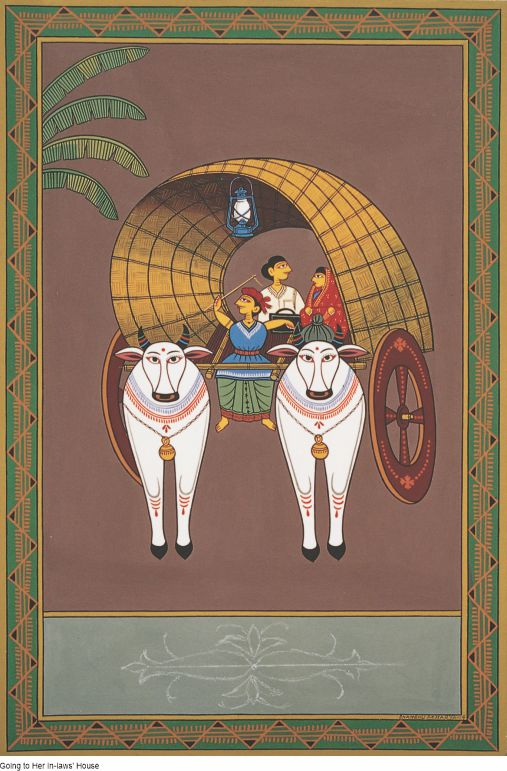
Almost all the types that have been produced by the patuas of Bengal, and for both Hindu and Muslim communities. Ramayana and Mahabharata pats, Sri Krishna and Monsha pats were in demand all year round in Hindu households, whereas Maharram pat—commemorating the tragic death of the grandsons of Prophet Mohammad at Karbala—were liked by the Muslims. Gazi pats were popular with both the communities, as they are even today. I must however add that the pats appealed to people of all religions, since these were not concerned with any particular tenets or teachings of any religion but appealed to everyone’s sense of the story.
These were mostly scroll paintings?
Yes. But some were rectangular or oblong too.
And the patuas narrated or sang the stories?
The earlier patuas did that. They were popular artists who went from place to place displaying their pats to the accompaniment of song and music. But people also bought pats, particularly those on paper which depicted deities, to hang in their houses.
When did you start painting pats?
I started quite early. Even before I had been introduced to Adarshalipi, the primer every child reads before starting school, I used to make chalk or charcoal drawings of birds and flowers on the tin walls of the houses in my neighbourhood. I watched my father work, and learnt the techniques. But as I grew up, I became a commercial artist—a sign painter—with a small studio at Rekabi Bazar. Although I did pats at home, I earned my livelihood as a commercial artist.
So when did the break come?
The break came not that long ago. I had my first major exhibition only in 1993. Let’s say, I have been recognized as an artist—not simply as a patua, an uninitiated artisan—since then. There was even a seminar held on my work at the Sonargaon Folk Art Museum in 1994. I have been invited to festivals and seminars in England and Indonesia. Before the 1993 exhibition, I’ve had the bitter experience of being turned down by big galleries in Dhaka who advised me to take my ‘handicrafts’ to outlets where these are sold. I did indeed sell them through Kumudini and Aarong, two big houses selling handicrafts and artisanal products but I knew that patachitra was more than that—it was genuine art that had moved people to sublime emotions through the ages. I was confident that people would one day see its worth.
Who organized the 1993 exhibition?
Mr. Ramendu Majumder of Expressions, an ad agency in Dhaka. But before that, in 1980, it was a dedicated researcher of folk art, Mr. Tofael Ahmed, who was president of the Jatiyo Karushilpi Parishad who really ‘discovered’ me and my father. He had gone to visit the Ashutosh Museum in Kolkata, where the only sample of Gazi pat was on display. It was done by a Lagnacharya from East Bengal—today’s Bangladesh. Mr. Ahmed decided to locate any practitioners who might still be in Bangladesh. With the help of the Ford Foundation, Mrs. Hamida Ali, and Mr. Kalidas Karmakar, the well-known artist, Mr. Ahmed eventually found out our address, and came to our house. I was in Chittagong at the time, painting a temple wall. When I returned home, Mr. Ahmed gave my father and me two weeks’ time to paint a Gazi pat each. We were expected to work independently. When I was doing mine, I felt I was including some ‘modern’ elements—mainly in figuration, so I backtracked. Mr. Ahmed liked our work, and more orders for Gazi pats followed. I was invited to become a member of the Parishad. Then in 1989, I participated in an exhibition of the Parishad at Bangladesh Shilpakala Academy. I took part in a seminar, and set up a small stall in the exhibition. There Mr. Majumder met me on the second day.
You do both scroll and chauka pats: which ones are you more comfortable with?
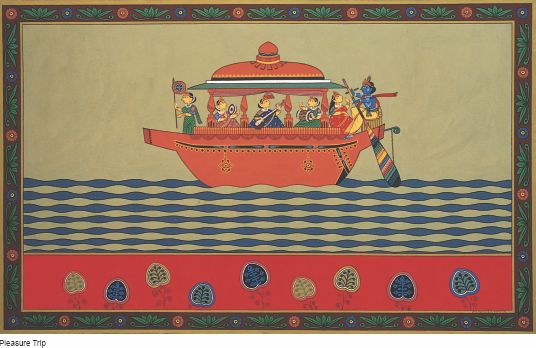
Both have their own challenges, and I like to meet them. I have done Mansha and Krishna pats, but over the years, I have tried to include themes from history and contemporary life in my pats. I took a kristi pat—depicting our culture—to the Festival of the Arts in London. I have also completed a very ambitious project—a history pat—showing the main events in the history of Bangladesh, beginning with the Battle of Plassey in 1757 which saw the defeat of the last independent Nawab of Bengal—Siraj Uddowla—and the arrival of the British, and ending with our Independence in 1971. Each of the 24 parts of the patachiatra is 8’x4′ in size, and the total number of panels is 1100. Now my dream is to do an equally ambitious Maharram pat. You seem to enjoy showing domestic themes.
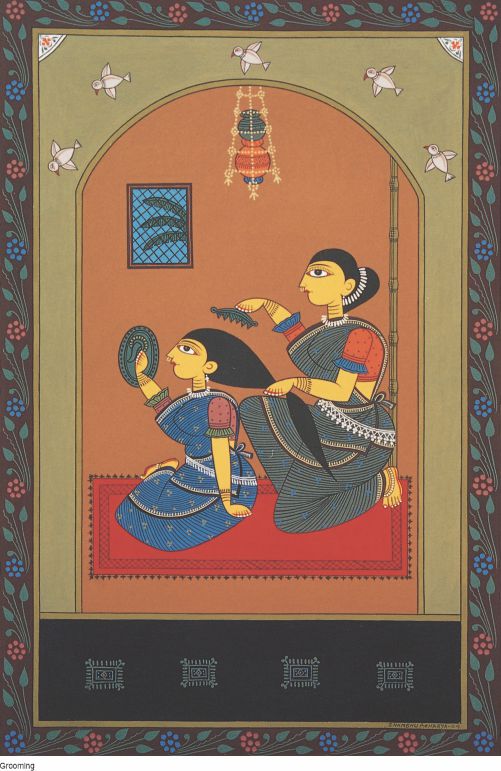
Yes. My forefathers didn’t do this type of pats, but I decided to accommodate everyday scenes—women fetching water, one woman combing another’s hair which is both a relaxation and chat time for them, fishermen with their catch. I paint milk vendors, fruitsellers and the like. Although the images are contemporary, the forms remain traditional. I like to closely follow my forefathers’ techniques and motifs.
But you have different border decorations than the traditional pats.
I am meticulous about my border designs. I have a repertoire of floral designs and motifs from alpanas, but I also evolve my own patterns to suit a particular mood that the images evoke. My mother, Kamala Acharya, was an excellent alpana artist. My wife also does exquisite alpanas. For me, the borders of my paintings are important as they not only frame the images, but must also lead the eye to them, so to say.
What about your figures?
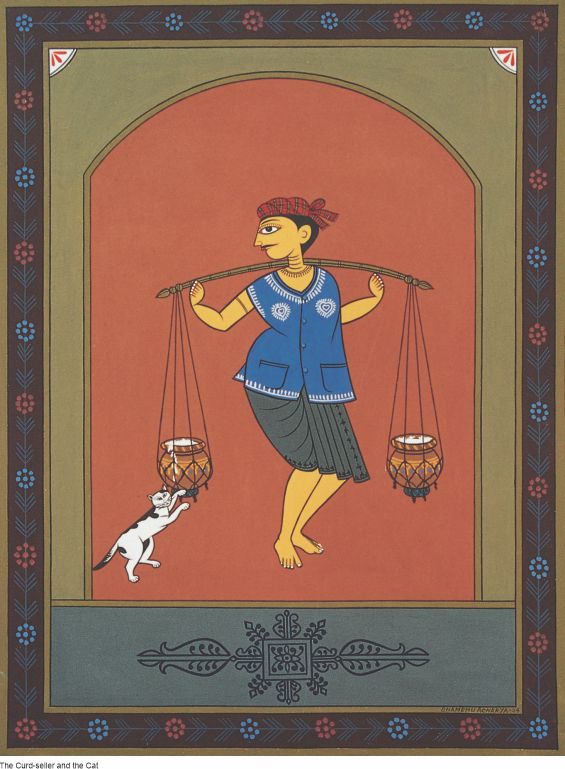
They are not much different from the ones you see in traditional patachitras. The same rounded and curvy bodies and large expressive eyes. But I try to make them more dynamic by painting the contour lines thicker and applying bolder brush strokes. I also use brighter colours for the body and clothes. You will notice that the saris the women wear are quite eye-catching.
How do you prepare your canvas?
How do you work?
On a piece of cotton cloth—locally known as ‘markin’—I apply a paste of tamarind seeds mixed with chalk powder and zinc oxide. This forms the surface on which I paint, but for the back of the canvas, I use the same paste mixed with brick powder. The canvas is called doli, and it lasts for ages. I have a work that my father did 45 years ago and the canvas seems to have been made yesterday. I use the two kinds of colours that patuas have traditionally used—the ‘thick’ and the ‘thin’ ones. Thick colours include yellow puree, vermilion, sky blue and a number of earth colours—gopi and ela mati (earth) which are basically red oxide. Thin colours are made from egg yolk, wood apple tannin (for red and black), and tamarind seed juice. With thick colours I draw figures, and with the thin ones, such as royal blue, I draw the outlines. My forefathers used hard chalk which was sometimes brought from China or Burma. The chalk slabs were scraped to make powder which was mixed with water to make white paste for the canvas. I buy some colours—yellow puree for example—from the market, but some other colours—black, for one—have to be made at home.
You use black for outline.
Yes. It gives a special look to figures and makes them stand out. The black ink I make from lamp soots. An oil lamp with a thick wicker burns the whole night, and the soot forms in fluffy balls on the underside of a clay lid hung over the lamp. I mix egg yolk with the soot to make the ink.
Patuas were once entertainers as well. How do you view yourself?
Patuas were educators, too. Well, times have changed. Even the people who buy my work are quite different from those who patronized my father’s pats. A large number of his buyers were Muslim bedes—gypsies. I remember one of them, a darvesh who came to our house dressed in red and wearing earrings, a stick in hand, in the month of Agrahayan, at harvest time. He didn’t have much money, so he asked father to lend him a pat. He made a small deposit. He then went away with the pat to different places, sang and danced as he described the images. People paid him money or rice for the entertainment. At the end of 2/3 months, the darvesh had enough money to pay for the pat and buy a few more.
I believe the main educational value of the pats was a cross-cultural, cross-religious one. The pat images and the narratives they generated as well as the songs that accompanied the display of the pats promoted a tolerant and humane culture, and a love for tradition, irrespective of one’s religion or class.
Where did you get your inspiration?
From my parents, from the tradition my father came to represent, from pratima (idol-making) art and from the everyday life of the people. I observe people’s lives, and anything that strikes my mind, I paint. But I like to keep my ideas to myself. I have never seen an exhibition of any patachitras for fear that I might unknowingly take something from them.
Anxiety of influence?
You may say so. But I’d like to believe that what I do—good or bad—should bear my signature.
Has any of your children picked up the art?
My eldest daughter Setu, a secondary school student, helps me paint some figures—especially when I am pressed for time—but I first draw the outline. She may decide to become a patua, if she wants. My other daughters Ritu and Shristi also can draw. My son Abhishekh, only 2½, draws figures with chalk or charcoal. I believe he will begin where I’ll leave off.
Syed Manzoorul Islam is a member of Jamini editorial board
Patuas are hereditary painters—the skills and dedication are handed down from one generation to the other. In Bangladesh many such families once existed, but now there are only to a few. Shambhu Acharya, a 10th generation patua, is one of the last, perhaps the last patua at the end of a long line of illustrious…