

edinburgh festival

In James Robertson’s brilliant novel Joseph Knight (2003), three Edinburgh lawyers, one fine afternoon in the late summer of 1776, stroll through the park by Holyrood Palace and ascend thence to the summit of Arthur’s Seat, the huge hill which dominates eastward views from the city.
‘Below them the city was spread out in the softening light…. They saw as a whole what they more often saw as a confusion of layers and fragments the old city on its rock, the various construction sites on the north side of the new bridge, the houses going up all along Princes Street and behind. It was borne in upon them how huge the changes were that had already taken place, and how, in time, all the fields and gardens as far even as the village of Broughton might become paved over and built on.’
They discuss the case of Joseph Knight, which one of them, Maclaurin, has taken on – the black slave brought from Jamaica by his Scottish master, whose liberation by a judgment of the highest court that slavery cannot exist on the soil of Scotland is the core of the novel’s action.
Then: ‘They sat in silence for a while, until Boswell said, indicating the scene below them with a sweep of his arm – the castle, the city, the broad gleaming firth, the green fields and woods extending westward, the Pentlands, the coast of Fife – “Am I hopelessly prejudiced, or is there another view in the world to better this one?” The others added their murmurs of appreciation.’

We have seen Dr Johnson’s biographer James Boswell and the liberal-minded Maclaurin together before, in December 1773, boozing in a tavern, after which they walked up the High Street together. Boswell, as usual, was thoroughly drunk. At the top of the street, near his residence by the Castle, where his long-suffering wife awaited him, he tried to persuade Maclaurin that they should now set out in search of bought sex. The other demurred, and watched his friend lurch away, reflecting: ‘There were not many folk about: the Cowgate, as ever, was where Edinburgh smouldered late into the night. Bozzy would get home safe, probably without satisfying his lust, as most respectable harlots would have long since turned in .’
These passages project two distinct but overlapping dualities of Edinburgh. One is the contrast between the ‘Old Town’–essentially little more than one long filthy High Street (turning into ‘Canongate’) of very tall buildings with ‘wynds’, courts and closes off it, running from Castle to Palace, with the Grassmarket and Cowgate running parallel at a steeply lower level–and the ‘New Town’. This was what our lawyers saw beginning in the 1770s–a geometrically ordered procession of clean streets, squares and circuses marching to the north as the city’s prosperous and fast-expanding middle class sought residences more hygienic and gracious than the reeking High Street offered. This controlled sequence of building developments created an exceptionally elegant environment, of handsome Georgian stone terraces and wide streets. At its southern edge, Princes Street, one sided, now overlooks public gardens created on what, in Boswell’s day, was the bed of a stinking, shallow loch.
The other duality is intellectual and moral. In Scotland everyone knows that R.L.Stevenson’s great fable of Dr Jekyll and Mr Hyde (1886), while ostensibly set in London, actually projects its author’s sense of his native city, so that it’s ‘really about Edinburgh.’ Boswell was merely the most blatant example of the dichotomy between the austere, puritanical, Calvinist morality professed by the city’s genteel classes and their actual sexual conduct. In the Parliament House, above the Cowgate, abode of booze and crude lust, lawyers dispute high-mindedly. Then, by the nineteenth century, they retreat from the Old Town, now becoming mostly a foul slum, to their homes in the New, where they reside beside peers of the realm and landed gentlemen, successful clergymen and university professors, sending their sons to the Royal High School or the new Edinburgh Academy, with their noble neo-classical premises. But as Stevenson gathered, as a student, drinking with ‘harlots’, hearing the city’s rich store of sinister legends, beneath and beyond douce respectability lurked criminal leanings and secret lust.
Stevenson was particularly fascinated by the true tale of Deacon Brodie (ancestor of naughty Miss Jean in Muriel Spark’s great novel ) who was town councillor and prosperous master-craftsman by day, by night the audacious leader of a gang of burglars. He was much aware of Major Weir, respected for his awesomely austere holiness, who in 1670 lost control and confessed to bestiality and incest, for which he was executed. Then there were Burke and Hare, low Irish immigrants, who, in days when body-snatchers opened up new graves to provide illicit corpses by which medical students could be instructed in human anatomy, thought they might as well create fresh corpses, and supplied their murdered victims to the great Professor Knox of Edinburgh University’s world-famous School of Medicine. I live hard by where Burke and Hare conducted their dark business, on the edge of the ‘Pubic Triangle.’ If I cross my street to the perfectly legal brothel, then turn left round a corner, and pass the discreet sex shop called ‘Erogeneous Zone’, I soon arrive at the spot where a long established stripper’s bar faces two pubs recently converted to lapdancing. Towards this choice arena, at weekends, surge groups of genial, tipsy men out on a spree, who have often come from afar to Edinburgh precisely to visit the Triangle.
Yet in and around neighbouring Lothian Road (where there is another brothel, about where RLS used to come to chat to whores), we have three famous theatres, three cinemas and the Usher Hall which is internationally celebrated for its classical music concerts. Also, the city’s best known jazz venue, Henry’s Cellar Bar, and the Methodist Central Hall, which has an excellent auditorium. Come August, all these will be seething with folk, involved in the Edinburgh International Festival and the several offshoot Festivals which it has spawned.
The Lyceum and King’s Theatres will be absorbed with ‘official’ EIF theatre, drawn from any and every quarter of Europe and the wider world. The Traverse Theatre epitomised when founded in 1963 the avant-garde rejection of conservative ‘high art’ at the serious cutting edge of the Fringe Festival. It dwelt until quite recently in ramshackle improvised spaces. Still committed to wholly new drama, in premises custom-built for it with ‘A3 millions of public money, it is now so Super-Fringe as to be virtually Non-Fringe, packing reverential critics from the big London newspapers in with its queuing, eager, mainstream audiences.

Film House is my favourite place in the universe, a cinema plus cafe-bar just under a quarter of a century old. Come August, it will be choked with movie buffs during the big and internationally important Film Festival, in which the Cameo art house and the semi-arty new Odeon will also be engaged. The Jazz Festival, Henry’s concern, is not now as splendid as it was during the Eighties, when veterans of the great US Swing bands came every year to evoke past wonders and create new ones, but it goes on. So, in the Central Hall does the long-running Festival of Youth Orchestras, which draws thousands of teenage amateurs from various quarters of Britain and further afield, quite often to premiere new work specially written for them by distinguished composers.
Oh–and ten minutes walk away across Princes Street, the world’s biggest Book Festival will be in progress, with hundreds of well-known writers arriving to read, or talk about their work, and sell their books. This takes place in tents in the garden at the centre of Charlotte Square, much vaunted, though not by me, as the loveliest portion of the New Town, designed as it was by that great purveyor of stateliness to the aristocracy, the architect Robert Adam. But all I’ve said so far will have given someone unfamiliar with Edinburgh in August little idea of its atmosphere.

The Castle hosts on its Esplanade the most popular event of all by far, the Military Tattoo, to which coachloads of folk come in torrents from near and far, and whence fireworks explode into the sky every night. Part of the High Street beneath it is closed to traffic and given over to jugglers, fire-eaters and street theatre of every kind. And the Fringe, not the EIF, is the world’s largest arts festival.
The Fringe flows over the entire centre of the city, into nooks and crannies unheard of in other months. Many hundreds of groups from dozens of countries come seeking venues for their shows. Anywhere might be a Fringe venue.
Events have been advertised in New Town flats, in a telephone booth, and in a hotel laundry cupboard. Some two decades ago, a taxi driver decided his cab was a Fringe event, decked it in tartan and played tapes of Scottish music to his customers. A Bengali restaurant and Edinburgh’s best-known Italian grocer’s shop have presented themselves as Fringe venues while maintaining normal service. More obvious long term improvisations have involved the old Assembly Rooms and Edinburgh University student facilities. Dozens of churches are drawn in. Famously, pious folk in this city once opposed theatre root and branch. But now churches are happy to gather cash from performances of foul-mouthed comedy and pagan tragedy.
Places usually functioning as nightclubs and rock venues are more obvious venues for the standup comedians who descend like locusts on the Festival, hoping to attract the attention of TV producers. Their sloppy overpublicised work does indeed dominate coverage of the Festival by lazy-minded overpaid media people. I once did a little research and relished pointing out in the press that the standup who had just won the ‘coveted’ Perrier Award for such tripe had drawn in only a fraction as many customers as one Grand Opera production, so that Jack Puccini could show two fingers to Al Murray.

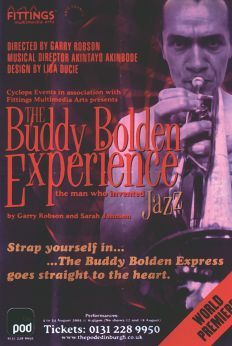
In August 2003, I was alarmed by the sudden appearance of a large tent-thing in Festival Square, just across Lothian Road from me. But the ‘Pod’turned out to be a very pleasant venue, with an auditorium much better insulated against traffic noise than the Book Festival tents, where a reading by a major poet can be drowned by police, fire or ambulance sirens. Meanwhile a Big Top on the Meadows, a large public park-space just up the road, does a roaring trade with the cross-dressing Ladyboys of Bangkok…
Who are clearly a most professional act. And some very fine and well-known professionals are pleased at times to operate on the Fringe. But there is nothing to stop any amateur group from anywhere who can find a few hundred quid to buy space in the Fringe Programme, and a few more to hire some dubious venue, from putting on the worst production of Shakespeare or Lloyd Webber ever seen. And with thousands of performances raging between breakfast time till deep into the small hours, inevitably most attract only very small audiences.
There is the well-loved story of an Albanian group who somehow paid their way to Edinburgh, found a venue well off the beaten track, and played there to audiences of nil – but told the press they didn’t mind, they were just so happy to be in Edinburgh. I myself turned up in August 2003 at the Crowne Plaza Hotel, a very central venue and much plusher than most, to support with a brief poetry reading a man who was promoting, as a Fringe act, his anthology of songs about whisky. (We share the same small local publisher.) No one turned up at all, except a couple with a video camera who intended to film us. They were asked to come back the following night, when apparently there was a decent turnout, say twenty…
The Greatest Show on Earth, which is what the Edinburgh Festivals collectively provide, creates mixed feelings in a longterm local resident like myself. Film House, normally a quiet place where one can read or even write over a slow coffee, is suddenly polluted by hordes of trendies up from London. One wearies of brushing off young persons proferring handbills for their unenticing Fringe productions.
Every year there comes a point where I wish I’d rented my flat out – with its dead-centre position, I could extort a lot – and fled to some peaceful rural spot or civilized unhysterical city. And every year there is a spasm of relief when, during the third weekend of August, all the Festivals pack up except the EIF, so there’s nothing on except high-class theatre and excellent classical music.
But of course on balance I love it all dearly. Gratifications can range from Scottish Opera’s spectacular, acclaimed production of Wagner’s mighty Ring Cycle, to unforeseen pleasure in some theatrical or musical event on the Fringe suddenly selected on the spur of the moment because it looks as if it might be fun. Personalities one might encounter in one’s local bar range from celebrated musicians, writers and film-makers to charming, intelligent young enthusiasts who have brought shows from Manchester, Mexico or Michigan. The final Firework Concert (classical) in Princes Street Gardens thrills the whole city, since anyone with a transistor radio can listen to the music while watching the synchronised skybursts, without paying for admission.
So, how did the Greatest Show come to eventuate, in this of all cities?
Edinburgh was almost unscathed by bombing in World War II, while other European cities, if not flattened, were savagely scarred. In 1944, Rudolf Bing, an Austrian who managed England’s famous Glyndebourne Opera, dreamed of starting an international arts festival in Britain when the war ended. Arts lovers in Edinburgh were thinking along the same line. The remarkable skylines of Edinburgh impressed Bing. In 1947, the dream was realised. Calvin’s God called a truce in his war against Scotland and permitted the weather to be glorious. Spared the characteristic bitter winds which take pleasure in twisting around every corner so they hit you in the face wherever you proceed–especially if they have rain to throw at you–visitors to the first Festival were enchanted.
In the context of the late Forties, the Festival represented reconciliation, restoring an imaginary past unity to European culture. Here, the Vienna Philharmonic Orchestra which had perforce performed for top Nazis could be reunited with its great prewar Jewish conductor, driven into exile in America. Here even Wilhelm Furtwaengler, one of Hitler’s favourite conductors, could perform not long before his death in 1953. And here the great Europhile T.S.Eliot could bring his strange plays to be premiered.
The Fringe now claims to have been there from the beginning. No doubt there were always opportunist groups doing their own little things on the side. The Film Festival certainly began in 1949 (and the Military Tattoo in 1950.) But the first memorable Fringe activity was provided by people in and around the Communist Party who from 1951 to 1954 ran a People’s Festival to counteract the presumed elitism of the EIF, and its shortage of Scottish content in the programme. This actually proved to be a milestone in the Folk Music Revival which has had a profound effect on Scottish culture. But the fame and allure of the Fringe with outsiders seems to date from the late Fifties when bright young chaps from Oxford and Cambridge Universities turned up with shows developing mild and zany traditions of undergraduate ‘satire.’ The four who devised ‘Beyond the Fringe’–Jonathan Miller, Alan Bennett, Peter Cook and Dudley Moore–would forge ahead variously to make striking careers. Then came the scandalous success of the Traverse Theatre, and in 1966 Tom Stoppard’s first great hit play, Rosencrantz and Guildenstern are Dead. By now lots of young hopefuls were getting it into their heads that performance on the Fringe, noticed by London critics, might launch them swiftly into high success. The momentum thus set up was irresistible, though of course the more groups and individuals try the Festival out, the less chance there is that any particular show will be much noticed. And so the dark wynds and Cowgate of Mr Hyde’s Edinburgh are annually transformed by flyposting, littered with handbills, and sucked into the sunlight of Carnival. An Edinburgh poet, Robert Garioch, wrote in early days, using Lothian Scots, a famous satirical piece, ‘Embro to the Ploy’, sending up the crazy conjuncture of American tourists ‘ wi routh of dollars/wha drink our whisky neat,/ wi Sasunachs [English] and Oxford Scholars’, all attending ‘Wop opera performed in Eytie’ -and the grimly respectable Jekyll traditions of the city. Not to speak of the whores of the Hydeite underworld, who were attracted to the Festival Club in the Assembly Rooms because it served beer ‘eftir hours’ – in those days Edinburgh pubs closed at 10pm.:
Just pitten-oot, the drucken mobs
frae howffs [pubs] in Potteraw,
fleein, to hob-nob wi the Nobs
ran to this Music Haa,
Register Rachel, Coogait Kate,
Nae-neb [no nose] Nellie and aa
stauchert [staggered] about amang the Great,
what fun! I never saw
the like,
in Embro to the ploy.
World famous novelists–Irvine Welsh and Ian Rankin–have latterly displayed the darker side of Edinburgh, and the broodings over evil of the latter’s Inspector Rebus explicitly echo those of RLS. But if Mr Hyde remains as brutish as ever, there is no doubt that Jekyll is a jollier chap these days. Thirty years ago, Edinburgh out of Festival-time remained a dour, austere city. Not so now. One can drink in pubs and clubs almost all the twenty-four hours. And prostitution is more or less legal. No doubt a few traditional moralists still feel that Mr Bing has a lot to answer for before his Maker, unleashing all this Art upon the city.
Angus Calder is an author, poet, critic, editor and journalist. He lives in Edinburgh, Scotland
In James Robertson’s brilliant novel Joseph Knight (2003), three Edinburgh lawyers, one fine afternoon in the late summer of 1776, stroll through the park by Holyrood Palace and ascend thence to the summit of Arthur’s Seat, the huge hill which dominates eastward views from the city. ‘Below them the city was spread out in the…