

a festival without fanfare
Recent Biennales have begun to assume a more ‘global’ approach, that is to say, an approach that plays down regional considerations in search of more authentic artistic engagements with our time and the experiences of living in an increasingly polarized and violent world

It started in 1981–and unlike many things Bangladeshi, has been taking place with reassuring regularity. Essentially a month-long art exhibition, Asian Art Biennale has, over the years, hugely overgrown its initial aim and scope. Begun simply as a reflection of the country’s wish to look beyond its borders for ‘wider communication’ with contemporary art traditions of neighbouring countries, the exhibition now brings together countries as unAsian as Ghana and Algeria and as unneighbouring as Turkey and Madagascar. The exhibition is no longer to be viewed from this ‘wider communication’ point of view, or seen as a wishful inquiry into what constitutes quintessential ‘Asianness,’ if there is any such thing. Recent Biennales have begun to assume a more ‘global’ approach, that is to say an approach that plays down regional considerations in search of more authentic artistic engagements with our time and the experiences of living in an increasingly polarized and violent world. How do artists anywhere, and not simply in Asia, react to the phenomenon called globalization? To the anxiety of being marginalized in a ruthlessly single-minded corporate culture? What do artists in roughly similar social, political or economic settings across the globe do in the face of a visual culture disseminated mostly from American airwaves and threatening to submerge their own cultural productions/identities? And what is the artists’ reaction to the proliferation of ‘fusion’ art, in other words, one that combines and blends properties of several art forms? When photography intrudes into the territory of painting, for example–not so much in the manner of pop-art mutation, but as a more straightforward cross-genre invasion–how are both these genres affected? These questions have arisen, but have not necessarily been answered in the current Biennale, as artists from Australia to Uganda reflect on the alienation, anxiety, and sense of displacement created by a material culture gaining momentum in the wake of globalization.

These and similar other problematics were no doubt expected to come to the surface when young artists were asked to send work ‘done in the last two years.’ Remember, the Biennale is an exhibition where mostly young artists compete for grand prizes, and are free to choose their subjects. The exhibition format does not provide for any curatorial role in planning a country’s entry. Only a few countries send curators. In the absence of an overarching theme, what do these artists do when they are asked to send entries for an exhibition which is Asian by description, but global for all intents and purposes? Well, they send just what they would send to any other exhibition held at home or abroad.
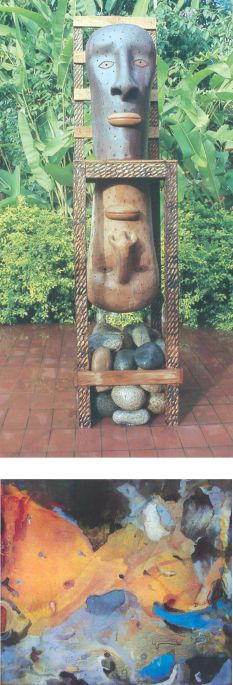
Mercifully, thus, the limiting rubric ‘Asian’ has not spawned any sentimentally manufactured ‘Asian art’ where tradition is seen frozen in fixed forms of the past. Indeed, Asian Art Biennale, Bangladesh, if anything, has always been a truly contemporary affair where living traditions and robust local cultures are valued as much as fairly recent art practices. To take a case in point, traditional Thanka painting from Bhutan, aboriginal/indigenous art from Australia, and tribal art from Sierra Leone have been exhibited in the same venue alongside shiningly modern installation art from Japan, sharing the same wall space with modernist (or postmodernist) paintings and graphic art from other countries. Apparently poles apart, these works have nevertheless showed how an interest in older forms may spring from a very contemporary need to order our experiences around a common denominator, as an interest in a new structure may arise from just about the same need. Indeed, all the Asian Art Biennales have offered the full range of art and not many viewers have gone back without relating, even in a minuscule way, to the art works on display. It is surprising indeed to see people spending long hours to look at paintings and sculptures, even intriguingly complex installation works. These collectively give out the impression of a sublime eclecticism, but, in the end, that eclecticism turns out to be a plurality of sorts: of images, interpretations and approaches that essentially spell out the experience of living in a postcolonial world. Besides, there are the tensions between ‘tradition’ and ‘modernism’; older values, and newer, mostly political and economic imperatives, that bring together many artists from across the continents in search of effective expressive modes. Moreover, the social and political realities of many of the Asian and African countries edge artists towards satire, irony or parody, which provide art works with a ‘common ground.’ Thus, any review of the Biennale should not miss out on the features that bind many of the artists and their work together.
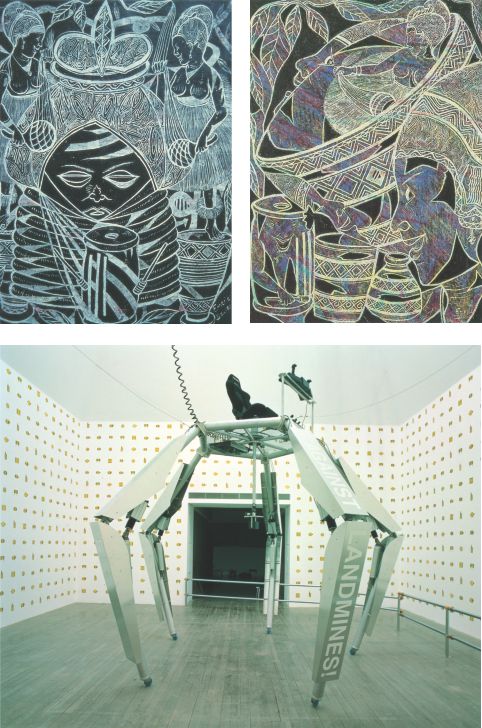
In the 11th Biennale, there are quite a few ‘common’ themes, only to be expected in a large exposition. There are some other themes, however, which are not just incidentally, but inevitably common to a number of politically conscious artists. They are a reaction to a world gone mad and bloodthirsty. The large installation work of Tusbaki Noboru, 6 ‘Penta’ UN application no 7, a landmine clearing robot in aluminum, micro pc and mounted on hydraulic joints, for example, suggests ‘how precious peace and freedom are.’ Landmines, of course, are the sort of things that destroy peace and that freedom. They do not fall from the sky but are planted by evil-minded men perfectly capable of pretending to be innocent of the fact that they are evil. The gap at the heart of ideologues who sanctify war is illustrated by the large chunks of emptiness the robot’s legs straddle. An underlying concern of this work is violence, and violence is present as a theme in explicit or implied ways in the work of many other artists in the exhibition. This theme makes this Biennale quite different from the last two or three Biennales, where violence was just an incidental theme.

There is also a strong sense of nostalgia and a desire for peace in many of the paintings which, in the context of the disquiet and unease marking the new century, make an eloquent statement on the rather unstable state of our existence. In a similar vein, many painters deal with childhood, with memory, and a wish for a utopia–actually a reconstructed landscape of memory with cool and inviting fields of colour–as recurring themes. One should not however, single these themes out as unique to this exhibition–indeed, a brief journey through the websites of artists from any country will reveal how these themes have been familiar preoccupations in any set up. But the point that is being made here is the frequency with which artists have evoked images of longing or regret, or have painted dreamscapes or mnemonic details–this suggests both an anxiety and urgency that seem to have been intensified by recent turn of events in the world. Or so it seems.

It is, however, ultimately unnecessary to insist on ‘common themes’ in an exhibition with such diverse cultural representations, since this runs the risk of oversimplification and unnecessary categorization. It is more important to see how the works on display reflect certain crosscutting concerns and stylistic changes as modernist pursuits enter newer territories where recent cultural formations spell out new rules of engagement.
One such concern appears to be what the introductory note accompanying the Indian entry raises in the shape of a polemic: ‘the continuation of the tradition or . . . the compromise between the East and the West.’ The same note also states how Indian artists of today ‘not only inherit the tradition of oriental arts but also absorb the best of occidental art.’ The introductory write-up for the Korean exhibition raises the same issue and notes how ‘very difficult’ it is ‘to construct new order on the old one, while finding and preserving the traditional values.’ The curatorial note from Singapore is more precise: ‘In the new millennium of globalization and technological progress, the effect has also led and engaged artists to re-affirm their practices investigating identity, culture and tradition.’ This observation is in broad agreement with what the introductory note for the Madagascar entry has to say. The note, which describes the five major divisions of Madagascar art–from funerary to living art–concludes with the observation that the ‘initial and traditional components of the Malagasy art are still of actuality and last until today, they nevertheless keep evolving and undergo external influences.’
What are these external influences? As we look at the paintings and sculptures and other art work from these countries, it becomes apparent that apart from closely following the contemporary art practices of the West, Japan and other important centres of art, young artists from Asia and Africa have also been absorbing the whole range of cultural, political, corporate and economic influences emanating from western metropolitan centres in the era of ‘globalization and technological progress,’ that have contributed to the complex nature of contemporary art. The effects/influences appear to be pervasive and unavoidable, notwithstanding the degree of a country’s development in technology and economy.

The picture is the same, whether it is a low technology-density country such as Bangladesh or a high density one such as Singapore. The same awareness, the same resolve to resist, appropriate or assimilate and, in the process, create art which will not only adopt or adapt but will also be adept–in the sense that it will make use of all the inherited/borrowed art forms and resolve the conflicts and contradictions inherent in the era of globalization and technological progress according to its own priorities and social-cultural inevitabilities (these terms were used by Peter Barry in describing the transition in postcolonial literature in Beginning Theory (Manchester university Press, 2002).
The process whereby local art traditions move from the adopt phase to the adept phase is a highly charged and often chaotic one, as was evident in the last few Asian Art Biennales. There is often confusion regarding the demarcation of the local and the external, the traditional and the contemporary, besides the tricky question of what constitutes progress. The situation is further compounded by the addition of new polarities. The Australian entry in this year’s Biennale was mainly based on photography and is evidence of fusion art depicting the disappearance of rigid boundaries between photography and art. The curatorial note describes ‘contrasting themes’ the exhibition explores–the ‘consumer/cultural and the personal/political’–and adds: ‘The intersection of these two dynamics marks a key point in the journey of the Australian psyche from past to future.’

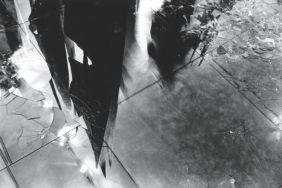
This, in a sense, sums up the experience of a major part of the exhibition. Reviewing the past is an important consideration, but except for some idyllic pursuits for lost innocence and bliss one usually associates with times gone by, most works reconstruct the past and its different manifestations in contemporary forms. A case in point are the entries from Iran. Jamshid Haghighat Shenas’ Imagination 1, Imagination 2 and Border Guard all project contemporary realities, but in doing so profusely use old Persian traditions of painting (soft colours, stylized figures, flat perspectives). Mahmod Bakhshi Moakhar’s installation piece, And now paradise . . . enter captures an idealized picture of paradise, seen in older paintings, in a row of steel structures resembling pine trees and glass flooring, suggesting a lake, but the broken glass and rusted steel structures do not inspire an unhesitant entry into that never never land. The times are harsh and acute–much like the rusted steel and broken glass. One has to look hard before one proceeds.

Reworking, reconstructing and remodeling past forms, or appropriating contemporary folk/ethnic forms to create images of the present, seem to have become a preferred way of creating art that will reflect both a country ethos and emphasise the current accent on cross-genre experimentation. This is amply demonstrated by entries from India, Nepal, Uganda, Sierra Leone, and many other countries.
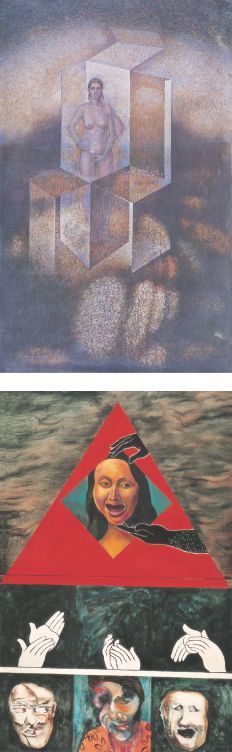
India took the first couple of Biennales seriously when works of first rate artists were sent. But after that, its interest slackened. A member of the jury of the 11th Biennale, Ghulam Muhammed Sheikh, from India, a reputed artist himself, has said in an interview that he was not happy with the Indian entry this time since they do not adequately represent the contemporary art scene in India. Still, one feels that the works of K. Murleedharan or Veer Munshi or Savitri Patel are not quite off the mark, since their work show the same predilection for figure, myth, folk and ethnic motifs and religious images and icons as one finds in more senior artists working today. If one looks closely at their work–and those of others like Jayesh B. Shukla (Har Har Mahadeva)–one notices how the need to balance opposing demands–and also resolve the resultant tension–of formal and substantive manifestations of modernism on the one hand and the pulls of a living tradition, sometimes veering towards metaphysics and mysticism, on the other, energizes the visual vocabulary of the artists. The Nepalese artists featured in the Biennale appear to be more forthright in carrying out the balancing act. The mixed media installation of Ashmina Ranjit, Buddha Mandala: Icon of Compassion and Peace, a ribbed stupa with concentric circles in sand replicating the mandala, is both a reaction to the chaos and conflicts of our time and an evocation of peace. The work is a fine example of how traditional, even religious ideas and icons, can be worked into such contemporary art forms as installation art.
This particular type of art, which is basically non-ownable, participatory, and one of a kind, is postmodern in its spirit as it pulls down the barriers of genres, brings the high and the low to the same level, and promotes a radical eclecticism that helps artists combine the mundane with the sublime and the mystical, although formal arrangements may reflect the artists’ particular choices (surrealism, constructivism, folk art). Installation art has also combined the local (materials, ideas, ingenuity) with the non-local (the art form itself came from the west and Japan) in a more vigorous way than, say, abstract expressionism. The fervour with which it has been accepted by artists of the region suggests that installation art has been able to strike a familiar chord with these artists.

The entries from Kyrgyzstan, Tajikistan and Yemen, and those from Sierra Leone and Uganda, show how tradition is still a living force in these countries (as they are in most Asian and African countries), providing ritual elements and dynamic forms and colours to the canvas as the artists struggle with their sense of displacement and angst, or explore for a stretch of quiet and peace.
The Bangladesh entry is the largest, as is only to be expected, but is also the most representative of the country’s current art trends and practices. Young artists are eager to participate in the Biennale, and many keep their best work for the exhibition. However, the selection process is also quite stiff, keeping out many artists who may be doing good work. Two things immediately strike the viewers of the Bangladesh part of the exhibition–the range of styles, media and materials used, and the youthfulness of the artists. From water colour to mixed media to terracotta to digital print, the range seems truly immense. Compared to Biennales held a few years ago, the Bangladeshi artists participating in 11th Biennale seem to be poised on surer grounds, adept in independent artistic expressions, creating, in the process their own styles and using materials of their own choice. The artists also appear more confident and seem to have got rid of the inhibitions once induced by rigid academic systems of art schools. Figures and colours are more robust, and traditional motifs are used with more abandon. Where abstraction is used, forms often subtly suggest some specifically local context, while colours tend to replicate those of the landscape.

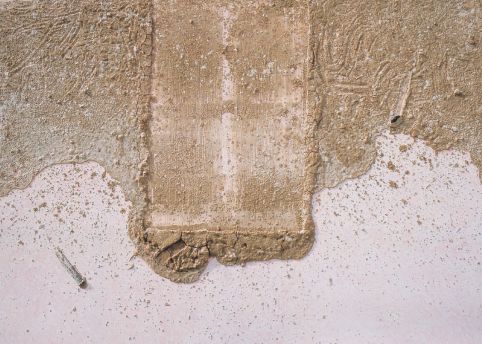
One area that the Bangladeshi artists represented have not been explored more vigorously, perhaps because facilities are not in place–or, in the case of the Biennale, because entry rules do not encourage works in this area–is the interface between photography and painting. Videography as art object also remains an outside involvement. In the 11th Biennale though, two of the three grand prizes have been claimed by entries in these two fields, showing how actively many artists are exploring these new areas. Iran’s Simin Keramati got one of the grand prizes with her video Rising or Falling while another went to an Australian artists, Micael Riley, whose Cloud 2000, a sequence of ten large inkjet prints on banner paper, grows out of a clash between the artist’s indigenous roots and an ‘imposed Christian upbringing,’ and the process of assimilation it initiated. In her video, Keramati is also making a similar statement: of adjusting to a world dominated by men with tunnel vision, whether in the family, community or the nation at large. The video describes a woman’s predicament in a male dominated world that pushes her down a well each time she surfaces. A third grand prize was won by Bangladesh’s Tayeba Begum Lipi for her My Childhood 2, done in oil. Essentially a self-portrait, the work shows a large face in striking red that stares out as if from under water. Lipi has tucked little dolls all around and over the face. The use of the dolls hardly needs any explanation, but what they bring home is an urge on the part of the artist to go beyond the plain surface and make a three-dimensional exploration of memory. The list of honourable mentions is quite large, but very well-chosen. Iran’s Shenas, Japan’s Noboru and Nepal’s Ranjit have been mentioned before. Two striking works in the list are The Miss 2 by Qatar’s Mohammad Al Atiq and Arcadia. The latter is a digital photograph by Lyndell Brown and Charles Green, both from Australia. Al Atiq’s work is in mixed media, and uses sand and board and has large textured areas. The simple forms come alive in fawn and beige and reflect provocatively on life’s lost opportunities.

Asian Art Biennales have truly been seen both by artists and art lovers as a festival, of course, minus the usual fanfare that accompany just about any festival here, religious or secular. Except for the ‘invitees only’ gala opening graced by the country’s head of government, and the customary dinners and a river cruise down busy and boat cluttered Buriganga, there is no other ‘festivity’. Yet in the three or four venues in which the exhibition is shown, flags of all the participating countries flutter, and large banners and hoardings announce the event’s uniqueness. Large crowds of people mill around or line up to view the works. What is striking is the presence of whole families, and one cannot miss the mirth of children who giggle at installations that move, or look bemusedly at pictures that make use of their own visual repertoire. For the art lover, it is an occasion that brings the creative world beyond within reach, and is an opportunity to compare and share.
And now some statistics–if only to show how difficult it is to host an exhibition of this magnitude, given the limitations the organizers face. Forty-four countries participated in this year’s Biennale, sending 587 art works of 355 artists. At least a few of these works have been large installation pieces needing a large space allocation. A two-day seminar (on the ethnic and the global in the context of Asian art) was also organized to follow the inauguration. While in countries where such biennales and triennales take place, a whole management set up comprising officials, curators, experts of various sorts and others work full-time between exhibitions, the Bangladesh Shiplakala Academy, the organizers, has only a small team, headed by its director of the fine arts department, Mr. Subir Choudhury to run the show. The funding from the government is generous compared to what other sectors of culture receive, but is not adequate for the purpose of the Biennale. Yet Subir Choudhury and his team have been pulling it off every time. There is, of course, the support of the art-loving public, without which the Biennale would remain just an exhibition, not the art festival that it has turned into.
Syed Manzoorul Islam is member of the Jamini editorial board
Recent Biennales have begun to assume a more ‘global’ approach, that is to say, an approach that plays down regional considerations in search of more authentic artistic engagements with our time and the experiences of living in an increasingly polarized and violent world It started in 1981–and unlike many things Bangladeshi, has been taking place…