
e d i t o r i a l
Over the years Jamini has touched on almost all the major art forms and their multiplicity of expression. In this special issue we take a look at an art form heretofore under-represented, cinema. Popularly known as the ‘seventh art’, after music, dance/theatre, painting, literature, architecture and sculpture, cinema by its very nature is an amalgamation of the other art forms that preceded it.
More specifically we chose to focus on the question of cinema and identity, in the South Asian context, with particular emphasis on both Bengals. The question of cultural identity is a crucially recurring one in the global and regional context, under the influence of advances in technology and communications and increasing market integration. Despite the overbearing influence of Hollywood and Bollywood, cinema as a form of artistic expression, reflecting a certain cultural and historical heritage, continues to survive if not to thrive. There is no reason to be highbrow here however; even Bollywood, or more generally South Asian popular cinema, has its own distinct character which grows out of the rich artistic traditions of the region.
Father Gaston Roberge touches on this theme as he searches for common aesthetic origins for South Asian cinema in the classical aesthetic treatise of Bharat Muni.
Biren Das Sharma takes a more specific view, looking at the influence of traditional proscenium theatre on acting styles, scenic conventions, and storytelling modes of early popular cinema.
In the same vein, as we can speak of a distinct tradition of Bengali literature, poetry, or music, can we speak of a distinct tradition of ‘Bengali’ cinema that draws on the common cultural origins of the two Bengals? Certainly the divergence of the two sides is reflected in their respective cinemas, through historical, religious, and political signifiers. Here the great names of Bengali cinema, like Ray and Ghatak, provide a common point of cultural reference, but it is also arguable that filmmakers of West Bengal and Bangladesh have their own distinct demons to grapple with through their art, however common their origins. Shugoto Singh attempts to tackle some of these issues in his analysis of Rwitik Ghatak’s cinema. Thanks to Ritaban Ghatak, stills for this article were graciously provided to us by the Ritwik Memorial Trust in Kolkata.
As for that other great pillar of Bengali cinema, Satyajit Ray, Andrew Robinson argues that Ray’s films have a strong Western sensibility, which give them universal appeal, while at the same time diluting their more specifically ‘Bengali’ character and appeal. A fine detailed analysis of Ray’s films, both lesser and more well-known, is to be found in John Hood’s latest book Beyond the World of Apu, reviewed in this issue by Shamsad Mortuza.
Moving to a more detailed look at the expression of identity in Bangladeshi cinema, Z.R. Raju gives an analysis of the representation of Islam in the ‘art cinema’ of Bangladesh by the more recent generation of independent filmmakers. The exploration of identity through cinematic expression is also a major theme of film historian James Leahy’s in-depth interview of filmmaker Tareque Masud.
Another important facet of identity in cinema is to be found in diasporic cinema.
The wave of diaspora-literature emanating from the Indian and Pakistani expatriate community found a Bangladeshi parallel with Monica Ali’s Brick Lane. Asif Saleh gives an insightful analysis of the recent film version of the book, and the extent to which it successfully portrays the diasporic experience of Bangladeshis in the UK.
In a special tribute, this cinema issue also includes an interview of the late Obaidul Huq, the first Bengali Muslim filmmaker. Taken shortly before his death, Huq talks about his struggle to make his first and only film Dukhe Jader Jibon Gora in Calcutta in the 1940s. Here much thanks to Obaidul Huq’s son Arham Huq for making available to us some rare archival photographs from his father’s life and work.
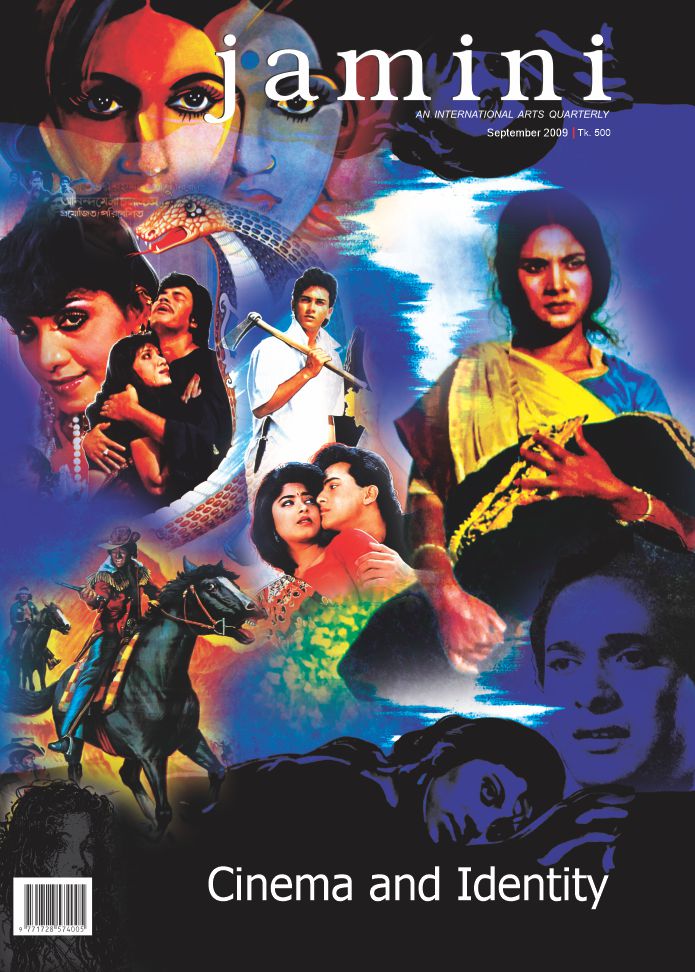
And finally: a look at Bangladesh’s cinema history through film posters, collected and photographed with the generous help of the Bangladesh National Film Archives. In addition to our cinema issue articles, we have also added a charming piece by Mahbub Alam on cartoons of Bengal from the late colonial period.
Over the years Jamini has touched on almost all the major art forms and their multiplicity of expression. In this special issue we take a look at an art form heretofore under-represented, cinema. Popularly known as the ‘seventh art’, after music, dance/theatre, painting, literature, architecture and sculpture, cinema by its very nature is an amalgamation…