
reimagining the commons city gardening and urban greenspace in havana, cuba
With unpredictable weather changes, global warming, and increasing resource scarcity, instability may become the defining environmental characteristic of future cities and towns. In this unpredictable context, a transition to resilient, flexible and productive urban systems could also dramatically alter urban forms. The once-reliable dispersed solutions for critical services such as food provisioning will need to be redesigned to accommodate instability through local alternatives. In the case of food production, urban agriculture can be appliqued directly onto existing infrastructures, providing a hyper-local source for food security. As urban dwellers prepare for self-sufficiency in the future, they could dedicate some portion of their public domain to the production of subsistence agriculture.

The urban commons presents a unique territory for the development of productive civic services. This state-held common property is typically used by civilians through a shared social or cultural understanding. Moreover, this collective use of, and decision making for the urban commons, can be used to develop new urban services in this space. In Havana, Cuba, this land was reimagined in the early 1990s for productive agricultural use, and it remains the preeminent model today. In redesigning the urban commons of Havana, citizens effectively bolstered their food security, diversified their foodshed, and developed many thousands of new acres of greenspace on collectively held urban lands.
As architects, landscape architects, and planners look for tested models addressing the cognate issues of scarcity and food security, the progressive urban farming work stemming from Cuba’s Special Period stands out as a rare and important precedent. Widely understood to be “one of the most successful examples of urban agriculture in the world,” Cuban urban farming incorporates grassroots organizing, the appropriation of public space for growing, and shared technical and educational support. This surprisingly effective movement stands in stark contrast to other wartime or post-disaster environments, with outcomes ranging from widespread self-sufficiency and profound community engagement to environmental remediation and improved stewardship. Moreover, this Cuban model highlights a number of infrastructural, social and political features that could be applied to other areas.

When Cuba found itself abruptly cut off from trade with the Soviet bloc in 1989, the country spun into an economic crisis of unprecedented severity. Suddenly lacking the oil, pesticides, and machinery with which to grow crops, and without access to the imported food that had previously sustained it, Cuba’s foodshed suddenly caved. Nearly twenty-five years later, this food crisis has vanished almost as swiftly as it arrived, in no small part due to the country’s innovative and widespread urban food production efforts. Combining state support and citizen participation, Cubans created an urban design framework to support urban agriculture initiatives through a reimagining of the commons. Today almost a dozen distinct types of urban farming approaches are visible in Havana, Cuba. These forms are a direct response to the 1989 food crisis and reflect the flexible modes of self-provisioning that followed. The decision to farm on the commons exposes the context, constraints, and cultural norms unique to Havana’s urban environment, revealing changing attitudes towards urbanism in Cuba’s capital city. In its incorporation of shared and public landscapes for food production, this urban agriculture system could well be translated for other parts of the world.
With natural and man-made disasters increasing in both frequency and severity, architects, landscape architects and planners can help cities plan for resilience by identifying replicable methods for self-sufficiency. The model urban farming programs underway in Cuba demonstrate self-sufficiency and food security in an oil-scarce environment. Moreover, Havana’s innovative urban agriculture on the commons suggests a method that could inform the development of productive landscapes in other parts of the world.

BACKGROUND
In 1989, the Cuban government abruptly lost an important trade ally with the dissolution of the Soviet bloc. Already isolated from world trade due to the U.S. sponsored trade embargos, Cuba became, almost overnight, cut off from the rest of the world. In the years that followed, the country was both incapable of effectively exporting sugar and citrus crops, and unable to import critical staples. This period became known as Cuba’s food crisis, in which most Cubans lost access to roughly one-third of their daily calories; there was widespread hunger, and the government instituted a peacetime austerity program for food rationing.
Beyond the overwhelming reduction of food-related imports, Cuba suffered from pervasive oil scarcity. One of the major motivations for turning to urban farming was that transportation in Cuba became very limited, as well as time-intensive and expensive. Growers had difficulty moving vegetables, meat and fruit to the tables around the region. In this sense, Cuba’s food crisis was both political (in the case of trade embargos) and locational (people were stranded in a food desert). Although Cuba had become reliant on other countries for food provisioning, its geography, history and political values actually pointed to a latent local foodshed. The island benefits from an ideal tropical coastal climate zone for growing year-round crops, sizeable tracts of arable land, a strong post-1959 government, and a socialist appreciation for agriculture and self-sufficiency.
Presented with a near collapse of its food provisioning system, the Cuban government responded with an overhaul of agricultural systems on the island, preferencing organic farming, useful edible crops, and peasant labor. In urban areas, guerrilla gardening initiatives blossomed into new state-supported urban farming programs, with widespread voluntary participation. Born out of necessity, the urban farming in Havana opportunistically re-appropriated the commons by converting many public and state-owned landscapes into production.
TODAY
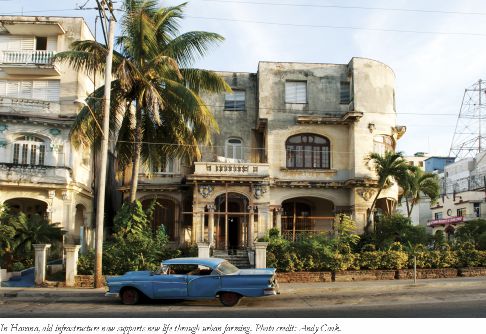
Havana is an exemplary model for this type of self-provisioning, and a useful precedent for individuals seeking to understand the opportunities and obstacles for transference. The city has more than two million people, many universal or ubiquitous infrastructural elements, and a contemporary urban form. In an effort to bring food production into the city, agricultural initiatives were necessarily layered over, and knitted into the existing urban fabric. From a design perspective, Havana’s urban agriculture can be read as an afterthought or a stop-gap measure, rather than a considered and intentional design process. This practice of greening the commons, however, is perhaps the program’s most salient design feature, demonstrating that productivity can be introduced and infused into hardened urban wastescapes.
Havana provides an example of a systematic approach to rethinking shared state-owned landscapes for more productive means. Today, Havana has a unique food production infrastructure woven into its contemporary city form, including 475 large state farms, 318 livestock farms, 179 organopónicos or collective farms, 418 high production orchards, 28 seedling production centers, 324 greenhouses; 162 school or workplace gardens, 7,848 vacant lot gardens, 126 forest farms, 67 cattle farms, 52 different agricultural stores, 3 compost production sites, 7 centers for artisanal biopesticide production and 40 urban veterinary clinics. (González 2008, 24) Economics professor Sinan Koont estimates that “more than 35,000 hectares (over 87,000 acres) of land are being used in urban agriculture in Havana!” (Koont 2009, 1)

URBAN AGRICULTURE ON THE COMMONS
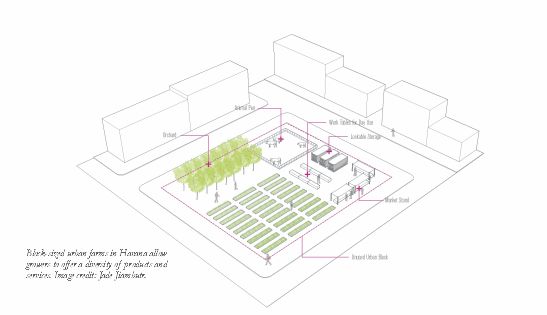
Urban agriculture in Havana occurs at a host of different scales, from the vacant lot to the multi-acre fields that comprise Havana’s greenbelt. These gardens also have a range in terms of production, from highly-productive enterprises to pleasure gardens, and varying degrees of state support and recognition. Havana’s urban gardens typically produce food for human and animal consumption, although the same formal structure of gardens also supports the production of compost and biofuels, as well as tree nurseries. While the vast majority of land for urban farms varies widely in size, shape, and character, most of these growing spaces are located on shared or state-held lands: what could be called the urban commons.
Many of these gardens have emerged somewhat opportunistically from vacant and blighted properties within the city, exploiting usufruct rights (free land provided by the government, at ten year intervals) to seize available space. The need for productive agricultural space in and around Havana required that growers reimagine the form of agrarian landscapes. Rather than looking to virgin land for farm development, many growers have restructured brownfield and grayfield landscapes within the city limits, and in doing so, effectively reimagined Havana’s urban commons.
THE ROLE OF DESIGN
Designers such as planners, architects and landscape architects have historically played a limited role in the development of agriculture systems. While food production has been disassociated from the design disciplines in the past, it is increasingly becoming relevant in the urban context. As societies begin to consider new forms and types of farming, designers could help to shape that work, especially on shared land within urban areas.
In the context of environmental crisis, the design disciplines could present useful agendas, advocacy and strategies for envisioning future cities. Architects, landscape architects and planners are poised to help ease the transition to more sustainable cities, by visualizing new forms of farming, developing new technologies, systems and materials, and working to connect farming to contemporary city life. Traditionally, designers have acted as the gatekeepers for public space shaping; indeed many of the same issues that affect urban spaces also impact urban farming. For instance, food production in cities has the potential to be form-based, affordable, efficient, visible, and to represent the interests of all citizens.
Moreover, designers could benefit from opening up new terrains in their field, as well as new forms of interdisciplinary work. Engaging in the design of urban food systems would highlight broader issues of food security, thereby expanding the field. As the design disciplines move from largely aesthetic conversations to topics of utility and resilience, this kind of work could serve to increase the relevance of the profession.

CONCLUSION
Cuba’s innovative approach to urban farming provides a blueprint for urban food security, demonstrating a form of reinterpreting the commons that could be useful in other areas. While not originally planned into the city fabric, this countrywide initiative suggests logical land-use transitions, provides a model for hyper-local agricultural production and offers a method for greening the city. Perhaps most importantly, Cuba presents a useful case study because the country has endured a food crisis brought about by oil scarcity, and has thrived.
Indeed, the urban agriculture practiced in Havana provides an important model for any city transitioning towards food independence. As global warming intensifies and energy, land and water reserves diminish, many see the value in a return to locavorism and the development of more resilient food systems. Havana’s model, which is affordable, accessible, comprehensive, and de facto organic, could be particularly instructive for other nations seeking improved food security. And while Cuba was forced to innovate due to the food crisis of 1989, other countries have the opportunity to develop their own self-sufficiency before such a crisis unfolds. The urban commons provides the interstitial space for such efforts, civic landscapes that could be retrofitted to host new urban food systems.
REFERENCES
González Novo, M. et al. 2008. Testimonios: Agricultura Urbana en Ciudad de La Habana. Havana: Asociación Cubana de Técnicos Agrícolas y Forestales.
Koont, S. 2009. “The Urban Agriculture of Havana,” in Monthly Review, vol. 60, issue 08.
Carey Clouse teaches architecture and landscape architecture at the University of Massachusetts, Amherst. After completing a degree in architecture and urbanism from the Massachusetts Institute of Technology, she co-founded Crookedworks Architecture with Zachary Lamb (www.crookedworks.com). Clouse is the author of Farming Cuba: Urban Agriculture From the Ground Up (Princeton Architectural Press).
With unpredictable weather changes, global warming, and increasing resource scarcity, instability may become the defining environmental characteristic of future cities and towns. In this unpredictable context, a transition to resilient, flexible and productive urban systems could also dramatically alter urban forms. The once-reliable dispersed solutions for critical services such as food provisioning will need to…