
brutal honesty
In the mid-90’s, a group of “enfants terribles” known as the Young British Artists (YBA) emerged around the figure and gallery of Charles Saatchi. Among them were the pelemical Damien Hirst and the less controversial Tracey Emin. A celebrated and oft-criticised artist, Emin (London, 1963) started to create videos in the 90’s before turning her attention to paitnings, installations, photographs, embroideries and sculptures.
It was her participation in the prestigious Turner Prize in 1999 which, although she did not win, shot her into stardom with a work entitled My Bed (1999). It consisted of – as its name suggests – her unmade bed with a quantity of objects, some of which were of an intimate nature, that she had accumulated during one month of seperation from her partner. The work attracted lots of attention from the public and generated the kind of controversy that Tracey Emin usually gets in so many of her works. This happens thanks to the undeniable capacity of the artist to tell stories taken from her own personal life with unrelenting transparency and brutal honesty.
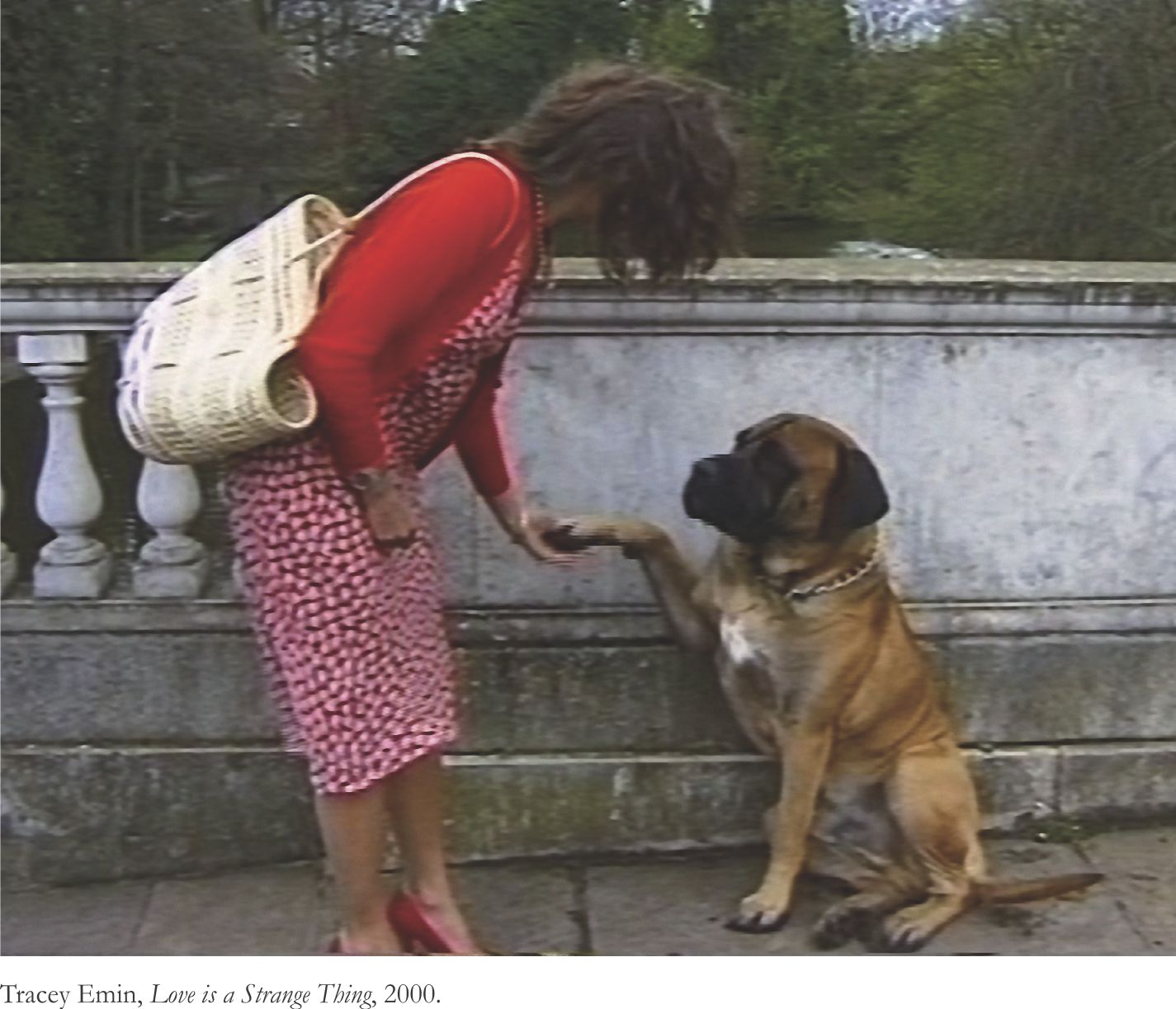
The exhibition, presented at the MALABA (Museo de Arte Latinoamericano de Buenos Aires) from 15 November 2012 to 25 February 2013 consists of a selction of videos – the medium in which Tracey Emin started to work with – that the artist created between 1995 and 2000. Why I Never Became A Dancer (1995); How It Feel (1996); Homage to Edvard Munch and All My Dead Children (1998); Riding for a Fall (1998) and Love Is A Strange Thing (2000).
“As a whole, her works can be understood as an attempt to capture the flow of life experiences. Working with different media allows her to be introspective, meditative and totally uninhibited,” says Philip Larratt-Smith, the Canadian curator of the exhibition.
The harshness and profundity of the issues is softened by the poetic and playful way of treating these images. Tracey Emin writes, directs and always acts in her videos as the main character, swaying between the bad and liberal girl to a more naive young woman who is crushed by the surrounding world. Taboo issues are dealt with in a way that creates a romantic mood, or even a funny one before it turns vulgar. There is a whole series of representations in which the characters act now in an exhibitionistic way. Stories of intimacy whose narratives are focused on topics of the feminine universe such as the discovery of early sex, abortion or gender-related issues. Among the delicate visual compositions, with an intelligent use of soundtrack, the viewers go from a seduction game with a dog to pain in the form of a terrible howl, from a liberating memory of a sexual initiation up to a descriptive and reflexive experience of an abortion.
The climax and the sensations that the exhibition provides are evident in Emin’s audience. The vast majority of women who leave the exhibition seem to be touched, shaken or moved. The men on the other hand perceive something unclear and disorienting. There is something in the way that Tracey Emin forges her idea of love, the relationships and the sexuality of the body that reminds us of the character of Marguerite Duras’ novel, The Lover, a similarly distant fascination.
In the mid-90’s, a group of “enfants terribles” known as the Young British Artists (YBA) emerged around the figure and gallery of Charles Saatchi. Among them were the pelemical Damien Hirst and the less controversial Tracey Emin. A celebrated and oft-criticised artist, Emin (London, 1963) started to create videos in the 90’s before turning her…