
Bangladesh bet
Discretion is one of the most important qualities of
auction houses and it could not be otherwise.
A high level of confidentiality must be maintained with regards to information about buyers and sellers. However, there have been attempts to buck these trends. A judge in the United States recently established a law that allows the buyers and sellers to – should they wish to do so – know the names of one another. But a single verdict does not make history and auction houses for the moment will keep on making confidentiality one of their most prominent features.
It is usually said that sellers are pushed to auction houses for one of the infamous “3 D’s”: debt, death and divorce. But there are obviously many other less dramatic reasons. One of these is linked to the idea of investing in art and the attempt to establish the reputation of an artist through important auction results.
From this point of view there has been a radical change in the perception of auction sales. There was a time when works of art sold at an auction were seen as proof that someone wanted to be rid of a certain work. Now gallerists and especially investors have understood that a passage at an auction is essential to establish the international reputation of an artist, even moreso if he or she is young and emerging. Therefore, long live now a passage at an auction!
The real problem has shifted to another aspect of the sale. The problem is that the result of the sale must be good. An unsold lot bears a black spot. A seller is not allowed to buy back the work he is offering to avoid the dishonour of having an unsold piece. It is evident that from a practical point of view, it is very easy to elude it by counting on a figurehead. There are also gallerists who, despite owning the works which are offered at an auction, nevertheless bid on them until a certain value to maintain the credibility of their prices at the gallery. Once another bidder surpasses that value, the gallerist leaves the work to the bidder.
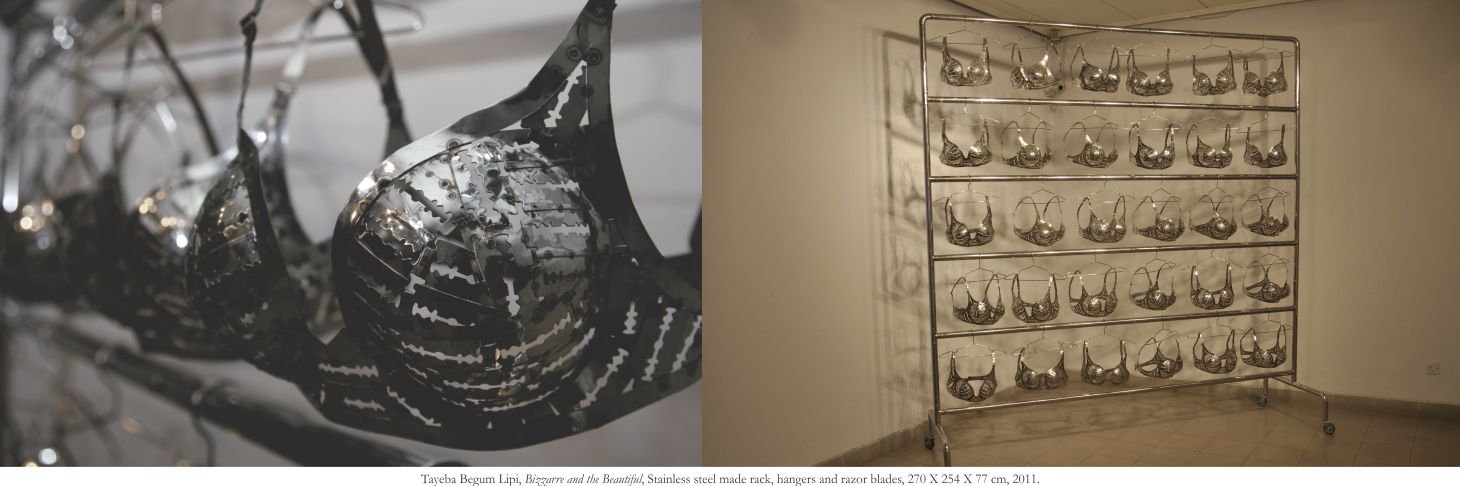
There were many people who questioned who the buyers and sellers of the work were when Bizzare and Beautiful II by Bangladeshi artist Tayeba Begum Lipi was sold at Christie’s at the “South Asian Modern and Contemporary Art” auction held in London on 11 June, 2012.
It is a sculpture in the form of a series of bras made with razor blades and recalls a larger piece by the same artist, now in the Samdani collection in Dhaka, exhibited at the Bangladesh pavillion at the Venice Biennale in 2011. That year also marked Bangladesh’s first foray onto the Biennale stage, which was organised by Bengal Foundation. The work was offered at an estimate of GBP 3,000 – 5,000 and was sold at a hammer price of GBP 5,500 which, raised with commissions for the buyer, amounted to GBP 6,875.
While it is easy to imagine that the work was offered to Christie’s by Mr. and Mrs. Samdani, who are trying to promote a group of Bangladeshi artists (including Tayeba Begum Lipi, her husband Mahbubur Rahman, and Ayesha Sultana), it is more difficult to know who bought the work. There are basically three possibillities: an anonymous collector, a public or private institution, or the same owner bought back the work.
Whatever was the case, there is a positive aspect that a young Bangladeshi artist has now been seen on the international scene. As far as the buyer, it is evident that the best option would be a public or private institution. If this is the case it will soon be revealed, because the work will appear in a collection and be exhibited in a public space or a private foundation. Another good option would be if the work ended up in a private collection. What would not be good is if the original owner bought it back.
The final price was not particularly high by international standards (Christie’s and Sotheby’s do not accept consignments whose estimate is below GBP 5,000 for their regular contemporary art auctions). But it is important to note that the artist was exposed outside her national borders and that for the first time hundreds of collectors saw a work from a Bangladeshi artist from the new generation in a Christie’s catalogue. It can be hoped that the sale of Tayeba Begum Lipi’s work does not remain an isolated episode.
Discretion is one of the most important qualities ofauction houses and it could not be otherwise. A high level of confidentiality must be maintained with regards to information about buyers and sellers. However, there have been attempts to buck these trends. A judge in the United States recently established a law that allows the buyers…