
agony to acceptance
At a youthful fifty-and-a-little Nazlee Laila Mansur belongs to the middle generation of our artistic community, and that means she is due for a regorous examination of her track record
Nazlee Laila Mansur’s June 2005 show at the Bengal Gallery—her fifth solo since her first in 2000—afforded us an opportunity to carry out the exercise, since it displayed her work of the last dozen or so years. The consensus must surely be that she deserves a respectable place among the small number of Bangladeshi painters distinguished by artistic integrity, pursuit of a consistent vision, social commitment and a distinctive style.
Nazlee’s work belongs to the narrative wing of figurative art—indeed, she is one of the very few Bangladeshis to specialize in this mode—and slots naturally into a loosely defined subcontinental school and, secondarily, into a global trend. The distinctiveness of the narrative mode within the broader figurative one is simple yet significant. A portrait is figurative—Lucian Freud is figurative—but not narrative, which Kitaj or Hockney often are. The purely figurative mode generally portrays the individual in isolation, the narrative arranges figures and background in a tableau that suggests the unfolding of a story. Both modes have been prominent since the beginning of art history, but in their contemporary manifestations locate themselves in a critical context shaped by debates inspired by modernism. Today’s figurative and narrative artists have taken on board the key lessons of modernism, which stem essentially from a rejection of post-Renaissance conventions of realistic perspective, naturalistic colours, etc.

Contemporary figurative artists reject the valorization of abstraction, which may be seen as the end of one line of development in modern art, and espouse greater openness and flexibility in choice of subject matter as well as technique. Narrative painters have a sympathetic eye for the ordinary and everyday (in a post-Pop manner, one might say) and are ready to incorporate the techniques of popular art—in the subcontinental context, such things as the iconography of bazaar posters, the spatial dynamic of rickshaw or truck art or cinema hoardings. At the same time they are also open to the influence of pre-modern high art traditions, both eastern (Indo-Persian miniatures, for instance) and western (say, Sienese paintings). Purely figurative works that focus on the individual—e.g., Lucian Freud’s—project modern alienation, whereas narrative art places equal if not more emphasis on the individual’s interrelatedness with his social environment. And hence the vitality and social relevance of the Indian narrative artists of the ‘Baroda School’–Bhupen Khakar, Ghulammuhammad Sheikh, Sudhir Patwardhan. They provide the regional context in which we may place Nazlee Mansur. One could also add the names of others who frequently use narrative-figuration, like Arpita Singh or Bikash Bhattacharya.
Focusing on the show itself, it is convenient to play one’s impressions against anthropologist Rahnuma Ahmed’s curiously titled introduction to the catalogue, ‘Nazlee Laila Mansur: The Brush of Agony.’ Though generally astute in its ‘readings’ of the paintings, it can be misleading too. Nazlee doesn’t paint in ‘a photo-realist mode’ as Rahnuma claims. Photo-realism tries to look more photographic than photography, as in the paintings of Richard Estes. Nazlee’s paintings make a point of not being photographic. They are realistic, but only up to a point, and they unabashedly incorporate fantasy and symbolism. Rahnuma rightly notes a kinship with Chagall, but is off the mark somewhat in drawing parallels with Hockney and Munch. Nazlee is a very sober artist, compared to the latter, and even though Hockney is no doubt an inspiration, her differences from him are obvious. Hockney’s figures are sharply individualized, usually drawn from his friends and acquaintances. Nazlee’s are generalized, as in our folk art; indeed, none seems to be drawn from life. There is verisimilitude in the figures, of course, but they tend to be banana-figured, as in popular art or book illustrations. They are types and suggest allegorical readings.
Voyeurs, prostitutes, bored and harassed housewives, homeless people, girls threatened with sexual violence, disenchanted couples—such are the characters that people Nazlee’s world. Obviously, things are out of joint, but the aesthetically ordered depiction of disorder is ameliorative. Nazlee’s vision is at its bleakest in the series titled ‘Bandaged Bondage,’ in which the canvas is dominated by a figure completely swaddled in surgical bandage. The theme, as Nazlee categorically declares, is helplessness. The central image no doubt has a certain raw power, but the symbolism is too obvious. To my mind subtler expressions of protest are aesthetically more effective, as in ‘Woman and Cow,’ where visual wit becomes the vehicle of the message. Against a conventionalized landscape are three figures: a graceful, airborne swan, a woman in attempted Chagallesque flight and a tethered cow. But the woman’s flight is impeded. Her sari has unwound like Draupadi’s and the free end of it, though outside the canvas, is clearly either in someone’s tight grip or tethered to something. Anxiety lines on her face complete the story. In the compositionally similar ‘Woman and Billboard’ a flying woman is counterpointed by a coca-cola billboard. A curving white band that runs horizontally through the billboard rhymes with a quarter-moon and its reflection in a windowpane. On a rooftop at bottom right a youth perches on the parapet and gazes upward. The painting is a delightful satire on consumerism, which is becoming increasingly potent even in our corner of the Third World. The romantic energy of the moon has been appropriated by the Coca-Cola billboard, which seems to have a magnetic pull on both youth and woman. If there is any romantic chemistry between the young persons, their relationship too is probably mediated by consumerist values. The woman’s anxious countenance, her restless hands and heavy derrière speak volumes. But her impact owes more to the colour symbolism of her sari, which is a luminous orange, suggesting youth and passionate energy.

Nazlee acknowledges the teaching of the late Rashid Choudhury as the major influence behind her choice of what one might call her Fauvist colours. She deliberately avoids naturalistic colours and makes her ‘unnatural’ hues stand out. An indigo woman in ‘At the Window’ broods over a cup of tea, watched over by a ravenous crow, while lush plants and flowers in cheerful warm shades set off a contrasting mood. A street urchin in ‘Whereabouts’ and a young wife in ‘Usable Painting (On Dining Table)’ are painted green; another boy, in ‘Bandaged Bondage (City)’, is a Krishna-like blue.
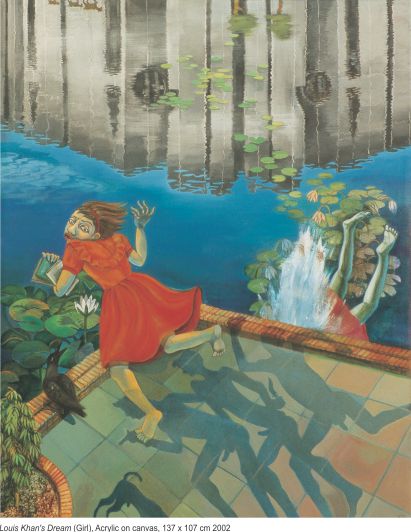
There is an interesting thematic evolution in Nazlee’s narrative tableaux over the years. The earlier paintings stress the agony promised by the exhibition’s title. The ‘Bandaged Bondage’ series dates from 2000. Two years later the series titled ‘Louis Kahn’s Dream’ powerfully exploits nightmarish juxtapositions. The architect’s celebrated creation, Bangladesh’s parliament building, squats stolidly, encircled by the mirror-surface of the wide moat, which is magically connected to the country’s extensive flood plains. The outcome in the painting parenthetically subtitled ‘Rapunzel’ is a comic enactment of the fairy tale while a flood-stricken family on a boat drifts into the picture: a goat, a grieving woman and, crudely wrapped in a mat for burial, the woman’s dead husband. In the painting subtitled ‘Girl’ two terrified schoolgirls (one plunges into the water) are chased by a trio of hoodlums whose sinister shadows score the foreground. Heightening the nightmarish effect, the shadows show them naked, with rampant organs, while lethal weapons are clutched in their hands. This is probably the most hard-hitting of the paintings with a feminist edge.
A few paintings satirize the male voyeur on the street. In ‘Whereabouts’ and ‘Man in a Rickshaw’, for instance, two males though different in class status (in the former a man of substance in a car, and in the latter, as the title implies and the man’s cheap T-shirt makes explicit, one from a humbler station) ogle homeless streetwalkers (one at her toilette, another curled up in sleep on a traffic island) while their itchy hands are extended like grasping tentacles.
But Nazlee, salutarily, is well aware that desire cuts both ways. Women are not only objects of desire but can also be ‘desiring machines’ (Deleuze and Guattari’s term) in their own right. The eponymous ‘Girl on a Rickshaw’ in a painting from 1994 flashes bee-stung lips as she casts a sultry glance backwards. Similarly, a thematically richer painting of 1997, ‘The Flute Player’, conflates the mythic and contemporary city life. A sooty complexioned youth perched on the boundary wall of a children’s park plays a flute, at once suggesting a link with Krishna, a link that is reinforced by his blue lungi. A young doe-eyed woman with face blanched, suggesting a link with the fair complexioned Radha, cranes her head back to gaze at the flute player. A cow lounging in the park amidst the playing children introduces a bucolic note that goes with the Krishna legends. However, undercutting it all is the presence of a raven with parted beaks that seems to be commenting sardonically on the wannabe Krishna.

A self-reflexive turn is evinced in the most recent series, titled ‘Useable Paintings’ (2003-05). Turning her back on the display of helplessness in ‘Bandaged Bondage’, Nazlee admits that ‘There is no respite, nothing more to be done’, and ventures to pose the rhetorical question, ‘What harm if art-work becomes merely ornamental?’ Rahnuma comments: ‘In a capitalist world-order, the commercialisatin of art destroys its radical fronts and possibilities.’ Both artist and interpreter need to be examined and clarified—even if we do not go into the related complexities brought up by Walter Benjamin in ‘The Work of Art in the Age of Mechanical Reproduction’. First, the critic’s comment on the capitalist world-order: if art is to be radical and revolutionary it has to be so in a capitalist society; so why complain? The artist’s statement seems to acknowledge that explicit protest is ineffectual, but that does not mean that it is meaningless, because the alternative is acquiescence. Actually, she has kept up the protest, but in a subtler form. Her acceptance of the ‘ornamental’ role of art, however, does not fully explain the ‘Useable Painting’ series. In these works Nazlee depicts interiors in which certain things—e.g., a table cloth, cushion covers, the door of a lift and adjoining floor space—are embellished with reproductions of her own paintings. It’s not only a question of art becoming ornamental: the unique, original painting too can fulfil an ornamental role. Here the original is replicated, either manually or mechanically, thereby diminishing what Benjamin calls the ‘aura’ of a work of art. This has two aspects, a negative and a positive one. There is trivialization, no doubt, as when a great painting—the Mona Lisa, say—is reproduced on a napkin. On the other hand each reproduction adds to what Andre Malraux called the ‘Museum Without Walls’ and acquaints more people with at least some of the aspects of the work.
Narzlee’s self-reflexive manoeuvre reappropriates her images in new paintings. There is a touch of humour here, and the possibility of generating what one might describe as a postmodern farce: imagine the ‘Useable Paintings’ reproduced on table cloths, etc., then again reappropriated by the Nazlee, then again reproduced . . . ad infinitum.
It is clear—at least so it is to the present critic—that Nazlee’s art has matured steadily, and we may expect more from her that will both delight and provoke thought.
Kaiser Haq is member of the Jamini editorial board
At a youthful fifty-and-a-little Nazlee Laila Mansur belongs to the middle generation of our artistic community, and that means she is due for a regorous examination of her track record Nazlee Laila Mansur’s June 2005 show at the Bengal Gallery—her fifth solo since her first in 2000—afforded us an opportunity to carry out the exercise,…