

craft in the work of pakistani women artists ‘a wished-for song’
You’re song
A wished-for song
Go through the ear to the center
Where sky is, where wind,
Where silent knowing,
Put seeds and cover them,
Blades will sprout
Where you do your work. Rumi

The canons of ‘Fine Art’ practice in Pakistan are being challenged by a number of contemporary artists, mainly women, who find prevalent art forms unable to address profound personal experience. Their work inevitably reclaims assorted everyday craft practices, which are an essential component of the upbringing of any Pakistani girl child. All of them had been to art schools in Pakistan, and their visual arts training provided them with the formal means and terms of reference considered appropriate for producing art work.
Travel and further study in the west familiarized them with the hegemonies of the international art world and its notions of authorship. The idea of invoking ‘craft’ as a way of delineating identity, or constructing the postcolonial art work, was not taken up at that time. With each artist it emerged later as an outcome of deep stirrings, emotional probing and a desire to prise open memories of forgotten tutelage and engrossing rituals.
For Naazish Ataullah, teacher and printmaker, the turning point as an artist came in the 1980’s, as she shifted away from the hegemony of oil-on-canvas, the legacy of British colonial art education. Ataullah describes how she enjoyed the physicality of marks made by the burin dry point and etching needles on the metal plate in the printmaking studio:
‘The physical contact with the surface of the plate, the stages involved in evolving one’s image are all components which generate the desire and the compulsion to make work. My practice negotiates the emotional space between the very personal and the political. In some very quiet but angry way, it performs acts of subversion and passion.’
The cerebral investigation in Ataullah’s printmaking ran parallel to the emotive, and eventually distanced itself from that medium. The shattering and brutal loss of a beloved friend in 1998 brought about a trail of investigations which estranged her from the printmaking studio. Ataullah relates how she searched and sifted her images and material to somehow approximate the inexplicable nature of the incident. The intensity of the probe led back to childhood memories of ‘hand work’. In a number of cathartic and stark works, Ataullah used a variety of mark-making devices, all embedded in remembered embroidery rituals. She reminisces, ‘I remember the sensation of pulling a thread through perforations round the shape of a cardboard duck! I also recall the experience of knitting, making cloth dolls and stitching their features with a thread and needle. In my teens, I recall embroidering mats, stem stitch, chain stitch, blanket stitch- adding stitch to my bag of tools- the essential training of genteel middle-class young women. All this was put into storage for thirty-five years. Now they have been recalled and transformed in another time and space’.
The works in heavy rag paper dipped in tea-wash, pierced, cut, stitched and perforated with hair and thread, were also flecked with fine marks in monochromatic acrylic paint. The struggle to find a fresh vocabulary was apparent in deep gashes in the paper, which revealed a desire not for turbulence, but a quest for calm. The memory of the printmaker’s craft lingered on, linking up with the directness of stitchery. Not that these interventions and explorations were entirely emotive. Ataullah’s academic research on colonial art education and the ‘arts and craft’ debate was a definite influence and may possibly have nudged the work in the direction it was going. Taking her concerns further, she acknowledges that the artist in South Asia experiences the living tradition of crafts ‘quite literally and naturally.’
She declares that ‘the distinction between ‘the artist’ and the ‘craftsman’ was a construct of the colonial era and much debated even at the turn of the 20th century by Coomraaswamy and Havell and the nationalistic painters. The creation of this hierarchy was later re-enforced by male artists who were celebrated as gallery artists.’
Ataullah points out that it is only recently that younger artists, especially women, have attempted to break boundaries and engage directly with artisans/craftsmen or with practices inherent to them in their domain. Her work is now involved with aspects of ‘dyeing’ or ‘staining’, using clay and cloth, including strips of muslin bandage. The selection of certain stitches such as the ‘Kantha’ or running stitch, traditionally used for narrative embroideries, is a conscious one. In other paper works muslin, clay, tea wash and pigment evoke references to skin, body surface and apparel. Colour speaks first as itself, before declaring its ritual intent, and reinforces the inherent two-dimensionality of the work.
The idea that tradition embodies unchanging continuity is debatable to any one reviewing the multiple ways in which a single ‘received’ craft practice may be employed by artists. Sue Rowley in her essay on ‘Craft, Creativity and Critical Practice’, notes that for the contemporary artist, craft practices may seem too indebted to the past and too lacking in spontaneity to produce ‘original’ objects. The problems relating to gaining acceptance for crafts in the contemporary art circuit are connected to the radicalism of the modern art movement and its severance from tradition. In the Pakistani context the incorporation of remembered craft practices into contemporary art-work has occurred in an unselfconscious organic way, which suggests a specificity of the artists’ needs, skills and the cultural milieu in which they are grounded. In the work of Ruby Chishti, one finds craft as the very essence of the object. Her work goes beyond the ‘symbolizing function,’ and draws upon deep reservoirs of creativity, physical materials, and working methods. Ruby Chishti notes: ‘Having been trained as a sculptor I have great respect for traditional sculpture materials like, wood, clay, bronze, fiber glass etc. But I think sometimes one selects a material which brings out the truth within’. The search for a ‘truthful’ material led Chishti to doll-making, a craft she had learnt as a child. She constructs figures, ‘not quite doll-sized, but aspiring to be human-sized, they squat somewhere in between.’
Referring indirectly to her poignant life experiences, Chishti speaks of how ‘women of my region carry the most delicate emotions and deal with the hardest facts of life, suffering all of nature’s hardships in the name of nature’. She points out that the doll-making tradition is the manifestation of the same aspect of being: sewing, mending, joining, tying, constructing or giving existence to an idea. The ‘tradition’ of re-cycling is so deep that nothing is discarded, ‘neither the material, nor its relationship.’
Ingenuity in re-cycling is common to many regions of the world and Pakistan is no different. Industrial and handmade objects live many lives as they outlive one function and acquire another. Cola tins and oil cans become toys and light fixtures, coins are sewn onto caps, and books become shoes. Cloth perseveres longer than most. Chishti points out that ‘In the past, fabric and women were so closely related that solutions to most household problems came from this material. Women kept their precious things in a small piece of cloth, or used a bed sheet for a cradle, or transformed it into a bandage with turmeric powder and mustard oil. Doll making was taught in every street, by women who used fabric and craft playthings’. Chishti regrets the replacement of human warmth by ‘the coldness of machine-made Barbie dolls.’
Using dismembered old quilts and sacking, painstakingly collected over the years, she builds groups of figures. Faces are cast in cloth, anonymous yet specific in their postures and group relationships. Crows made of grey cloth stuffed with straw surround groups of figures, communing with them. Chishti’s other works include weary-looking buffaloes with endearing qualities which make them universally accessible.
Chishti’s deep association with fabric mirrors the kinship of the craftsperson with his or her own tangible material. She describes the process of work as being one of ‘transformation’, similar to clay turning to vessel.
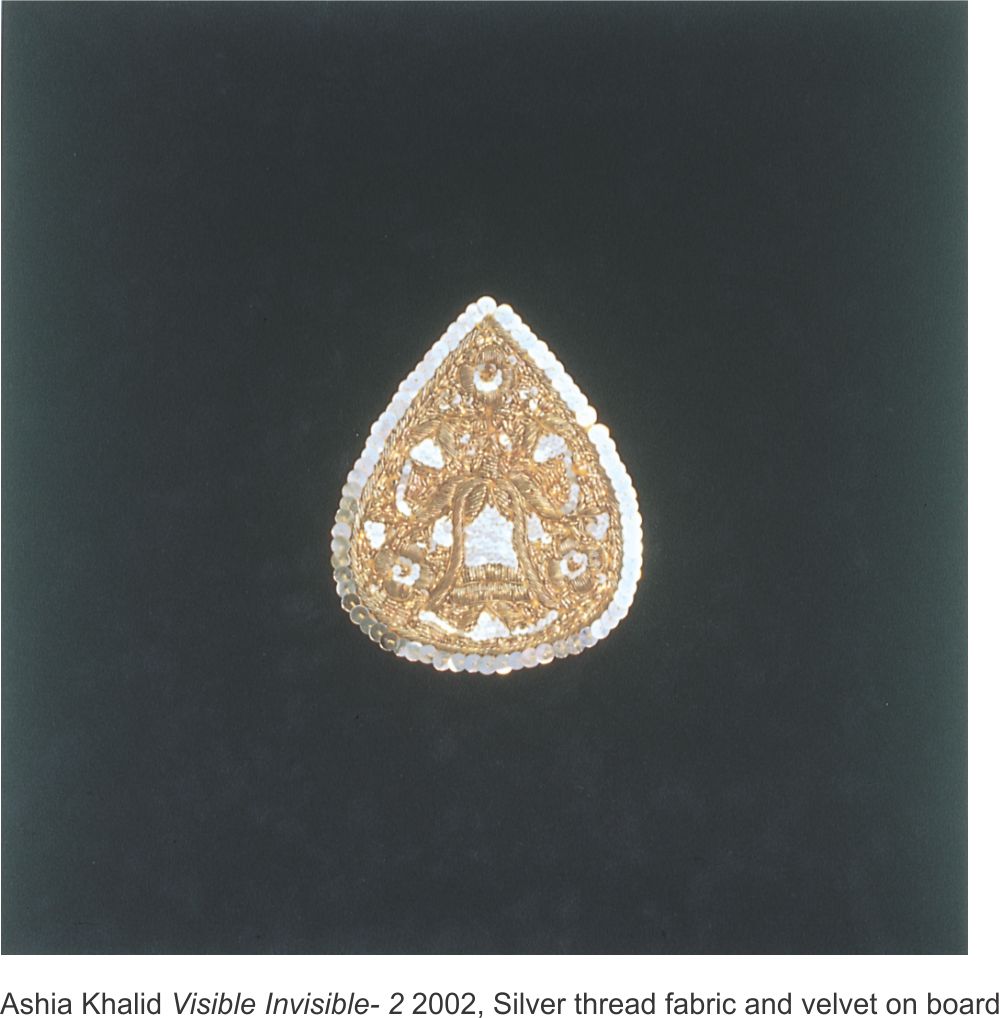
Ruby Chishti’s observation that the textile fabric is woven into women’s lives is pertinent when engaging with the work of Aisha Khalid who trained as a traditional miniature painter at the National College of Arts (NCA), in Lahore. Long before her arrival in Lahore, Aisha, also like Chishti and Ataullah, learnt to make cloth dolls, knit sweaters, and stitch and embroider her own and her sister’s clothes. She inform us that ‘There was never any pressure to learn these skills from my mother, which converted themselves into refined and serious forms of sewing!’.
She brought one of these samples of embroidery to her admission interview to the college, but herself considered these skills irrelevant to the artistic skills she was now introduced to. Never mind that her mother’s injunction against bringing images of the human figure into the house was strictly followed, and even the face of a dog in a painting was left blank to placate her parent! Burqa-clad female figures in Aisha’s paintings which invariably have their backs to the viewer, may be an unconscious adherence to these early constraints.
Setting up a textile workshop soon after graduating (and her marriage to fellow miniature painter Imran Qureshi), brought her back into contact with the textile fabric. The process of dyeing, block printing, creation of motif and pattern, made its presence felt in her paintings which seized upon a new series of symbolic images like the ‘curtain’ and the ‘burqa’.
The choice of these images was not random. Growing up in a small town in the province of Sindh, Khalid’s sister wore a burqa while she herself was well covered in a chaddor. Dissatisfied with the legacy of myth and romance associated with the genre of miniatures, Khalid began to probe the claustrophobia of the women’s experience. Acording to her, ‘The burqa engulfs her- the curtains, walls, floors rush to contain her; they constrict, smother and silence, yet there is a delight in repetition of pattern’.
The sumptuousness of pattern in Khalid’s work seemed to contradict the menace of its message, and could also be seen as a celebration of her passion for textile. The contradiction was a deeply felt one, notes Virginia Whiles: ‘The exquisite ornamentation in Khalid’s work distills a dual sense of oppression and subversion’.
Aisha Khalid’s stay at the Rijksakademie in Amsterdam in 2001 resulted in exploration of other media. ‘Conversations’, a video installation, focused on parallel images of a ‘brown’ and ‘white’ hand, one embroidering a red rose, the other simultaneously effacing the embroidery. The brown hand could be seen as implying the creation of ‘beauty’ and the white hand annihilating it, making it a work painful to watch in its simplicity and directness. Violence is conveyed through the sounds of the needle unpicking the embroidered rose, which becomes a metaphor for life itself.

After September 11, 2001 Khalid found herself isolated and desolate in Amsterdam. Quite prophetically, she had selected a military camouflage fabric to embroider barely a month earlier. Embroidered rich red roses similar to the ones found in the images on Pakistani greeting cards, enclosed by the ’embroidery’ frame, were eloquent with menace and imminent danger, a reference also to American bombing in Afghanistan.
Khalid’s return to Pakistan was a return to tangible fabric. From the high tech of video she reverted to cloth. Searching through her mother’s trunks, she probed memories of ceremonies and rituals. ‘Lifting the fabric’ into a fresh context, she urged it to speak with a different voice. Occasionally stitching it into place, she preferred to cut and layer, to establish meaning through colour and minimal form. Fragments of her father’s wedding garland are surrounded by velvet-black. Her painting runs parallel to fabric works, a dialogue ensuing between them. Khalid has always asserted that ‘work is totally tied up with life; the appearance and disappearance of textile therefore is an indication of its significance as a potent constituent in her work.
Risham Syed’s body of works done in the year 2000 also employed embroidery, but in this case, the artist depended on the expertise of male machine embroiderers whose tiny shops are located in Lahore’s bazaars. Like the other women artists she too had been trained in needle work and stitchery, and being from an upper-middle-class family, had gone to a Convent School. The instilling of Victorian values by the nuns with an emphasis on essential home-making skills was recalled with the birth of her son in 2000. Remembering her very early lessons in cross stitch, she began embroidering a new set of ‘lessons’ onto her canvas. She declares: ‘This experience got me thinking about women through history who turned to crafts as the only accepted means of expression. Since no written history ever focused on the lives and experiences of women, craft became a communication of sorts, through which women told their personal stories’.
Syed collected embroidery books imported from the west, and decided to work with male urban artisans to see what form of hybridity might emerge. The embroiderers were instructed to copy motifs as accurately as possible and produced bright mechanical looking flowers, which Syed included in her work, juxtaposing them with images of violence, culled from the events in Afghanistan and the Middle East. Syed asserts that ‘collage and collaboration with traditional arts was a challenge to the distinction between the ‘merely’ decorative low-arts usually associated with women and the more meaningful abstract high-art of male artists.’
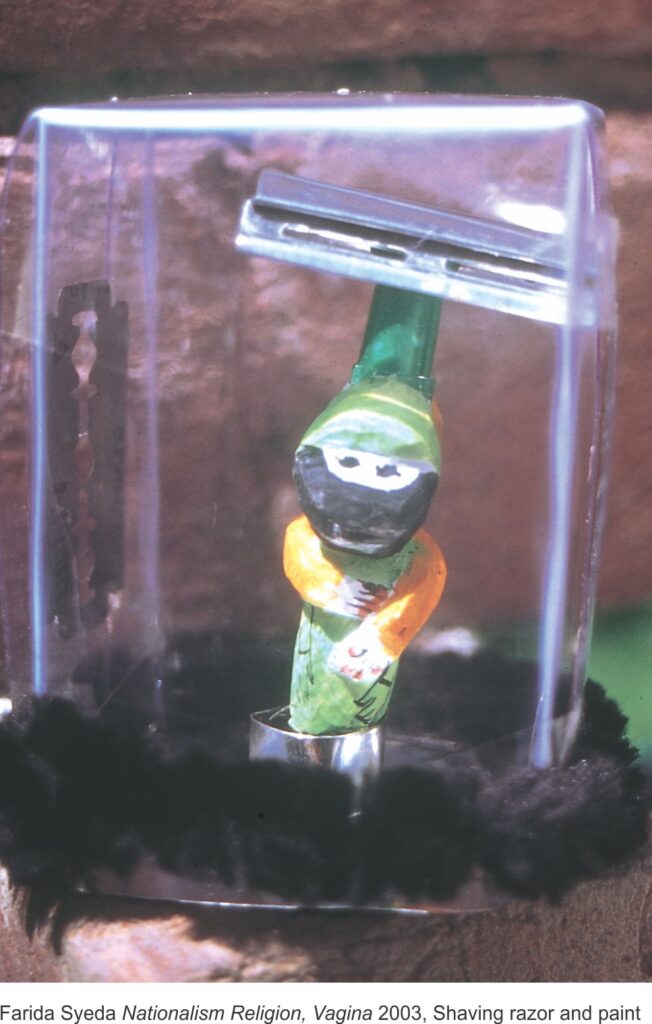
A rejection of the ‘high-art’ circuit in Pakistan was preferred by Farida Syeda while still a student at NCA. Choosing ceramic tiles produced by an industrial house as her medium, she undertook an ambitious mural spanning a wall of the college building, from ground to top floor. After college she worked in a socially deprived area of Lahore in a vocational centre for women. Working with them at everything from weaving to block printing, she also provided them with rolls of art paper, paints, brushes and assorted materials, encouraging them to narrate their stories in collage and paint. Working with them to connect their ‘art’ to their ‘craft’, Farida Syeda was dealing with similar affiliations in her own practice. Taking semi-baked industrial tiles, she carved and painted the surface to initiate a series of images of women she admired, loved or was influenced by. Also entering the format were repetitive images of ‘the limitless sky, stars, confined lands, juxtaposed with the engraved outline of my body’.
Farida Syeda spent two years studying in Sydney where she rethought some of the conflicts that engaged her as a practicing artist in Pakistan. Realizing that she was dissatisfied with the required persona of the art practitioner as well as the fractured and inadequate function of the ‘community’ artist, she felt the need to address both the personal and the political aspects, very directly and assertively.’
On Independence Day, 14th August, 2003, Farida Syeda mounted a performance cum-art activity located in a large park, which commemorated the birth of the Pakistan Movement. Using ready made toys and everyday objects like razors, plastic cameras and mirrors, emblazoned with slogans and images about military rule, male supremacy, mullahs, and women’s chadors, she handed them out to men, attempting to draw them into conversation and dialogue. Batool plans to make this a series of events, employing familiar objects transformed by her, to become ‘toys’ for adults and ‘junctions’between artist and public.
Quite contrary to Farida Syeda who employs industrial goods, Masooma Syed encroaches on the human body for raw materials and meanings. The intrusion is both provocative and celebratory. The connections made between body ‘extensions’, i.e. hair, nails and the artisan’s raw materials, suggest primeval bonds. Tiny, brittle components like the finger nail or a lock of hair are meticulously worked upon to assume a revelationary existence.
A painter with an interest and training in jewelery-making, Syed brings relevant skills to the delicate handling of fragile substances. Substances that threaten to disintegrate or flutter away are threaded, conjoined, woven into necklaces, coronets, and altars.

States Syed ‘I was challenged by the soft, careful, calculated handling of this material. It was just the opposite to my earlier, restless fumbling of markmaking, collage and markmaking, collage and assemblage. This shift has changed the ‘making process’.
Obviously, Syed had sifted processes familiar to artists trained in art schools and studios, and found them wanting. Syed points out that her working to ‘craft’ the object has slowed her pace of work and focused her thoughts. The question arises as to whether her earlier experience did not insist on such focus or is it the ‘nature’ or ‘history’ of the process which is now different?
The making of knots, the piercing, threading, combing (of hair) refer to unarticulated histories and practices. Refuting the idea that craft is ‘un-reflecting’ Syed contends that instead it releases deep undercurrents of untapped possibilities.
Syed ‘harvests’ hair and nails from friends and strangers alike, enforcing a relationship with the crafted object. She observes that ‘The process not only involves craftsmanship, but also provides an opportunity to interact with strangers for the collection of nails. This is followed by the cutting, washing, piercing and threading of them with human hair. On the one hand this was an effortless transformation of prickly, tiny, delicate, morbid materials into desirable enchanting, provocative, crafted jewels– and on the other hand the enigmatic pleasure already existing in the material had an affinity with my own feelings.’
Syed’s observation that this unusual, intimate material couched in familiar craft processes somehow arrives at a deeply satisfying, interactive entity is telling. The body’s ‘waste’ i.e. hair and nails, separated and removed from it at regular intervals is now retrieved and given status as iconic objects.
The labor and genius of the craftsperson is thus underlined as being the medium that invests material with meaning. In this case the ‘craftsperson’ is the contemporary artist who blurs categories, ignores valorizations, and expectations and sets out to ‘make things the best way’ they can.
Salima Hashmi is Dean of the School of Visual Arts at Beaconhouse National University at Lahore. She is the author of Unveiling the Visible: Lives and Works of Women Artists of Pakistan (2002)
You’re song A wished-for song Go through the ear to the center Where sky is, where wind, Where silent knowing, Put seeds and cover them, Blades will sprout Where you do your work. Rumi The canons of ‘Fine Art’ practice in Pakistan are being challenged by a number of contemporary artists, mainly women, who find…