
murtaja baseer's retrospective 2005 images of a lifetime
Murtaja Basheer’s Retrospective at the Bengal Gallery of Fine Arts, spanning 55 years of his career as an artist, opened on 17 August 2005, the day he turned 73. Imaginatively curated by Subir Choudhury, Director of the Gallery, the Retrospective brought together selected art works from almost every phase of Baseer’s career
Murtaja Basheer’s Retrospective at the Bengal Gallery of Fine Arts, spanning 55 years of his career as an artist, opened on 17 August 2005, the day he turned 73. Imaginatively curated by Subir Choudhury, Director of the Gallery, the Retrospective brought together selected art works from almost every phase of Baseer’s career. For those who have been following his progress through the decades it was an occasion to revisit many old works that had been confined in galleries and private collections; for those who have only seen his recent work, it was a pleasant trip down the path that the artist had taken in pursuit of a distinctive style. Baseer, however, has mastered not one but several styles, each of which bears hisindividual stamp, and has experimented with a range of expressive modes–from realism to abstraction, to what he calls, abstract realism. But no matter what style he has pursued or what ethos he has belonged to, he has never failed to energize his composition. This he has done with his characteristic elan, with unusual colour schemes or his penchant for innovation and experimentation with form or technique or colour. There have been a couple of other retrospectives of Baseer’s work in the past, but none in recent years, and certainly none as representative as this one.
Two main concerns seem to have guided Subir Choudhury in curating the show: (i) make it as inclusive as possible so that viewers encountered a proper Baseer omnibus with all his leading preoccupations and experimentations on display; (ii) and provide a visual history of Baseer’s development as an artist—which has been extremely uneven, to say the least. For, beginning with an academic training that was fairly comprehensive but uninspiring in the end, Baseer moved to higher grounds on his own, picking up skills from his close study of other artists and art traditions (pre-Renaissance and Byzantine art, for example) or from chance encounters with living artists (such as Paritosh Sen, who taught him how to use a palette knife to make the line sharp and crisp).
Early in his career, Baseer had decided that he wouldn’t go the way of many artists of his time, by pursuing an abstract style that rejected the ‘phenomenal image’ and relied on the ‘conceptual’, ‘abstruse’ and what is ‘derived and disengaged from nature’ (to use terms from Herbert Read’s famous description of abstraction in The Philosophy of Modern Art, 1952). Not only was abstraction considered modern–in the sense it was a global practice–it was also seen as a way of recording sensibilities and impressions that were too conflictual, indistinct and flitting to be accommodated in figural representation. Baseer was committed to the leftist ideology of the time, which were all about bringing fundamental changes to the life of the poor and disprivileged masses; thus, a departure from realism, for him, was untenable. He therefore employed a realistic style, which, all along, constituted his staple. But his penchant for innovation and experimentation meant that there would be substantial variation in his styles and techniques, as well as marked departures from and return to dominant styles and modes he had once practiced, since Baseer has been a restless traveller, never content to rest on critical acclaim. Thus, after the success of the Wall series, Baseer moved to a completely different area of experimentation, which involved a departure from both the thought and formal arrangement that the series had deployed. The Epigraph series which followed, was about memories (of martyrs, and their impact on the artist’s/people’s mind) and was meant to be an elegy, but became something more–a probe into the despair the country was experiencing after the euphoria of liberation had died down. Baseer had found in some ancient cultures the custom of honouring the dead with pebbles strewn on their grave, and he took the manifold designs of pebbles for paying his homage to the martyrs. He used the organic shapes of pebbles–their exterior and the cross-sections of their interior–as his dominant formal arrangement. The 35 paintings in the series show formal arrangements as varied as the shapes and designs of pebbles.
A sampling of all these different styles is indeed difficult, but once judiciously done, as has been the case with this Retrospective, it helps one to understand what drove Baseer to set the bar a notch higher each time, challenging himself to come up with styles and forms, images and colour schemes that would be as close a visual representation of his ideas as possible. Not that Baseer has been successful in everything that he has done–indeed, some of his paintings, especially those form the different series are repetitious, some even flat. The recent calligraphic works are probably the least appealing of his entire opus, except for their colour schemes. Baseer has perhaps painted many a work with an eye for prospective buyers–and buyers’ taste here, as elsewhere, is notoriously uneven. Fortunately, such pitfalls have not been many, and, as far as this Retrospective goes, those ‘uneven’ works have been kept out.
Baseer has been a prolific artist, painting vigorously right into his septuagenarian years. His work reflects a contemplative and thinking mind, one that searches for the right relation between object and image; between the mystery of colour and the grammar that governs its use; between the thought that leads to an image and the feeling that anchors the image. Baseer likes to think through an idea, reducing its complex web of associations into neat narrative structures.These are then set in the form of recurring visual images, each of which brings out an aspect of the dominant idea. The result is often a group of paintings, sometimes as many as 92 (The Wall series). Indeed, Baseer seems to have a penchant for expressing himself in a series held together by a common theme rather than in a single, monumental work.
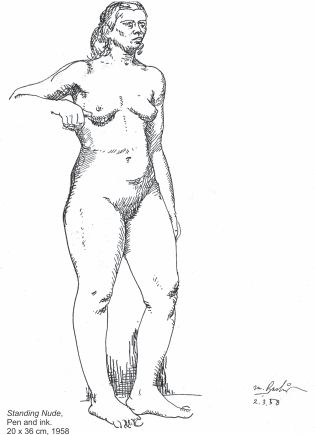
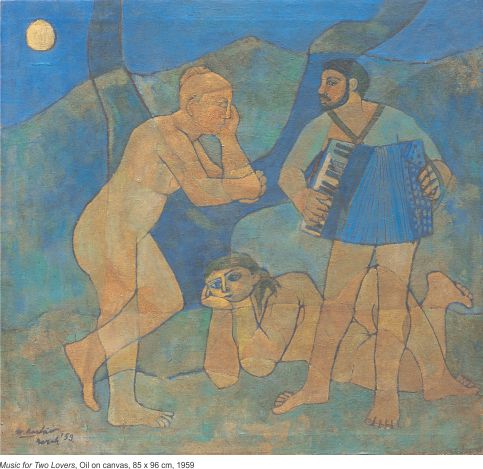
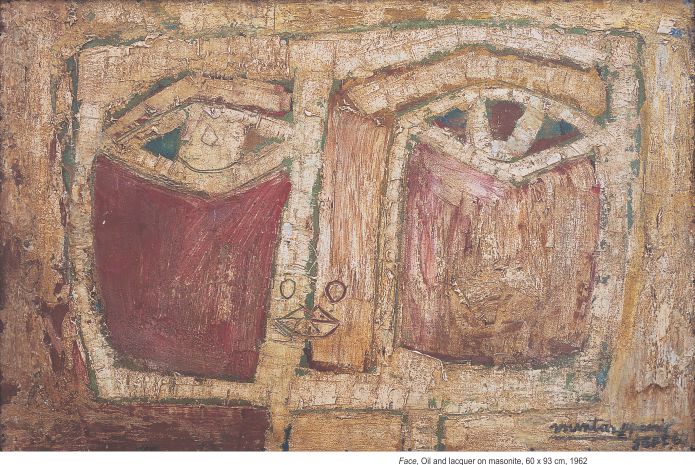
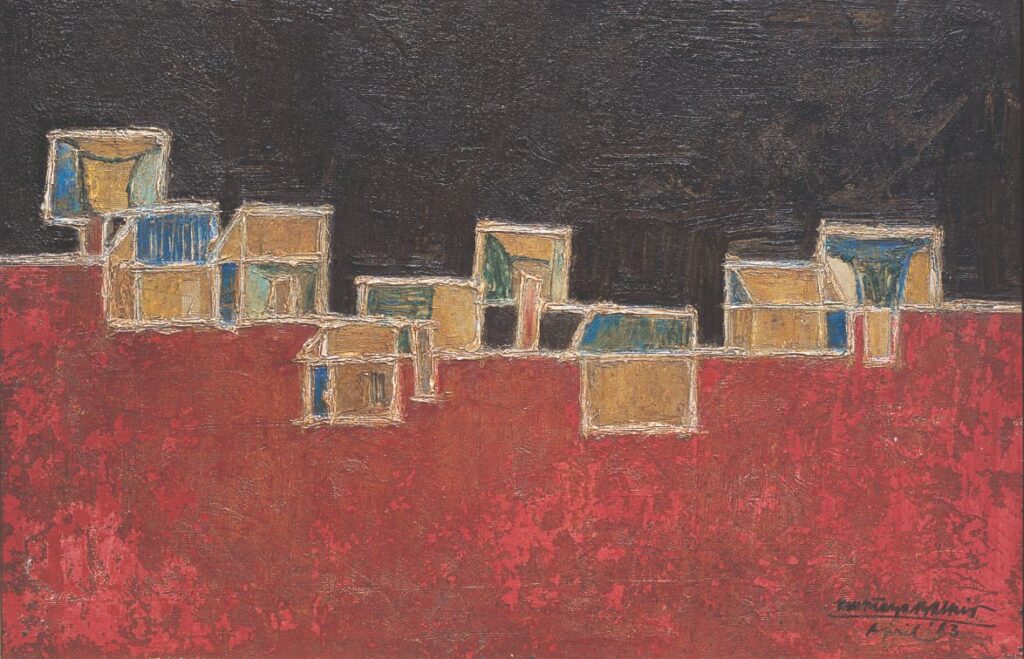
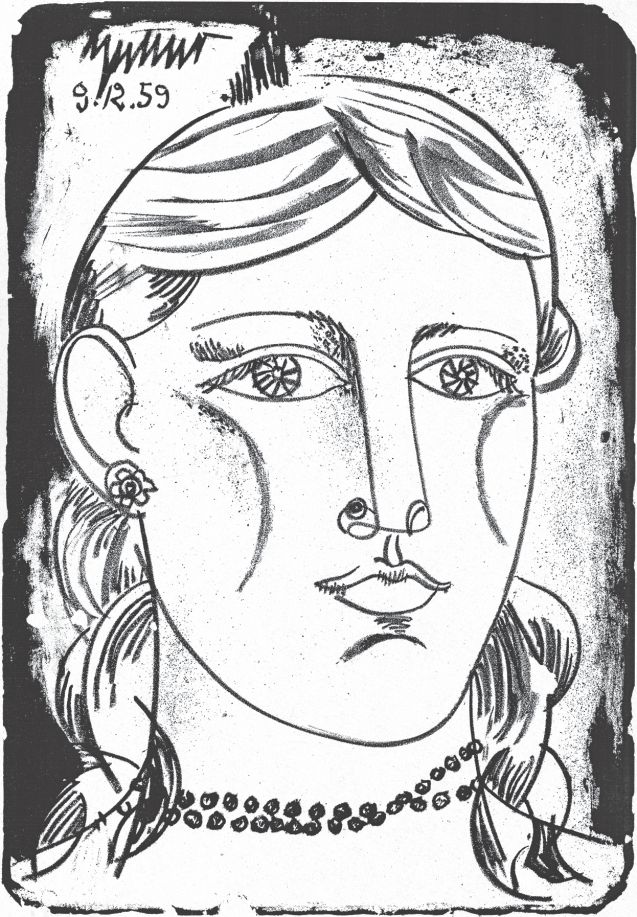
Baseer has done watercolours, oils, pen and ink, lithography and other forms of graphic work, mosaic work and murals. He began with linocut and woodcut, then shifted to watercolour. But as he found watercolour too messy, he moved to oils. Along the way, he honed his skills in drawing, especially line drawing, which became sharper and more vivid after he went to study art at the famed Academia di Belli-arti in Florence in 1956 (he had graduated from the Fine Art Institute a couple of years earlier). Up until 1963, Baseer did figurative work, painting men and women, boats, fish and bird, employing primary colours and minimizing drawing. In 1960-61, for example, he made 40 paintings depicting faces and birds. Then, in 1967, came the Wall series. From 1973 to 1976 he worked on the Epitaph for the Martyrs series, displaying them in a solo exhibition in 1976. In 1977 came the Desire and Eternal series of paintings. But he had made a very different kind of journey into popular beliefs previously, drawing images and patterns for his paintings from amulets and prayer mats, as well as Arabic calligraphy (he made a series, The Divine Light, out of these objects and patterns). From 1984 to 1988 Baseer worked in abstraction although he eliminated perspective and depth of field, and overlapped figures, forms, lines and shapes so that everything was simultaneously foregrounded. This appeared to be a bold play on the notion of abstraction and is reflected in works such as When the Wind Blows, Wave, Explosion and so on. His abstraction was not pure geometry or formal indeterminacy: rather, he searched for a nuanced and suggestive representation of objects and ideas that would not entirely suppress the object or idea.
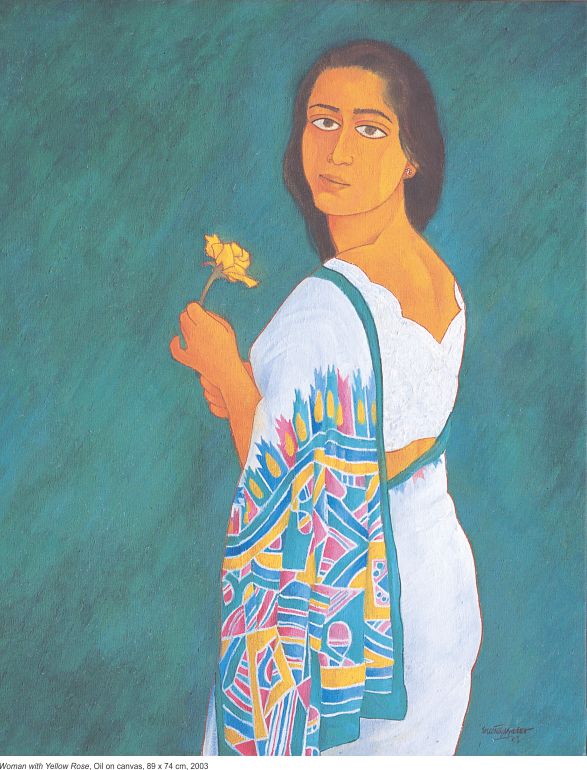
In 1990 Baseer made a return to figurative painting. He was commissioned by a multinational company to paint female characters from popular fiction for its yearly calendar. He came up with the figures of Anwara, Saleha and other fictional heroines. The treatment of these figures was strong and sensual, employing a pure and vivid colour scheme. They also showed Baseer’s indebtedness to folk tradition since the figures depicted a prominent use of eyes; brow and hairline, and an elongated treatment of the face, with thick contours demarcating the head and shoulders.
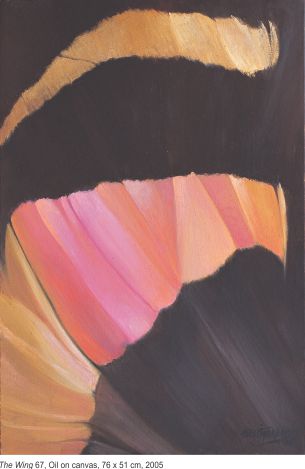
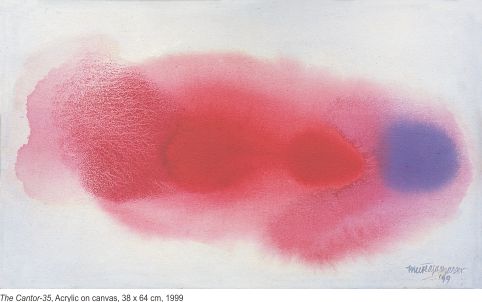
In 1999 Baseer painted the Cantos series which showed a different use of abstraction. This time his canvas became resonant and playful, as though both sight and sound had come into play. Done in acrylic, the small paintings were distinguished by their uninhibited use of colour. Then, in 2002, came the calligraphic works, the Kalema Tayyeba series, whose seeds were sown by the earlier Divine Light series. He also finished two other series in that year–Memory and Wings. The latter experimented with the forms of butterfly wings, and were, once again, a feast of colour. The Wings series itself was repeated, with the third series exhibited in 2005. Meanwhile Baseer had returned to figuration a third time in 2003, now probing the links between man and nature and his immediate surroundings.
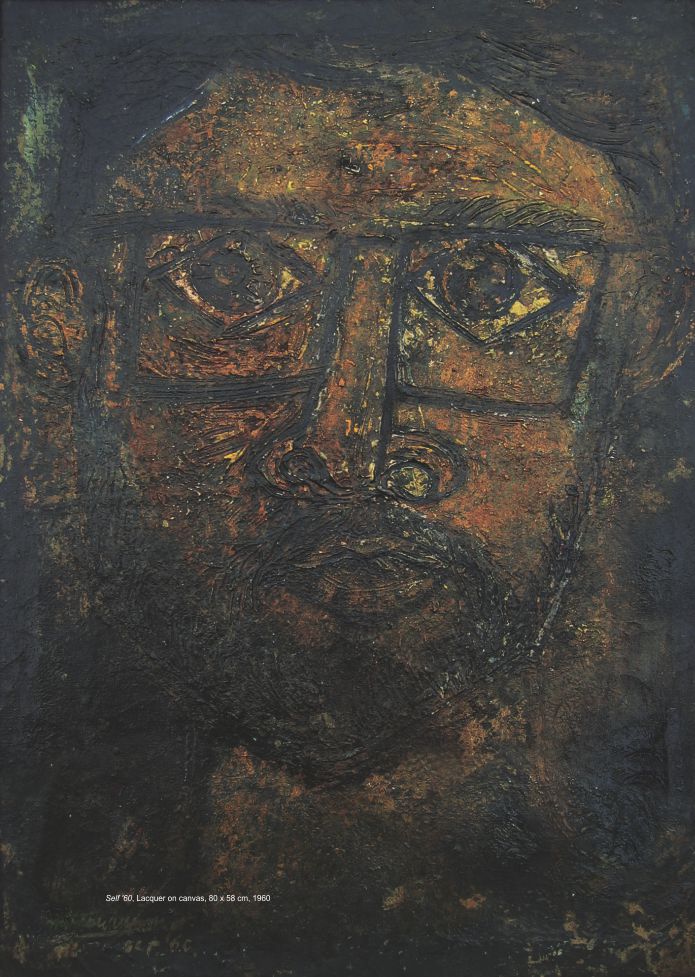
Baseer has also drawn self portraits obssesively. He made each portrait bring out an aspect of his personality. Thus the portraits are alternately playful or thoughtful; they exude confidence or despair. Some are sombre, some self-questioning. A couple even show him caught up in dramatic moments or gestures. The self portraits may be seen as another series, which reveals both the man and the artist in rare moments of introspection or engagement.
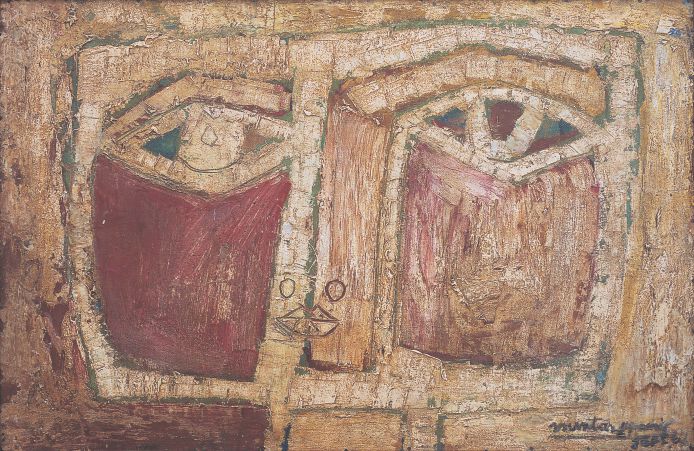
Murtaja Baeer’s ovuvre is a record of his diversity, and exhibits a protean sensibility that is not content with the mere satisfaction of a work well done. He seems to be an artist who is in constant need to reassure himself that he is out there to give as truthful a record as possible of the changes that time wreaks in people and places and the configurations of human experience.
Syed Manzoorul Islam is a member of Jamini editorial board
Murtaja Basheer’s Retrospective at the Bengal Gallery of Fine Arts, spanning 55 years of his career as an artist, opened on 17 August 2005, the day he turned 73. Imaginatively curated by Subir Choudhury, Director of the Gallery, the Retrospective brought together selected art works from almost every phase of Baseer’s career Murtaja Basheer’s Retrospective…