
a lot of this and a bit of that works of bangladeshi artists living abroad
Although quite a number of Bangladeshi artists live and work in the metropolitan centres of Europe, Japan and USA, and are usually considered part of the expanding Bangladeshi diaspora, their work does not necessarily reflect the ‘shifting’, ‘ambiguous’ and problematic nature of diaspora identity; or the experience of ‘uprooting, disjuncture and metamorphosis’ that inevitably accompanies the process of assuming a diaspora identity; or the strategies of negotiation that a diaspora artist has to employ to accommodate his/her cultural production within the mainstream/national culture
Diaspora theories foreground hybridity and ambiguity as inescapable conditions for those living in interstitial and in-between spaces: migrants, exiles, refugees and other displaced persons so conspicuous in global metropolitan societies today. Salman Rushdie, in his Imaginary Homelands (1991) (from where the quoted words above have been taken), maintains that a diaspora is a disjuncture between ‘here’ and ‘there’. A diaspora artist, if (s)he is true to the ambivalent nature of his/her experience would, in the end, produce ‘a bit of this and a bit of that’. Most Bangladeshi artists living abroad are preoccupied with ‘this’—that is, their natal homeland and the images it etches in their mind–and only secondarily with ‘that’, i.e., their adopted country. The reasons are not far to seek. Briefly, these are:
The difficulties of finding a place in the mainstream art of the adopted country. Most expatriate Bangladeshi artists work in isolation from the dominant local art scene, as do ethnic and migrant artists in general, without the patronization of leading galleries and art establishments. They also find it difficult to exhibit in national level exhibitions and can claim virtually no space in leading art publications of the countries they live in.
Their strong connections with home. Almost all expatriate Bangladeshi artists regularly exhibit in Dhaka—either solo or in the national and Dhaka Biennale exhibitions. They also periodically visit their motherland for exhibitions, to conduct workshops or just to visit family. As these contacts stabilize feelings of displacement, ‘A bit of this’—in terms of content, intellectual production, emotional investment, the styles they pursue—then becomes quite overwhelming in their work. The ‘thisness’ of their experience also overwrites ‘thatness’—a fact that explains why typical migrant experiences, which are a mélange of contested feelings of alienation, anxiety, a sense of dispalcement, rootlesness and the like, hardly appear as the leading traits of the work of Bangladeshi expatriate artists. Instead, they resort to nostalgia, memories and dreams to evoke both ‘the Bangladesh of the mind’ (to rework a Rushdian phrase) and the actual Bangladesh to which they periodically return. Thus, their work usually does not reflect the overlappings of histories (of the two locations), cultures and life styles that commonly problematize as well as energize diaspora cultural production. Similarly, the conflictual nature of diaspora aesthetic and psychic experiences, or the economic, political, social and material forces that impact on diaspora art are also largely absent in their work. Bangladeshi migrant artists also do not go through any deeply felt identity crisis as they navigate around the mainland culture in search of entry points, since their attempts at social assimilation (through marriage or membership of neighbourhood communities and peer groups), coupled with their strong ties with families back home provide them with a stay against confusion.
The ‘voluntary’ nature of exile/migration of almost all these artists (as against ‘involuntary’ or forced—a distinction popularized by Edward Said—which entails a whole range of complex and ambivalent reactions, including resistance also means that there is no compulsive sense of homelessness or of violence, withdrawal or anxiety in their work. What there is, is a subtle interplay of nostalgia, longing or desire that marks out certain images and forms. There is also an absence of the usual diasporic dialectic between resistance and acceptance (involving the dominant forms of the mainstream culture) which often results in an intermingling of original cultural/historical/mythical memories of the natal country and those experienced in the adopted country. Indeed, if the recent exhibitions of a number of expatriate Bangladeshis are any indication, there appears to be hardly any influence of diasporic experiences that typify the works of, for example, the African diasporic artists living in UK. They pursue themes and styles that are very much part of Bangladeshi mainstream art. Even exclusive migrant/diasporic experiences are mediated by aesthetic/cultural or everyday experience of Bangladeshi life and society to which they remain tied, even from a distance.
‘Diaspora identities’, wrote Stuart Hall (in an essay titled ‘Identity and Diaspora’), ‘are consistently producing and reproducing themselves anew, through transformation and difference’ (Contemporary Postcolonial Theory: A Reader, ed. Padmini Mongia, London: Arnold, 1997). This is hardly applicable in case of Bangladeshi artists living abroad. Their experiences of ‘transformation’ and ‘difference’ are hardly substantial enough to fundamentally affect their cultural production.
But this is not to say that Bangladeshi artists shy away from accommodating migrant experiences in their work, or reflecting on the life, landscape and realities of the place they have chosen to live in, particularly when these become overpowering. Indeed, artists like Monirul Islam and Shahid Kabir—who incidentally live in the same country, Spain—have routinely turned to, among others, the cultural markers and distinctive features of life and landscape of that country in their search for significant form and meaning. Other artists have blended, sometimes seamlessly, their experience of living in metropolitan cultures with the dominant pictorial language they pursue. Some other artists continue with home-grown preoccupations and styles which predate their migration overseas, adding or changing very little by way of accommodating new experiences and new realities. This is a rather small group, but one whose members are conscious of their ‘signatured’ style that had given them a distinctiveness which they are reluctant to part with. Shahabuddin, who lives in France, Maruf Ahmed (Germany) and GS Kabir (Japan) belong to this group, although each of them travels a path widely different from those of the others. The word ‘group’, it needs to be stressed, is used here only as a descriptive marker, and not as a homogenizing label.
In addition to Monirul Islam (b. 1943), Shahid Kabir (b. 1947), Shahabuddin (b. 1950), Maruf Ahmed (b. 1951) and GS Kabir (b. 1960), mentioned earlier, there are many other Bangladeshi artists living and working abroad. Notable among them are Kazi Ghiyasuddin (b. 1951), who lives in Japan, Wakilur Rahman (b. 1961) and Murshida Alpana Arju (b.1961) who live in Germany and Shahadat Hossain (b. 1955) and RA Kajol (b. 1956) living in France and Denmark respectively. A detailed study of their work, their involvement with the art scene of their adopted country or their progress as artists over the years would be out of the question here. Besides, not everyone is working at the same level of intensity or quality; their mediums, methods, styles and pursuits are also markedly different. What I intend to do in the following few pages, therefore, is to place each artist in the context of his/her pre- and post-migration scenarios, describe the leading preoccupations, styles, and techniques employed in their work, and, where possible, contextualize the nature of their experiences of migration and displacement.
All the artists mentioned above had attended the Institute of Fine Art of the University of Dhaka, which began as a government school of art in 1948 and maintained a steady curve of development to reach the position that it now occupies. The Institute, set up by a group of artists led by Zainul Abedin, played a pioneering role in creating, almost from scratch, a modernist art tradition that is rich in vitality, energy and output. The Institute has been compared with the Bauhaus, not only for its systematic and dynamic teaching of form, method, technique and other elements of an art curriculum, but also for its promotion of ‘craft’ alongside ‘art’. Many leading artists of the 1950s and 1960s were on the faculty of the Institute, and had a profound and formative influence on their pupils. While the Institute emphasized the formal aspects of art education, it also encouraged innovative thinking. Thus Monirul Islam, who became a faculty member after his graduation not only had the scope to hone his skills (he is an outstanding print maker and painter), but also the ambience needed for artistic self-expression. The time he spent at the Institute before he left for Spain on a scholarship was indeed a very fruitful one. He studied nature, which provided him with fluid and spontaneous forms and colours and the distinctive horizontal spread and spatial rhythms that mark his canvas. His composition, figurative as well as semi-abstract and abstract, assumed a lyrical and resonant quality and reflected an intense sensitivity.
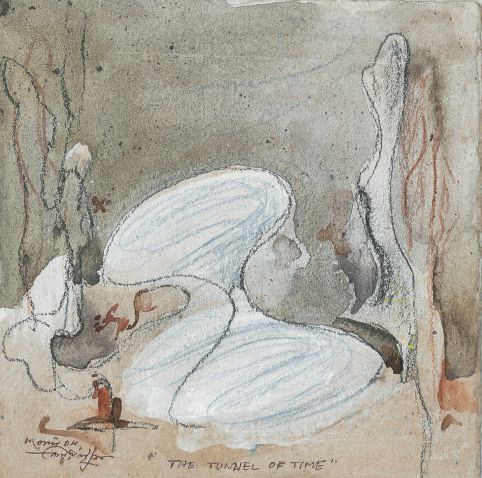
It was after he had arrived in Spain, however, that Monir (as he is known) began to expand the range of his styles and techniques and his modernistic sensibility. Removed from reassuring family ties, alone and struggling in a western metropolis, Monir learnt to take his subject matter from everyday life and from his own surroundings. Thus the life he lived in a rat-infested house became an occasion to launch into an exploration of the modern metropolitan world where a sense of displacement rules, where time and space lose their clarity, and a tunnel vision—emblematic of the loss of hope and sense of direction—restricts human interaction. In an interview with Jamini (August 2004) Monir maintained that Spain, while it brought him face to face with a completely different metropolitan culture, also gave him the confidence to look at himself, and to search for his roots. It helped him to get out of rigid notions of modern art, so that his style became dynamic as he began to concentrate on space and line. He began to improvise on his abstract style by hiding figures under suggestive piles of images. Besides, the ‘clear light and ample space’ of Spain, particularly its countryside, exposed him to dimensions of nature he had never thought existed. He quickly put these ‘alternative images’ into his work, coming up with fascinating, shifting forms and colour schemes. The alienation that he had initially felt in Spain was thus assuaged by nature. Monir was also helped in this by his strong, outgoing personality and a robust optimism about life.
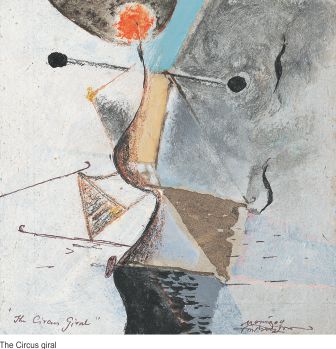
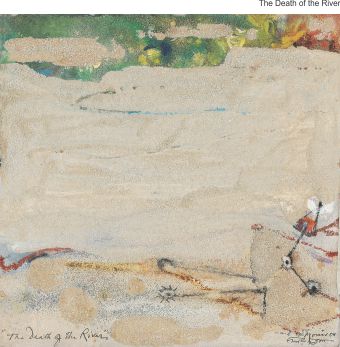
In Spain Monir came under the influence of Miro and Tapies, two artists he liked for their innovative ways of thinking and artwork. While Miro fascinated him for his surrealistic leanings, his suggestive figuration, and his accommodation of a personal mythology with abstract forms, Tapies encouraged him to explore the value of commonplace materials (Monir, like Tapies, uses marble dust, powdered egg shells and other unconventional materials in his work). Monir also began to explore the Spanish landscape for its distinctive forms. His recent exhibitions (from the end of the 1990s) show a cumulative manifestation of his different learning and practicing phases. Cities, beaches, and houses are now sites of his encounter with the place he has chosen to live, which is also a recognition of the conditions of his life as a migrant. But these objects/images also play upon the sensibilities of a Bengali who grew up on the shores of a mighty river. The haunting images, evoking memory and desire, are uplifting. There is no ambiguity about his location, rather a recognition of the multiple registers his mind has to work on. Monir has claimed a place for himself in the contemporary Spanish art scene, winning a national grand prize in 1997. Still, he likes to come to Dhaka, where he has an apartment, and to work and exhibit here.
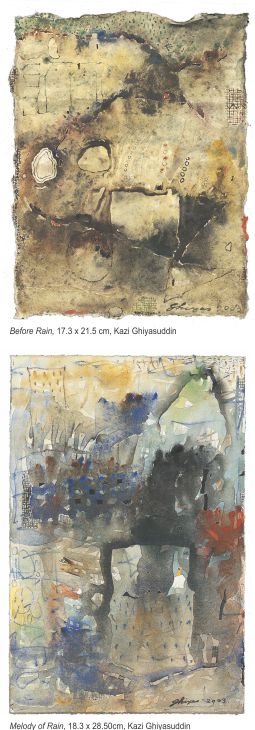
Like Monir, Kazi Ghiyasuddin also has held at least two major exhibitions in Dhaka in the last six years. He too left Bangladesh in the mid-1970s on a scholarship. He too never returned, but settled down in Japan and made Tokyo his home. He continued to paint in the style he had been pursuing before he went to Japan and many of his thematic concerns remained with him. He of course kept adding new elements of style that his academic training and exposure to the Japanese art scene were familiarizing him with, but his life as an expatriate did not impact much on his treatment of themes. Except for occasional images or suggestive details of an urban milieu, or his experiment with different types and shapes of paper, his sensibility remains largely a Bengali one. Indeed, Ghiyas’s recent works where forms, shapes and colours appear to interact with each other in a free-floating world, the mood is happy and relaxed, as he goes back to nature for inspiration. If one notes his emphasis on various sounds (of life, of full moon, of rain), one sees how this landscape is basically one that he is carrying in his mind.
Ghiyas’s initial approach to art was meticulous. He was more interested in the formal arrangement of objects and in exploring their inherent patterns. His colours were rich and resonant. His early works also show his penchant for texture, which contributes a great deal—even today—to a painting’s meaning and focus. Texture also highlights feelings of tenderness or sensuousness or an intense lyricism.
Like most Bangladeshi artists working in the non-figurative mode, Ghiyas too had to explore geometric shapes and concentrate on the formal aspects of his composition. But his eye for detail makes his forms stand out, even when they are apparently swamped by richly worked-out surface areas. His primary source of energy has been nature. Once it gave him colour, line, form, and rhythm. Now he finds a correspondence between the world of nature and the spiritual world within. It’s a happy conjunction, which restores and renews his imagination and his sense of fullness.
Over the years, Ghiyas has added elements from diverse sources to his style. Primitive signs, runic letters, scribbles and scratches, for example, make up a personal hieroglyphic which comes in handy in exploring the mystery of life. He is also fascinated by simple folk designs and motifs which he uses in his composition. Ghiyas’s work thus looks for harmony—not the fractured elements of life—and attempts to bring nature and life together on an even plane. His life in Japan has certainly enriched his vision, but deep down, Ghiyas remains solidly tied to his native soil.
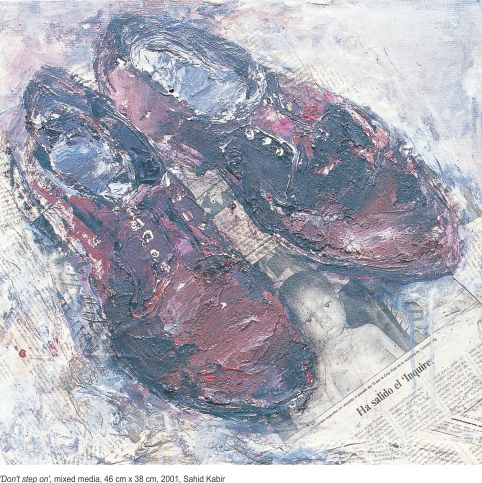
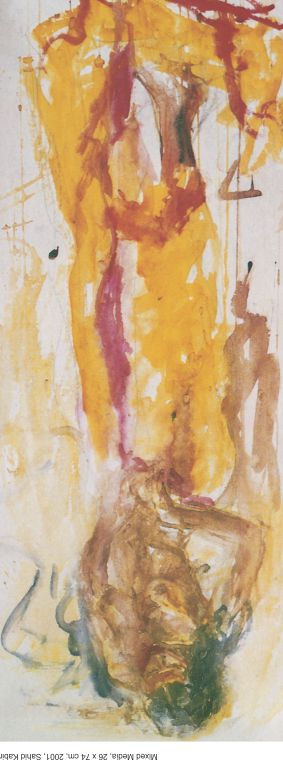
If we have to single out an artist who has made use of his immigrant experience to any significant extent, it would be Shahid Kabir. Living in Spain since the early 1980s, Kabir has been a keen participant in the life around him, and has taken his theme from everyday experience. And everyday experience for him foregrounds a Spanish milieu. A boiling kettle, a bullfight or a matador dodging a charging bull, an abandoned pair of boots—these are some of the objects that constitute his repertoire of everyday images. Kabir employs a narrative style that works at two levels: on the level of the object, which has its own fragmentary tale to tell (the kettle with boiling water spilling over its rims); and on the level of idea where the same kettle tells the story of a household where there are people behind the image (perhaps a housewife who had put it on a stove and forgot to remove it). At the second level, Kabir’s storeis relate to his immigrant experience. Besides, as the stories bring out their emotional/psychological content, we realize that Kabir is actually staking out a range of feelings and conditions—from loneliness to detachment, from fullness to absence—that characterize modern life.
Before he left Bangladesh, Kabir was known for his forthright expression of emotion. His early work has been mystical and brooding, sometimes even morbid. But once he began to register scenes of human degeneration, which were commonplace in the early 1970s in the aftermath of a bloody war of independence, and the ravages of famine and food shortages, his paintings began to record his anguish, protest and denunciation of the social-political scene of the time. From a brooding and contemplative mood, his canvas became directly expressive of his feelings. Colours became subdued and the composition became simple and focused.
However, as the years progressed, and Kabir confronted rising uncertainty about life, his canvas changed. It now reflected an impressionistic element, involving shifting perspectives and an interplay between light and shade. The surface became more detailed, with ornamental and stylized designs taking the place of simple forms. But Kabir’s interest in the life of the common man remained; only, he now began to show his interest in folk elements. They added variety to his composition, which nevertheless remained quite subjective. One feels that Kabir was very much present in everything that he painted. Once in Spain however, that subjective mood changed. Kabir now began to assume an onlooker’s point of view, and his style also began to reinforce that impersonal feel. Thick layers of paint, applied as in the impasto technique, seemed to highlight the object while concealing personal feelings. But one could see that, increasingly, Kabir was grappling with a sense of dislocation and a loss of centre. His emphasis on the narrative and the mundane was a way of recording his feelings of alienation and displacement.
As in the case of all narration, Kabir’s narrative technique implies an interpretation. His paintings show the working of a dialectic—between surface and depth, between object and meaning, and between the here and now of an object and its strangely timeless moment. Recent works of Kabir show that he is still sorting out the elements of that dialectic and harnessing the energy it releases.
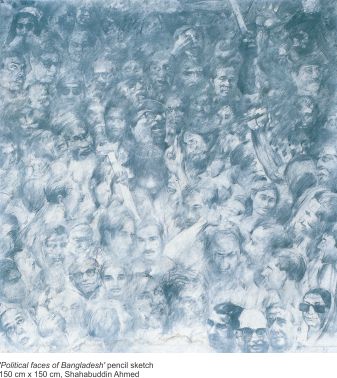
Shahabuddin Ahmed, for his part seems to exhibit a full dose of energy. His work is characterized by a forceful engagement with figure and space, and with bold and sweeping brushwork he builds up a frenzied sense of speed and motion. A large number of his works depict strong, muscular figures, usually male, in motion, exuding a kinetic energy that is exuberant and uplifting. Drawn with an anatomical abandon, the muscular figures often assume an extra-human dimension because they go beyond real life referents. As figures representing some primal force bent on achieving a coveted task (total freedom, perfection of love, for example), they also become mythical. Indeed, one recurrent image in Shahabuddin’s paintings has been that of the freedom fighter. As someone who took an active part in Bangladesh’s war of independence, Shahabuddin invests a great deal of his emotional and creative energy in projecting the ideals a freedom fighter represents. In the process the figure (usually male) is invested with larger than life qualities and his representation becomes more mythical than historical or social. In painting these figures, Shahabuddin removes any reference to everyday life; they are placed in large spatial fields where, through sweeping lines and a swift patchwork of colours, effects of kinetic energy are reinforced.
From his early years at the Institute of Fine Art at Dhaka, Shahabuddin has attempted to get away from rigid forms and what has been considered a ‘painterly correct’ use of space and colour. His academic exercises, where objects are reproduced without any accompanying commentary or interpretation, are routine, some even uninspiring. Although he did a number of life studies, and even included some of them in a recent exhibition in Dhaka, it was clear that his dynamic vision of life and his restless energy needed other forms of representation. While his participation in the war of liberation helped him to draw on the force and power such an engagement releases, the very war itself, fought with the Bengali nation’s resolve to defend its identity, gave him a whole range of new referents to work on–the country, its people, its history and myth. Many of the new nation’s heroes—its political leaders and poets, for example—became his subjects. As he painted them, made them more mythical than historical, in that an aspect of their personality (the saintly visage of Rabindranath Tagore), or a gesture that typified them (the raised index finger of Sheikh Mujibur Rahman that characterized his charismatic resistance against Pakistani hegemony) or any object associated with them (the wickerwork cap Moulana Bhashani wore) became ultimately a symbol that stood for the ideals and accomplishments of the person.
Shahabuddin of course has drawn other objects and images such as domestic and natural scenes and everyday activities as well as sketches, drawings and studies, but his paintings of human figures in motion or in a dynamic encounter with time or history remain his characteristic mode. These figures have an austere beauty and a sculptural quality, in spite of the fact that they are often exaggerated, sometimes even distorted. They are dramatic in their blending of motion and idea, and the dynamic pose they strike. But over the years, his accentuating the same aspects of the moving figures and the same formal execution of these figures have resulted in a feeling of deja vu, of repetition and replication. Perhaps Shahabuddin himself is aware of this, since his recent works appear to be coming out of this signatured mould. One has to wait and see.
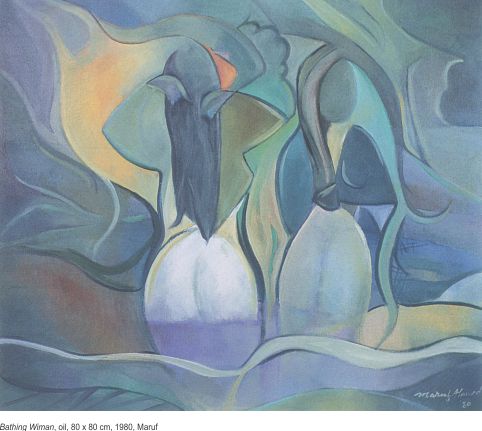
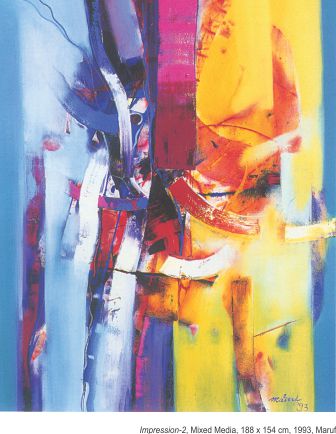
Maruf Ahmed, like Shahbuddin, has also evolved a style that has remained with him ever since his first solo exhibition (in 1974 in Dhaka) brought him into the limelight. In that exhibition, Maruf’s works were mostly semi-abstract and abstract and done on large canvases, employing an expressionistic technique that also accommodated an intensely poetic content. His colours were bold and often contrasting and suggestions of figures were muted by a web of tangled lines and overlapping forms. There were also nature studies, and studies of men and women and their relationships (not necessarily love); but the emphasis was on mutability; hence the slightly anguished mood of the works. In that exhibition Maruf showed that a direct and focused, and to some extent, an irreverent approach to form and technique was more suited to his temperament. He liked space, but he usually filled it up with myriad forms, lines, shapes and details. It presaged the kind of work he would do: a more direct and uninhibited treatment of form and colour and an engagement with space that now stood as a metaphor for life. But as he entered the second phase of his career (which was a consolidation of the gains from the 1974 exhibition) he went to Germany to study art. He remained there and quickly found a niche for himself. Today he lives in Bonn and commutes to Cologne to work in his large and spacious studio there.
In Germany Maruf found the art scene and the general artistic ambience conducive to his growth. Although he had done figure studies before switching over to abstraction, and was now thinking of reviving the practice, if only to add variety to his output, he was reassured by the appreciation of abstract art in Germany and the interest viewers had in genuinely brave work that challenged established norms. Maruf had done both, blending abstract and semi-abstract elements in his composition, and he soon began to explore the possibilities of colour and line. He proceeded to internalize his search, focusing on the inner dynamics and aesthetics of his forms and colour. In his recent works, he also has introduced an element of playfulness which makes his forms free-floating and spontaneous.
Over the years, as his abstract work looked for a visual experience that draws its emotional content from one’s response to reality as well as memory, Maruf began to include recognizable objects and shapes–houses, rooftops, open books. These provided him with an escape route to both a different mode of representation (realist/symbolist-abstract) and a different emotive response (nostalgia, for example). More recently, Maruf has moved to appreciating—if not celebrating—nature. There is in his work more light, more vibrant colours, and more dynamic lines. The ambience is one of quiet happiness. But the change from the earlier expressionistic phase of strong emotions and anxiety to the recent one of quiet appreciation of nature is not a sudden one. It has taken time to materialize, but Maruf was gradually moving towards this phase, one that he would like to call a ‘mature’ one.
Maruf’s expatriate/migrant experience in Germany has not been much different from that of others in a similar situation. But for him, the ‘mature’ phase indicates that he has overcome his sense of personal dislocation, loss and tensions by steadfastly drawing on his inner resolve to hold his ground—in Germany or in Bangladesh.
If Maruf’s life in Germany has not significantly impacted on his style or the moods and feelings his canvas conveys, the same may be true of another Bangladeshi artist—living in Germany—Wakilur Rahman. For anyone who has closely watched Wakil’s progress over the years, it is even possible to assume that had he remained in Bangladesh, he would have more or less arrived at the same point, without much deviation or detour. Wakil’s aesthetic philosophy, his visual vocabulary, and the social and historical content of his work had already assumed a distinctiveness by the time he left for Germany. One can therefore read his recent images in the light of his earlier development, and see them as evolving naturally from earlier conceptual and artistic stands, although one must also admit that his years in Germany have significantly matured his understanding of time, history and the human scene.
Wakil has worked in oil and watercolour, and has done some superbly executed etchings. In this last preoccupation, he has used aluminum, so that he calls his technique allugraphy. Whatever his medium, Wakil has treated a wide range of themes—from gender to ecology and the politics of representation—employing a style that, behind its attempts at precision and a certain objectivity, is intellectually and emotionally charged. He looks at the world with the calm eye of a chronicler and thinker which accounts for the certain cerebral quality that characterizes his work, but he becomes deeply engaged when his observation reveals social and political deprivation behind facades of democracy and ‘development’. Wakil’s images then begin to show a tension that results from the dual representation of order and disorder, plenty and vacuity, and the like. But overall Wakil’s work highlights the vitality and self-generative quality of life. Even when he treats contemporary history (for example the Bangladesh war of libertarian and the devastation associated with it in such works as A Tale of a Country series), he concentrates not on what has been lost, but what can be recovered and rejuvenated.
This emphasis on the restorative aspect of time and history has added to the vitality of Wakil’s images, and the fluidity and spontaneity of his forms. Done in an abstract style where mutating shapes create their own field of engagement, his shapes are however, not entirely detached from the world of lived experience. One may make out living forms from them as one does from patches of clouds in an autumn sky. Like the clouds, Wakil’s forms evolve from a world where man and nature can still connect, and life is still precious.
In his recent works, such as those he has done using a photo-transfer method, Wakil is attempting to work out more of these ‘connections’. The collage-like works appear layered, with each layer revealing a depth below. His work now has certainly become more ‘thoughtful’ as he reflects on society and the individual. As he tries to understand the complex nature of the relationship between society and the individual, and between what connects individuals and what alienates them, it would appear that Wakil is making use of his expatriate experiences. This may very well be true, but even then, one realizes that these preoccupations had been there with him in the mid 1980s, and are resurfacing in a new context.
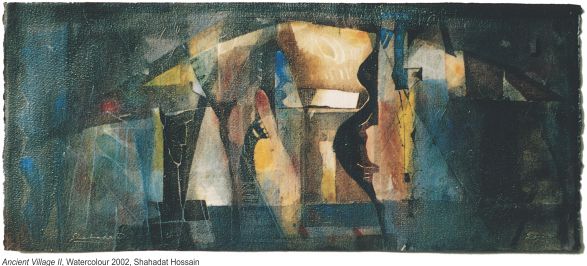
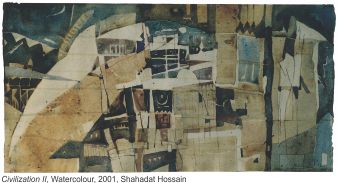
Shahadat Hossain has chosen to live and work in Paris. For the last ten years he has been pursuing the same broad range of preoccupations as he had been doing in Dhaka before he left, although his exposure to the French and European art scenes has helped him attain precision and balance where his use of material, technique, or the choice of images is concerned. Shahadat’s early work showed an exuberance of feelings and moods, reflected in his nuanced use of colour and the vibrant rhythm of his lines and brushwork. It celebrated the individual and the community although Shahadat was well aware of the difficulties and challenges of modern living. To offset that nagging feeling he evoked a timeless ambience highlighted by designs and images taken from folk traditions. Shahadat of course reworked the design elements into the larger spread of his modernist composition, but one could see that he was interested in depth, in the truth content of experience, and in momentary releases of psychic and spiritual energies.
In France, Shahadat has taken up his old themes but has reworked them into the context of his new experiences. Time, history, memory and desire are now important concerns for Shahadat, but his treatment of them does not reflect any urgency or anxiety. Rather, there is a realization that they yield their meaning more fully in moments of unhurried reflection. His images are fairly detailed and the composition always appear well structured. He pays a great deal of attention to balancing form against space or the different elements of a composition. But Shahadat likes to people his canvas with suggestive human figures. In some paintings, such as Civilization 1, where an adumbration of such human shapes against objects looking like machine parts humanizes the composition he, appears to reach for the human and mechanical elements of life.
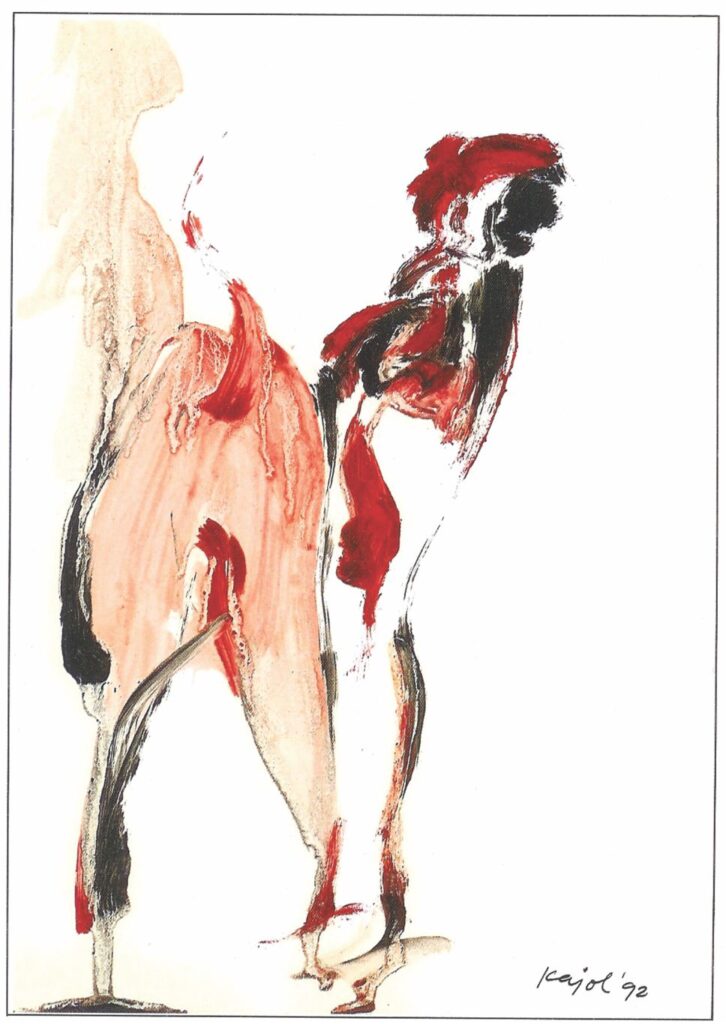
RA Kajol, who has been living in Denmark for the last twenty years, cannot be easily placed in the company of other Bangladeshi artists living and working in Europe. Both in terms of his engagement with the events of his motherland and the themes and style of his paintings as well as the materials he uses, Kajol is clearly different from the others. As a student of the Institute of Fine Art, Kajol had been a political activist, taking part in all major students protest movements of his time and imbibing, in the process, a deep love for democracy and a commitment to the rights of the people, particularly the underprivileged. At the same time, Kajol began to be repulsed by the hypocrisy and duplicity that he saw around him. These feelings eventually found their place on his canvas. He was also keenly aware of the patriarchal domination of society which was extremely discriminatory to women. As he reflected on politics, society and the human condition, he realized that it was not the repressive political system of the country or the wiles of the male-dominated society which were alone responsible for the deprivation of the general people, but the global power games as well. Kajol described this new global power manipulation—in which the poor countries always lose out to the rich ones—as ‘colonialism’ and ‘imperialism’. Starting in the early 1980s, Kajol has consistently presented his political and social themes in a series of paintings, sometimes grouped under ironic, even sarcastic, titles (Imbalanced World 1992, Democrazy 2000 or Killigion 2001, for example).
Kajol’s canvas stands out for its energy and verve. He likes to work in bold brush strokes, which mark off his figures and forms from the surrounding space. His application of paint is also distinctive—ranging from light touches to thick impasto. Kajol is more and more imparting messages through his paintings (Killigion is about the misuse of religion which kills innocent people) and is becoming more innovative, using his space to increasingly interact with his figures/objects.
Kajol however, does not confine himself to painting alone: he is also doing other forms of art. ‘Traffic art’ is one such preoccupation, which saw him execute in a European city the longest street painting in the world. He also does installation work—the latest being a series of tall bamboo structures depicting Nordic and Bangladeshi folk and mythical figures and objects. He has displayed his ‘bamboo sculptures’ both in Denmark and Bangladesh. But whatever he does, Kajol always brings his experience of his days in Bangladesh and Denmark to bear upon his work.
GS Kabir, after graduating from the Institute of Fine Art at Dhaka, went to Japan for higher studies. He spent his time well, honing his skills and learning new techniques, and making contacts with galleries there. After his return, Kabir kept up the line of communication, regularly exhibiting in Japan, and side by side showing his works in solo exhibitions in Dhaka. Then a few years ago, Kabir decided to settle down in Japan, since he felt that he had more scope in that country. He is still in the process of acquiring a migrant identity; besides, his recent work does not show any significant departure from his earlier style. There is no significant trace of his experience of living in Japan as a migrant in his recent work either.
Kabir is a talented artist and has a style that easily distinguishes itself. Basically abstract, his paintings nevertheless make use of familiar objects to emphasize a particular point of view. Time is an important theme with Kabir and nature is another. In between, the idea of change and the changing moods of an individual also find an important place in his canvas. In his recent paintings, Kabir has moved towards the world within, and has attempted to discover an inner harmony. His compositions, in keeping with this shift, have become sparer, allowing Kabir’s striking colour schemes to take effect. He makes intelligent use of certain recurrent shapes—such as the triangle and circle. But it is his overall intricate formal arrangements that really make his canvas dynamic.
Murshida Arzu Alpana went to Germany in the early 1990s to study art. There she received a Bachelor’s and a Master’s degree in Experimental Painting. Her own work also underwent an experimental phase while she was completing her education. From an earlier concern with the self (her figures were always brooding and self-reflexive) to a more recent emphasis on the external world, Alpana has adjusted her focus and her priorities. Her paintings are now more open, less colour coded and more interactive. Colour, line, space—all become involved in an intense understanding of the individual’s place in the world. Perhaps the years of living in Germany have given her a global perspective, but the expansiveness of her vision may also have been the result of self-questioning. In her earlier work, such self-questioning was a way of establishing a foothold for the self in a shifting world. The same may now yield a larger perspective about the self and the world.
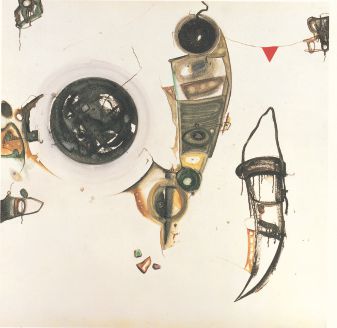
The formal arrangement of Alpana’s paintings is delicate, and there is a certain musical quality to her painting and perhaps a reflection of her own intense love for music . Her first solo exhibition in Bangladesh, one may recall, was titled Of Beauty and Aspiration which showed her early promise as an artist with a keen sense of form, balance and structure. Music was an important element there, too.
In her more recent work, Alpana is moving towards a fuller treatment of the conflicts and tensions that are inevitable outcomes of living in a large western metropolis, not necessarily as a migrant. One has to wait to see how this latest preoccupation shapes up, in terms of images and style.
Most Bangladeshi expatriate artists, like many from other South Asian, Asian and African migrant communities/diasporas work within limitations. For them, access to the mainstream art industry is extremely limited. They are marginalized by the mainstream regime of representation and the politics of signification. They are disadvantaged by the increasingly exclusionist nature of the relation between culture and economic power. And they are hardly able to attain a footing in the vicious politics of recognition. Thus, while many of these artists have received national level recognition and national civil awards in Bangladesh, hardly any one, except Monirul Islam, has won any significant distinction in their adopted countries. I must however, quickly add here that for an artist such recognition is not necessarily a measure of his/her artistic merit and distinction, and that many mainland artists too may not even receive a national award in their lifetime.
Syed Manzoorul Islam is a member of the Jamini editoral board
Although quite a number of Bangladeshi artists live and work in the metropolitan centres of Europe, Japan and USA, and are usually considered part of the expanding Bangladeshi diaspora, their work does not necessarily reflect the ‘shifting’, ‘ambiguous’ and problematic nature of diaspora identity; or the experience of ‘uprooting, disjuncture and metamorphosis’ that inevitably accompanies…